Is there a correlation between dimension change and curvature change? By performing multiple dimension perturbations within a hypergraph, the influence on curvature and a possible correlation between these variables was studied .
Introduction
Introduction
The Wolfram Physics project introduces models in which space is represented by a hypergraph and its dynamics are determined by a set of rules and operations performed on determined systems. Since this a discrete spacetime formalism, there is no definition of time, space, geometry and matter in this model, but the transformation rules can perform these roles, depending on how they are applied with an increasing number of steps. As a consequence, many properties of fundamental physics arise from this point of view, as a result of the graph’s evolution. Two important properties for the characterization of the laws of physics using this model, are the notion of geometry (curvature) and dimension. After a certain amount of steps in the evolution of the graph, these properties emerge and can be therefore studied within the framework of physics (and of course, Cosmology).
Dimension and Curvature in the Wolfram Model
Dimension and Curvature in the Wolfram Model
The notion of dimension in the physics world, for a continuous space is trivially referred to the least number of coordinates necessary to describe any point within that space. Although there is no definition in the Wolfram Model for dimension, when the graphs evolve with a certain set of rules, a notion of an interpretation for dimension arises. In the Wolfram Model, the space is discretized, we do not have a smooth manifold, so in this sense, dimension is related to a volume (number of nodes within a particular radius in a region), which increases approximately as R^d, where d is the dimension and R is the radius inside the region.
Concerning the notion of geometry, in General Relativity, there is the notion of perturbations in the curvature of spacetime. The overall objective of the Wolfram Model is to describe the fundamental laws that could describe the universe and to find different phenomena that can be represented as the mentioned evolution of a set of relations. In the context of the Wolfram Model, curvature is conected to a correction for the volume of a d-dimensional ball in a curved space.
The aim of this work is to study the possible effects that a perturbation in the local dimension of a region have in the overall approximate dimensionality of the graph. Does this dimension perturbation have an influence on the local curvature of the region? The goal of this project is to analyze the effects of such dimension perturbations by the characterization of the dimension and curvature of a graph.
Dimensional perturbations within a graph
Dimensional perturbations within a graph
Since the notion of dimension in the Wolfram Model is related to the volume of nodes within a region, a dimension perturbation is accomplished by adding hyperedges to a determined vertex. A determined set of Wolfram Model’s rules that generates a simple grid [1] will be the starting point:
In[]:=
GridHypergraph=ResourceFunction["WolframModel"][{{1,2,2},{3,1,4}}->{{2,5,2},{2,3,5},{4,5,5}},{{0,0,0},{0,0,0}},100,"FinalState"];
In[]:=
Gridgraph=ResourceFunction["HypergraphToGraph"][GridHypergraph,VertexLabels->Automatic];
In[]:=
VertexList[Gridgraph];
Choosing a determined vertex within the graph to introduce the perturbations:
In[]:=
v=48;
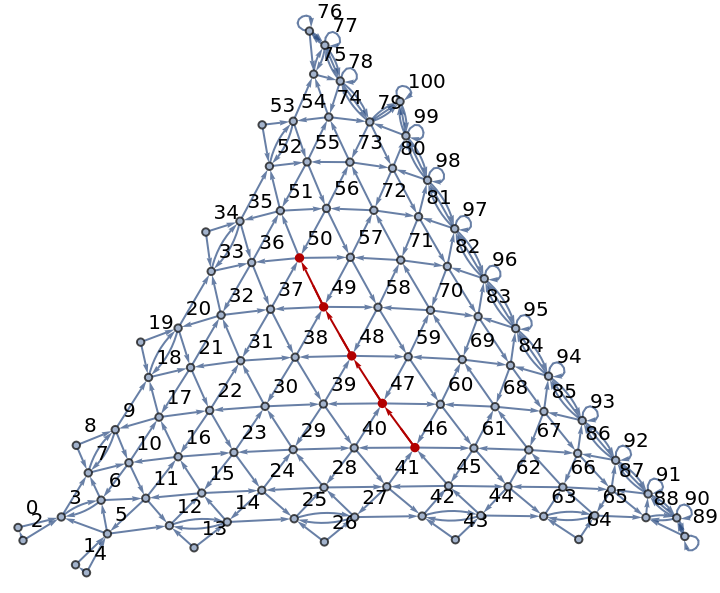
Drawing the shortest path between two vertex within the region that contains this vertex to see how it evolves while performing the perturbations:
In[]:=
start=46;end=50;
In[]:=
Geodesic=HighlightGraph[Gridgraph,PathGraph[FindShortestPath[Gridgraph,start,end],DirectedEdges->True]]
Out[]=
Let’s define 4 lists containing each of the variables (Num for the total number of perturbations and Perturbation for the list of each Perturbation):
In[]:=
Num=10;
In[]:=
LocalDimension={};GlobalDimension={};LocalCurvature={};GlobalCurvature={};Perturbations=Range[0,Num];
Measuring the dimension around the chosen vertex:
In[]:=
LocalDim0=ResourceFunction["WolframHausdorffDimension"][Geodesic,v,2,"Dimension"];
In[]:=
AppendTo[LocalDimension,LocalDim0];
And the global dimension:
In[]:=
GlobalDim0=ResourceFunction["WolframHausdorffDimension"][Geodesic,v,8,"Dimension"];
In[]:=
AppendTo[GlobalDimension,GlobalDim0];
Measuring the curvature locally, around the same vertex:
In[]:=
LocalCurv0=ResourceFunction["WolframRicciCurvatureTensor"][Geodesic,LocalDim0,39,58,"Curvature"];
In[]:=
AppendTo[LocalCurvature,LocalCurv0];
And the general curvature:
In[]:=
GlobalCurv0=ResourceFunction["WolframRicciCurvatureTensor"][Geodesic,GlobalDim0,0,100,"Curvature"];
In[]:=
AppendTo[GlobalCurvature,GlobalCurv0];
PERTURBATION 1:
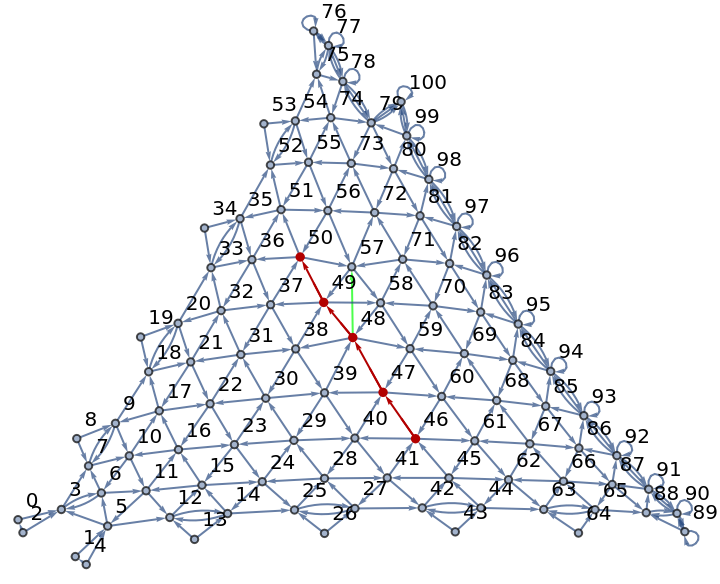
Adding the first dimension perturbation (hyperedge), from vertex 48 to 57:
In[]:=
Perturbedgrid1=EdgeAdd[Geodesic,48->57];
In[]:=
Perturbedgrid1Hg=HighlightGraph[Perturbedgrid1,{Style[48->57,Green]}]
Out[]=
Measuring the local dimension of perturbed hypergraph over the chosen vertex:
In[]:=
LocalDim1=ResourceFunction["WolframHausdorffDimension"][Perturbedgrid1Hg,v,2,"Dimension"];
In[]:=
AppendTo[LocalDimension,LocalDim1];
And the global dimension:
In[]:=
GlobalDim1=ResourceFunction["WolframHausdorffDimension"][Perturbedgrid1Hg,v,8,"Dimension"];
In[]:=
AppendTo[GlobalDimension,GlobalDim1];
The local curvature of the perturbed hypergraph:
In[]:=
LocalCurv1=ResourceFunction["WolframRicciCurvatureTensor"][Perturbedgrid1Hg,LocalDim1,39,58,"Curvature"];
In[]:=
AppendTo[LocalCurvature,LocalCurv1];
The general curvature:
In[]:=
GlobalCurv1=ResourceFunction["WolframRicciCurvatureTensor"][Perturbedgrid1Hg,GlobalDim1,0,100,"Curvature"];
In[]:=
AppendTo[GlobalCurvature,GlobalCurv1];
PERTURBATION 2:
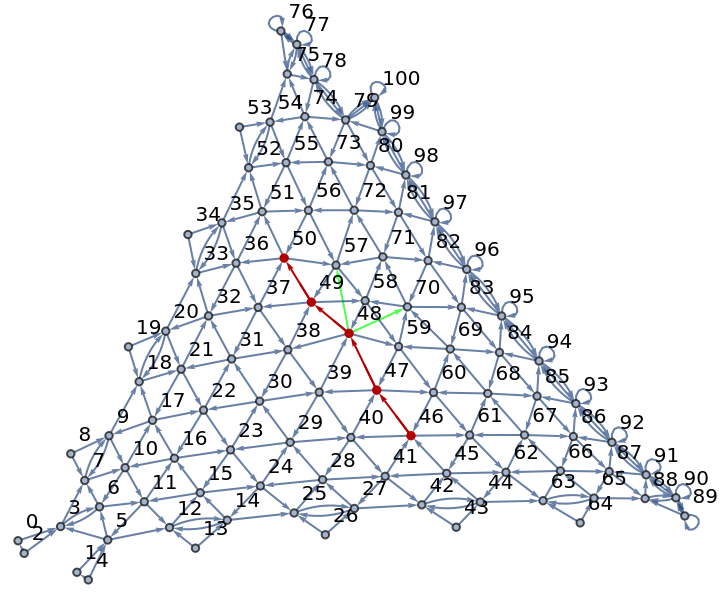
Adding an additional perturbation in the same chosen vertex (from 48 to 70):
Adding an additional perturbation in the same chosen vertex (from 48 to 70):
In[]:=
Perturbedgrid2=EdgeAdd[Perturbedgrid1Hg,48->70];
In[]:=
Perturbedgrid2Hg=HighlightGraph[Perturbedgrid2,{Style[48->70,Green]}]
Out[]=
Measuring the local dimension of perturbed hypergraph over the chosen vertex:
In[]:=
LocalDim2=ResourceFunction["WolframHausdorffDimension"][Perturbedgrid2Hg,v,2,"Dimension"];
In[]:=
AppendTo[LocalDimension,LocalDim2];
And the global dimension:
In[]:=
GlobalDim2=ResourceFunction["WolframHausdorffDimension"][Perturbedgrid2Hg,v,8,"Dimension"];
In[]:=
AppendTo[GlobalDimension,GlobalDim2];
The local curvature of the perturbed hypergraph:
In[]:=
LocalCurv2=ResourceFunction["WolframRicciCurvatureTensor"][Perturbedgrid2Hg,LocalDim2,39,58,"Curvature"];
In[]:=
AppendTo[LocalCurvature,LocalCurv2];
The general curvature:
In[]:=
GlobalCurv2=ResourceFunction["WolframRicciCurvatureTensor"][Perturbedgrid2Hg,GlobalDim2,0,100,"Curvature"];
In[]:=
AppendTo[GlobalCurvature,GlobalCurv2];
PERTURBATION 3:
Adding an additional perturbation from vertex 48 to 40:
In[]:=
Perturbedgrid3=EdgeAdd[Perturbedgrid2Hg,48->40];
Measuring the local dimension of perturbed hypergraph over the chosen vertex:
And the global dimension:
The local curvature of the perturbed hypergraph:
The general curvature:
PERTURBATION 4:
Additional perturbation from 37 to 48:
Measuring the local dimension of perturbed hypergraph over the chosen vertex:
And the global dimension:
The local curvature of the perturbed hypergraph:
The general curvature:
PERTURBATION 5:
Additional perturbation from 30 to 48:
Measuring the local dimension of perturbed hypergraph over the chosen vertex:
And the global dimension:
The local curvature of the perturbed hypergraph:
The general curvature:
PERTURBATION 6:
Additional perturbation from vertex 48 to 60:
Measuring the local dimension of perturbed hypergraph over the chosen vertex:
And the global dimension:
The local curvature of the perturbed hypergraph:
The general curvature:
PERTURBATION 7:
Additional perturbation from 48 to 61:
Measuring the local dimension of perturbed hypergraph over the chosen vertex:
And the global dimension:
The local curvature of the perturbed hypergraph:
The general curvature:
PERTURBATION 8:
Additional perturbation from 28 to 48:
Measuring the local dimension of perturbed hypergraph over the chosen vertex:
And the global dimension:
The local curvature of the perturbed hypergraph:
The general curvature:
PERTURBATION 9:
Additional perturbation from 32 to 48:
Measuring the local dimension of perturbed hypergraph over the chosen vertex:
And the global dimension:
The local curvature of the perturbed hypergraph:
The general curvature:
PERTURBATION 10:
One last perturbation from 48 to 72:
Measuring the local dimension of perturbed hypergraph over the chosen vertex:
And the global dimension:
The local curvature of the perturbed hypergraph:
The general curvature:
Key Results:
Key Results:
Dimension and curvature change:
Dimension and curvature change:
Below there is the analysis in an attempt to compare the behavior of the local dimension (measured with a small radius) and the local curvature (also measured within a small region from the chosen vertex of the grid) with respect to the number of perturbation. Both variables seem to increase with respect to the dimension perturbation, and visually there’s a correlation, even in the fluctuating points.
Correlation between Dimension and curvature:
Correlation between Dimension and curvature:
Since both variables, local dimension and local curvature seem to increase with the number of perturbations, if we plot both of them with respect to each other, there’s also an increasing behavior of the local curvature with respect to the local dimension change (taking into account the above chosen region).
It’s important to mention that the dimension perturbations were performed randomly, but there are some cases in which the increase of curvature is slightly small compared to others, as we can see in the images above. So there is a slight dependence of the increase in curvature and dimension, with respect to the region in which the perturbation is applied.
Concluding remarks and future direction
Concluding remarks and future direction
By performing dimension perturbations within a hypergraph, evolved by a certain set of Wolfram Model’s rules, we determined that there’s a correlation between the local dimension and the local curvature, within a region that contains such induced perturbations. Both variables seem to increase their value with the number of perturbations, and as a consequence, they seem to be correlated. Local dimension increases with respect to local dimension. In the framework of Cosmology this result can be of great importance, because Einstein Field Equations were developed with notions of curvature, and therefore there must be a set of rules that can represent such behavior with notions of dimension. Another additional remark is related to the fact that we are working with static hypergraphs, and in order to have a panorama of this variables with respect to space-time, an additional analysis can be performed with the causal graph.
Moreover, the continuum case may also be analyzed, to see if this interesting result remains.
Moreover, the continuum case may also be analyzed, to see if this interesting result remains.
Keywords
Keywords
◼
Perturbation
◼
Dimension estimation
◼
Curvature
◼
Wolfram Model
Acknowledgment
Acknowledgment
Mentor: Hatem Elshatlawy
I’m really thankful with my mentor Hatem Elshatlawy for all his patience and guidance. I guess I didn’t only have a mentor, but a person who gave some life lessons during this time. Without his ideas, advice and support this project would not have been possible. I would also like to thank the entire Wolfram Summer School team for organizing this interesting, innovative and helpful experience. Also special thanks to Jonathan, Stephen, Erin, and Xerxes for their work, and to Tobias, Joana, Max and Jan for their help and willing to discuss their ideas.
I’m really thankful with my mentor Hatem Elshatlawy for all his patience and guidance. I guess I didn’t only have a mentor, but a person who gave some life lessons during this time. Without his ideas, advice and support this project would not have been possible. I would also like to thank the entire Wolfram Summer School team for organizing this interesting, innovative and helpful experience. Also special thanks to Jonathan, Stephen, Erin, and Xerxes for their work, and to Tobias, Joana, Max and Jan for their help and willing to discuss their ideas.
References
References
◼
[Wolfram Physics Project - Technical Introduction]
◼
[Jonathan Gorard, “Algorithmic Causal Sets and the Wolfram Model”]
◼
[Jonathan Gorard, “Some Relativistic and Gravitational Properties of the Wolfram Model”]
◼
[Jonathan Gorard, “Hypergraph Discretization of the Cauchy Problem in General Relativity via Wolfram Model Evolution”]
References for functions
References for functions
Wolfram Function Repository. Wolfram Physics Project. https://resources.wolframcloud.com/FunctionRepository/category/wolfram-physics-project