Cellular automata
Cellular automata
In[]:=
SeedRandom[42];size=512;standardInitialization={{1},0};randomInitialization=RandomInteger[1,size];
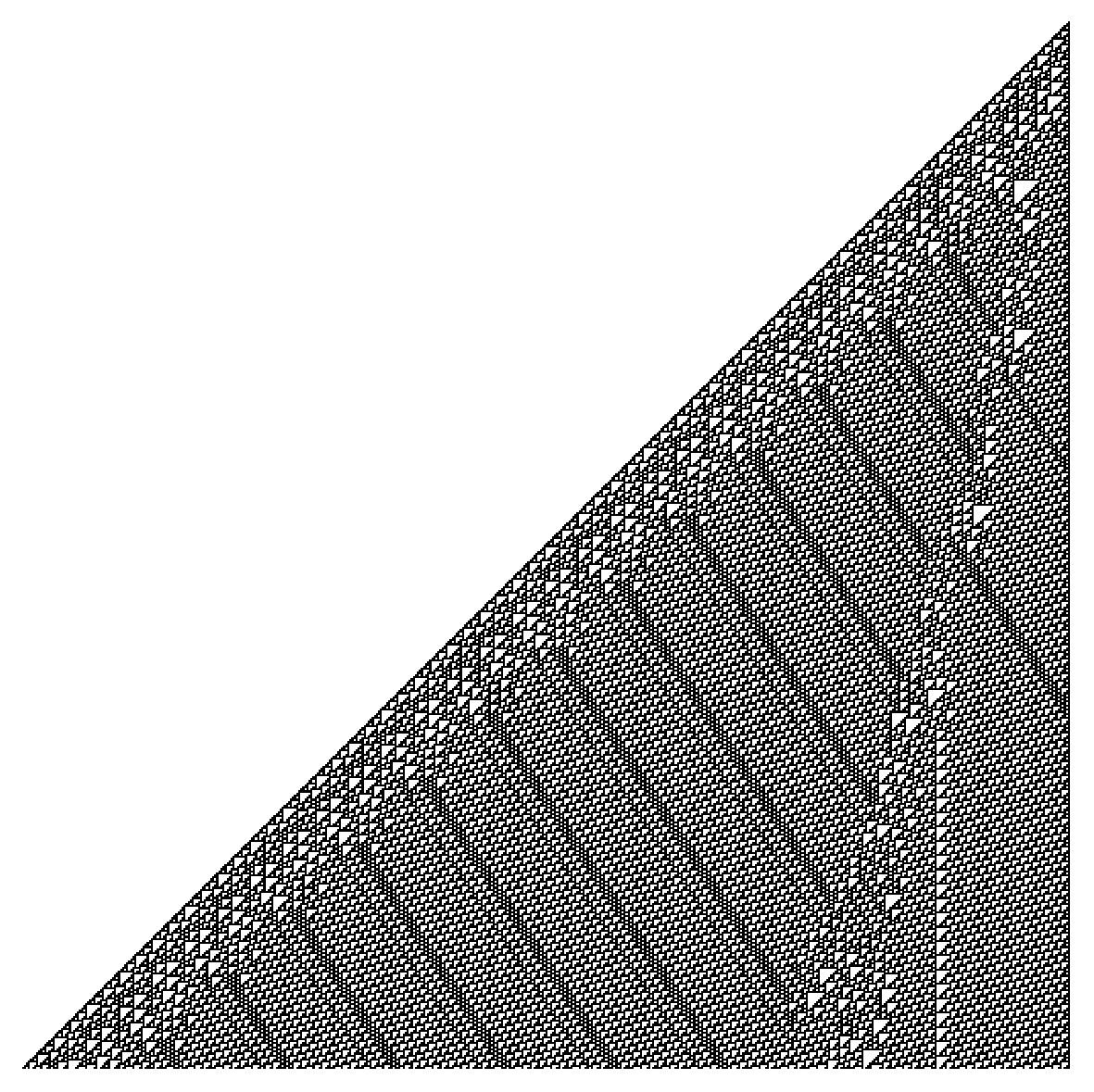
Rule 110 and 30 are elementary cellular automaton rules introduced by Stephen Wolfram in 1983. The rule defines the binary coloring of cells of subsequent rows of a square grid based on three neighboring cells.
Top rows of the pattern generated by rule 110:
Module[{automaton,centerColumn},automaton=CellularAutomaton[110,standardInitialization,size-1];ArrayPlot[automaton,Frame->None,ImageSize->600,ColorRules->{0->White,1->Black}]]
Out[]=
Starting from a random initial condition highlights the particle like interactions:
Module[{automaton,centerColumn},automaton=CellularAutomaton[110,randomInitialization,2size-1];ArrayPlot[automaton[[Range[size,2size]]],Frame->None,ImageSize->600,ColorRules->{0->White,1->Black}]]
Out[]=
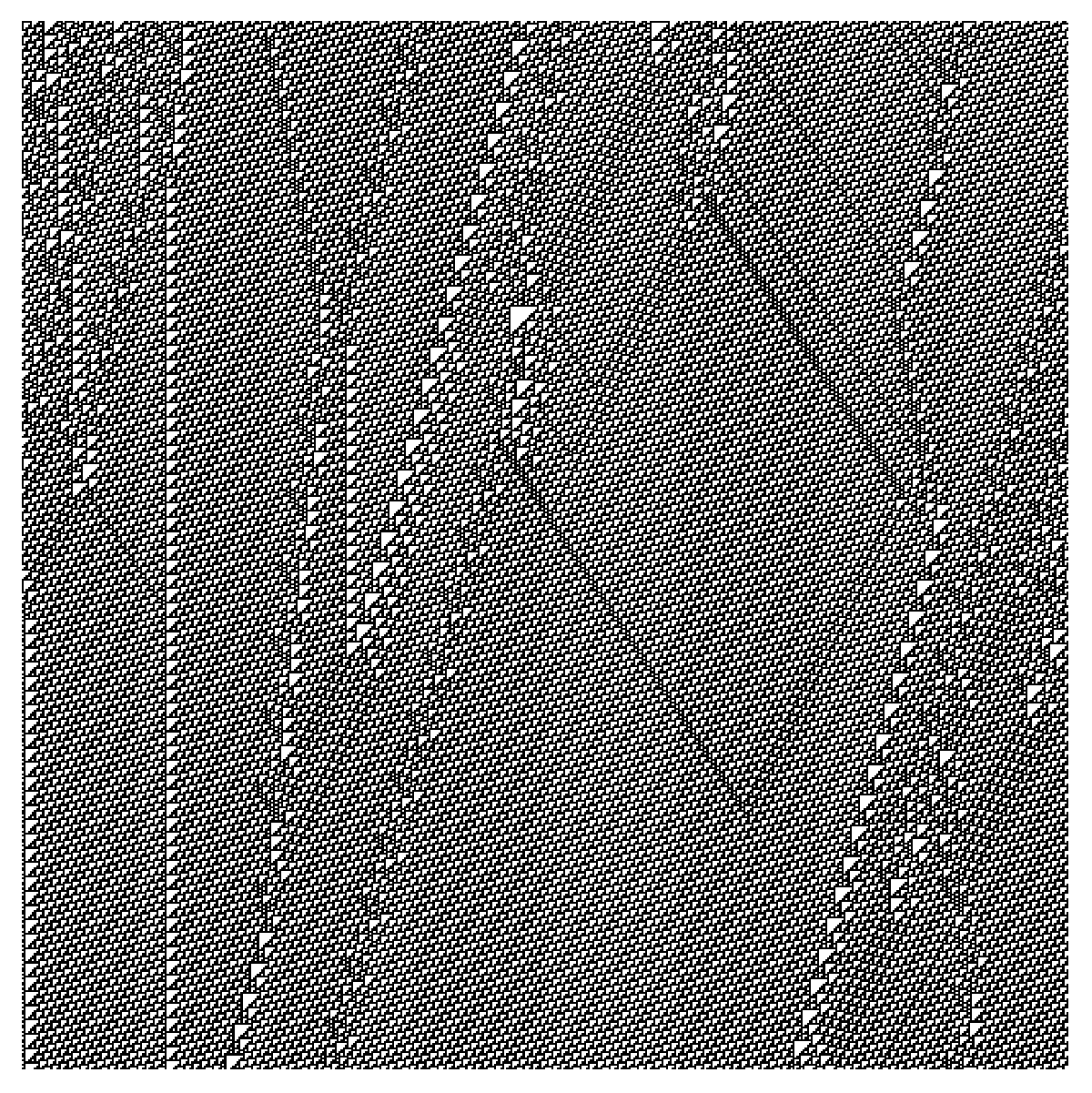
It would be quite useful to highlight these particles for further analysis.
How could these particles be identified in general and in a formal way?
How could these particles be identified in general and in a formal way?
Physics analogy
Physics analogy
◼
The computation required to produce the subsequent rows corresponds to the passage of time.
◼
The horizontal axis corresponds to one dimensional space.
◼
Coarse-graining by an observer is introduced by collecting microstates over a sliding window both in time and space, simulating a finite sized observer defined by a bit-mask.
◼
A notion of measured energy (entropy) is established as the negative log-probability of the microstate in the sliding window.
◼
The probabilities need to be “calibrated” for each rule and observer mask on a representative sample. This ensures that subsequent plots will have comparable coloring.
◼
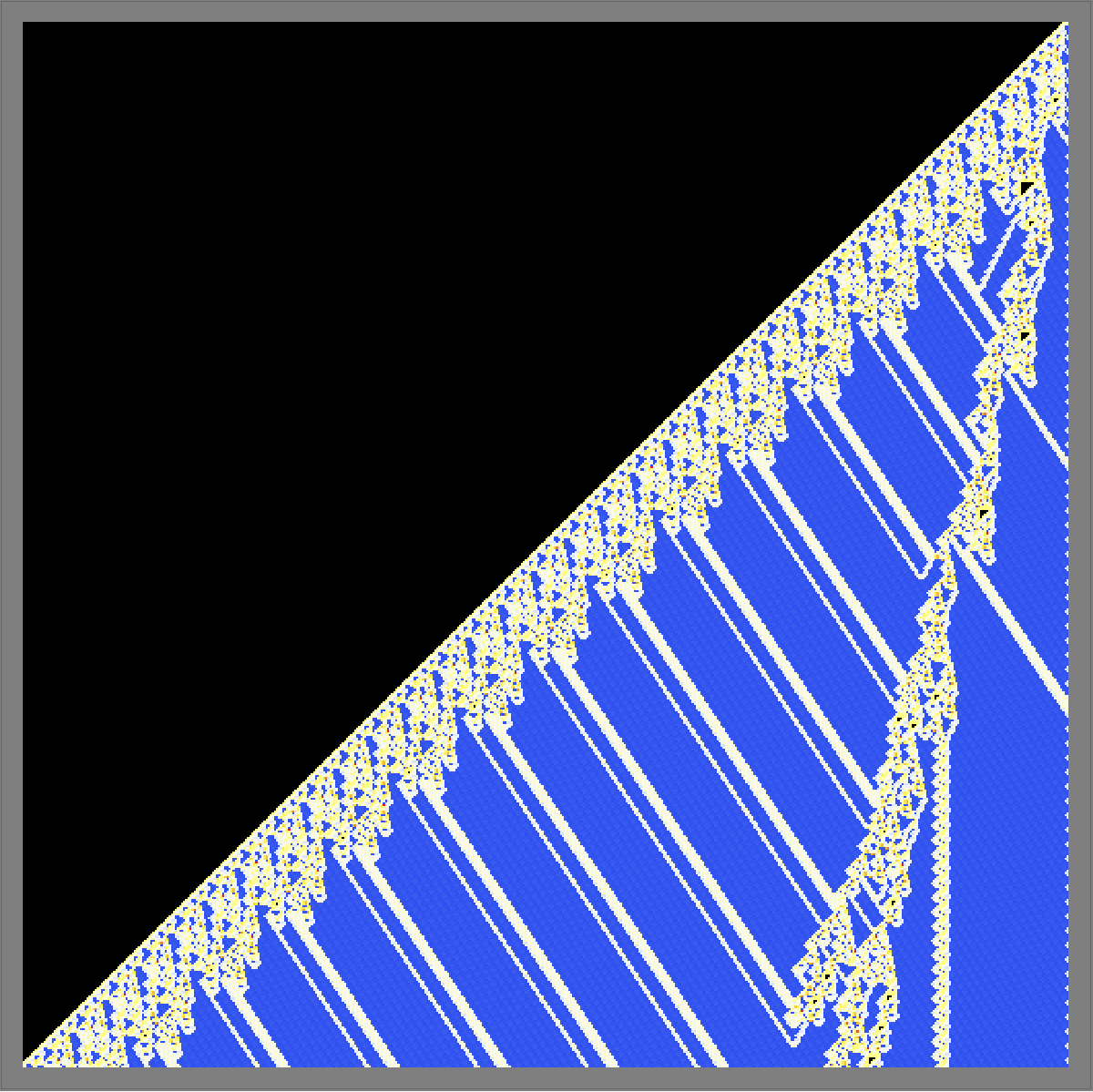
The energy values can be used to identify the “particles” moving in front of a background “vacuum” state by coloring them on the plot.
In[]:=
Observe[automaton_,mask_]:=Module[{d,h,w,rows,cols,observations},d=Dimensions[mask];h=d[[1]];w=d[[2]];rows=Length[automaton];cols=Length[automaton[[1]]];observations=Table[BitAnd[mask,automaton[[i;;i+h-1,j;;j+w-1]]],{i,rows-h+1},{j,1,cols-w+1}];observations]CalibrateEnergy[automaton_,mask_]:=Module[{hole,observations,counts,energyMap,minEnergy,normalizedEnergyMap},hole=mask*0;observations=DeleteCases[Observe[automaton,mask],hole];counts=Counts[Flatten[observations,1]];energyMap=Association[KeyValueMap[#1->N[-Log[#2],9]&,counts]];minEnergy=Min[Values[energyMap]];normalizedEnergyMap=Association[KeyValueMap[#1->#2-minEnergy&,energyMap]];Append[normalizedEnergyMap,hole->-Infinity]]MeasureEnergy[automaton_,mask_,energyMap_]:=Module[{hole,observations,energy},hole=mask*0;observations=DeleteCases[Observe[automaton,mask],hole];energy=Replace[observations,energyMap,{2}];energy]PlotEnergy[automaton_,mask_,energyMap_]:=Module[{observations,hole,energy},energy=MeasureEnergy[automaton,mask,energyMap];ArrayPlot[energy,ImageSize->600,ColorFunction(If[#==-Infinity,Black,ColorData["TemperatureMap"][#]]&),Background->Gray]]PatternGrid[energyMap_,observerMask_]:=Module[{patterns,values,items},patterns=SortBy[Most[Keys[energyMap]],energyMap];values=Most[energyMap]/@patterns;items=Table[Column[{Overlay[{ArrayPlot[observerMask,ColorRules->{0->White,1->LightBlue},Frame->True,ImageSize->{50,50}],ArrayPlot[patterns[[i]],ColorRules->{0->Transparent,1->Black},Frame->False,ImageSize->{50,50}]}],NumberForm[Round[values[[i]],0.001],{5,3}]},Center],{i,Length[patterns]}];Grid[Partition[items,8,8,{1,1},{}],Spacings->{2,2}]]SquareMask[size_]:=Table[1,{i,1,size},{j,1,size}]DiamondMask[size_]:=Module[{h},h=(size-1)/2;Table[If[Abs[i]+Abs[j]<=h,1,0],{i,-h,h},{j,-h,h}]]observerMask=DiamondMask[5];calibratedEnergies=<|30->CalibrateEnergy[CellularAutomaton[30,standardInitialization,512],observerMask],110->CalibrateEnergy[CellularAutomaton[110,randomInitialization,1024],observerMask]|>;
Rule 110
Rule 110
Standard
Standard
automaton=CellularAutomaton[110,standardInitialization,size-1];PlotEnergy[automaton,observerMask,calibratedEnergies[110]]
Out[]=
Random
Random
Patterns
Patterns
Rule 30
Rule 30
Standard
Standard
Random
Random
Patterns
Patterns