Find the second and third parts here:
2nd: Consistent Force Field: alkylbenzenes, alkanes, alkenes. Conformational analysis of molecular rotors
3rd: Consistent Force Field: alkylbenzenes, alkanes, alkenes. Conformational analysis of molecular gears
2nd: Consistent Force Field: alkylbenzenes, alkanes, alkenes. Conformational analysis of molecular rotors
3rd: Consistent Force Field: alkylbenzenes, alkanes, alkenes. Conformational analysis of molecular gears
Table of Contents
Table of Contents
Introduction
Motivation
Motivation
In 2012 the alkane portion of the Consistent Force Field (CFF) [10] was implemented in WL so that the conformations of small rings could be studied and the results presented later that year at the Wolfram Technology Conference [41]. At the time, there was no real support for molecular modeling in WL and a number of supporting functions were also needed, not the least of which was a data structure for molecules. The CFF was chosen because the proposed analysis included conformation maps which require accurate energies and optimized geometries, not only for ground states (energy minima on the potential energy hypersurface), but also for transition states and other higher-order partial maxima.
Seven years later, and related functions became part of the language, and in the lead-up to version 12.0 the remaining alkene portion of the CFF was implemented. In the end, the Merck Molecular Force Field (MMFF) [34, 35, 36, 37, 38, 39, 40] and the Universal Force Field (UFF) [21, 22, 23] were implemented in favor of the CFF because of their broader coverage of chemical structure.
Molecule
With the recent release of the Wolfram Language Paclet Repository (WLPR), we now have the means to implement the CFF “in the language,” and take advantage of the additional computational capabilities such as analytic first and second derivatives of the energy, vibrational frequencies, normal mode analysis, molecular thermodynamic functions, symmetry coordinates, and direct unconstrained optimization of transition state structures.
Our hope is that this new paclet will help provide a better understanding of empirical force fields (EFFs) and their use, provide additional conformational analysis capabilities to WL, and enable the extension of CFF to additional classes of molecules by users.
This Wolfram Community post is the first in a series. The second part will be about conformation space mapping, and the conformational analysis of simple molecular rotors and molecular gears. The third part will be about the conformational analysis of rings.
What is a Molecular Empirical Force Field?
What is a Molecular Empirical Force Field?
A full telling of the origins, development, and myriad applications of molecular Empirical Force Fields (EFFs) could easily fill a book or two. There is a good overview of force fields in Wikipedia [44]. For the purposes of this post we will provide enough information for the reader to understand the computations involved, and the major limitations. For the curious, there is a brief review of the development of EFFs in an appendix to the post.
Empirical force fields are just that, empirical. They were conceived and developed to provide a convenient and relatively easy method to compute the energy and geometry of molecules based largely on experimentally observed steric effects. They have been refined over the years to take into account nonlinear, electronic, and solvent effects, but again in a wholly empirical manner. In their modern form, the energy of a molecule is a sum of various terms
E
total
E
diagonal
E
nonbond
E
cross
E
solvent
(
1
)where
E
diagonal
E
stretch
E
bend
E
torsion
E
out-of-plane
E
nonbond
E
vanderWaals
E
charge
E
cross
E
stretch-stretch
E
stretch-bend
E
bend-bend
E
bend-torsion
(
2
)The diagonal energy term represents contributions from the bonded interactions: bond stretching, angle bending, torsional twisting, and out-of-plane puckering. They are generally harmonic in nature. The non-bonded energy terms represents through-space interactions: van der Waals and electrostatic attraction and repulsion. Van der Waals interactions are usually restricted to pairs of atoms that are no closer than three bonds. Electrostatic interactions are usually included for molecules that contain polar atoms, such as N, O, Cl, etc. The so-called cross-term energy represents the anharmonic contributions from adjacent bonds, angles, torsions, and out-of-planes (aka, internal coordinates). Generally, the EFF energy is for an isolated molecule in the gas phase, and when modeling a molecule in bulk solution a solution mean field term is included.
The CFF of Ermer and Lifson was a continuation of earlier work by Warshel and Lifson [8, 9]. The explicit form of the energy for the CFF [10, 13, 20] is
E==+++(1+cos)+,(-)(-)+2-3
1
2
∑
i
K
b,i
2
-
b
i
b
0,i
1
2
∑
i
H
θ,i
2
-
θ
i
θ
0,i
1
2
∑
i
H
χ,i
2
χ
i
1
2
∑
i
H
Φ,i
s
i
n
i
ϕ
i
∑
i
∑
j!=i
F
p
i
p
j
p
i
p
0,i
p
j
p
0,j
∑
i
∑
j>i
ϵ
i
ϵ
j
9
*
r
i
*
r
j
r
i,j
6
*
r
i
*
r
j
r
i,j
(
3
)where
K b,i | stretchforceconstantforthei-thbond |
b 0,i | referencebondlengthforthei-thbond |
b i | lengthofthei-thbond |
H θ,i | bendforceconstantforthei-thbondangle |
θ 0,i | referencebondangleforthei-thbanondangle |
θ i | measureofthei-thbondangle |
H χ,i | forceconstantofthei-thout-of-planeangle |
χ i | measureofthei-thout-of-planeangle |
H Φ,i | forceconstantforthei-thtorsonangle |
s i | +1iftheenergyisamaximumfortheeclipsedconformation-1iftheenergyisaminimumfortheeclipsedconformation |
n i | periodicityofthei-thtorsionangle |
ϕ i | measureofthei-thtorsionangle |
F p i p j | forceconstantforthe p i p j |
p 0,i | referencevalueforthe p i |
p i | measureofthe p i |
ϵ i | Lennard-Jonesconstantforthei-thatom |
* r i | vanderWaalsradiusofthei-thatom |
r i,j | distancebetweennon-bondedatomsiandj |
The CFF methodology has been extended to amides an peptides by Hagler and Lifson [11, 12, 16, 17, 18], and to general organic molecules (CFF93) by Hagler, Maple, Dinur, et al. [24, 25, 26, 27, 28, 29, 30, 31, 32, 33] by using geometries and energies generated with molecular orbital methods as calibration data.
There are many different force fields in use today. Some are designed for specific kinds of molecules, such as proteins and DNA, while others are designed for specific environments, such as crystalline or solution, and still others are designed for high quality structures or relative energies. the Wikipedia page Force field (chemistry) has a summary. Because of this diversity of goals, the absolute energies computed by different force fields for the same molecule will be different. Energy differences between different conformations, however, are generally similar. Optimized geometries will almost always be slightly different, and sometimes very different.
Using the Paclet
Installation and Loading
Installation and Loading
First, install and load the paclet (click Yes to evaluate the initialization cells first).
In[]:=
PacletInstall["RobertNachbar/ConsistentForceField"]
Out[]=
PacletObject

In[]:=
Needs["RobertNachbar`ConsistentForceField`"]
Building molecules
Building molecules
We’ll use the molecules ethane ) and ethylene ) to demonstrate many of the capabilities of the ConsistentForceField paclet. Please refer to the documentation for more examples.
The Wolfram Language has many ways of building models of molecules, from drawing them, to looking them up in databases, to entering them in SMILES notation [45] as a string. We’ll use the last method here as it is very convenient.
In[]:=
ethane=Molecule["CC"]
Out[]=
Molecule

In[]:=
ethylene=Molecule["C=C"]
Out[]=
Molecule

ethane | ethylene |
 |  |
Parameterizing molecules
Parameterizing molecules
Before the energy, gradient, normal modes, etc. can be computed for a molecule, the molecule must be “parameterized”, that is, the lists of all the valence, non-bonded, and cross-term interactions used in Eqn. 3 must be tabulated and the force field parameters assigned. In all the published descriptions of the CFF [10, 13, 20], the specific molecular interactions and their attendant parameters have always been given pictorially, as shown here [10].
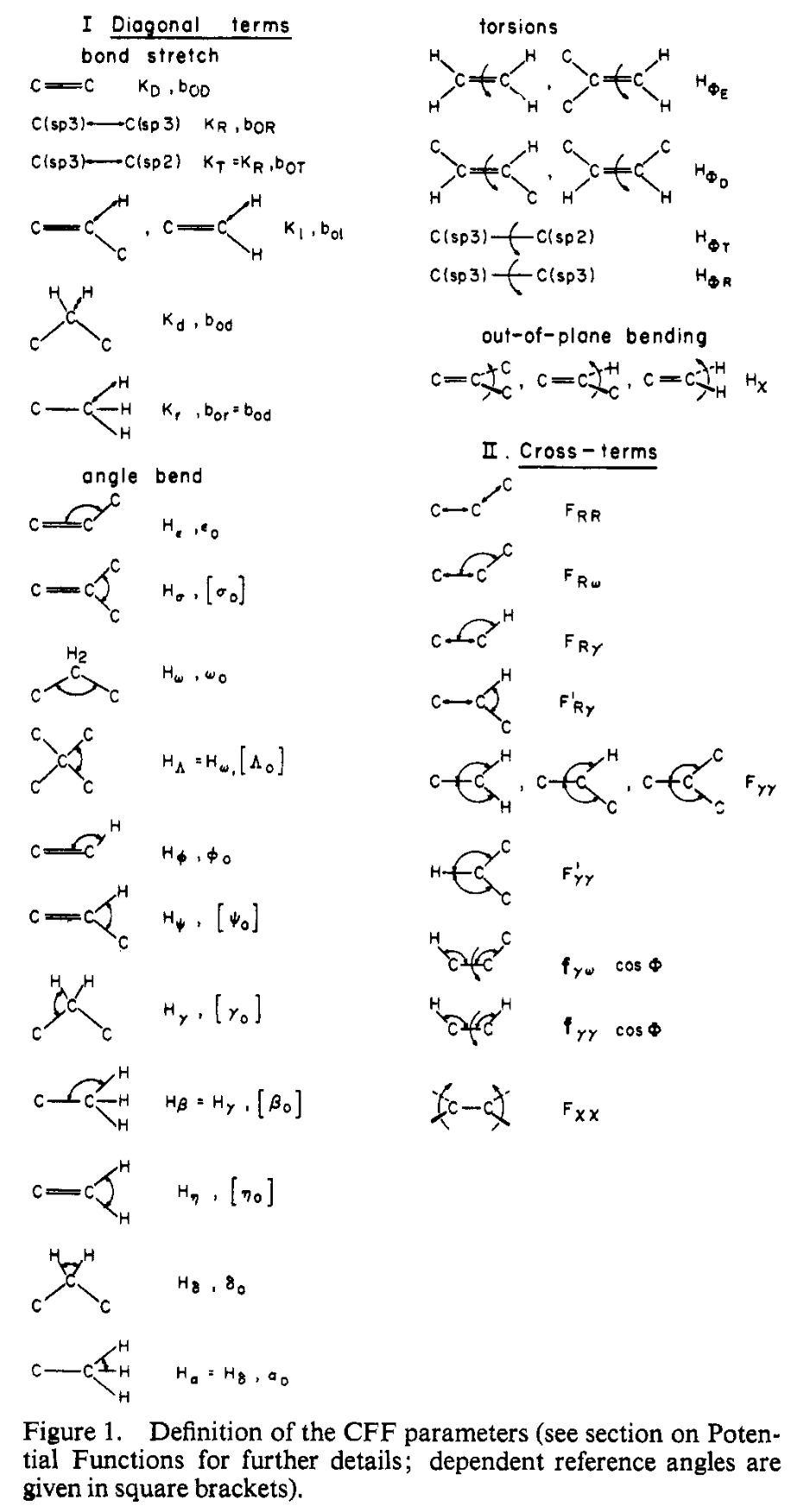
One of the main advantages of this approach is that it is very clear just what the force field authors intended. Moreover, the force constant and reference value parameters were defined symbolically, which meant that a given parameter could be used in multiple instances with the clear meaning that all those instances were considered exactly identical, and not by chance the same. While a picture is worth a thousand words, as the saying goes, there are often nuances in meaning or application that may be omitted accidentally or even for brevity in publication, which can be a serious disadvantage. This indeed was the case here, and it was only through the detailed implementation of the CFF and extensive testing against published results that these nuances and omissions were discovered and remedied.
Nearly every other force field is defined by a set of “atom types” and tables of various combinations of those atom types for the stretch, bend, torsion, and other terms of the energy expression with the necessary numeric parameter values. Perceiving the atom types is not always a straight forward process, and often there are exceptions to the strict atom-type tuples that need to take into account a large chemical structure environment.
In the initial implementation of the CFF we wanted to eschew atom types and take advantage of WL’s exceptional pattern matching capabilities and rule-based methods. To that end, WL expression patterns for the chemical environment were used to specify the symbolic parameters and an additional set of rules provided the numeric values as well as replacement rules for parameters that depended on other parameters (for example, -> in the diagram above). Here are the original specifications for the stretch interactions
K
T
K
R
(* patterns used to assign force constants and reference values *)sP[{{"C", _, _}, "Double", {"C", _, _}}] := {Subscript[, D], Subscript[, 0, D]}sP[{{"C", _, _, _}, "Single", {"C", _, _, _}}] := {Subscript[, R], Subscript[, 0, R]}sP[{{"C", "Double"["C"], "Single"[_]}, "Single", {"C", "Single"[_], "Single"[_], "Single"[_]}}] := {Subscript[, T], Subscript[, 0, T]}sP[{{"H"}, "Single", {"C", "Double"["C"], "Single"[_]}}] := {Subscript[, l], Subscript[, 0, l]}sP[{{"H"}, "Single", {"C", "Single"["C"], "Single"["C"], "Single"["C" | "H"]}}] := {Subscript[, d], Subscript[, 0, d]}sP[{{"H"}, "Single", {"C", "Single"["C" | "H"], "Single"["H"], "Single"["H"]}}] := {Subscript[, r], Subscript[, 0, r]}sP[pat_] := With[{i = Unique[]}, Message[sP::urpat, "stretch", pat]; {Subscript[, i], Subscript[, 0, i]} ]
Computing the energy
Computing the energy
Here is a comparison of the energies of default geometries of ethane and ethylene computed with CFF, MMFF, and UFF:
As noted above, the values are quite different. However, conformational energy differences are fairly similar from one force field to the next. Here we compute the energy difference for the staggered and eclipsed conformations of ethane with each of the three force fields:
We can easily see the the higher energy of the eclipsed conformation is due to torsion and non-bond interactions.
Geometry optimization
Geometry optimization
Generally, the symmetry of the input geometry does not decrease during the geometry optimization, and therefore the final geometry may actually be an energy partial maximum. To test for that condition, one needs only to compute the eigenvalues of the Hessian matrix and count the number of negative values, remembering that there will be six very small eigenvalues (five if the molecule is linear).
Computing normal modes of vibration
Computing normal modes of vibration
At all temperatures, include absolute zero, molecules are always vibrating. That is, the internal distances and angles are undergoing periodic changes even though the center of mass of the molecule is not moving and the molecule is not rotating about its center of mass. Even though the overall vibration may appear random, it can be decomposed into a linear combination fundamental vibrations that are characteristic of the symmetry of the molecule. These periodic motions are known as normal modes of vibration.
Normal modes are usually computed for stationary structures, so an optimization of the geometry is required.
As mentioned above, the normal modes can be visualized. The dynamic visualization below makes use of atomic displacements. Open the time controller and press the Play button to see continuous motion. The high frequency modes tend to be composed of bond stretches, the middle frequency modes are generally angle bending, and the low frequency modes are torsional distortions.
Comparison with MMFF and UFF
The WL built-in chemistry functions already support the use of the Merck Molecular Force Field (MMFF) and the Universal Force Field (UFF). MMFF was designed for drug design in the pharmaceutical industry. It covers a broad range of organic compounds, proteins, and biologically important molecules such as biotin, nicotinamide, and ATP. The parameters were fit to high level (at the time) molecular orbital results for geometry, relative energies, and some vibrational frequencies. The UFF, on the other hand, was designed for a broad as possible coverage of the period table at the expense of highly accurate geometries and relative energies. The Consistent Force Field was designed to study the geometry and energetics of distorted CC double bonds and conformational analysis of some high symmetry saturated hydrocarbon. So, naturally there are differences, and, as far as we know, no comprehensive comparison. To fill that gap, we have undertaken a small comparison employing a subset of the molecules used to parameterize the CFF.
Even though the calibration of MMFF made use of vibrational frequency data, the ability to compute vibrational frequencies from analytic second derivatives of the energy (the Hessian matrix) has only been available in commercial molecular modeling packages such as BatchMin from Schrödinger Inc. The only publically available version of MMFF is in RdKit [42] which currently supports only energy computation and geometry optimization with MMFF.
Twenty three saturated and unsaturated hydrocarbons were used to parameterize the CFF, and they are listed below (some have more than one conformation included).
We selected 12 of them and added several more for the comparison, as show below. Casewit et al. provided a table of relative energy differences for a number hydrocarbons with experimental values for comparison with their results for UFF, and we included six of those molecules that could be computed with CFF.
We can group them by canonical SMILES and compute the MMFF- and UFF-optimized geometries:
First, let’s compare the symmetries of the optimized geometries, as that will reveal any gross differences. In the table below we’ve highlighted the triples of point group symbols that are not the same.
The UFF gives a planar optimized geometry for cyclobutane.
Examination of the geometries is done more closely in the next set of plots. We computed all the bond length, bond angles, and torsion angles of each molecule with the function geometryTable (defined in the Initialization section at the end).
The distributions of the bond lengths for the three force fields are shown below. While they look similar, there are some important differences.
Scatter plots (with tooltips), on the other hand, show that MMFF and UFF are quite similar, and CFF has some long outliers (cyclobutane) and shorter outliers (cis-di-t-butylethylene).
The bond angles differences are not remarkable, as shown in the scatter plots below.
All three force fields reproduce the wide CC—C angle in cis-di-t-butylethylene.
The small bond angle near 90° is for the C—C—C angle in cyclobutane, which is constrained by the small ring.
Looking at the torsion angles, CFF and MMFF agree very well, and UFF has two outliers, namely, cyclobutane and skew 1-butene.
The skew conformation for 1-butene with CFF and MMFF has a C—H bond at C3 coplanar with the C1C2 double bond, and pointing toward the double bond (syn). For UFF the C—H bond is again coplanar, but pointing away from the double bond (anti).
We now turning to the energies. The only valid comparisons are between conformations, so the table below shows only the comparison molecules that have more than one conformation. For a given set of conformations the minimum energy for each force field was subtracted to give relative energies. As can be seen in the table below the agreement is rather good. The conformations with a coefficient of variation greater than 5% are highlighted yellow and those greater than 25% are highlighted red.
All three force fields give qualitatively the same results, however disappointingly, although not surprisingly, the quantitative differences are large. The computed results for 1-methyl-1-phenylcyclohexane are the reverse of the experimental data reported by Eliel and Manoharan [19].
Back Matter
References
References
1
.Hill, T. L. (1946). On steric effects. The Journal of Chemical Physics, 14(7), 465-465. https://doi.org/10.1063/1.1724173
2
.Westheimer, F. H., & Mayer, J. E. (1946). The theory of the racemization of optically active derivatives of diphenyl. The Journal of Chemical Physics, 14(12), 733-738. https://doi.org/10.1063/1.1724095
3
.Westheimer, F. H. (1956). Steric effects in organic chemistry. by MS Newman, John & Wiley Sons, New York, 523-555.
4
.Hendrickson, J. B. (1961). Molecular geometry. I. Machine computation of the common rings. Journal of the American Chemical Society, 83(22), 4537-4547. https://doi.org/10.1021/ja01483a011
5
.Wiberg, K. B. (1965). A scheme for strain energy minimization. Application to the cycloalkanes1. Journal of the American Chemical Society, 87(5), 1070-1078. https://doi.org/10.1021/ja01083a024
6
.Allinger, N. L., Miller, M. A., Van Catledge, F. A., & Hirsch, J. A. (1967). Conformational analysis. LVII. The calculation of the conformational structures of hydrocarbons by the Westheimer-Hendrickson-Wiberg method. Journal of the American Chemical Society, 89(17), 4345-4357. https://doi.org/10.1021/ja00993a017
7
.Allinger, N. L., Hirsch, J. A., Miller, M. A., Tyminski, I. J., & Van Catledge, F. A. (1968). Conformational analysis. LX. Improved calculations of the structures and energies of hydrocarbons by the Westheimer method. Journal of the American Chemical Society, 90(5), 1199-1210. https://doi.org/10.1021/ja01007a017
8
.Lifson, S., & Warshel, A. (1968). Consistent force field for calculations of conformations, vibrational spectra, and enthalpies of cycloalkane and n-alkane molecules. The Journal of Chemical Physics, 49(11), 5116-5129. https://doi.org/10.1063/1.1670007
9
.Warshel, A., & Lifson, S. (1970). Consistent force field calculations. II. Crystal structures, sublimation energies, molecular and lattice vibrations, molecular conformations, and enthalpies of alkanes. The Journal of Chemical Physics, 53(2), 582-594. https://doi.org/10.1063/1.1674031
10
.Ermer, O., & Lifson, S. (1973). Consistent force field calculations. III. Vibrations, conformations, and heats of hydrogenation of nonconjugated olefins. Journal of the American Chemical Society, 95(13), 4121-4132. https://doi.org/10.1021/ja00794a003
11
.Hagler, A. T., Huler, E., & Lifson, S. (1974). Energy functions for peptides and proteins. I. Derivation of a consistent force field including the hydrogen bond from amide crystals. Journal of the American Chemical Society, 96(17), 5319-5327. https://doi.org/10.1021/ja00824a004
12
.Hagler, A. T., & Lifson, S. (1974). Energy functions for peptides and proteins. II. Amide hydrogen bond and calculation of amide crystal properties. Journal of the American Chemical Society, 96(17), 5327-5335. https://doi.org/10.1021/ja00824a005
13
.Ermer, O. (1976). Calculation of molecular properties using force fields. Applications in organic chemistry. In Structure and Bonding, vol 27 (pp. 161-211). Berlin, Heidelberg: Springer Berlin Heidelberg. https://doi.org/10.1007/3-540-07671-9_3 [translation of parts of Aspekte]
14
.Allinger, N. L. (1977). Conformational analysis. 130. MM2. A hydrocarbon force field utilizing V1 and V2 torsional terms. Journal of the American Chemical Society, 99(25), 8127-8134. https://doi.org/10.1021/ja00467a001
15
.Faber, D. H., & Altona, C. (1977). UTAH5, a versatile programme package for the calculation of molecular properties by force field methods. Computers & Chemistry, 1(3), 203-213. https://doi.org/10.1016/0097-8485(77)85011-0
16
.Lifson, S., Hagler, A. T., & Dauber, P. (1979). Consistent force field studies of intermolecular forces in hydrogen-bonded crystals. 1. Carboxylic acids, amides, and the C: O. cntdot.. cntdot.. cntdot. H-hydrogen bonds. Journal of the American Chemical Society, 101(18), 5111-5121. https://doi.org/10.1021/ja00512a001
17
.Hagler, A. T., Lifson, S., & Dauber, P. (1979). Consistent force field studies of intermolecular forces in hydrogen-bonded crystals. 2. A benchmark for the objective comparison of alternative force fields. Journal of the American Chemical Society, 101(18), 5122-5130. https://doi.org/10.1021/ja00512a002
18
.Hagler, A. T., Dauber, P., & Lifson, S. (1979). Consistent force field studies of intermolecular forces in hydrogen-bonded crystals. 3. The C=O···H—O hydrogen bond and the analysis of the energetics and packing of carboxylic acids. Journal of the American Chemical Society, 101(18), 5131-5141. https://doi.org/10.1021/ja00512a003
19
.Eliel, E. L., & Manoharan, M. (1981). Conformational analysis. 40. Conformation of 1-methyl-1-phenylcyclohexane and conformational energies of the phenyl and vinyl groups. The Journal of Organic Chemistry, 46(9), 1959-1962. https://doi.org/10.1021/jo00322a056
20
.Ermer, O., (1981) Aspekte von Kraftfeldrechnungen, Wolfgang Bauer Verlag, Muenchen.
21
.Rappé, A. K., Casewit, C. J., Colwell, K. S., Goddard III, W. A., & Skiff, W. M. (1992). UFF, a full periodic table force field for molecular mechanics and molecular dynamics simulations. Journal of the American chemical society, 114(25), 10024-10035. https://doi.org/10.1021/ja00051a040
22
.Casewit, C. J., Colwell, K. S., & Rappe, A. K. (1992). Application of a universal force field to organic molecules. Journal of the American chemical society, 114(25), 10035-10046. https://doi.org/10.1021/ja00051a041
23
.Casewit, C. J., Colwell, K. S., & Rappe, A. K. (1992). Application of a universal force field to main group compounds. Journal of the American Chemical Society, 114(25), 10046-10053. https://doi.org/10.1021/ja00051a042
24
.Maple, J. R., Dinur, U., & Hagler, A. T. (1988). Derivation of force fields for molecular mechanics and dynamics from ab initio energy surfaces. Proceedings of the National Academy of Sciences, 85(15), 5350-5354. https://doi.org/10.1073/pnas.85.15.5350
25
.Dinur, U., & Hagler, A. T. (1990). A novel decomposition of torsional potentials into pairwise interactions: A study of energy second derivatives. Journal of computational chemistry, 11(10), 1234-1246. https://doi.org/10.1002/jcc.540111015
26
.Maple, J. R., Hwang, M. J., Stockfisch, T. P., Dinur, U., Waldman, M., Ewig, C. S., & Hagler, A. T. (1994). Derivation of class II force fields. I. Methodology and quantum force field for the alkyl functional group and alkane molecules. Journal of Computational Chemistry, 15(2), 162-182. https://doi.org/10.1002/jcc.540150207
27
.Hwang, M. J., Stockfisch, T. P., & Hagler, A. T. (1994). Derivation of class II force fields. 2. Derivation and characterization of a class II force field, CFF93, for the alkyl functional group and alkane molecules. Journal of the American Chemical Society, 116(6), 2515-2525. https://doi.org/10.1021/ja00085a036
28
.Maple, J. R., Hwang, M. J., Stockfisch, T. P., & Hagler, A. T. (1994). Derivation of class II force fields. III. Characterization of a quantum force field for alkanes. Israel Journal of Chemistry, 34(2), 195-231. https://doi.org/10.1002/ijch.199400025
29
.Peng, Z., Ewig, C. S., Hwang, M. J., Waldman, M., & Hagler, A. T. (1997). Derivation of class II force fields. 4. van der Waals parameters of alkali metal cations and halide anions. The Journal of Physical Chemistry A, 101(39), 7243-7252. https://doi.org/10.1021/jp964080y
30
.Maple, J. R., Hwang, M. J., Jalkanen, K. J., Stockfisch, T. P., & Hagler, A. T. (1998). Derivation of class II force fields: V. Quantum force field for amides, peptides, and related compounds. Journal of computational chemistry, 19(4), 430-458. https://doi.org/10.1002/(SICI)1096-987X(199803)19:4%3C430::AID-JCC5%3E3.0.CO;2-T
31
.Hwang, M. J., Ni, X., Waldman, M., Ewig, C. S., & Hagler, A. T. (1998). Derivation of class II force fields. VI. Carbohydrate compounds and anomeric effects. Biopolymers: Original Research on Biomolecules, 45(6), 435-468. https://doi.org/10.1002/(SICI)1097-0282(199805)45:6%3C435::AID-BIP3%3E3.0.CO;2-Q
32
.Ewig, C. S., Thacher, T. S., & Hagler, A. T. (1999). Derivation of class II force fields. 7. Nonbonded force field parameters for organic compounds. The Journal of Physical Chemistry B, 103(33), 6998-7014. https://doi.org/10.1021/jp991011l
33
.Ewig, C. S., Berry, R., Dinur, U., Hill, J. R., Hwang, M. J., Li, H., ... & Hagler, A. T. (2001). Derivation of class II force fields. VIII. Derivation of a general quantum mechanical force field for organic compounds. Journal of computational chemistry, 22(15), 1782-1800. https://doi.org/10.1002/jcc.1131
34
.Halgren, T. A. (1996). Merck molecular force field. I. Basis, form, scope, parameterization, and performance of MMFF94. Journal of computational chemistry, 17(5-6), 490-519. https://doi.org/10.1002/(SICI)1096-987X(199604)17:5/6%3C490::AID-JCC1%3E3.0.CO;2-P
35
.Halgren, T. A. (1996). Merck molecular force field. II. MMFF94 van der Waals and electrostatic parameters for intermolecular interactions. Journal of Computational Chemistry, 17(5-6), 520-552. https://doi.org/10.1002/(SICI)1096-987X(199604)17:5/6%3C520::AID-JCC2%3E3.0.CO;2-W
36
.Halgren, T. A. (1996). Merck molecular force field. III. Molecular geometries and vibrational frequencies for MMFF94. Journal of computational chemistry, 17(5-6), 553-586. https://doi.org/10.1002/(SICI)1096-987X(199604)17:5/6%3C553::AID-JCC3%3E3.0.CO;2-T
37
.Halgren, T. A., & Nachbar, R. B. (1996). Merck molecular force field. IV. Conformational energies and geometries for MMFF94. Journal of computational chemistry, 17(5-6), 587-615. https://doi.org/10.1002/(SICI)1096-987X(199604)17:5/6%3C587::AID-JCC4%3E3.0.CO;2-Q
38
.Halgren, T. A. (1996). Merck molecular force field. V. Extension of MMFF94 using experimental data, additional computational data, and empirical rules. Journal of Computational Chemistry, 17(5-6), 616-641. https://doi.org/10.1002/(SICI)1096-987X(199604)17:5/6%3C616::AID-JCC5%3E3.0.CO;2-X
39
.Halgren, T. A. (1999). MMFF VI. MMFF94s option for energy minimization studies. Journal of computational chemistry, 20(7), 720-729. https://doi.org/10.1002/(SICI)1096-987X(199905)20:7%3C720::AID-JCC7%3E3.0.CO;2-X
40
.Halgren, T. A. (1999). MMFF VII. Characterization of MMFF94, MMFF94s, and other widely available force fields for conformational energies and for intermolecular-interaction energies and geometries. Journal of Computational Chemistry, 20(7), 730-748. https://doi.org/10.1002/(SICI)1096-987X(199905)20:7%3C730::AID-JCC8%3E3.0.CO;2-T
41
.Nachbar, R. B. (2012) Demonstrations for Organic Chemistry--Conformational Analysis of Linear and Cyclic Alkanes. Wolfram Technology Conference 2012, Champaign, IL. https://library.wolfram.com/infocenter/ID/8709/
42
.Tosco, P., Stiefl, N., & Landrum, G. (2014). Bringing the MMFF force field to the RDKit: implementation and validation. Journal of cheminformatics, 6, 1-4. https://doi.org/10.1186/s13321-014-0037-3
43
.Mobley, D. L., Bannan, C. C., Rizzi, A., Bayly, C. I., Chodera, J. D., Lim, V. T., ... & Eastman, P. K. (2018). Escaping atom types in force fields using direct chemical perception. Journal of chemical theory and computation, 14(11), 6076-6092. https://doi.org/10.1021/acs.jctc.8b00640
44
.Force Field (Chemistry), Wikipedia. accessed 21 May 2024 https://en.wikipedia.org/wiki/Force_field_(chemistry)
45
.Daylight Theory Manual, Daylight Chemical Information Systems. accessed 4 June 2024. https://www.daylight.com/dayhtml/doc/theory/
Initialization
Initialization
CITE THIS NOTEBOOK
CITE THIS NOTEBOOK
Consistent Force Field: alkylbenzenes, alkanes, alkenes. Energy, geometry optimization, vibrations.
by Robert Nachbar
Wolfram Community, STAFF PICKS, June 7, 2024
https://community.wolfram.com/groups/-/m/t/3189203
by Robert Nachbar
Wolfram Community, STAFF PICKS, June 7, 2024
https://community.wolfram.com/groups/-/m/t/3189203