Purpose
Purpose
This notebook computes the steady-state composition profiles of a reactive distillation column in which the equilibrium-limited liquid-phase reaction takes place. The reactant is the intermediate boiler, is the lightest species and the heaviest. As soon as reacts, the light product therefore moves up the column and the heavy product moves down. This continuous removal of both products shifts the chemical equilibrium forward, so that a single column converts almost all of the pure feed and delivers two almost pure product streams.
2C⇌A+B
C
A
B
C
A
B
C
The reaction is a metathesis (disproportionation) of olefins, for example cis-2-pentene ⇌ cis-2-butene + cis-2-hexene, with = cis-2-pentene, = cis-2-butene and = cis-2-hexene.
C
A
B
Mixture and reaction
Mixture and reaction
Components , and form an ideal ternary mixture with constant relative volatilities =4 and =0.25 measured against (the reference component, =1). The volatility order is therefore . The reaction takes place in the liquid phase with rate
A
B
C
α
13
α
23
C
α
33
A>C>B
r=k−
2
x
C
x
A
x
B
K
eq
with =0.25 the equilibrium constant, which is the value of at chemical equilibrium. The rate vanishes at equilibrium.
K
eq
x
A
x
B
2
x
C
Column and feed specification
Column and feed specification
◼
Stages: 13 plates numbered 1 to 13 from the top, plus a partial reboiler that is stage 14. Stage 0 denotes the total condenser and reflux drum, whose liquid composition equals both the reflux and the distillate.
◼
Feed: kmol/hr of pure entering stage 5 as a saturated liquid.
F=100
C
◼
Reactive section: stages 2 to 7 (six stages, straddling the feed stage). Stage 1 above and stages 8 to 14 below are purely separating stages.
◼
Assumptions: ideal vapor-liquid equilibrium on every stage, constant molal overflow (CMO: constant vapor flow V, liquid flow L above the feed stage and L' = L + F from the feed stage down), and no heat effects, so no energy balance is needed. Olefin metathesis is generally close to thermoneutral, which makes the last assumption reasonable here.
◼
Operating parameters: Damköhler number , reflux ratio and reboil ratio . Here D is the distillate flow and B the bottoms flow. The choice makes the distillate and bottoms flow rates equal (). This is the stoichiometric split, because two moles of give one mole of and one mole of . The Damköhler number is defined so that the reaction extent on a reactive stage equals Da times the liquid flow leaving that stage times r: Da L r on stages 2 to 4 and Da L' r on stages 5 to 7.
Da=20
R=L/D=7
s=V/B=R+1=8
s=R+1
D=B=F/2
C
A
B
Model equations
Model equations
For stage and component (, , ) the model combines the following relations.
n
i
A
B
C
Vapor-liquid equilibrium with =,=,=1:
α
1
α
13
α
2
α
23
α
3
y
i,n
α
i
x
i,n
∑
j
α
j
x
j,n
Mole fraction closure, which eliminates as an unknown: =1−−.
C
x
C
x
A
x
B
Component balance on stage for the products and , which are formed by the reaction:
n
A
B
V(−)+−+F+Da=0
y
i,n+1
y
i,n
L
n−1
x
i,n−1
L
n
x
i,n
z
i
L
n
r
n
The feed term appears only on stage 5 and vanishes for and because the feed is pure . The reaction term appears only on stages 2 to 7. is the liquid flow leaving stage n: L for n < 5 and L' = L + F for n ≥ 5. Stage 0 (condenser) and stage 14 (reboiler) have their own balances:
F
z
i
A
B
C
L
n
V=(L+D),L'=V+B
y
i,1
x
i,0
x
i,13
y
i,14
x
i,14
The reaction conserves the number of moles, so the overall balance is simply . Together with , and this closes the problem: there are 35 unknowns (V, B, L', D, L, and the mole fractions of and on stages 0 to 14) and 35 equations, which FindRoot solves simultaneously.
2C⇌A+B
F=D+B
R=L/D
s=V/B
L'=L+F
A
B
What the notebook shows
What the notebook shows
The cells below define the parameters and the model, solve the column, and show two kinds of profiles:
◼
(1) Composition versus stage number for (dark red), (blue) and (green), with the reactive stages 2 to 7 shaded light blue.
A
B
C
◼
(2) A ternary diagram of the stage-by-stage liquid composition in mole fractions, in an equilateral triangle with at the bottom right, at the top and at the bottom left. The reactive stages 2 to 7 are drawn in blue and the non-reactive stages (0 to 1 and 7 to 14) in dark red. The feed, pure , is the magenta dot at the corner.
A
B
C
C
C
A key-results cell and a discussion of the findings follow at the end of the notebook. Evaluate the cells from top to bottom.
Notes on the parameter values
Notes on the parameter values
Da = 20 is the value used in the code and in the saved plots. It is large, so the reactive stages are close to chemical equilibrium (r = 0), as discussed at the end. An earlier version of this text quoted Da = 200; that value gives profiles that differ from the saved ones by less than 0.002 in mole fraction.
Operating parameters
Operating parameters
Operating parameters chosen by the designer
Reflux ratio, R = L/Dist (liquid reflux flow divided by distillate flow)
R=7;Da=20;
Damköhler number: reaction extent on a reactive stage is Da times the liquid flow leaving the stage times rate
s = R + 1;
reboil ratio, s = V/B; the choice s = R + 1 makes the distillate and bottoms flows equal (Dist = B = F/2)
Reaction kinetics and equilibrium data
Reaction kinetics and equilibrium data
Reaction rate on stage i for 2C <-> A + B, in the form r = xC^2 - xA xB/Keq (positive when C is consumed).
The rate constant is absorbed in Da. The delayed assignment (:=) keeps x1, x2, x3 symbolic until FindRoot supplies their values.
rate[i_]:=x3[i]^2-x1[i]x2[i]/Keq;
Equilibrium constant of 2C <-> A + B: xA xB/xC^2 at chemical equilibrium
Keq=0.25;
Vapor-liquid equilibrium
Vapor-liquid equilibrium
Relative volatilities of A and B with respect to the intermediate reference component C (alpha33 = 1).
A is much more volatile than C, B much less volatile.
α13=4;α23=0.25;
Vapor mole fractions in equilibrium with the liquid leaving stage i (constant relative volatilities).
Index 1 = A, index 2 = B, index 3 = C. All three share the same normalizing denominator.
Vapor mole fraction of A
y1[i_]:=α13x1[i]/(α13x1[i]+α23x2[i]+x3[i]);
Vapor mole fraction of B
y2[i_]:=α23x2[i]/(α13x1[i]+α23x2[i]+x3[i]);
Vapor mole fraction of C
y3[i_]:=x3[i]/(α13x1[i]+α23x2[i]+x3[i]);
Closure of the liquid composition: the three mole fractions sum to one, so xC is not an independent unknown
x3[i_]:=1-x1[i]-x2[i];
Feed
Feed
Feed specification
Mole fraction of A in the feed
xf1=0.;
Mole fraction of B in the feed; the feed is therefore pure C
xf2=0.;
Feed flow rate, kmol/hr
F=100;
Column model and solution
Column model and solution
Steady-state column model: 35 nonlinear equations in 35 unknowns, solved with a Newton-type method.
Stage numbering: 0 = condenser, 1-13 = plates from the top, 14 = reboiler. Feed on stage 5, reactive stages 2-7.
Unknowns: V (vapor flow), B (bottoms), Lp (liquid flow below the feed, L’), Dist (distillate), L (liquid flow above the feed), and the liquid mole fractions x1[i] (A) and x2[i] (B) on stages 0-14. Component C follows from the closure x3[i].
A and B are produced by the reaction, so the reaction terms are added (+) in their balances.
Results
Results
Plot 1: liquid composition of A, B and C versus stage number, with the reactive stages shaded
Show[(*compositionprofiles*)ListPlot[{Table[{i,x1[i]},{i,0,14}]/.sol,(*A:stagenumberandmolefraction,valuestakenfromthesolution*)Table[{i,x2[i]},{i,0,14}]/.sol,(*B*)Table[{i,x3[i]},{i,0,14}]/.sol},(*C*)GridLines->{Table[i,{i,1,15,1}],Table[i,{i,0,1,0.1}]},(*verticallinesateverystage,horizontallinesevery0.1*)PlotMarkers->Automatic,(*defaultmarkerateachstage*)Joined->True,(*connectthepointsofeachprofilewithaline*)PlotRange->{{0,14},{0,1}},(*stagerange0-14,molefractionrange0-1*)PlotStyle->{{Thick,RGBColor[.49,0,0]},{Thick,RGBColor[.25,.43,.82]},{Thick,RGBColor[.6,.73,.36]}},(*darkred=A,blue=B,green=C*)Frame->True,(*useaframeratherthanaxes*)FrameLabel->{"stage number","composition"}(*axislabels*)],(*shadedbandmarkingthereactivezone(stages2to7)anditslabel*)Graphics[{RGBColor[.25,.43,.82],Opacity[0.2],Rectangle[{2,0},{7,1}],(*translucentbluerectanglecoveringstages2to7*)Opacity[1],(*restorefullopacityforthetext*)Style[Text["reactive stages",{3,0.85},{-1,0}],Black,14,Bold](*labelplacedinsidetheband*)}],ImageSize->{500,400}(*overallimagesizeinpixels*)]
Out[]=
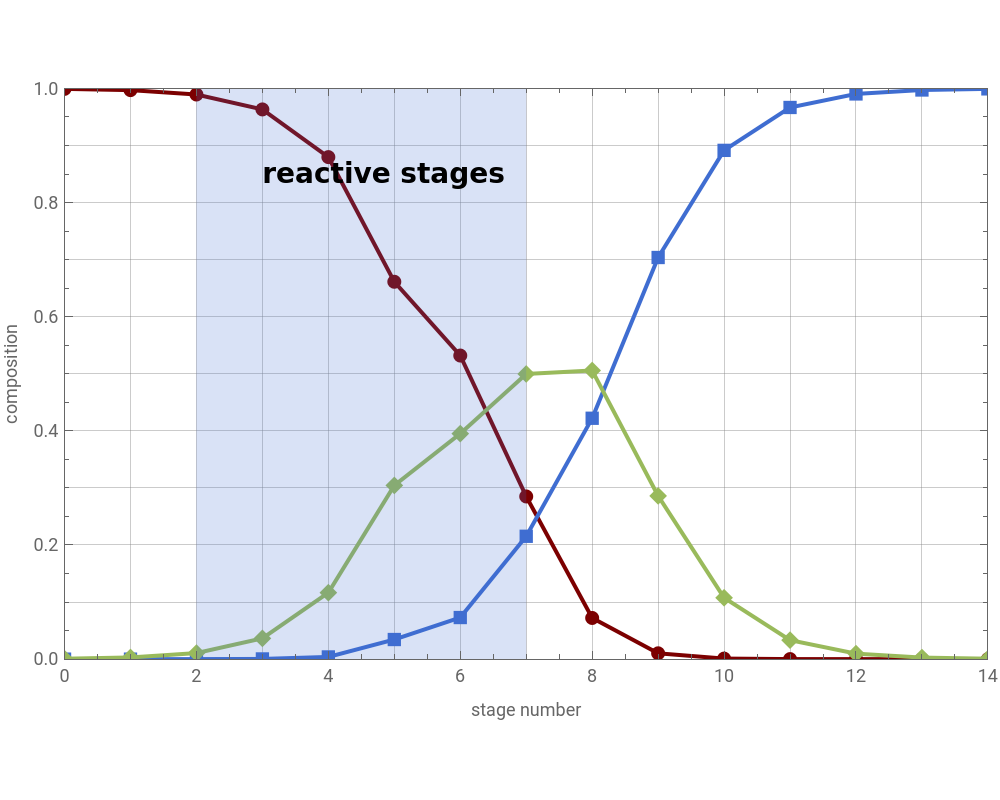
Plot 2: ternary diagram (equilateral triangle) of the liquid composition profile, A at bottom right, B at top, C at bottom left
TernaryListPlot[{Table[{x1[i],x2[i],x3[i]},{i,0,1}]/.sol,(*rectifyingend:stages0and1,non-reactive*)Table[{x1[i],x2[i],x3[i]},{i,7,14}]/.sol,(*stages7to14,towardsthereboiler*)Table[{x1[i],x2[i],x3[i]},{i,2,7}]/.sol},(*reactivestages2to7*)Joined->True,(*connectconsecutivestages*)PlotRange->All,(*showthewholetriangle*)PlotMarkers->Style["*",18],(*starmarkerateverystage*)GridLines->Automatic,(*defaultternarygrid*)PlotStyle->{{Thick,RGBColor[.49,0,0]},{Thick,RGBColor[.49,0,0]},{Thick,RGBColor[.25,.43,.82]}},(*darkred=non-reactivesegments,blue=reactivestages*)Method->{"Backdrop"->LightGreen},(*lightgreentrianglebackground*)Epilog->{Darker@Magenta,PointSize[0.025],Point[{0.,0.,1.0}]},(*magentadot=feedcomposition(xA,xB,xC)=pureC*)FrameLabel->{Style["A",18,Darker@Green],Style["B",18,Darker@Green],Style["C",18,Darker@Green]},(*cornerlabels*)AxesLabel->{Style["A",Italic],Style["B",Italic]},(*italicaxislabels*)LabelStyle->Directive[Bold,16],(*bold,largerlabelfont*)TicksStyle->Black,(*blackticklabels*)ImageSize->{400,400}(*imagesizeinpixels*)]
Key results
Key results
The following cell collects the main performance figures from the solution sol. Evaluate it after the column has been solved.
Key performance figures computed from the converged solution sol
Discussion
Discussion
Main result
Main result
Reading the profiles
Reading the profiles
Where the reaction takes place
Where the reaction takes place
Close to chemical equilibrium
Close to chemical equilibrium
Influence of the reflux ratio
Influence of the reflux ratio
◼
R = 7 (the case shown): conversion 99.93%, vapor flow 400 kmol/hr.
◼
R = 3: conversion 99.74%, vapor flow 200 kmol/hr. Halving the boil-up costs only about 0.2 percentage points of conversion.
Even a low reflux ratio therefore gives better than 98% conversion and purity, and a value of R between 3 and 7 looks like a sensible compromise between product purity and energy consumption. Since s = R + 1 is tied to R here, changing R also changes V = 50 (R + 1) and L = 50 R.
Model limitations and numerical remarks
Model limitations and numerical remarks
◼
The model assumes ideal vapor-liquid equilibrium with constant relative volatilities, equilibrium stages and no energy balance. Neglecting heat effects is less restrictive for olefin metathesis than for most reactions because the reaction is generally close to thermoneutral, and constant molal overflow is consistent with the mole balance because the reaction conserves moles. Liquid holdup, hydraulics and catalyst loading are represented only through Da.
Possible extensions
Possible extensions
Natural next steps are to vary the feed stage, the reactive zone and the number of stages, to add an energy balance and non-ideal vapor-liquid equilibrium, to decouple s from R so that D and B can differ, to use a finite-rate kinetic model with explicit liquid holdup, and to plot the profiles on a logarithmic scale to examine the product impurities.
CITE THIS NOTEBOOK
CITE THIS NOTEBOOK
Reactive distillation of a ternary mixture: olefin metathesis, 2C <=> A + B
by Housam Binous
Wolfram Community, STAFF PICKS, November 4, 2026
https://community.wolfram.com/t/28495