I did a project in a math class last semester on the value of math/computation and thought it would be fun to share!
Problem Statement/Motivation
Problem Statement/Motivation
What are emotions? Beginning even with the definition and going onwards, emotions are complicated. There are many disagreements in the field and proposed theories to how emotions work and what their components are; we will expand upon this in a later section. For now, emotions are just brief reactions to some sort of stimuli; they are not the same as feelings or moods, however they can contribute to those.
There are 3 generally agreed upon components of emotions: cognitions, behaviors, and physiology. Cognitions refers to how one perceives an event. Two people may perceive an insult differently--one may take it personally and the other may take it as a joke. Evidently, they will have different emotional responses based on how they perceived the event. The next component is behaviors--the observable ways that someone expresses their emotions; a great example of this is facial expressions. Lastly, physiology refers to physical symptoms of emotions evident in the body; this includes things such as cortisol to indicate stress, serotonin to indicate happiness, and increased heart rate (which can indicate a variety of things).
Even with this basic definition comes many debates--in what order do these components converge? Do we have a physiological reaction (nervous system--sweating, heartbeat, etc.) then cognitive processes to interpret that reaction and inform our behavior (known as the James-Lange Theory)? Does our behavior, specifically our facial expressions, impact our cognitions and physiology (known as the Facial Feedback Theory)? Do our cognitions interpret a stimulus and then simultaneously send physiological and behavioral reactions (known as the cognitive appraisal theory, we’re going to look at this one more in depth later on)?
Even with this basic definition comes many debates--in what order do these components converge? Do we have a physiological reaction (nervous system--sweating, heartbeat, etc.) then cognitive processes to interpret that reaction and inform our behavior (known as the James-Lange Theory)? Does our behavior, specifically our facial expressions, impact our cognitions and physiology (known as the Facial Feedback Theory)? Do our cognitions interpret a stimulus and then simultaneously send physiological and behavioral reactions (known as the cognitive appraisal theory, we’re going to look at this one more in depth later on)?
My hope is that maybe computer science could help us find a solution to this debate or a more universal model. There are benefits from considering things from a computational standpoint--in introduces new goals and parameters for a model. For example, to create an “optimal” computer science model, one must consider time and space complexity. The emotional model in this case must be able to optimize its computing speed and the amount of memory it takes up. These create new ways to weigh different theories. For example, maybe the Cognitive Appraisal theory would be a more efficient model from a computational standpoint since it parallel propagates physiological and behavioral reactions; making it output faster by using parallel processing. An important part of time complexity is how a model can scale up; perhaps with simple situations different models will execute their computations in the same amount of time, but as the complexity of the situation (as it usually is in the real world) increases, then the models will behave with drastic differences in speed. In this case, the Facial Feedback Theory may be better--it is less complex in its levels of computation and also would take up less memory since it doesn’t compute as many parameters (or does it? Facial recognition is a complicated machine learning problem, it depends on what we consider as internal to the system and what we must compute in a model--maybe the input is an already classified facial expression).
No matter these specifications, in general, computational models are an important step in helping us create good models of emotion and may even be able to expand upon existing models in order to further the field.
Representation: Systems POV
Representation: Systems POV
Emotions have a complicated definition--at its simplest, emotions can be regarded as an immediate, polarized reaction to something. They can be represented from a systems theory perspective as a system containing multiple components--which are all interconnected and evolve simultaneously as their own systems--that contribute to an overall emotion expressed.
Theory
Theory
Systems theory expands on the basic components of emotions defined above, representing these components in a jumbled system with all components interconnected. The idea in systems theory is that there is usually not one direct cause or independent-dependent variable relationships; these systems are constantly evolving and influencing each other--its a messy, casual web.
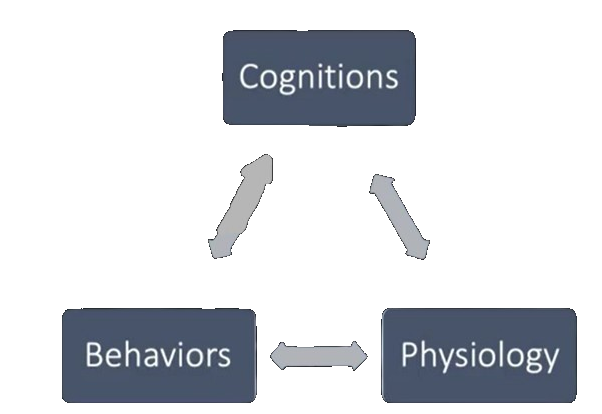
(Robins 2020)
Implementation
Implementation
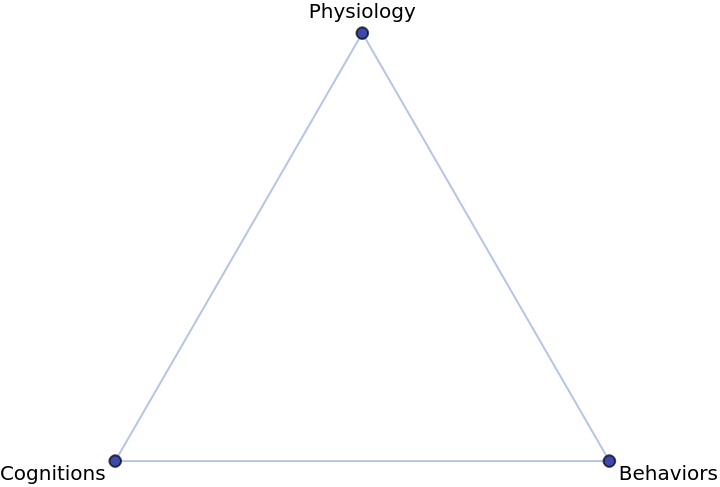
In order to create a graph representation of the system without losing the continuous causal effect that systems theory sports, a complete partite graph will be used to represent this system. Using this graph, the systems rejection of single independent-dependent variable relationships is maintained while quantifying the relationships between components as detailed as possible. Each vertex will represent the overall status, rating, or output from that component. The edges will represent the influences a component has to another and they’re weighted--some components may influence others more. Another interesting way to think about it is that each component is a way to measure emotions, usually we observe peoples emotions through their behavior and tests for determining one’s emotional state try to measure all 3+ factors to get a wholly representation of one’s emotions.
Defines all components to be discussed, so far we’ve only explored the first three:
In[]:=
components={"Cognitions","Behaviors","Physiology","Enviornment","Health","Job/Career","Relationships"};
Utilizes these components to define a set of vertex labels for graph analysis:
In[]:=
vertexLabelsFull=VertexLabels->Table[i->components[[i]],{i,Length[components]}]
Out[]=
VertexLabels{1Cognitions,2Behaviors,3Physiology,4Enviornment,5Health,6Job/Career,7Relationships}
Defines complete graph with k=3:
In[]:=
basic=CompleteGraph3,vertexLabelsFull,
Out[]=
Edge Weights
Edge Weights
Now lets add weights to our edges and expand this basic model! This expands on the systems theory model by assuming that the causation of different components to one-another can vary. Some relationships aren’t fully explored yet, so it wouldn’t be fair to wrongly attribute an equally casual weight to them as the others. Important to note, these weights are self-assigned based on general findings from literature and there hasn’t been enough research done yet to make great generalizations. However, this can still be used to illustrate the basis for a weighted framework that could be refined later on. One could even treat this graph as a neural network and tune the weights on a representative sample of output emotions.
◼
Physiology to cognitions: has a complicated relationship with learning, yet there is a clear relationship between the two (Wirth et al. 2011); the weight attributed will be 0.7.
◼
Physiology to behavior: struggle in field to quantify the relationship between the two (Marek et al. 2022); the weight attributed is left at 0.2 for lack of reliable results.
◼
Cognitions to physiology: experiments with stress illustrate perceived stress leading to production of higher cortisol levels, possibly illustrating a generalizable relationship between perception (cognition) and physiology; the weight will be 0.8 (Blankenship et al. 2019).
◼
Cognitions to behavior: cognitive appraisal theory (and the one explored in the next section) states that the perception of the event informs how one responds (Ortony et al.); the weight will be 1.
◼
Behavior to physiology and cognition: in a study done on how suppressing behavioral reactions while watching a movie will impact physiology (cardiovascular system activity) and self-reported (aka perceived) emotions, researchers found a strong correlation between suppressing reactions during valanced films, perceived emotions, and physiological responses (Gross and Levenson 1997); the weight will be 0.75 for both.
Defines Edge Weights:
In[]:=
edgeWeighList={1,1,0.8,0.75,1,0.75,0.68,0.2,1};
Defines component graph where edges between components are distinct; multigraph:
In[]:=
IndexEdgeTaggedGraphDeleteDuplicates[Flatten[Table[ab,{a,3},{b,3}]]],VertexLabels->Table[i->components[[i]],{i,Length[components[[;;3]]]}],EdgeWeight->edgeWeighList,EdgeLabels->"EdgeWeight",
Out[]=
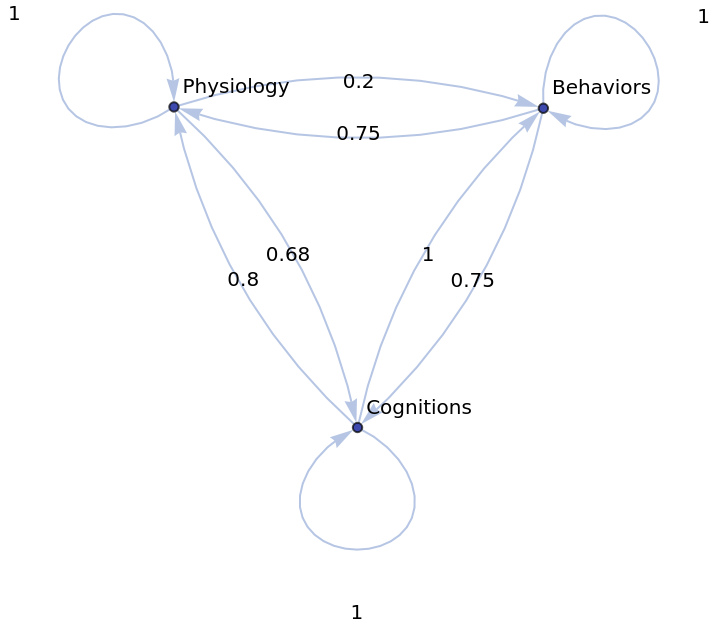
It’s interesting to see how such an abstract system can be quantified in such specific terms--vertexes and edges and weights to represent it all. Each vertex will be constantly evolving and its outputs will be propogated to other evolving components with its outputs (signals) dampened by the edge weights.
Expanding Model
Expanding Model
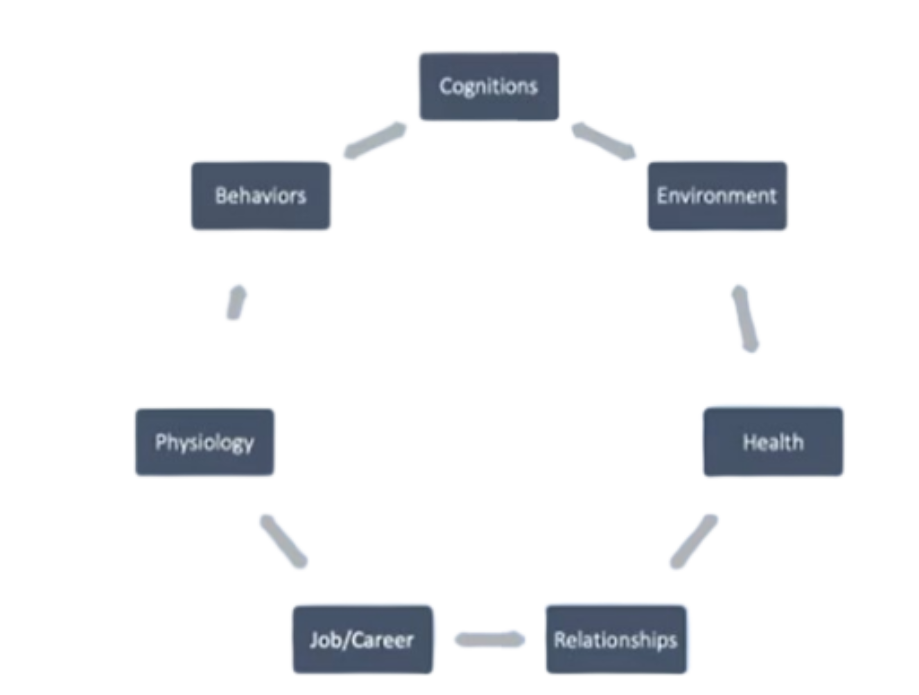
Now, we need to consider more factors that may be part of this model and influence our emotions; a very-system centric approach to emotions will emphasize this. We can consider other factors--for example, we can consider the influence of our overall health on cognition, behavior, physiology, etc.
This is what this model looks like in systems theory--we’re going to try to translate it into a graph that is possible to utilize for computations. (Robins, 2020) As an example of this larger interconnected system, if one has a job they’re unsatisfied with or had a bad day at work, their perception of their job would be darkened. In terms of vertices and edges, the value of the vertex “Job/Career” would be lower, meaning as it interacts and feeds into other components, such as physiology, it will have a negative impact on their outputs as values are propogated across edges.
Defines and labels a complete graph involving all components of the system:
In[]:=
full=CompleteGraphLength@components,vertexLabelsFull,
Out[]=
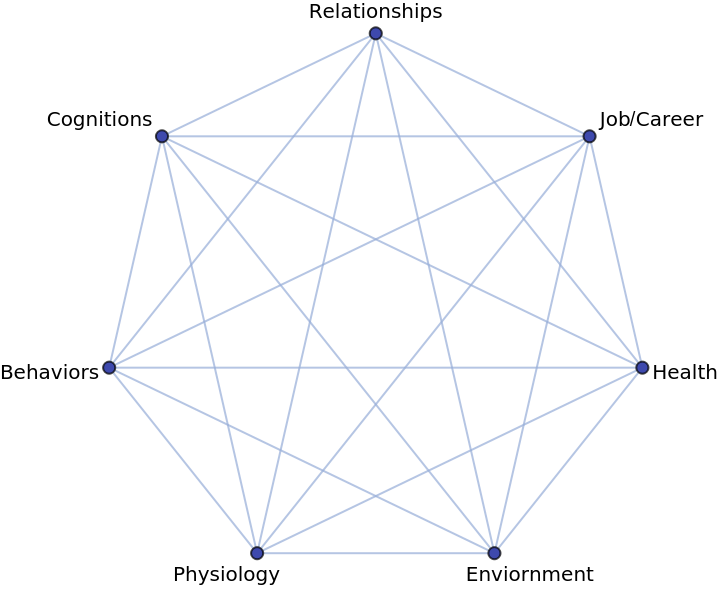
Interesting to note: this is a complete graph (with k=7) and it has subgraph of the basic components of emotions model (from above).
Highlights basic component graph, the subgraph, in the more complex component graph:
In[]:=
HighlightGraph[full,basic]
Out[]=
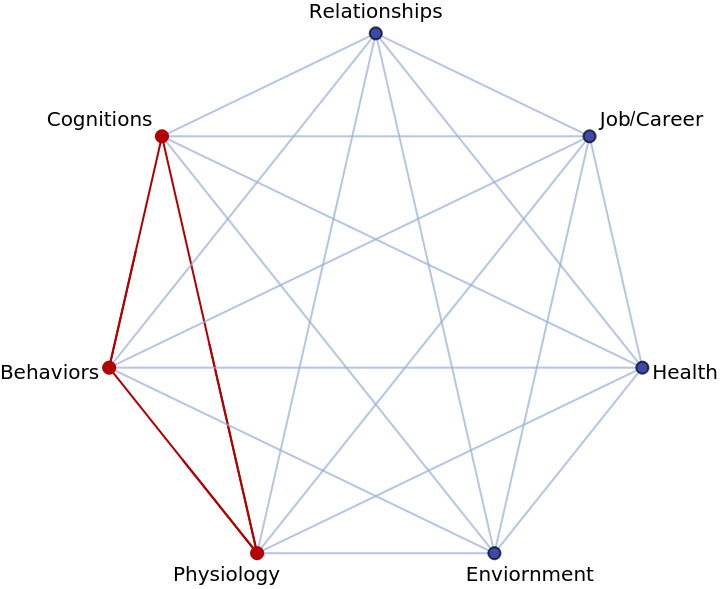
One last interesting observation regarding these systems--in a way, they resolve some of the debates regarding the order that components of emotions are computed. Maybe each component is pseudo-constantly being computed and those outputs are constantly being fed to other systems and they’re all evolving in this very entangled way instead of a very sequential model. Maybe these models inform to us that we need to get out of the mindset or expectation that emotions are sequential processes--for certain, computers and brains aren’t (at the syntactical level).
Representing our world
Representing our world
To expand on this model and provide more interesting insights, I categorized these factors influencing our emotions into external vs internal factors; in another sense--the things we can’t directly control (internal factors) compared to the things we can tangibly control (external factors). Perhaps this perspective may reap some computational benefits as well--all to see ahead!
Separating factors
Separating factors
This factor separation is essentially a complete bi-partite graph.
Ensuring connectivity of internal factors
Ensuring connectivity of internal factors
However, there is a problem with this representation: it does not reflect the direct relationship/interactions the internal factors have with one another. For external factors, it is sensible to keep their interactions separate--each change in external factors must be processed and perceived by mental, internal proceses.
formGraph[n] with n=4 and formatting:
Increasing external factors
Increasing external factors
Going back a step, its important to address the abstraction that occurs in this model. In reality, our emotions are influenced by a great, entangled web of experiences and opportunities that grows as time progresses (as we go through life, we build knowledge and connections to the external world). Everything from one’s dog to the color of their couch may influence how one feels.
In order to approximate understand the behavior of this constantly growing system--visualizations prove helpful. Below is a visualization of the graph, the adjacency matrix, and edge list as n grows larger.
It’s interesting how after a relatively few number of external factor additions, the emergent shape becomes apparent--the graph shape changes drastically within the first couple steps and then begins to converge to a specific shape. Perhaps this is synonymous with the way that there is a "rapid proliferation" of neural connections within the first couple of years life that eventually calms down. We learn a lot about the world in our first couple of years of existence! The heavy weight placed on the primary developmental years of children is explained with this too--our early experiences, few in number, can have drastic impacts on our emotions; explained from a mathematical perspective: the first couple of years determined the shape of the graph, the overall emotional system of the person.
This value placed on early developmental years can also be explained in terms of network resilience. With little other experiences/external factors, its evident that each edge holds much greater of an impact on the internal factors of the system. In essence, the system is a lot less resilient to fluctuations in one external factor because there are little other external factors influencing emotions. The great brain plasticity that characterizes early years of development as well illustrates the variability of internal factors cognition and behavior as well.
This value placed on early developmental years can also be explained in terms of network resilience. With little other experiences/external factors, its evident that each edge holds much greater of an impact on the internal factors of the system. In essence, the system is a lot less resilient to fluctuations in one external factor because there are little other external factors influencing emotions. The great brain plasticity that characterizes early years of development as well illustrates the variability of internal factors cognition and behavior as well.
Here is an example of such a system with minimal factors that may lead to a lack of network resilience as explained above:
Creates a system with 3 external factors
Infinite external factors
Infinite external factors
Mathematically, this infinite increase in external factors could be represented as the limit as n-> ∞ of the second group of a bi-partite graph (we’ll ignore the internal factor connectivity for simplicity here):
The edge list function for this graph can be described as 3+3n; 3 edges connecting the internal factors and then 3 edges spurring from each external factor to the internal factors.
Considering the edge list function of this graph, the graph does diverge:
Considering the edge list function of this graph, the graph does diverge:
Yet, the graph still converges to a form. With 1000 external factors, an emerging shapes appears--a sphere.
Discrete Categories (as an abstraction)
Discrete Categories (as an abstraction)
For the sake of simplicity and computation, we cannot regularly express an infinite number of external factors. This brings us back to where we started--dividing our external factors into 4 basic categories. As we saw above, everything is a system within a system, but most of this complexity can be abstracted into the 4 basic categories outlined above: relationships, job/career, health, and environment.
Calculations are more efficient with smaller system
Calculations are more efficient with smaller system
Another benefit to this external v.s. internal factor representation of systems is the decreased computation time required of a graph with less edge density. This is an important consideration--we need to be efficient with our computations, even if they’re emotions. Let’s analyze the time efficiency of both these systems!
Graph Construction
Computes and times the construction of both types of graphs:
As is evident, on initial evaluation, the modified bipartite graph is slightly faster in computation. However, this value fluctuates greatly on further repetitive evaluations.
Plots the time for graph construction for each re-evaluation--1 to 100.
It’s evident that the timing for graph construction fluctuates greatly--there isn’t a clear difference in timing for graph construction evaluation between the two types. It appears that the bipartite graph tends to rise higher than the complete graph, but it isn’t distinct enough to make a generalization.
Graph Path Searching
Now let’s analyze graph computations to see if we can find some more conclusive results!
Computes and times path searching on both types of graphs:
Here is a visualization of the paths found in a subgraph of the original graphs:
Constructs a smaller version of both graphs, then highlights the paths on both
Now let’s look at this computation time repeated to evaluate whether these results are stable.
Plots the time for graph searching for each re-evaluation--1 to 100.
As is evident, on initial evaluation, the modified bipartite graph is slightly faster in computation when attempting to traverse the graph through path searching. Interestingly, unlike graph construction, this difference in timing is consistent even as the computation is repeated. This shows the clear benefit of this system when considering time complexity--its far more efficient to perform computations on this graph than the complete graph. Separating internal and external factors allows us to more efficiently and regularly control our emotions, there’s less things to consider.
Cognitive Representation: Cognitive appraisal
Cognitive Representation: Cognitive appraisal
How do brains process emotions? How do they respond/react? What is the basic structure?
Specifically, Ortony et al.’s model focuses on the theory in which changes by “things” in our world cause emotions to occur. The “things” are events, agents, and objects; events have consequences, agents have actions, objects have qualities. Often, a change is perceived as blend of these different “things” (complex emotions), however, for our cases, lets begin with examining each of these individually (basic emotions).
The core idea of this theory is that how we perceive an event leads to an experienced emotion. For example, one’s car may break down and the event of it breaking down may not be desirable for the goals the person (for example, getting to work on time), eliciting a negatively valanced response. Additionally, the car could be conceived as an agent, where the action is its failure. This action would not meet the standards of the person, where they expect their car to work properly and reliably, also eliciting a negative response.
A specific term to keep in mind as we move along is emotional valence--it refers to the primitive positive or negativity of an emotion. It, in itself, is the primitive (basic) emotion structure; this primitive real number is then interpreted in context--of the thing being perceived and (sometimes) what type of “thing” that thing is. We will explore this idea in the next sections.
Events
Events
Like previously mentioned, events have consequences. The consequences of an event are evaluated from how greatly they meet ones goals. In this way, emotions are very person-dependent, which makes sense. One person may love piano and enriching their education (goals), making them experience happy emotions when going to a recital (event) because it will allow them to celebrate and cherish the art (consequence). On the other hand, their little sister may hate piano and would rather be outside playing and having fun (goals), leading them to experience negative emotions when at the recital (event) because it wasted time that they could’ve spent outside playing (consequence).
Despite the person-dependence of this model, we can still generally represent an emotion conceived from an event as a relationship between fulfillment of goals and satisfaction. For our purposes, it is a linear relationship.
The “desirability” of an event (prospective or already experienced) refers to how greatly an event fulfills goals.
The y-axis of each plot mirrors emotional valence model, where positive ratings on this axis correspond with positive emotions that are associated with this type of perception. To further reiterate, each type of perspective on the world gives rise to valanced (positive to negative) reactions. These reactions, based on context, form different emotions. In this way, the raw desirability of an event is the “basic” form of an emotion and the more complex emotions that can arise may be things such as joy. Reactions can also be based on prospective events, such as the possibility that one may get into a car crash and then feeling relieved that the prospective event didn’t occur; this is a positive reaction to a confirmed-outcome prospective event.
In this way, the definition of an event is more complicated--it can be a prospective event or an experienced event; prospective events can be confirmed as to their outcome or remain ambiguous. Depending on this type of event, the context, different emotions come to rise. However, there is a basic fundamental structure that underlines all of these context-dependent reactions: the valence of the emotion.
Plots relationship between Fulfillment of Goals and the desirability of the event :
Agents
Agents
In reference to agents, as previously mentioned, valanced emotions are proportional to how greatly an action of an agent meets the standards of the person. I will briefly explore different ways this adherence to standards may be computed in a computational model. For now, here is a way to visualize the relationship identified by Ortony et al.
The “approval” of an action is the variable defined to represent with how greatly it corresponds to the standards of a person. Standards are also defined loosely--any expectations, moral or otherwise, a person may have.
For example, someone may feel shame if the actions of the agent do not meet their standards and they have a relationship to the agent. More concretely, if someone’s child starts crying in the middle of a silent lecture, the person may feel shame as the outburst does not meet their standard of being quiet and appearing respectful (“non disruptive”) to the lecturer, even if the outburst wasn’t theirs. Now, this is entirely person dependent, others may not have a strict adherence to such a quiet, respectful demeanor or may have a different definition for what “respect” may mean--taking care of a crying child isn’t really a disrespectful or controllable duty.
Plots relationship between how the actions of an agent meet standards to the positively or negatively-valanced emotion:
How to measure standards being met?
How to measure standards being met?
The question now is, how can one quantify to what extent their standards are being met?
One possible way is to visualize the standards someone may have towards a particular situation as an n-dimensional space. For simplicity, lets consider a 3 dimensional space with the parameters kindness, generosity, and honesty. The three parameters symbolize the three characteristics of an agent’s actions that the person most greatly values, top three parameters for standards.
These parameters would have values, the person has standards for how much kindness, generosity, and honesty an ideal action would have:
And all actions committed by agents would be evaluated by how closely their parameters resonate to the ideal standards of the person. For example, an input to this calculating model could be {0.2, 0.8, 0.9}: 0.2 degree of kindness, 0.8 degree of generosity, 0.9 degree of honesty. But how would we calculate the difference?
These types of formulas are known as distance formulas--to compute the distance between 2 points. Some work with n-dimensional vectors and some may only work with 2d vectors, such as the Pythagorean Theorem. An example of a distance formula that works in an n-dimensional space is the Manhattan Distance formula--it calculates the distance between 2 points by finding the difference in each dimension. This formula can be used to compute how far away (the distance) an agents actions are from the standards of a person, no matter the number of standards that must be included in the model.
Computing the Manhattan Distance for the above example gives us:
Computes Manhattan Distance on sample data:
Scaling it to - 1 to 1 scale gives us the x-coordinate of the plot above! This is achieved by considering that the maximum distance between 2 points in each dimension will be 2, since each plane is scaled from -1 to 1. Summing this across each dimension will get us our maximum value from the manhattan distance function.
Scales computed Manhattan Distance:
Visualize point on earlier plot:
Utilizing the manhattan distance, we can scale infinitely complex standard systems (like the ones humans really have) to our 2d cognitive appraisal representations.
Objects
Objects
The last field of perception is the most simple--it pertains to how appealing the characteristics of an object are to a person. Perceiving things as objects causes simple emotional reactions--“love” and “hate”. As a concrete example, if one sees an “ugly” baby, one may feel hate because its characteristics are not appealing to the person.
Plots relationship between how an objects’ properties alignment with preferences correspond to the positively or negatively-valanced emotion:
Combination
Combination
The beauty of this representation is that it illustrates both the valanced nature of emotions along with the fact that language is simply an abstraction of a complex, possibly numerically-based, nurture of emotions
As a comprehensive review, here is an example list of some of the positive and negatively based emotions that may be elicited as a result of a cognitive computation:
◼
Event Reactions: gloating, resentment
◼
Agent Reactions: pride, reproach
◼
Reproach refers to an “expression of disapproval or disappointment” (Oxford Language)
◼
Object Reactions: Love, Hate
Now we get to the fun stuff! Some times --we perceive something from different perspectives, as previously explained. To further elaborate, Ortony et al. identifies gratitude and remorse as a combination of an agent and event reaction. For some clarity, remorse refers to a “deep guilt for a wrong committed” (Oxford Languages)--this can be both an event and an action committed by an agent.
Now, to computationally represent different emotions that may arise from this model!
Defines parameters of emotions from scales of (-1, 1):
And here is a fun playground to visualize these emotions on a 3d plot. In a way, this space is an abstract representation of our perception of the world around us--based on events, agents, and objects--and how emotions may lay in this complicated world.
Visualizes these points and allows for interaction with user:
Takeaways
Takeaways
It’s interesting to note that most of these emotions stick along their one axis. However, representing Ortony et al.’s theory in such a way allows expansion of theory in broader ways. Previously they only identified emotions that would stick to one perception of an event or emotions that would represent a combination of agent and event perspectives. This 3d space implies that there’s more emotions out there that can be quantified in this way--we just have to find them.
Another interesting idea is that usually, on a day-to-day basis, humans feel more than one emotion at a time. This 3d space allows for that complexity in how humans feel emotions--based on their own complex systems. What if something meets their goals but is against their standards--they could fulfill their goal of being rich by winning a million dollars, but in a very immoral way; someone who values actions based on morals would say no. Why? There’s hope of a prospective good event but there’s also greater shame of acting immorally. Perhaps one of the greater meanings of this model is that it can even give us insight as to how we make decisions when we have complicated allegiances; perhaps being rich is a goal but not as important as a goal as the standard of acting morally is (|-1| > |0.8|)
Plots the example situation in relation to other emotions:
Even beyond a simply conflicting situation, in real life we usually feel multiple emotions at once. If our significant other has an important performance, we could feel love for a person, as an object, for their appealing characteristics (maybe its kindness or confidence for being on stage) and feel pride from their actions as an impressive performer.
Plots the example situation in relation to other emotions:
Another thing to consider is that the points labeled in this space are simply words in the English language that represent a certain emotional state. It is very plausible that there’s a plethora of other distinct emotions that just aren’t expressed in the English language (but perhaps in other languages) that may be more complicated--that is, that they are valanced in multiple dimensions. Perhaps, in the future, one could use this model to find new distinct emotional states to incorporate into expressible English language by looking at distributions of peoples emotional states, with respect to this model, and finding any distinct communities or clusters.
Application: Affect Heuristic
Application: Affect Heuristic
Now that we have an understanding of how to represent emotions, lets look at how emotions can influence our cognitions (and how our cognitions can then influence our behavior/decisions again), furthering the positive feedback loops and continuous casual structure illustrated by the systems theory conceptualization. The Affect Heuristic is a brain heuristic that illustrates how emotions can impact and impair our decision making. A heuristic, generally, is a shortcut a brain takes in order to make a computation more time efficient (the same as in computer science and game theory). Specifically, the affect heuristic explores how the brain uses past related experiences and the emotional connotation those experiences have to inform present decisions. Concretely, consider the situation where someone broke their leg while biking when they were younger. When trying to decide whether or not to bike later, as an adult, the affect heuristic says that the brain will consult a set of all past experiences, identify experiences that are similar to the current decision at hand, and use how the person felt in that moment to inform its current decision; the brain makes decisions that primitively avoid pain. In short, if one had negative-feeling experiences with something in the past, they’re more likely to avoid that pain again in the future, despite the fact that the experiences may not be representative of the true risk involved with pain from an experience. In reality, falling off a bike and breaking a leg is not highly probable, yet the affect heuristic shapes behavior to act like it is.
Lets go through another example to create a computational method of representing the affect heuristic. In this situation, a person is deciding whether it would be safe enough for them to lock their bike outside. We’re going to compare the decision made using only statistics of people’s bikes getting unlocked (logical) to decision made with affect heuristic (emotional).
Emotional Approach
Emotional Approach
To begin the emotional approach to this decision, I start by defining our representation of a past experience: {Key words (search terms) pertaining to experience, representation of emotion}. The representation of the emotion will be similar to a representation of valanced emotion in response to an event, as the previous section defined, a real number from -1 to 1.
In order to achieve this, I need some helper functions to create a brain/set of “experiences”
Defines to function to get key words related to an event/experience:
Defines word variable: general list of English words
Defines keywords/representation for specific instant we are analyzing:
We need to stimulate a brains representation of experiences, so I define a set, initialized with a random experiences (nouns and verbs) and a random emotion.
Takes a random sample of words from all words (which represent ideas) in English dictionary and assigns random real from (-1 to 1) to each:
Now, we need to stimulate our new decision (related to locking a bike) that will be affected by the affect heuristic. When one is faced with a decision, their brain utilizes the affect heuristic to quickly make a decision by sampling past outcomes from similar experiences. I simulate this by queueing from the full experience set (of words) all the experiences (synonyms/related words) related to the decision and sum each of the valanced reactions. This effectively surveys past experiences and uses a representative sum of such experiences to make a decision about a new/prospective experience.
Selects situation words that are in the total experience set and averages the valanced reaction values:
Now that we have a survey of past experiences, we need to translate this into a binary yes or no. This will depend on the individual person’s threshold for a “yes”; another example of systems theory--this threshold is bound to be influenced by past experiences with family, friends, work, etc. that make them more/less trusting. For an unbiased POV, I set this threshold to 0. This means that whenever we have a net positive reception of the experience associated with an event, we will output a “1”, yes and vice versa.
Defines piecewise function to output result:
Computes result:
This is saying we should (positive perception) lock our bike and that it won’t be dangerous!
Logical/Statistical Approach
Logical/Statistical Approach
Lets now compare this to the mathematical approach to solving this problem. Common bike locks have 4 slots and 10 digits that can be scrambled to create a random code. We can use permutations to calculate the probability of someone unlocking a bike lock; each combination of the 10 digits in the 4 slots is a permutation and only one of them is the permutation that represents the person’s bike lock code.
Calculates probability of someone breaking into bike using permutations:
Whoa! This is a very small probability. Although there are many other factors to consider when computing this probability--such as the neighborhood (and related crime rates), the number of times a robber will attempt to break the lock before quiting, etc.--this still gives us a pretty reasonable (and simple) estimation of how likely it is that one’s bike would be broken into it. It’s immediately evident that for many people, this would be a logical risk to take--1/5040 is a relatively very small chance of demise. However, just like before, its still important to note individual thresholds for risk. Even setting a threshold for risk at being 1%--meaning that if the probability of demise is greater than 1%, the risk wouldn’t be taken--still proves it safe to lock a bike.
Proves above statement using inequalities:
Comparison
Comparison
Therefore, we can conclude that the first method--utilizing the affect heuristic--is a much less reliable source of decision making than sticking with the rather certainty of probability. The probabilistic approach, evidently, has much less bias attributed to it; it’s also a constant value, giving a decision a much more objective truth than the constantly changing heuristic approach (since everyone’s experiences are different). A subjective reasoning is not a reliable schema; this modeling illustrates the great emotions (and our perception of situations) can impact our behavior and decision making in real life situations. Maybe if one had a less negative view of locking a bike--despite maybe having one bad experience with it--by considering the objective perspective, they would be able to make more rational decisions--something that will aide us all in our complex society. In a similar fashion, this illustrates the importance of cognitive reframing and overall emotional regulation in order to make more rational decisions; if we can’t avoid our brain’s tendency to rely on heuristics in time-limited situations (possibly high-stress ones), we can at least try our best to minimize the error by regulating our emotions and ensuring we don’t have greatly valanced emotions when not needed. If we can regulate our brain’s tendency to utilize heuristics, maybe this model and example illustrates the importance of being aware of its impact. The statistical probability says a lot!
Discussions/Conclusions
Discussions/Conclusions
Generally, this project illustrates our simple capability to compute parts of an emotion. Importantly, it allows us to have more universal definitions of emotions that aren’t language-dependent. Instead, it moves us towards representing things mathematically--the (pseudo) universal language. Additionally, turning concepts into computational models allows us to expand on those models in our computational spaces--just like how turning a system into a graph allowed us to add weights and more nuance to the way components of emotions interact so that we can begin to demystify this complex and frequently debated field of how emotions work. As we get closer to creating accurate computational models, we will be able to train more emotionally intelligent machines and learn from them as well. Teaching a machine something is like teaching a baby from the moment it was born; if we learn effective ways to teach a computer how to compute emotions, maybe we can use that to inform our own social and emotional intelligence as well. Having emotionally intelligent machines is applicable in so many ways--better customer service, virtual therapy/mental health services, less dehumanization, etc. The possibilities are endless!
Works Cited
Works Cited
“Affect Heuristic - The Decision Lab.” The Decision Lab, https://thedecisionlab.com/biases/affect-heuristic. Accessed 8 Dec. 2023.
@mychalsimka, 11Eleven_twitter. “The Mathematics of Emotion (Part 1) | by 11Eleven_twitter @mychalsimka | Medium.” Medium, Medium, 20 Apr. 2017, https://medium.com/@MychalSimka/the-mathematics-of-emotion-part-1-6ba049a5b34d.
Nikolopoulou, Kassiani. “What Is the Affect Heuristic? | Example & Definition.” Scribbr, 28 Dec. 2022, https://www.scribbr.com/research-bias/affect-heuristic/.
Ortony, Andrew, et al. The Cognitive Structure of Emotions. Cambridge University Press, 1988.
Robins, Shani. Systems Conceptualization Lecture (Pt 1). 2020.
Robins, Shani, and Raymond Novaco. Systems Conceptualization and Treatment of Anger. June 1999.
“Science of Emotion: The Basics of Emotional Psychology | UWA.” UWA Online, 27 June 2019, https://online.uwa.edu/news/emotional-psychology.
Gratton, Caterina, et al. “Brain-Behavior Correlations: Two Paths toward Reliability.” Neuron, Cell Press, 4 May 2022, www.sciencedirect.com/science/article/pii/S0896627322003634.
Gross, James, and Robert Levenson . “Apa PsycNet.” American Psychological Association, American Psychological Association, psycnet.apa.org/record/1997-02518-009.
HC;, Wirth MM;Scherer SM;Hoks RM;Abercrombie. “The Effect of Cortisol on Emotional Responses Depends on Order of Cortisol and Placebo Administration in a Within-Subject Design.” Psychoneuroendocrinology, U.S. National Library of Medicine, pubmed.ncbi.nlm.nih.gov/21232874/.
HC;, Wirth MM;Scherer SM;Hoks RM;Abercrombie. “The Effect of Cortisol on Emotional Responses Depends on Order of Cortisol and Placebo Administration in a Within-Subject Design.” Psychoneuroendocrinology, U.S. National Library of Medicine, pubmed.ncbi.nlm.nih.gov/21232874/. Accessed 24 Mar. 2024.
CITE THIS NOTEBOOK
CITE THIS NOTEBOOK
Comparing computational representations of emotions (and related models)
by Zoya Brahimzadeh
Wolfram Community, STAFF PICKS, March 26, 2024
https://community.wolfram.com/groups/-/m/t/3147541
by Zoya Brahimzadeh
Wolfram Community, STAFF PICKS, March 26, 2024
https://community.wolfram.com/groups/-/m/t/3147541