Dynamics of a Lever and Water Level System to Generate Power
Dynamics of a Lever and Water Level System to Generate Power
The following derivations are based on the filed patent “A LEVER AND WATER WATER LEVEL SYSTEM TO GENERATE POWER” invented by James D. Rudd.
Dynamics of the System with a Fixed Container, Arm Hose and Outer Container
Dynamics of the System with a Fixed Container, Arm Hose and Outer Container
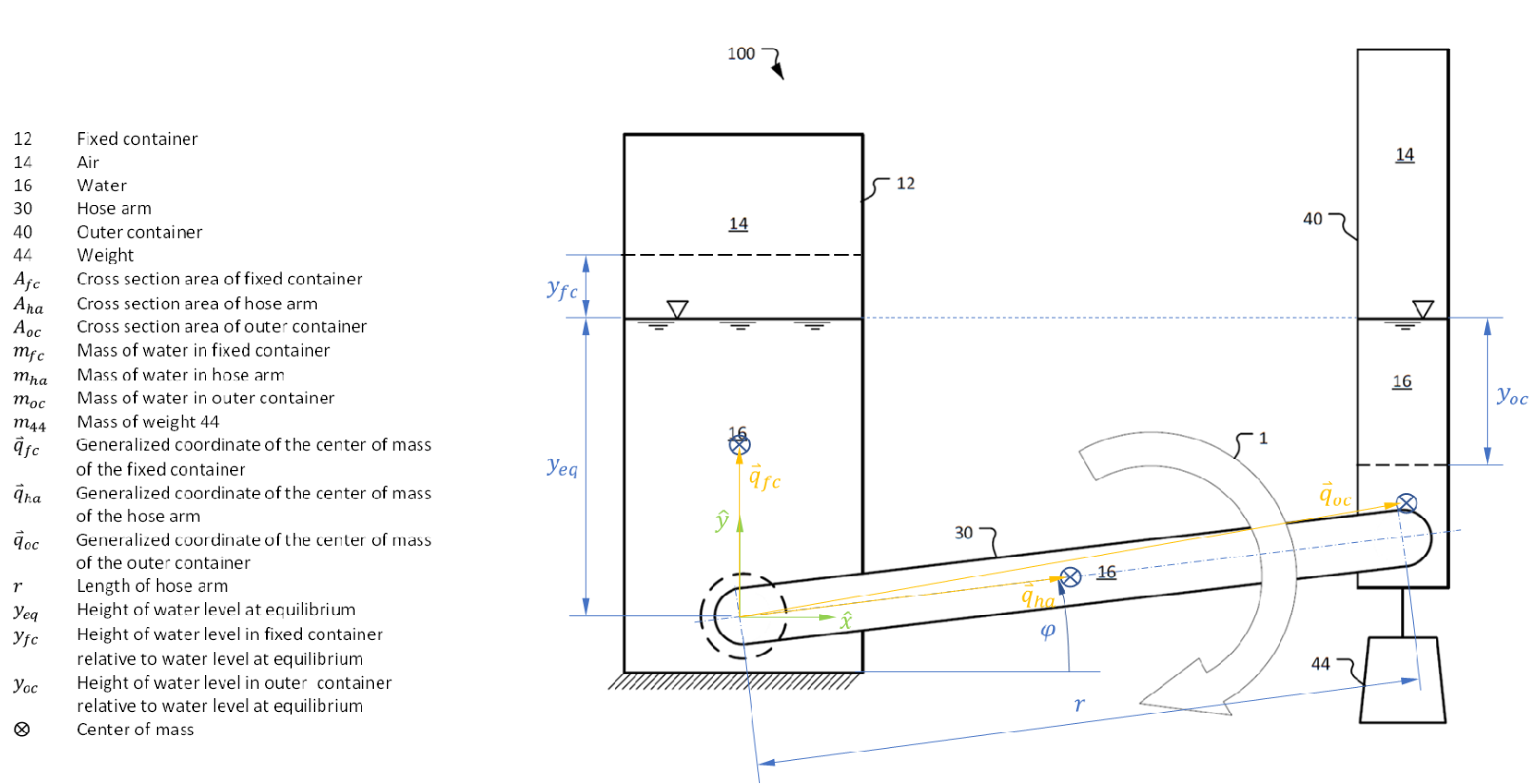
Generalized Coordinates for the Center of Mass
Generalized Coordinates for the Center of Mass
The generalized coordinates , and define the position of the center of mass of the fixed container, hose arm and outer container respectively. From Figure 1, these can be written as
q
fc
q
ha
q
oc
q
fc
1
2
y
eq
y
fc
0 |
1 |
0 |
q
ha
1
2
cos(ϕ) |
sin(ϕ) |
0 |
q
oc
rcos(ϕ) |
1 2 y eq y oc |
0 |
(
1
)The center of mass for the entire system can then be written as
q
cm
m
fc
q
fc
m
ha
q
ha
m
oc
q
oc
m
fc
m
ha
m
oc
(
2
)Velocity of the Center of Mass
Velocity of the Center of Mass
To determine the velocity of the system, the Generalized Coordinates (Eq. 1) are differentiated with respect to time. The time variant variables in the system are , , and ϕ. To simplify the notation, note that f(t) will be written as .
y
eq
y
fc
y
ha
t
f
q
fc
1
2
y
eq
y
fc
0 |
1 |
0 |
q
ha
1
2
ϕ
-sin(ϕ) |
cos(ϕ) |
0 |
q
oc
-r ϕ |
1 2 y eq y oc ϕ |
0 |
(
3
)Conservation of Mass
Conservation of Mass
The three masses in the system can be expressed as
m
fc
ρA
fc
y
eq
y
fc
m
ha
ρA
ha
m
oc
ρA
oc
y
eq
y
oc
(
4
)For this system the sum of all the masses remains constant at all times. Therefore the total mass flow in the system is zero.
m
fc
m
ha
m
oc
(
5
)The individual mass flows can the be expressed as
m
fc
ρA
fc
y
eq
y
fc
m
ha
ρA
ha
v
ha
m
fc
ρA
oc
y
eq
y
oc
ϕ
(
6
)Note that while is constant, if the water levels in the fixed and outer container are not at the equilibrium, there has to be flow through the hose arm. It will be assumed that the total flow in the hose arm has a mean velocity .
m
ha
v
ha
Simplification
Simplification
We can make a simplification by assuming that the water levels are at equal height at all time (neglecting the dynamics of the flow through the hose arm), then ==0. Then the conservation of mass can be expressed as
y
fc
y
oc
m
fc
m
ha
m
oc
ρA
fc
y
eq
ρA
ha
ρA
oc
y
eq
and be solved for .
y
eq
1
ρ
m
fc
m
ha
m
oc
A
fc
y
eq
A
ha
A
oc
y
eq
1
ρ
m
fc
m
ha
m
oc
A
fc
A
oc
y
eq
A
ha
A
oc
A
fc
A
oc
y
eq
1
ρ
m
fc
m
ha
m
oc
A
ha
A
oc
y
eq
1
ρ
m
fc
m
ha
m
oc
A
ha
A
oc
A
fc
A
oc
(
7
)Out[]=