In the textbook “Klassische elementare Analysis 1987. Max Koecher” the following elegant recurrence relation is proved for on p. 157: for
ζ(2n)
n+ζ(2n)=ζ(2k)ζ(2n-2k)
1
2
n-1
∑
k=1
n>1
The main purpose of this notebook is to proof the above recurrence relation inspired by [2]. But it was already known to Euler 1739, see E130 §23 and the Appendix.
We start with the partial fraction expansion of Cot:
https://en.wikipedia.org/wiki/Trigonometric_functions
https://en.wikipedia.org/wiki/Trigonometric_functions
Out[]=
The partial fraction can be rewritten as:
Out[]=
So (1) turns into the definition of the function :
This equation was known to Euler by 1739, see the Appendix.
f(x)
This equation was known to Euler by 1739, see the Appendix.
Out[]=
And here is a ComplexPlot of with the zero’s and poles on the real axis:
f(x)
Out[]=
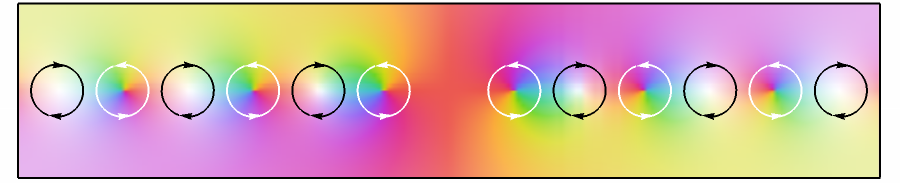
And Plot of for real :
f(x)
x
Out[]=
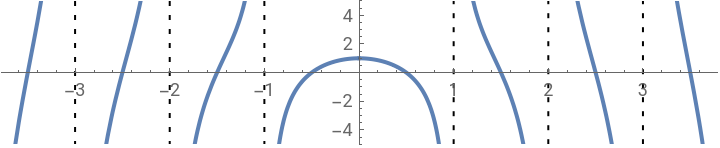
(2) can be written as an infinite sum:
Out[]=
and insert (4) into (3) to get:
Out[]=
The sums can be swapped, because is bounded ()
2n
x
2n
k
k,nϵ,x<1
Out[]=
The term can be extracted from the second sum and 2 from both sums:
2n
x
Out[]=
The second sum is:
Out[]=
And (7) can now be written as:
Out[]=
The cot has the following derivative:
Out[]=
Proof of identity (10):
In[]:=
FullSimplify[Activate[eqn10]]
Out[]=
True
f(x)
Out[]=
Proof of identity (11):
In[]:=
Simplify[ReleaseHold@eqn11/.f->Function[{x},πxCot[πx]]]
Out[]=
True
Now we insert the l.h.s. of (9) into (11) and extract the coefficients:
Out[]=
It can be solved for :
ζ(2n)
Out[]=
The building law is:
This recurrence relation was also known to Euler! See the Appendix.
This recurrence relation was also known to Euler! See the Appendix.
In[]:=
recurrencerelation[m_Integer?EvenQ]:=ζ[m]->Sum[ζ[k]·ζ[m-k],{k,2,m-2,2}]
2
m+1
Here Centerdot, . is used for non commutative multiplication, so you can see better, how the calculation is performed.
Example:
Out[]=
Allow commutation with Times:
In[]:=
%/.CenterDot->Times
Out[]=
In[]:=
Simplify[%]
Out[]=
Now the explicit recurrence relation is (*):
In[]:=
zeta[2]:=(*=/6*)zeta[m_Integer?EvenQ]:=zeta[m]=Sum[zeta[k]zeta[m-k],{k,2,m-2,2}]
ζ
2
2
π
2
m+1
Example:
In[]:=
Map[zeta,Range[2,14,2]]
Out[]=
,,,,,,
ζ
2
2
2
ζ
2
5
8
3
ζ
2
35
24
4
ζ
2
175
32
5
ζ
2
385
44224
6
ζ
2
875875
768
7
ζ
2
25025
In[]:=
%/.->/6
ζ
2
2
π
Out[]=
,,,,,,
2
π
6
4
π
90
6
π
945
8
π
9450
10
π
93555
691
12
π
638512875
2
14
π
18243225
Compare with built in Zeta:
In[]:=
Map[Zeta,Range[2,14,2]]
Out[]=
,,,,,,
2
π
6
4
π
90
6
π
945
8
π
9450
10
π
93555
691
12
π
638512875
2
14
π
18243225
Appendix: Euler E130 and the Cot series
Appendix: Euler E130 and the Cot series
Leonhard Euler, Princeps Mathematicorum.
Salutation in a Letter from 1745 by
Johann Bernoulli (1667-1748).
Salutation in a Letter from 1745 by
Johann Bernoulli (1667-1748).

S.P.D. salutem plurimam dicit.
https://scholarlycommons.pacific.edu/euler-works/130/
E130 De seriebus quibusdam considerationes (Considerations on certain series). Written 1739. Published 1750.
Euler factors a power series into an infinite product, applying it to, and evaluates a number of series using what look like trigonometric substitutions. He also applies this to the differential equation by recursion. Then he attempts to evaluate .
E130 De seriebus quibusdam considerationes (Considerations on certain series). Written 1739. Published 1750.
Euler factors a power series into an infinite product, applying it to
f'/f
zs'–s–sz+=0
2
s
ζ(2k+1)
There is an english translation:
https://download.uni-mainz.de/mathematik/Algebraische%20Geometrie/Euler-Kreis%20Mainz/E130RevisedVersion1.pdf
https://download.uni-mainz.de/mathematik/Algebraische%20Geometrie/Euler-Kreis%20Mainz/E130RevisedVersion1.pdf
In §9 Euler derives:
Euler writes the right side differently:
But it is the same:
The cot series appears with:
In §17 Euler derives:
and:
and:
and:
and:
In §22 Euler derives (3) from above:
but writes the r.h.s. as:
In §23 Euler writes down the recurrence relation.
https://scholarlycommons.pacific.edu/euler-works/130/
https://scholarlycommons.pacific.edu/euler-works/130/
euler[1] is A, euler[2] is B etc.:
It is the same as above (*):
It’s the same:
https://mathoverflow.net/questions/306898/a-recurrence-relation-for-zeta2n-reference-request
[1] G. T. Williams, “A new method of evaluating ζ(2n)“, Amer. Math. Soc, 60, (1953) 19--25.
[2] Max Koecher, Klassische elementare Analysis (1987) p. 157.
[0] Euler E130 §23 (Written 1739, published 1750)
[1] G. T. Williams, “A new method of evaluating ζ(2n)“, Amer. Math. Soc, 60, (1953) 19--25.
[2] Max Koecher, Klassische elementare Analysis (1987) p. 157.
[0] Euler E130 §23 (Written 1739, published 1750)
CITE THIS NOTEBOOK
CITE THIS NOTEBOOK
An elegant recurrence relation for Zeta(2n), Euler E130
by Oliver Seipel
Wolfram Community, STAFF PICKS, January 3, 2024
https://community.wolfram.com/groups/-/m/t/3094943
by Oliver Seipel
Wolfram Community, STAFF PICKS, January 3, 2024
https://community.wolfram.com/groups/-/m/t/3094943