Objective
Objective
◼
Introduce high school students to computational thinking, which includes problem analysis, decomposition, abstraction, and algorithmic thinking.
◼
Foster an understanding of natural laws such as competition, cooperation, and adaptation.
◼
Develop skills in problem-solving, critical thinking, teamwork, and resilience.
Core Principles
Core Principles
◼
Openness: Encourage students to explore, ask questions, and seek solutions.
◼
Competition and Cooperation: Use natural competition and cooperation to drive learning and achievement.
◼
Reward and Encouragement: Recognize and reward efforts and achievements to motivate continuous improvement.
Teaching Methods
Teaching Methods
1
.Project-Based Learning (PBL)
Project Selection: Offer a variety of open-ended projects for students to choose from based on their interests. Examples include developing solving a real-world problem. Decomposition: Guide students to break down their projects into manageable tasks, understanding the purpose and implementation of each. Implementation: Teach students to write code and use computational tools to complete each task and integrate them into a final project.
2
.Natural Law Framework
Teamwork and Roles: Assign students to teams where each member has a specific role (e.g., project manager, developer, designer). Encourage them to work together and learn from each other. Elements: Introduce healthy competition through hackathons, coding challenges, and project presentations where teams can compete for the best project or solution. Collaboration Opportunities: Facilitate collaboration between teams for more complex projects, promoting the idea that cooperation can lead to better results.
3
.Feedback and Iteration
Continuous Feedback: Provide regular feedback on students’ progress, highlighting strengths and areas for improvement. Iterative Process: Encourage students to iterate on their projects based on feedback, reinforcing the concept of continuous improvement.
Inspiring Ideas
Inspiring Ideas
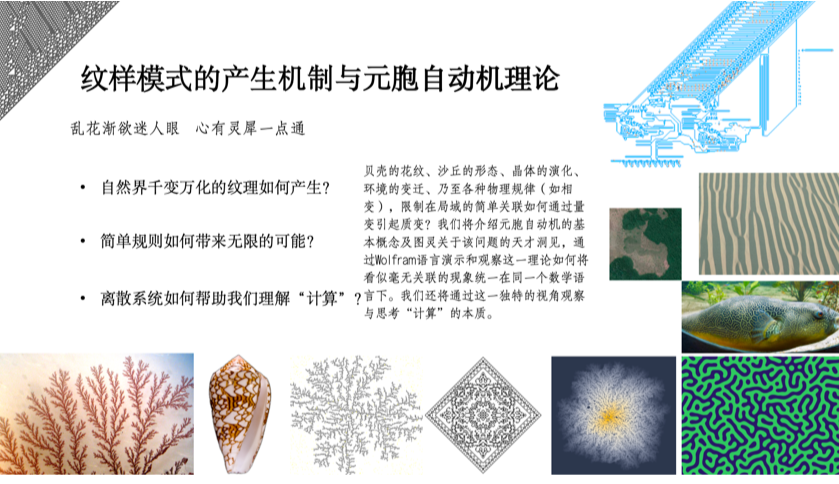
Pattern Generation with Cellular AutomataProject Description: Student teams design and implement a cellular automaton to simulate natural patterns like shell patterns, sand dunes, or crystal growth.Team Roles: Team members can divide tasks such as algorithm design, coding, data visualization, and result analysis.Learning Goals: Understand the basics of cellular automata and how simple rules can create complex patterns, while enhancing teamwork skills.
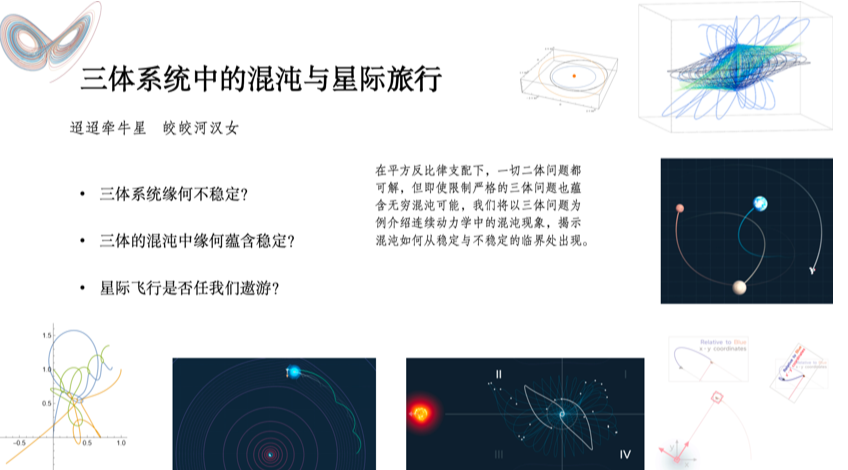
Three-Body Problem and Chaos Theory
Project Description: Student teams study the chaos phenomenon in the three-body problem, using programming to simulate the system and explore its chaotic behavior.
Team Roles: Team members can handle theoretical research, coding, result analysis, and report writing.
Learning Goals: Grasp the fundamentals of the three-body problem and chaos theory, improve coding skills, and strengthen collaborative efforts.
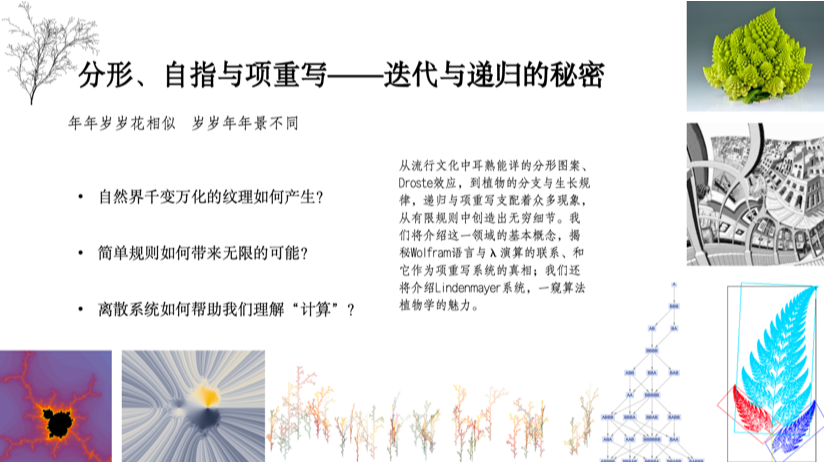
Fractal Patterns and Recursion
Project Description: Student teams create fractal patterns and explore the concepts of recursion and rewriting systems.
Team Roles: Team members can work on fractal algorithm design and implementation, recursive principles, pattern generation, and presentation.
Learning Goals: Learn the basics of fractal geometry and recursion, master methods for generating complex patterns, and boost teamwork efficiency.
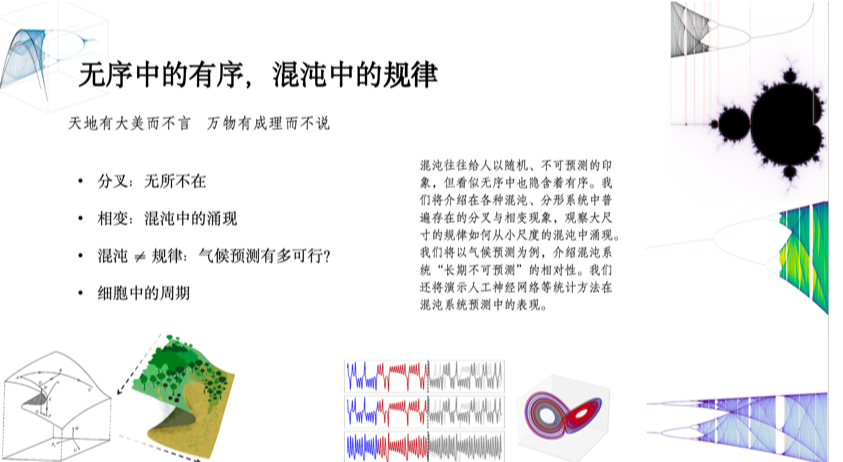
Predicting Chaos Systems
Project Description: Student teams use statistical methods and neural networks to predict the behavior of chaotic systems, such as climate changes.
Team Roles: Team members can handle data collection and preprocessing, model design and training, result analysis, and presentation.
Learning Goals: Understand the characteristics of chaotic systems, learn to use statistical methods and machine learning for prediction, and enhance problem-solving and collaboration skills.
Extension Activities
Extension Activities
Team Building Activities
Role-Playing: Students simulate a company’s operation, with each playing a different role (e.g., project manager, developer, designer), to complete a project, enhancing teamwork and role understanding.
Team Games: Engage in team games (e.g., escape rooms, obstacle courses) to build cooperation and team cohesion.
Community Service and Outreach
Community Service Projects: Organize student teams to participate in community service projects, such as environmental campaigns or volunteer work, to experience the importance of cooperation.
Educational Outreach: Students plan and conduct workshops for younger students or community members, teaching basic computational thinking and programming skills, enhancing their communication and organizational abilities.
Implementation Steps
Implementation Steps
Needs Assessment: Understand students’ interests and skill levels to determine suitable projects and activities.
Curriculum Design: Develop a curriculum that includes a mix of theory, hands-on projects, and extension activities.
Teacher Training: Train teachers in project-based learning, computational thinking, and natural law principles.
Resource Preparation: Ensure the availability of necessary resources like computers, software, and project materials.
Course Delivery: Implement the curriculum, providing ongoing support and adjustments based on feedback.
Evaluation and Feedback: Continuously assess student progress, gather feedback, and refine the program as needed.
Expected Outcomes
Expected Outcomes
Through these projects and extension activities, students will: Enhance teamwork and communication skills. Improve problem analysis and solving abilities. Experience the joy and challenges of collaboration. Develop a sense of responsibility and leadership.
5-Day Educational Program Handbook
Day 1: Team Building and Outdoor Activities
Day 1: Team Building and Outdoor Activities
Objective: To enhance student interaction, communication, and teamwork through engaging outdoor activities.
8:00 AM - 9:00 AM: Arrival and Registration
Students arrive, register, and receive welcome kits.
Brief introduction and overview of the day’s schedule.
9:00 AM - 10:00 AM: Icebreaker Activities
Activity: Human Knot
Students form small groups, stand in a circle, and randomly hold hands with two different people. The goal is to untangle without releasing hands.
Activity: Two Truths and a Lie
Each student shares two true statements and one false statement about themselves. The group guesses which statement is false.
10:00 AM - 12:00 PM: Team Relay Race
Activity: Obstacle Course Relay
Teams navigate through an obstacle course including running, jumping, and crawling under nets.
Activity: Sack Race
Teams compete in a relay-style sack race, hopping to a designated point and back.
12:00 PM - 1:00 PM: Lunch Break
1:00 PM - 3:00 PM: Treasure Hunt
Activity: Geocaching
Teams use GPS devices to find hidden caches around the campus. Each cache contains a clue to the next location.
Activity: Code Breaker Challenge
Teams solve a series of puzzles and riddles to unlock the final treasure.
3:00 PM - 4:00 PM: Reflection and Discussion
Teams gather to discuss their experiences, what they learned about teamwork, and how they can apply these lessons in their studies.
4:00 PM - 5:00 PM: Free Time and Departure
Day 2: Computational Thinking Training
Day 2: Computational Thinking Training
Objective: To introduce students to computational thinking using Freemind and basic statistical concepts through hands-on projects.
8:00 AM - 9:00 AM: Arrival and Warm-up Activity
Activity: Morning Brain Teasers
Simple puzzles and logic games to warm up the students’ minds.
9:00 AM - 12:00 PM: Introduction to Freemind
Workshop: Mind Mapping with Freemind
Overview of mind mapping and its benefits.
Hands-on session: Students create their own mind maps using Freemind to organize ideas for a project.
12:00 PM - 1:00 PM: Lunch Break
1:00 PM - 3:00 PM: Basic Statistics
Lecture: Introduction to Statistics
Key concepts: mean, median, mode, variance, and standard deviation.
Activity: Data Collection and Analysis
Students collect simple data (e.g., daily temperatures, class survey) and use statistical methods to analyze it.
3:00 PM - 4:00 PM: Project Planning
Workshop: Planning a Research Project
Students use their mind maps and statistical knowledge to outline a small research project.
Presentation: Each group presents their project plan.
4:00 PM - 5:00 PM: Free Time and Departure
Day 3: Project-Based Computational Thinking
Day 3: Project-Based Computational Thinking
Objective: To deepen computational thinking skills through practical project work and plan implementation.
8:00 AM - 9:00 AM: Arrival and Warm-up Activity
Activity: Collaborative Puzzle Solving
Teams solve complex puzzles that require collaborative thinking.
9:00 AM - 12:00 PM: Project Work
Activity: Implementing the Research Project
Students work in teams to start their research projects planned on Day 2.
Guidance and support from instructors.
12:00 PM - 1:00 PM: Lunch Break
1:00 PM - 3:00 PM: Data Analysis and Visualization
Workshop: Analyzing and Visualizing Data
Students use software tools to analyze their collected data.
Creating charts and graphs to represent data visually.
3:00 PM - 4:00 PM: Project Presentations
Activity: Project Presentations
Each team presents their findings and visualizations to the class.
Q&A session to provide feedback and suggestions.
4:00 PM - 5:00 PM: Free Time and Departure
Day 4: Heuristic Science Projects
Day 4: Heuristic Science Projects
Objective: A New Kind of Science, to introduce students to heuristic scientific concepts such as cellular automata, chaos, and fractals through engaging projects.
8:00 AM - 9:00 AM: Arrival and Warm-up Activity
Activity: Science Trivia
Fun trivia questions related to cellular automata, chaos theory, and fractals.
9:00 AM - 12:00 PM: Introduction to Cellular Automata and Chaos Theory
Lecture: Cellular Automata
Explanation of basic principles and historical context.
Hands-on Activity: Students simulate simple cellular automata (e.g., Conway’s Game of Life).
Lecture: Chaos Theory
Key concepts and examples in nature.
Hands-on Activity: Exploring chaotic systems through simulations.
12:00 PM - 1:00 PM: Lunch Break
1:00 PM - 3:00 PM: Exploring Fractals
Lecture: Introduction to Fractals
Explanation of fractal geometry and its applications.
Hands-on Activity: Students create fractal patterns using software tools and explore their properties.
3:00 PM - 4:00 PM: Heuristic Science Projects
Activity: Project Exploration
Students choose one of the heuristic topics (cellular automata, chaos, or fractals) and work on a small project.
Presentation: Each student presents their project and findings.
4:00 PM - 5:00 PM: Free Time and Departure
Day 5: Community Farm Volunteer Activities
Day 5: Community Farm Volunteer Activities
Objective: To engage students in community service, fostering a sense of responsibility and teamwork.
8:00 AM - 9:00 AM: Arrival and Introduction
Briefing on the day’s activities and the importance of community service.
Introduction to the community farm and its mission.
9:00 AM - 12:00 PM: Farm Activities
Activity: Gardening and Planting
Students assist in planting seeds, weeding, and tending to plants.
Activity: Harvesting
Students help in harvesting fruits and vegetables.
12:00 PM - 1:00 PM: Lunch Break
1:00 PM - 3:00 PM: Farm Maintenance
Activity: Farm Maintenance Tasks
Students participate in activities such as building compost piles, repairing fences, and cleaning farm areas.
Activity: Animal Care
Students help in feeding and caring for farm animals.
3:00 PM - 4:00 PM: Reflection and Discussion
Gathering to reflect on the experience.
Discussion on the importance of community service and how it impacts the community and personal growth.
4:00 PM - 5:00 PM: Free Time and Departure
Project-Based Computational Thinking: Real-World Problems
Project 1: Business Operations Analysis
Project 1: Business Operations Analysis
Problem:
Analyze the operational efficiency of a retail company to identify areas for cost reduction and productivity improvement.
Steps:
Problem Analysis:
Define the scope of the analysis (e.g., inventory management, sales performance, employee productivity).
Use Freemind to create a mind map outlining the main areas of focus.
Data Collection:
Gather data on inventory levels, sales figures, employee schedules, and customer feedback.
Statistical Analysis:
Calculate basic statistics such as mean sales per day, variance in inventory levels, and average employee productivity.
Identify trends and patterns using statistical methods.
Data Visualization:
Use software tools to create charts and graphs (e.g., bar charts for sales, line graphs for inventory levels, pie charts for employee performance).
Presentation:
Prepare a PowerPoint presentation to share findings.
Include visual aids created during the data visualization step.
Discuss recommendations for improving operational efficiency.
Evaluation Criteria:
Completeness and accuracy of the data analysis.
Clarity and effectiveness of the visualizations.
Practicality and relevance of the recommendations.
Quality and professionalism of the presentation.
Project 2: Pandemic Response Planning
Project 2: Pandemic Response Planning
Problem:
Develop a response plan for managing a pandemic outbreak in a community, focusing on minimizing spread and ensuring public safety.
Steps:
Problem Analysis:
Use Freemind to map out the key aspects of pandemic management (e.g., infection tracking, quarantine protocols, resource allocation).
Data Collection:
Collect data on infection rates, hospital capacity, resource availability (e.g., PPE, ventilators), and population demographics.
Statistical Analysis:
Analyze trends in infection rates and project future cases using statistical models.
Evaluate the effectiveness of different quarantine measures based on data.
Data Visualization:
Create graphs showing infection rate trends, resource usage, and projected case numbers.
Develop maps indicating hotspot areas and resource distribution.
Presentation:
Develop a comprehensive response plan presentation.
Include data visualizations to support proposed measures.
Outline steps for implementing the plan and ensuring community compliance.
Evaluation Criteria:
Thoroughness and feasibility of the response plan.
Accuracy and insightfulness of the statistical analysis.
Effectiveness and clarity of the visual aids.
Overall impact and persuasiveness of the presentation.
Project 3: Environmental Protection Initiative
Project 3: Environmental Protection Initiative
Problem:
Design a project to reduce plastic waste in the local community and promote environmental sustainability.
Steps:
Problem Analysis:
Use Freemind to identify key sources of plastic waste and potential areas for intervention (e.g., recycling programs, community education, policy advocacy).
Data Collection:
Gather data on current plastic waste levels, recycling rates, and public awareness.
Survey community members about their recycling habits and attitudes towards plastic use.
Statistical Analysis:
Calculate statistics such as average plastic waste per household, recycling rates, and survey responses.
Identify key factors influencing plastic waste and recycling behavior.
Data Visualization:
Create charts and graphs to display plastic waste levels, recycling rates, and survey results.
Develop infographics to illustrate the environmental impact of plastic waste and the benefits of recycling.
Presentation:
Prepare a detailed proposal for the environmental protection initiative.
Include visual aids and infographics to emphasize key points.
Outline steps for implementing the initiative and engaging the community.
Evaluation Criteria:
Creativity and feasibility of the proposed initiative.
Depth and accuracy of the data analysis.
Quality and impact of the visualizations.
Effectiveness and persuasiveness of the presentation.
Classroom Evaluation
Classroom Evaluation
Problem Analysis:
Evaluate the thoroughness and clarity of the problem analysis and mind map created using Freemind.
Check if all relevant aspects of the problem are identified and well-organized.
Data Collection:
Assess the accuracy, relevance, and completeness of the collected data.
Ensure that data sources are credible and properly documented.
Statistical Analysis:
Review the statistical methods used and the correctness of the calculations.
Check if the analysis provides meaningful insights and supports the project’s objectives.
Data Visualization:
Evaluate the clarity, accuracy, and effectiveness of the visualizations.
Ensure that visual aids are appropriately used to support the analysis and recommendations.
Presentation:
Assess the overall quality and professionalism of the presentation.
Check if the presentation is well-structured, clear, and engaging.
Evaluate the persuasiveness and practicality of the recommendations.
Outdoor competition challenges
Team Relay Race
Activity: Set up multiple relay tasks, such as running, jumping rope, and crawling through hoops. Each team member completes one task and then passes the relay baton to the next teammate.
Competition: The team that completes all the relay tasks the fastest wins.
Benefits: Enhances teamwork, coordination, and team spirit.
Capture the Flag (Real-life CS)
Activity: Use laser tag or paintball equipment to simulate a battle. Each team has a base and a flag to defend or capture.
Competition: The team that captures the opponent’s flag or eliminates the most opponents within a set time wins.
Benefits: Improves strategic planning, teamwork, and communication.
Treasure Hunt
Activity: Teams follow a series of clues and maps to find hidden treasures at various locations. Each treasure found provides the next clue.
Competition: The team that finds all the treasures first wins.
Benefits: Fosters problem-solving, teamwork, and time management skills.
Outdoor Obstacle Course
Activity: Set up various obstacles such as climbing nets, jumping pits, and balance beams. Teams work together to overcome these obstacles and complete the course.
Competition: The team that completes the obstacle course the fastest wins.
Benefits: Strengthens coordination, physical fitness, and mutual support.
Team Building Challenge
Activity: Provide limited materials (such as planks, ropes, and tape) and ask teams to construct a specific structure, like a bridge or tower, within a set time.
Competition: The team that builds the most stable and functional structure within the time limit wins.
Benefits: Enhances creativity, problem-solving, and collaborative skills.
Elementary Cellular Automaton
Usage
Usage
Rule Planel
Rule Planel
Invariant
Invariant
Amphichiral
Amphichiral
Self-Complement
Self-Complement
Complemented Mirror Image
Complemented Mirror Image
Encoding as an Integer Sequence
Encoding as an Integer Sequence
As logic functions
As logic functions
NKS Notes, p. 869
Rule 30
Rule 30
Rule 90
Rule 90
Rule 110
Rule 110
Rule 250
Rule 250
Rule 254
Rule 254
Sierpiński Sieve
Sierpiński Sieve
Plot
Plot
V5
V5
Mod 2
Mod 2
Formuals
Formuals
LSB
LSB
XOR
XOR
Elementary Cellular Automaton
Elementary Cellular Automaton
Wolfram (2002, pp. 931–932)
Wolfram (2002, pp. 931–932)
Constructible Odd Polygons
Constructible Odd Polygons
Three-body
The three-body problem is a problem in the field of physics. The goal is to find how three things move when they attract each other with gravity. It would be for instance the problem of the movement of the Sun, the Earth and the Moon. Physicists do not have a general solution that always works.
Non-relativistic movement
Non-relativistic movement
“Relativistic” refers to the theory of Albert Einstein called Relativity. This theory must be used when things move at great speed. But as long as things move at small enough speed, you can use every day classical mechanics, and this is called “non-relativistic movement”. You know if the speed is great or small enough by comparing to the speed of light c, which is the highest possible speed.
In non-relativistic physics, one must know the place and velocity of the three things. One must also know their masses. Then one uses Newton’s laws of motion to learn how the things move.
In non-relativistic physics, one must know the place and velocity of the three things. One must also know their masses. Then one uses Newton’s laws of motion to learn how the things move.
Relativistic movement
Relativistic movement
When a thing is moving, it has energy of movement. Scientists use a short-cut when they talk about this energy, they call it ‘E.’
In a field called General relativity, experts say that movement with higher velocities causes the radiation of gravitational waves. In this case, the thing moving loses energy, and this makes calculation more difficult. Experts say that the system is “not conservative”.
Experts in another field called Quantum mechanics say, in addition, at high speed the creation and annihilation of particles becomes possible, so, it is not possible to keep the number of particles constant.
There is no relativistic solution that always works for the movement of two or three things.
Concluding Remarks
Concluding Remarks
In conclusion, this project has demonstrated the potential and effectiveness of integrating computational thinking with the principles of natural law for high school education. By fostering skills in problem-solving, critical thinking, and resilience, students are better equipped to navigate complex challenges both academically and in their future careers. The approach of leveraging competition, cooperation, and adaptation not only mirrors real-world scenarios but also enriches the learning experience, making it more engaging and impactful.
Acknowledgments
Acknowledgments
I would like to extend my deepest gratitude to my mentor, YIYIN, for their invaluable guidance and support throughout this project. Their insights and encouragement have been instrumental in shaping the direction and success of this work. Additionally, I would like to thank Xuelian, Glen, Charlie for their contributions and support. This project would not have been possible without the collective effort and collaboration of everyone involved.
References
References
1. Papert, S. (1980). Mindstorms: Children, Computers, and Powerful Ideas. Basic Books.
2. Resnick, M. (2017). Lifelong Kindergarten: Cultivating Creativity through Projects, Passion, Peers, and Play. MIT Press.
3. Bransford, J. D., Brown, A. L., & Cocking, R. R. (2000). How People Learn: Brain, Mind, Experience, and School: Expanded Edition. National Academy Press.
4. Fullan, M. (2013). The New Meaning of Educational Change (5th Edition). Teachers College Press.
5. Defining social innovation for post-secondary educational institutions: a concept analysis https://www.nature.com/articles/s41599-024-03236-6
6. Developing the skills for complex thinking research https://www.frontiersin.org/journals/education/articles/10.3389/feduc.2024.1322727/full
7. https://mathworld.wolfram.com/Fractal.html
8. https://www.wolframalpha.com/input/?i=three-body+problem
Cite This Notebook
Cite This Notebook