Article Abstract
Article Abstract
The n-qubit stabilizer states are those left invariant by a -element subset of the Pauli group. The Clifford group is the group of unitaries which take stabilizer states to stabilizer states; a physically--motivated generating set, the Hadamard, phase, and CNOT gates which comprise the Clifford gates, imposes a graph structure on the set of stabilizers. We explicitly construct these structures, the “reachability graphs,” at . When we consider only a subset of the Clifford gates, the reachability graphs separate into multiple, often complicated, connected components. Seeking an understanding of the entropic structure of the stabilizer states, which is ultimately built up by CNOT gate applications on two qubits, we are motivated to consider the restricted subgraphs built from the Hadamard and CNOT gates acting on only two of the qubits. We show how the two subgraphs already present at two qubits are embedded into more complicated subgraphs at three and four qubits. We argue that no additional types of subgraph appear beyond four qubits, but that the entropic structures within the subgraphs can grow progressively more complicated as the qubit number increases. Starting at four qubits, some of the stabilizer states have entropy vectors which are not allowed by holographic entropy inequalities. We comment on the nature of the transition between holographic and non-holographic states within the stabilizer reachability graphs.
n
2
n≤5
n
Introduction
Introduction
Stabilizer states comprise a special class of quantum states, notable in their discrete structure and utility within quantum error-correcting schemes. The Clifford group, consisting of the Hadamard, phase, and CNOT operations, is sufficient to move between all stabilizer states at a given qubit number. The set of stabilizer states at n-qubits is constructible using only stabilizer circuits, i.e. quantum circuits containing only Clifford gates. These properties allow the set of n-qubit stabilizer states, and the associated Clifford gates, to be realized as a discrete graph known as a “reachability graph”. Further restricting the allowed set of gates to some subset of the n-qubit Clifford group accordingly defines subgraphs of the n-qubit reachability graph, which we term “restricted graphs”. These restricted graphs retain important information that is often obscured by the complexity of full reachability diagrams at higher qubit number. Examining reachability graphs and restricted graphs, especially within a graph-theoretic framework, offers a tractable means of stabilizer state analysis.
Stabilizer states are also of particular interest to the holography community as they form the smallest superset of the holographic states. Different classes of quantum states can be characterized by the entropic structure of their constituent states, specifically according to the relationship among subsystem entropies. Holographic quantum states, those possessing a dual representation in classical gravity, have entropic structure that necessarily satisfies a collection of derived entropy inequalities. While it is true that all stabilizer states are holographic up through 3-qubits, beginning at 4-qubits the two classes of quantum states diverge with the arrival of stabilizer states that violate the Monogamy of Mutual Information, one entropy inequality necessarily satisfied by all holographic states. This transition out of the space of holographic states occurs through Clifford group action, namely the action of a CNOT gate as it is the only operation capable of modifying entropic structure.
The stabilizerstates.wl package was developed to build and simulate stabilizer circuits, generate the n-qubit set of stabilizer states, and construct representative reachability graphs and restricted graphs. The package also contains a set of tools for analyzing graph and subgraph structure, computing relevant entropic properties of states, and identifying holographic and non-holographic states. Further details, stabilizer state data, and generated graphs are available at: http://github.com/WMunizzi/StabilizerStateData.
Included within are instructions for use and examples pertaining to the Mathematica package stabilizerstates.wl.
Installation
Installation
Package can be downloaded from https://github.com/WMunizzi/StabilizerStateData/blob/main/stabilizerstates.wl and imported to Mathematica notebook from whichever external storage it is located in.
<<"/Applications/Mathematica.app/Contents/AddOns/Packages/stabilizerstates.wl"
Additional data files for stabilizer states, graphs,and entropy vectors available at:
Hyperlink["Additional Information","http://github.com/WMunizzi/StabilizerStateData"]
Out[]=
Examples of Visualization Functions
Examples of Visualization Functions
Graph Builders
Graph Builders
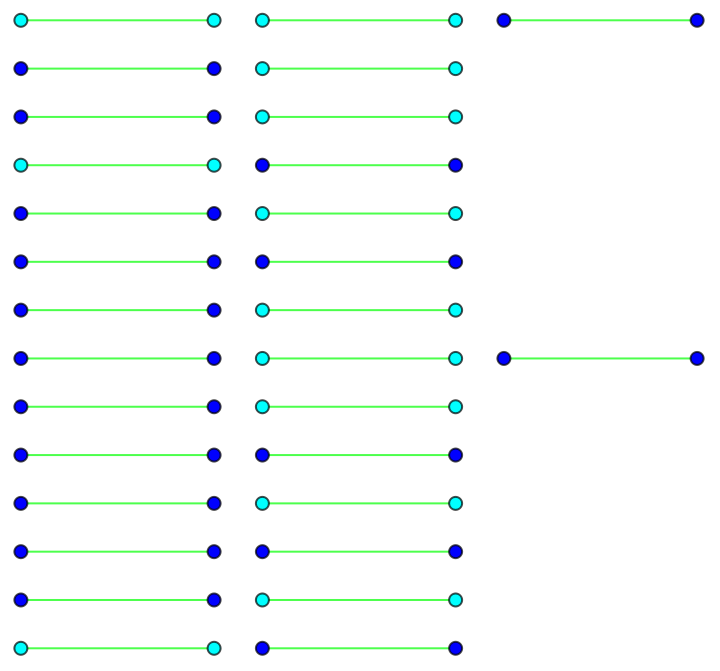
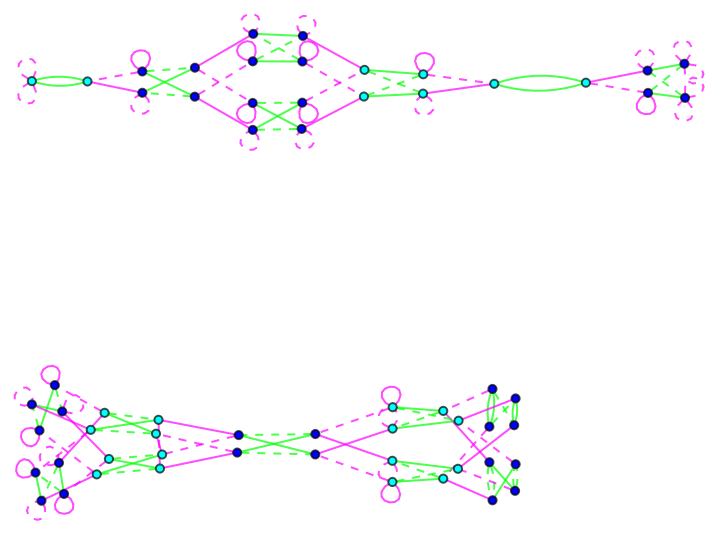
The ReachabilityGraphBuilder function is used to generate graphs from a map of stabilizer states.
desiredGates1={{"H",{1}}};ReachabilityGraphBuilder[twoqubitstatemap,desiredGates1,twoqubitreducedentropyvectors,False,False,Automatic]
Out[]=
In[]:=
desiredGates2={{"H",{1}},{"H",{2}},{"CNOT",{1,2}},{"CNOT",{2,1}}};ReachabilityGraphBuilder[twoqubitstatemap,desiredGates2,twoqubitreducedentropyvectors,False,False,Automatic]
Out[]=
Examples of General Functions
Examples of General Functions
The Swap function is used internally within certain functions to swap elements of a list. The example below swaps elements at indices 1 and 3 in OrderedList.
OrderedList={1,2,3,4,5};Swap[OrderedList,1,3]
Out[]=
{3,2,1,4,5}
ThePermutedIdentityfunctiongivesthexpermutationmatrixthatreordersadensitymatrixofnqubitsintotheneworderingrequested.Theexamplebelowreplacesthenaturalordering1,2,3withtheordering2,3,1.
n
2
n
2
NewOrdering={2,3,1};dimension=3;PermutedIdentity[dimension,NewOrdering]//MatrixForm
Out[]//MatrixForm=
1 | 0 | 0 | 0 | 0 | 0 | 0 | 0 |
0 | 0 | 1 | 0 | 0 | 0 | 0 | 0 |
0 | 0 | 0 | 0 | 1 | 0 | 0 | 0 |
0 | 0 | 0 | 0 | 0 | 0 | 1 | 0 |
0 | 1 | 0 | 0 | 0 | 0 | 0 | 0 |
0 | 0 | 0 | 1 | 0 | 0 | 0 | 0 |
0 | 0 | 0 | 0 | 0 | 1 | 0 | 0 |
0 | 0 | 0 | 0 | 0 | 0 | 0 | 1 |
Examples of Quantum Entropy Functions
Examples of Quantum Entropy Functions
The DensityMatrix function gives the density matrix corresponding to the input ket.
twoqubitsampleket={{1},{0},{0},{1}};DensityMatrix[twoqubitsampleket]
Out[]=
{{1,0,0,1},{0,0,0,0},{0,0,0,0},{1,0,0,1}}
The KetProjector function projects out a density matrix into the ket representation of the measurement basis.
sampledensity={{1,0,0,1},{0,0,0,0},{0,0,0,0},{1,0,0,1}};KetProjector[sampledensity]
Out[]=
{{1},{0},{0},{1}}
The TraceSystem function gives the reduced density matrix of a subsystem of qubits, after tracing out over undesired qubits. For example, we can trace out qubit 1 to give the reduced density matrix for qubit 2,
TraceSystem[sampledensity,{1}]
Out[]=
{{1,0},{0,1}}
Similarly, computing the reduced density matrix of qubits 1 and 2 by tracing out the third qubit in a 3-qubit system,
threequbitsampleket={{1},{0},{0},{0},{0},{0},{0},{1}};threequbitsampledensity=DensityMatrix[threequbitsampleket];TraceSystem[threequbitsampledensity,{3}]
Out[]=
{{1,0,0,0},{0,0,0,0},{0,0,0,0},{0,0,0,1}}
The SvonNeumannBinary function computes the entanglement entropy for a chosen subsystem of qubits in an n-qubit system. The overall system is input as a state ket. For example, computing the entanglement entropy of the third qubit in a 3-qubit system,
SvonNeumannBinary[threequbitsampleket,{1}]
Out[]=
1
TheEntropyVectorBuilderfunctioncomputesthevonNeumannentropyforallsubsytemsinann-qubitsystem,andordersthesetofentanglemententropiesintoavectoroflength-1.Theorderofthisvectorfollowsthenaturalordering,e.g.(,,,,,,)fora3-qubitsystem.
n
2
S
A
S
B
S
C
S
AB
S
AC
S
BC
S
ABC
threequbitvacuumket={{1},{0},{0},{0},{0},{0},{0},{0}};threequbitGHZket={{1},{0},{0},{0},{0},{0},{0},{1}};EntropyVectorBuilder[threequbitvacuumket]EntropyVectorBuilder[threequbitGHZket]
Out[]=
{{0},{0},{0},{0},{0},{0},{0}}
Out[]=
{{1},{1},{1},{1},{1},{1},{0}}
TheReducedEntropyVectorBuilderfunctioncomputestheentropyvectorforachosenstate,thenreducestheentropyvectoraccordingtopurityconstraints.Forapuresystem,theentanglemententropyofthefullsystemis0,thereforethelastcomponentoftheentropyvectorwillalwaysbe0.Furthermore,theentanglemententropyofanysubregionwillbeequaltotheentanglemententropyofitscomplementsubregion,sinceonepurifiestheother.Therefore,anentropyvectoroflength-1canbereducedtooneoflength-1iftheoverallsystemispure.
n
2
n-1
2
ReducedEntropyVectorBuilder[threequbitvacuumket]ReducedEntropyVectorBuilder[threequbitGHZket]
Out[]=
{{0},{0},{0}}
Out[]=
{{1},{1},{1}}
Examples of Quantum Logic Gates
Examples of Quantum Logic Gates
The HadamardAction, PhaseAction, and CNOTAction functions give the matrices that act on a state when a Hadamard, Phase, or CNOT gate is applied respectively.
For example, the matrix corresponding to a Hadamard gate acting on the first qubit of a 2-qubit system is given by,
dim=2;HadamardAction[2,1]
Out[]=
{{1,1,0,0},{1,-1,0,0},{0,0,1,1},{0,0,1,-1}}
Similarly, a phase gate applied to the second qubit in a 4-qubit system is described by the matrix,
A CNOT gate acts on any two qubits in an n-qubit system. For example, the matrix corresponding to the 3-qubit CNOT gate with the first qubit the control, and second qubit the target is,
Or with the third qubit the control, and the first qubit the target,
Examples of Stabilizer State Functions
Examples of Stabilizer State Functions