This project investigates the intersections of computational multiverse models and topological probability theory by applying multiway system computation to the study of knot formation in lattice-constrained spaces, with a focus on calculating the probability of specific knot types occurring with fixed-length self-avoiding polygons. Using a discrete model inspired by the Wolfram Physics Project, we construct a multiway system in which each state represents a distinct polygonal embedding of a closed loop on a lattice. The frequency of each knot type is determined by counting occurrences across the full set of configurations, yielding empirical knotting probabilities for various types at a fixed lattice length.
Ultimately, this project will explore the symmetries and exploration with regards to higher-dimensional perspectives. We analyze how knotting probabilities decay with dimension, and how the structure of the multiway system reflects the increased freedom of embedding in higher-dimensional spaces. This research provides insight into the geometric and topological constraints that govern knot formation in discrete systems, with implications in statistical mechanics, polymer physics, and higher-dimensional models of spacetime. It bridges computational knot theory with discrete geometry and the foundations of physics by exploring how dimensionality controls the emergence of topological complexity.
Ultimately, this project will explore the symmetries and exploration with regards to higher-dimensional perspectives. We analyze how knotting probabilities decay with dimension, and how the structure of the multiway system reflects the increased freedom of embedding in higher-dimensional spaces. This research provides insight into the geometric and topological constraints that govern knot formation in discrete systems, with implications in statistical mechanics, polymer physics, and higher-dimensional models of spacetime. It bridges computational knot theory with discrete geometry and the foundations of physics by exploring how dimensionality controls the emergence of topological complexity.
Introduction
Introduction
Knots arise naturally in both abstract topology and real-world physical systems—from tangled polymers and DNA strands to topological features of quantum fields. Understanding how knots form in constrained environments such as lattices is of interest in fields ranging from statistical mechanics to molecular biology. In such contexts, a central question is not merely whether a configuration is knotted, but how likely it is for specific types of knots to occur under given geometric constraints.
A powerful way to study this question is through lattice models, where closed self-avoiding walks, i.e., lattice polygons, simulate physical systems with topological degrees of freedom. As the dimensionality of the lattice increases, the freedom of embedding also increases, intuitively reducing the chance of accidental knot formation. This motivates a systematic, dimension-sensitive approach to analyzing knotting probabilities.
In this project, we approach the problem from a computational perspective rooted in multiway systems, a formalism developed in the context of the Wolfram Physics Project. Here, each state in the multiway system corresponds to a distinct polygonal embedding of a closed curve on the lattice. Transitions between states reflect local geometric rewrites, and the global structure of the system encodes the full space of possible embeddings. By exhaustively or probabilistically traversing this space, we empirically estimate the probability distribution over knot types for fixed polygon lengths.
The goal of this work is twofold: first, to demonstrate how multiway computation can serve as an effective generative framework for knot statistics, and second, to explore how these statistics evolve across higher dimensions. This not only provides new insight into the topology of embedding spaces, but also opens the door to computational models that more closely mimic the geometric constraints of high-dimensional physical systems.
Computation vs. Theoretical Gap
Computation vs. Theoretical Gap
While analytic methods have provided asymptotic estimates for knotting probabilities in certain cases, they often fall short in capturing the full structural richness of finite, dimensionally constrained embedding spaces. The computational approach pursued here allows for a finer-grained examination of local and global transitions in knot type under lattice constraints. Ultimately, computations, such as multiway systems allow exploration of configuration spaces beyond what closed-form math allows.
Moreover, knot classification is extremely algorithmically difficult. If we consider our findings below, we find that there are many steps in classifying a knot computationally and the enumeration of embeddings grows exponentially. This makes finding probabilities extremely difficult, especially in higher dimensions. As discussed later, knot types are identified using invariants, such as utilizing the Alexander polynomial, HOMFLY-PT, or, in this work, the Jones polynomial.
In higher-dimensional lattices, such as and , embeddings are much less constrained. For example, random walks are unknotted almost surely in higher dimensions. In contrast, knotting in 3-D becomes almost certain as length increases.
4
Z
5
Z
This brings to the emphasis of exploiting the Multiway System’s Interpretive Power, reflecting casual structure, rewriting history, and branching complexity. While other known algorithms utilize different assets in computations, the Multiway System provides a bridge to this higher-dimensional complexity, which offers more understanding in classical knots at the lower dimensions and the trajectories it could have on higher-dimensions. Ultimately, this gives rise to a natural encoding of topological evolution as discrete updates.
This is an example of a CodeText cell. CodeText is usually a one-line summary of what you’re doing with the code after it. It typically ends with a colon:
In[]:=
1+1
Out[]=
2
Preliminaries
Preliminaries
Definitions
Definitions
Knot Definition
Knot Definition
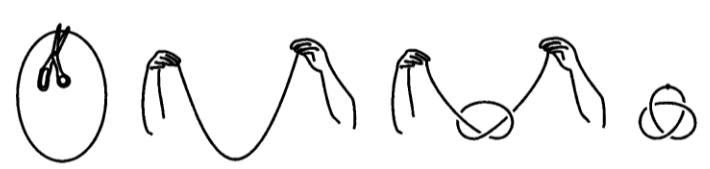
A knot is a knotted loop of string , having no thickness and its cross-section being a single point. The knot is then a closed curve in space that does not intersect itself anywhere.
Let be a smooth function. Then, is an embedding: injective and continuous. The image is called a knot.
Let
f:
1
S
3
R
f
f()⊂
1
S
3
R
Equivalent Definition
Equivalent Definition
Two knots , are considered equivalent, if there exists an ambient isotopy such that for each , H(·,t) is a homeomorphism of , , and f()g().
f
g:
1
S
3
R
H:[0,1]
3
R
3
R
t
H
t
3
R
H
0
id
3
R
H
1
1
S
1
S
Knot Invariant Definition
Knot Invariant Definition
Let denote the set of knot types, i.e., the equivalence classes of smooth embeddings under ambient isotopy. A knot invariant is a function from the set of knot types to some set , such that if two knots ,∈K are equivalent, then .
K
f:
1
S
3
R
I:KS
S
K
1
K
2
I()I()
K
1
K
2
Examples
Examples
In[]:=
Graphics3D[{PointSize[Large],Red,Point[Flatten[Table[{i,j,k},{i,0,2},{j,0,2},{k,0,2}],2]],Blue,Line[{{0,0,0},{1,0,0}}],Blue,Line[{{1,0,0},{1,1,0}}],Blue,Line[{{1,1,0},{1,1,1}}],Blue,Line[{{1,1,1},{0,1,1}}],Blue,Line[{{0,1,1},{0,0,1}}],Blue,Line[{{0,0,1},{0,0,0}}]}]
Out[]=

(*TrefoilKnot*)Graphics3DPointSize[Large],Red,Point[Flatten[Table[{i,j,k},{i,0,3},{j,0,3},{k,0,3}],2]],
Out[]=

In[]:=
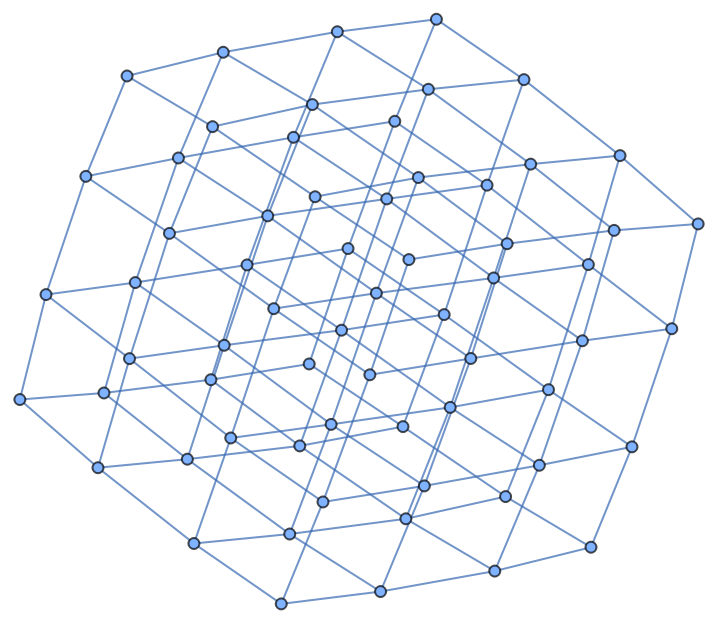
GridGraph[{4,4,4}]
Out[]=
In[]:=
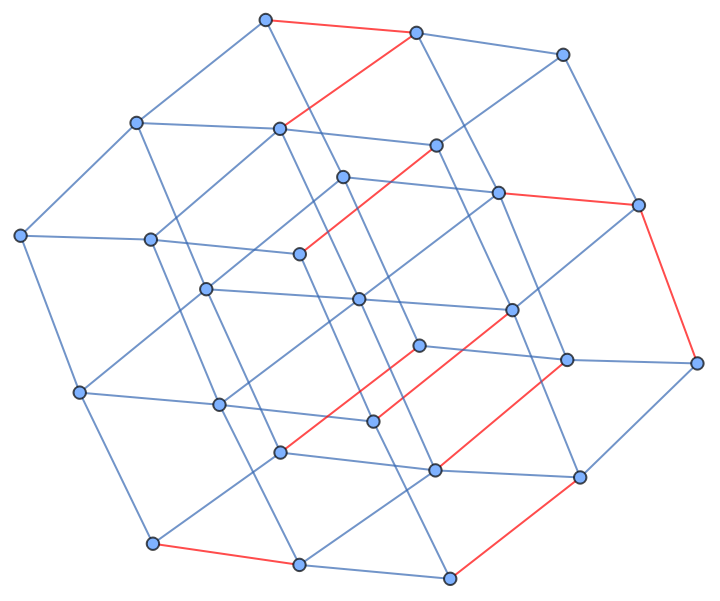
Graph[GridGraph[{3,3,3}],EdgeStyle->Thread[RandomSample[EdgeList[GridGraph[{3,3,3}]],10]->Red]]
Out[]=
We now want to construct the class or association (in the case of Mathematica) to describe what properties a knot has. Moreover, we want to compute a knot invariant and determine whether two knots are isotopic. We assume that the knot is embedded in R^3 on a discrete lattice. A knot class or association would have the following:
In[]:=
knot=<|"Name"->"Trefoil","Nodes"->{(*insertnodes*)},"Edges"->{(*insertedges*)}|>;
Take the following example:
Consider the very first example of our knot visual. We can now interpret this using our code above and find unique properties that allow us to use more complex and future functions. We have
If we want to make this visual different and create a better visual, we can use the following: USING GRIDGRAPH
Next, we attempt to find if two cubic lattice knots are isotopic in a discrete lattice setting.
Rough Plan:
Check if knot graphs are isomorphic as cubic lattice paths: Do both knots have the same number of edges and nodes? Are their adjacency isomorphic?
Then, check basic invariants: Do both knots have the same length, edges, and crossings (might be hard)?
Next, apply Reidemeister moves.
Return False or Indeterminate if moves fail.
Then, check basic invariants: Do both knots have the same length, edges, and crossings (might be hard)?
Next, apply Reidemeister moves.
Return False or Indeterminate if moves fail.
Consider this rough code, which first creates an abstract graph whose vertices are integers:
Consider using the two different trefoils:
Observe that this function is incorrect since it checks for combinatorial equivalence. We proceed by utilizing full topological isotopy. We first project onto a 2D plane to use a polynomial. Moreover, we also include a function that graphs any knot association, specifically 3D and 2D knots.
We also need to upgrade our 2D projection function to include cross and over/under data, which will be useful in the polynomial computations. We first find the crossing points, where intersections between edges and not nodes are returned.
Now, we determine over and under information at each crossing utilizing FindCrossingPoints.
Additionally, we add crossing signs and knot orientation.
Next, we need to construct a cross graph and then apply skein relations to compute the Jones polynomial recursively, which will allow us to find the knot types and classification and returns the knot invariant. Ultimately, this will also allow us to determine if two knots are isotopic; however, they may not be completely isotopic.
We begin by constructing the knot diagram graph.
Next, we will utilize the Kauffman bracket skein from our knot diagram graph to compute the Jones polynomial.
Part 2 - Multiway System Computations (Probabilities)
Part 2 - Multiway System Computations (Probabilities)
We will now utilize multiway system computations to find all knots constrained to a cubic lattice of length L. Observe that this system is topology-preserving to explore the space of the embeddings of a specific type of knot. We proceed by using the same unknot example as an initial state; however, we will state the rewrite rules
Rewriting code as per mentor suggestions.
Cite This Notebook
Cite This Notebook
Multiway system computations in knot probabilities
by Brooklyn Vasquez
Wolfram Community, Staff Picks, July 9, 2025
https://community.wolfram.com/groups/-/m/t/3496907
by Brooklyn Vasquez
Wolfram Community, Staff Picks, July 9, 2025
https://community.wolfram.com/groups/-/m/t/3496907