2016 puzzles: can you calculate these values?
by Ed Pegg Jr
by Ed Pegg Jr
There are various ways to get 2016 in unexpected ways.
In[]:=
45^2-4-5
Out[]=
2016
In[]:=
2^11-2^5
Out[]=
2016
In[]:=
Divisors[55^4-1]〚88〛
Out[]=
2016
There is a puzzle going around -- make 2016 with 5 6’s or 4 6’s and any desired mathematical operations.
In[]:=
(6!!-6)6!!
Out[]=
2016
It’s connected to Fibonacci numbers.
In[]:=
Fibonacci[23+1]/23
Out[]=
2016
How many unit squares are contained within a circle of radius 26?
In[]:=
4Sum[Floor[Sqrt[26^2-k^2]],{k,1,26}]
Out[]=
2016
A picture of those squares.
In[]:=
Graphics[{Line[{First[#],Last[#]}],Line[Reverse/@{First[#],Last[#]}]}&/@SplitBy[Select[Tuples[Range[-25,25],{2}],Norm[#]<=26&],First]]
Out[]=
Since it’s a triangular number, we may as well take a look at the triangle.
In[]:=
63(63+1)/2
Out[]=
2016
Graphics[Circle[#,1/2]&/@Flatten[Table[a{1,0}+b{-1/2,Sqrt[3]/2},{a,1,63},{b,1,a-1}],1]]
For that matter, what is the Topological Index of this triangular grid?
GraphData[{"TriangularGrid",4}]
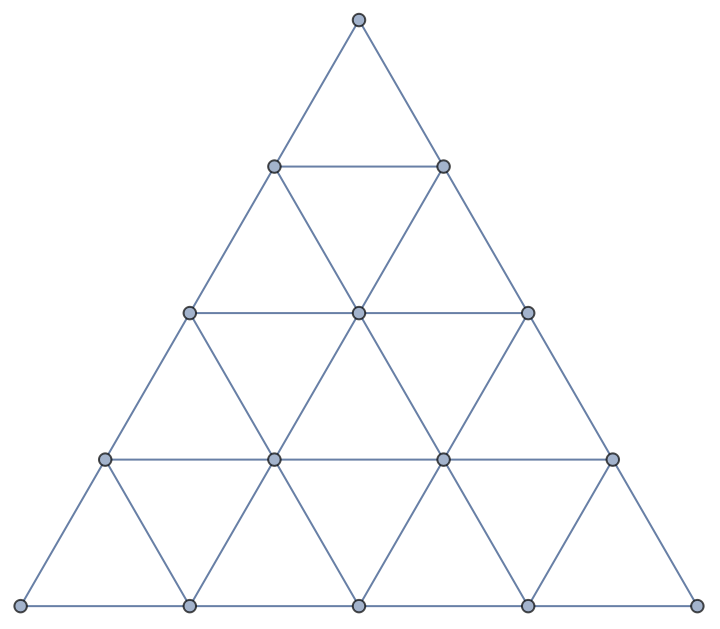
GraphData[{"TriangularGrid",4},"TopologicalIndex"]
2016
What is the magic sum in the following magic square of consecutive primes?
data={{103,113,131,409,349,421,197,293},{389,331,397,97,193,263,179,167},{109,433,439,199,127,101,241,367},{137,373,353,163,359,211,229,191},{311,181,149,419,79,271,223,383},{157,269,151,277,401,337,317,107},{379,83,307,313,251,173,283,227},{431,233,89,139,257,239,347,281}};
103 | 113 | 131 | 409 | 349 | 421 | 197 | 293 |
389 | 331 | 397 | 97 | 193 | 263 | 179 | 167 |
109 | 433 | 439 | 199 | 127 | 101 | 241 | 367 |
137 | 373 | 353 | 163 | 359 | 211 | 229 | 191 |
311 | 181 | 149 | 419 | 79 | 271 | 223 | 383 |
157 | 269 | 151 | 277 | 401 | 337 | 317 | 107 |
379 | 83 | 307 | 313 | 251 | 173 | 283 | 227 |
431 | 233 | 89 | 139 | 257 | 239 | 347 | 281 |
{Total/@data,Total/@Transpose[data]}
{{2016,2016,2016,2016,2016,2016,2016,2016},{2016,2016,2016,2016,2016,2016,2016,2016}}
What is the missing coefficient in the following “Swiss knife polynomial”?
It seems to give the same values as cos(x Pi/2).
It seems to give the same values as cos(x Pi/2).
Plot[{Cos[xPi/2],(9x^8-168x^6+2016x^4-9792x^2+7936)/7936},{x,-Pi/2,Pi/2}]
How many nonsingular 2x2 matrices are there, mod 7? I believe the code might be
In[]:=
Length[Select[Partition[#,2]&/@Tuples[Range[0,6],{4}],Det[#,Modulus7]≠0&]]
Out[]=
2016
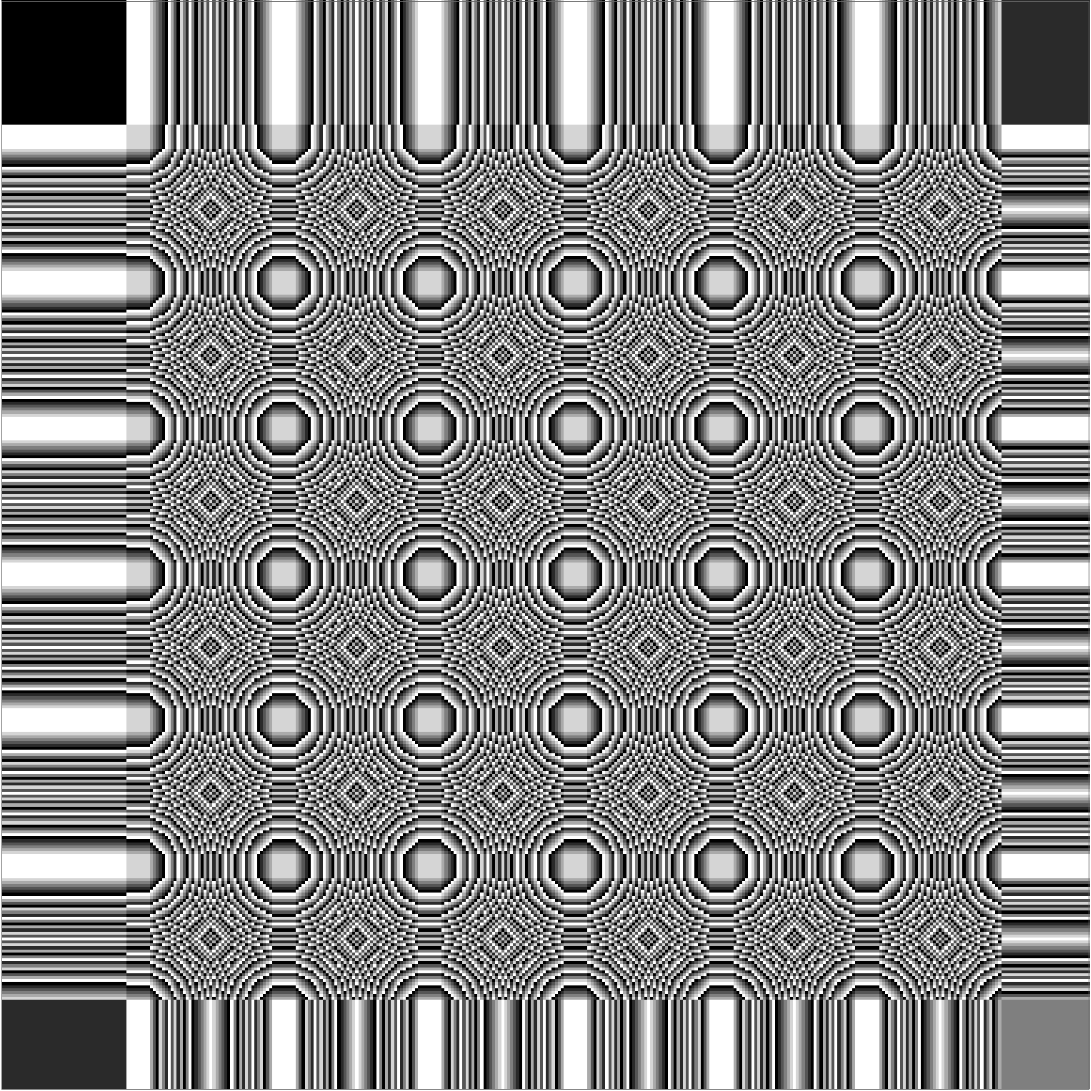
These matrices can make a multiplication table. Here’s a part of it.
g=SortBy[Select[Partition[#,2]&/@Tuples[Range[0,6],{4}],Det[#,Modulus7]≠0&],Det[#,Modulus7]&];ArrayPlot[Table[Det[Mod[g[[a]]g[[b]],7],Modulus7],{a,1,366},{b,1,366}],ImageSize750]
Of the permutations on Range[7], we can pick out the ones which contain a maximal increasing run of length 2.
Then we can plot the structure of those 2016 permutations.
There are 2016 different ways to remove 6 edges from this graph to leave a tree.
Let’s calculate the area of the triangle in back using Heron’s formula.
It’s the smallest number equal to the sum of its first 31 divisors.
The sum of its square and cube is pandigital. It is the only number with this property.
May you find 2016 to be a wonderful year.