This essay explores the generation of space and geometry through autopoiesis and structural coupling rather than traditional representation and mimesis. Trying to think beyond Darwinian adaptation, along the notions of a metabolic, homeostatic and poetic theory of form, the research utilizes 3D Cellular Automaton to model complex ecological rhythms—such as water, vegetation, and soil—interacting with a native flower - the observer on this essay. The landscape is conceptualized not as fixed entities, but as a dynamic, woven fabric of life-sustaining intensities. Finally, the study makes a first attent to introduce hypergraphs to project these autopoietic processes into broader, multi-dimensional relational structures.
Why an over-view?
Why an over-view?
Not as an attempt of distancing myself, of adopting the pleasing perspective of the observer.
On the contrary, as an act of situated practice.
One performed by someone, me, that decides to see a number of great scientist and wants to approach them.
While, at the same time, doesn’t have the (embodied or computed) words to dialogue with them.
So remains fascinated from the outside, even if still on the surface.
Because of my (yet?) inability to fully embody the computational realm, I cannot but use it (only) in a metaphorical or poetic fashion, as a means to illustrate my intuition about space, time and autopoietic processes. Not to be understood in a reductionist way, all computational is, by principle, overarched by poetry - but in my case I won’t be then able to work with the mathematical and physical principles with the level of detail and comprehension that could allow for my illustrations to be taken as the basis of any scientific work, although I hope this effort helps to illuminate some future work in this direction.
Research questions
Research questions
How do living systems generate space through structural coupling rather than through representation? Can space itself, or its design, be understood as an emergent metabolic and homeostatic fabric generated by autopoietic interaction?Rather than assuming geometry as a pre-existing mathematical container, this project explores whether geometry itself can emerge from local interactions. In this sense, the computational model becomes a way of asking a deeper philosophical question: if mathematical worlds are constructed rather than given—as suggested by topos theory—what kinds of worlds become possible when the organizing principles are not efficiency or optimization, but rhythm, care, and structural coupling? Following the Spanish philosopher María Zambrano and her reflections on poetry as what lays underneath all logics and episthemological, hence ontological, process we can socially build - a perspective that does not fall far apart from Stephen Wolfram’s notion of computational irrudictibility and the consecuent pockets of reductibility -, we could ask: What would technologically built worlds look like if their underlying logical spaces were filled not only with formal relations, but also with poetry?This essay was developed in relation to Stephen Wolfram’s What’s special about life (2025) reflection.
Cellular Automaton beyond Darwin’s evolution theory
Cellular Automaton beyond Darwin’s evolution theory
Even though Stephen Wolfram (2017) defends D’Arcy Wentworth Thompson´s perspective in which evolution has a secondary role to physical and mathematical laws in shaping biological forms, most work on cellular automata implicitly starts from a logic very close to Darwin’s: population, competition, selection, survival, adaptation. However, through their concept of autopoiesis, Maturana and Varela (1994) introduce a nuanced shift in Darwinian evolution: they suggest that the environment does not dictate an organism’s development, but rather acts as a boundary that makes specific internal transformations viable through structural coupling.
When applied to computing, an autopoietic perspective would changes the type of rules applied to cellular automaton: instead of writing rules similar to if neighbors = X → become Y, we could write rules where memory, rhythm, care, desire could be incorporated, much closer to the conservation of organization the Chilean authors suggest.
In this sense my research is not only about applying cellular automaton to space, but aiming at explore a metabolic and homeostatic theory of geometry: replacing the Darwinian logic of adaptation with the autopoiesis of Humberto Maturana and Francisco Varela, understanding space and the geometries that constitute it as a fabric that emerges from structural coupling, and using cellular automaton first, and hypergraphs later, to show how that geometry can be continuously rewritten - at least as an intuitive first attempt.
The process, embodied, more like a dance
The process, embodied, more like a dance
My recent introduction to the Wolfram Language made of the design process an embodied dialogue. Each piece of code became a rhythmic two-way dance, where my spatial, poetic and conceptual intuitions and the algorithm’s response, as well as the reactions, comments and thoughts of those helping me with the code, constantly adapted to and guided one another.
A. Space as a sedimentation of time, a landscape
A. Space as a sedimentation of time, a landscape
An embodied experience of space is always 4D - accounting for the volumetric nature of the space-body continuum as well as their ability to synthetise time.
Therefore, my initial intuition was to check whether cellular automaton could work in 3D or 4D in order to integrate time within each temporal iteration (which would lead to a 4D model if we work with 2D objects or a 5D model if we worked with 3D ones) - and it can.
Therefore, my initial intuition was to check whether cellular automaton could work in 3D or 4D in order to integrate time within each temporal iteration (which would lead to a 4D model if we work with 2D objects or a 5D model if we worked with 3D ones) - and it can.
Out[]=
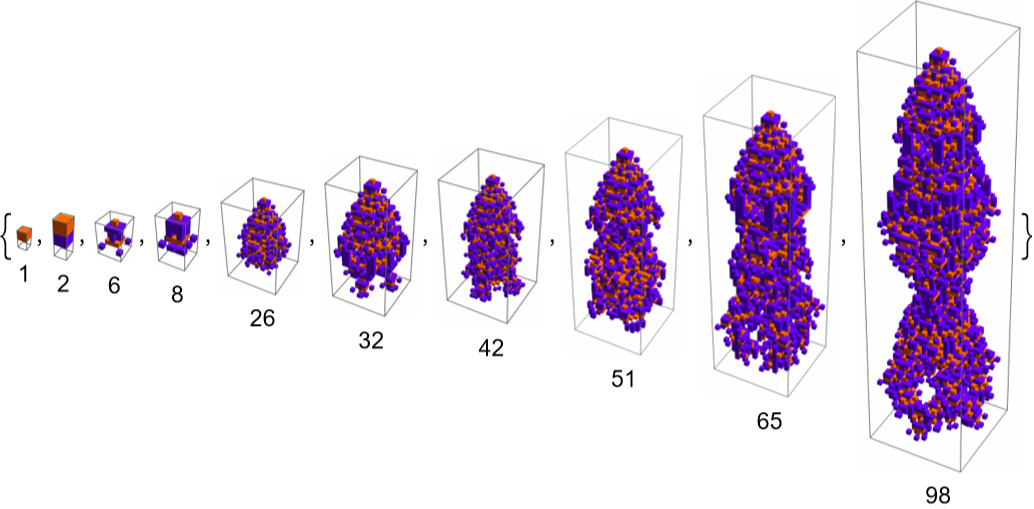
Thanks to Willem Nielsen, I was able to understand how this 3D cellular automaton could look like. Nonetheless, I wasn’t able to understand what those volumes could mean spatially, ecologically.
Eventually I realized that time shouldn’t be an axis:
When we talk about 3D as (x, y, t) or 4D as (x, y, z, t) time is still an added dimension. But from a phenomenological perspective (Merleau-Ponty, Bergson, Zambrano...) time is not an axis. Time is the process (the space!, the pre-geometric space) that makes form possible.
Therefore it wouldn’t be about representing space + time but rather space as the sedimentation, synthesis, of time.
With this in mind I finally decided to work with a 3D cellular automaton, where each iteration, instead of trying to incorporate time within the spatial dimension and see how it evolves over time, works with the 2D complete synthesis of the embodies heritage that lays underneath. Each horizontal slice would be a different 2D layer, the footprint, of the same (r)evolution, as a coupling process.
An interesting side note is that with cellular automaton all layers are rewritten with each iteration, which accounts for the notions of space as synthesis (Orejas, 1991) that mutates over and across times due to embodied movement within it, rather than each layer been taken as a some sort of geological stratum that cannot be touched from above.
The same could be done with a 4D cellular automaton process, which may remain as a side project to touch further down the line.
Subsequently, instead of space, I will use the word landscape, to account for the intertwined cultural and biological processes, the memory and emotions (Tuan, 1974), that inform each iteration, to understand, contrary to the linear and mechanistic paradigm of Modernity, space is not a vacuum, but a geology or cosmology, a socioecological environment for which there is a need to care for.
B. Designing the Cellular Automaton (in collaboration with Phileas Dazeley-Gaist)
B. Designing the Cellular Automaton (in collaboration with Phileas Dazeley-Gaist)
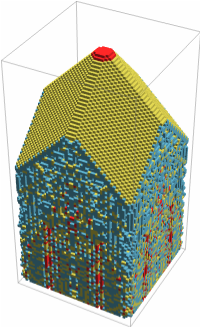
Following Deleuze and Guattari (1980)’s notion of immanence, reality is understood not as a collection of discrete objects but as a continuous field of flows, intensities, and energetic relations. Rather than representing the landscape as a composition of fixed entities — mountains, rivers, vegetation or infrastructures — this project approaches it as a dynamic configuration of interacting intensities. Cellular automata are therefore used not to reproduce the visible appearance of a landscape but to explore how local interactions can generate and preserve the conditions that sustain life.
Within this framework, each cell is not interpreted as a parcel of land or a cartographic unit, but as a metabolic unit of the ecosystem. Its value does not represent an object or a land use category. Instead, it expresses the local capacity of that portion of the landscape to sustain life, understood here as the ecosystem’s ability to preserve one of its most fragile species: a native flower selected as an indicator of ecological integrity. In this sense, every iteration evaluates not the state of the landscape itself, but the intensity with which each metabolic unit contributes to the persistence of the living system as a whole.
To construct this intensity, the model considers three fundamental ecological processes. Although the implementation refers to them as water, vegetation, and soil, these terms are better understood as rhythms rather than isolated environmental variables. The intention is to move away from a symbolic representation of the landscape and towards a process-based understanding of ecological organization. These rhythms describe the temporal dynamics through which the ecosystem continuously reproduces itself. Their interactions are far more complex than the categories our language assigns to them, and therefore the notion of rhythm better captures their relational and metabolic character.
For each cell, the average value of these three ecological rhythms defines its initial metabolic intensity. A fourth rhythm—the flower—is then introduced. Rather than functioning as an independent variable, the flower establishes a reciprocal relationship with the ecosystem. At every iteration, only those state transitions that allow the flower to remain viable are considered valid. Conversely, whenever the flower successfully develops, its presence contributes positively to the surrounding ecological rhythms, reinforcing the metabolic conditions that sustain the ecosystem itself. The relationship is therefore circular rather than hierarchical: the ecosystem enables the flower, while the flower simultaneously strengthens the ecosystem.
This transforms the logic of the cellular automaton. Instead of asking what configuration a landscape should evolve towards, the model asks which local transformations remain compatible with the conservation of life. The transition rules Therefore operate as constraints of conservation or coupled mutation rather than rules of adaptation or optimization. The patterns that emerge after each iteration become a consequence of maintaining metabolic continuity instead of a predefined objective.
This implementation should be understood as a conceptual simplification rather than as an ecological simulation. Many relevant processes remain outside the current model. Future developments could include the decline or death of the flower, disturbances, seasonal variability, or interactions with additional species. Likewise, the ecological rhythms could be calibrated using environmental datasets and ecological indicators, allowing the model to move progressively from a philosophical exploration towards a more empirically grounded representation of ecosystem dynamics.
B .1 . Definition of the rythms of the landscape
B .1 . Definition of the rythms of the landscape
Out[]=
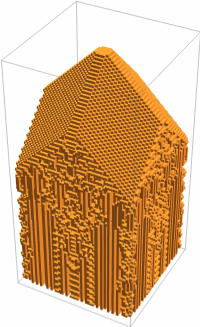
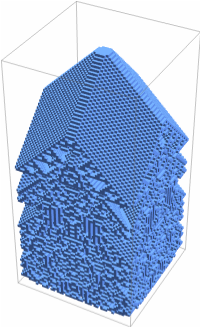
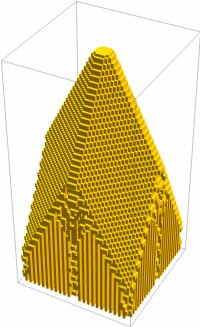
B.2. Definition of the “tower of rules” to stablish the couplilng principles between the rythms of the landscape and those of the flower
B.2. Definition of the “tower of rules” to stablish the couplilng principles between the rythms of the landscape and those of the flower
Out[]=
| ||||||||
|
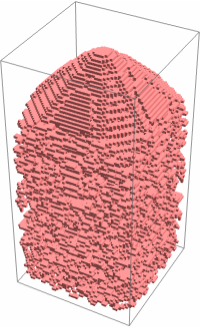
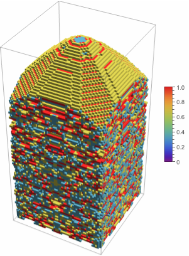
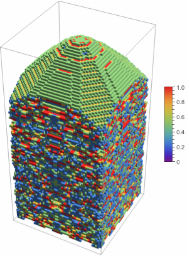
B.3. What if we transformed the rhythyms into a melody?
B.3. What if we transformed the rhythyms into a melody?
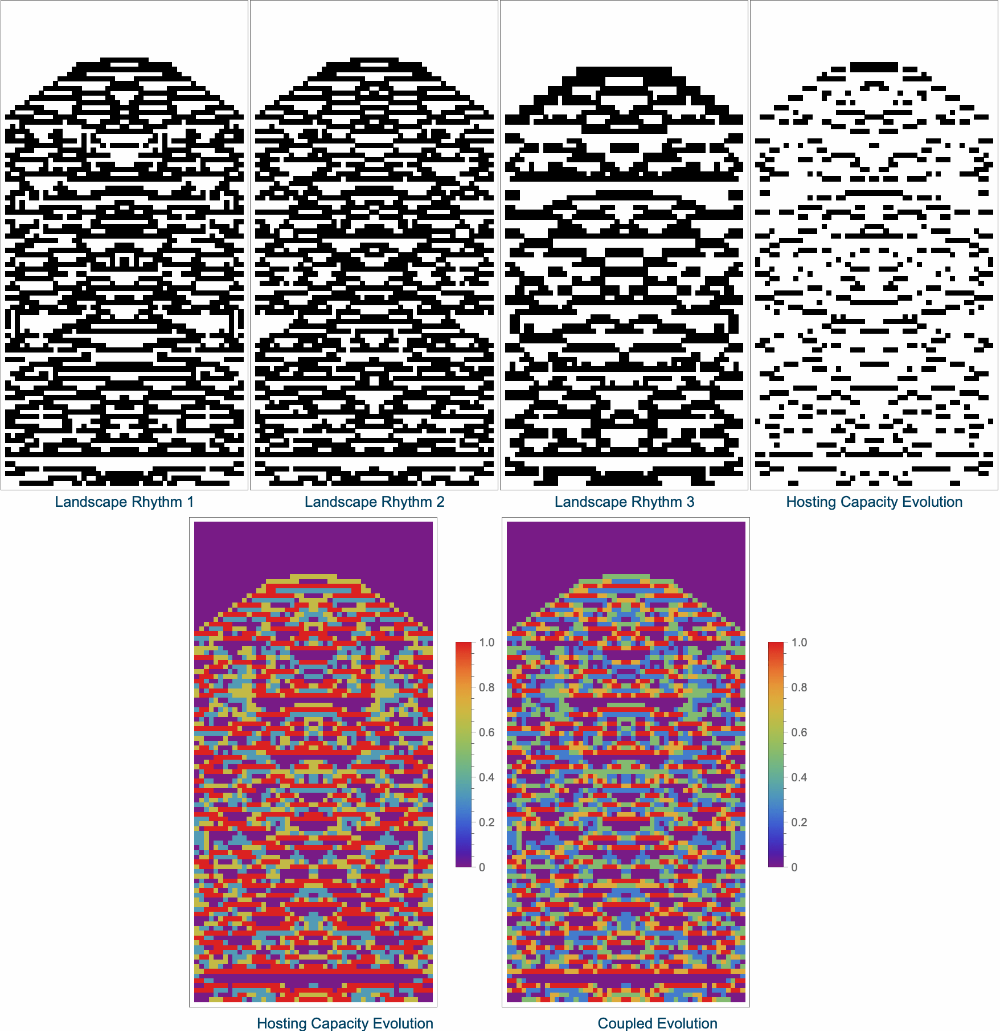
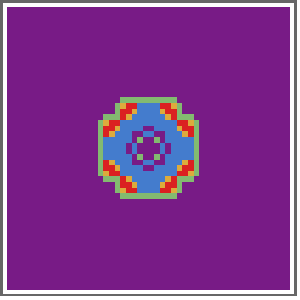
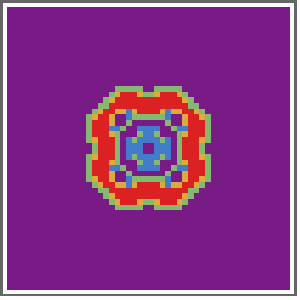
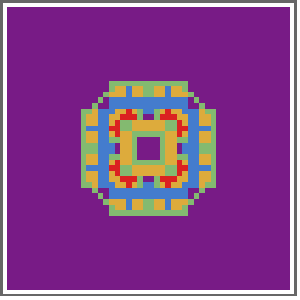
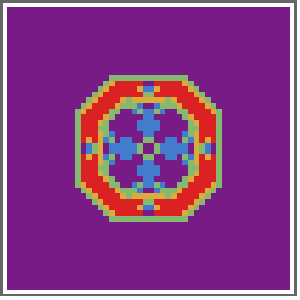
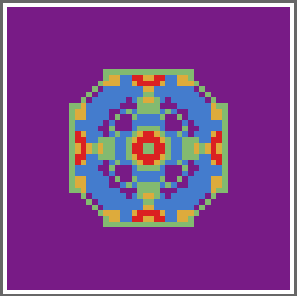
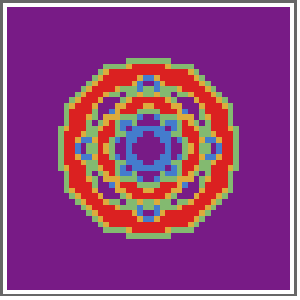
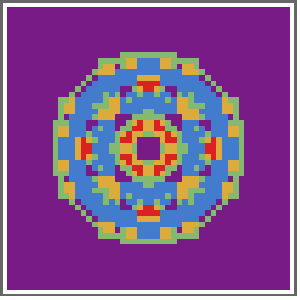
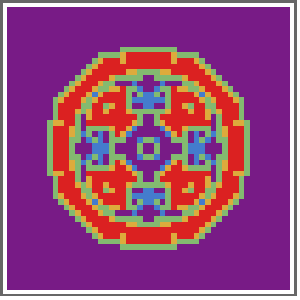
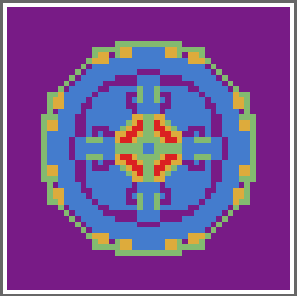
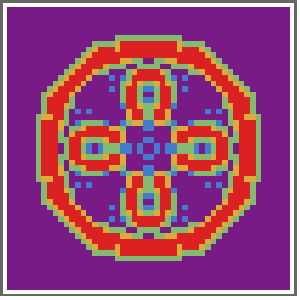
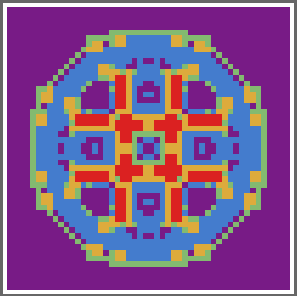
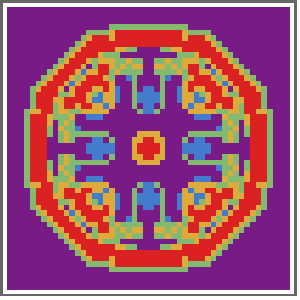
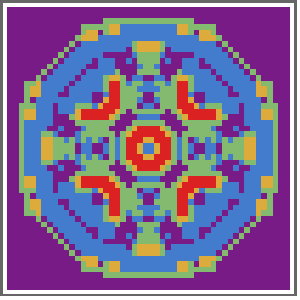
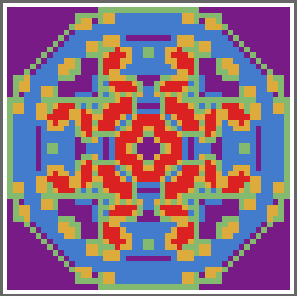
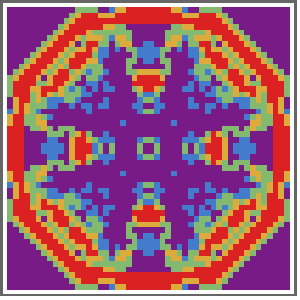
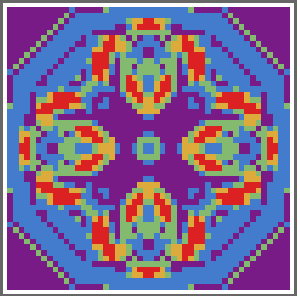
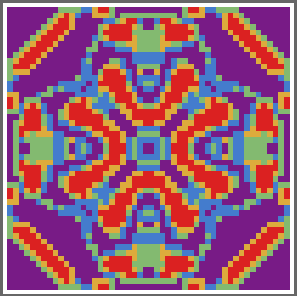
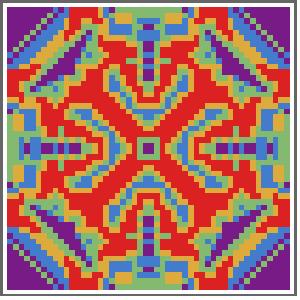
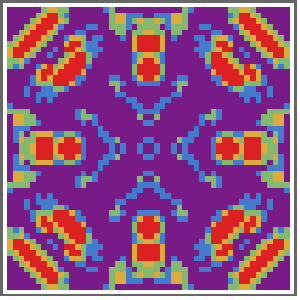
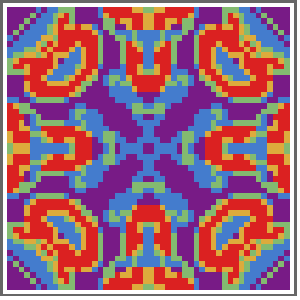
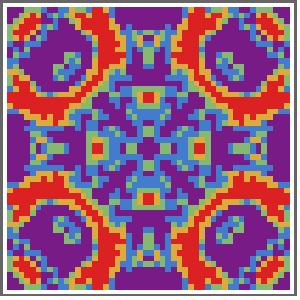
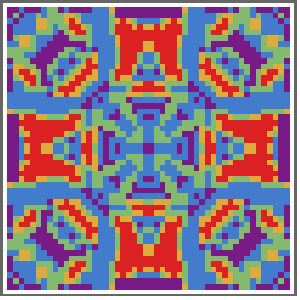
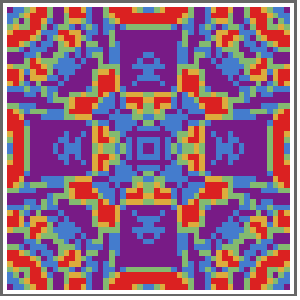
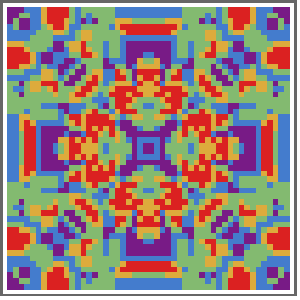
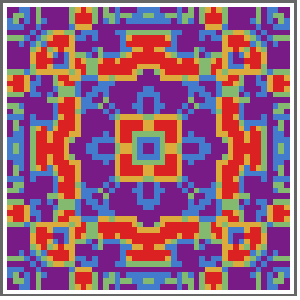
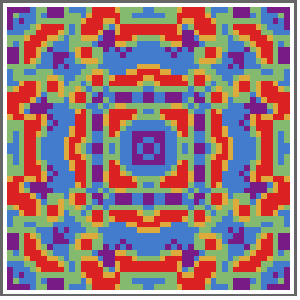
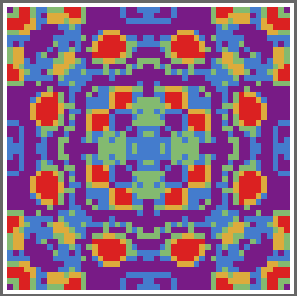
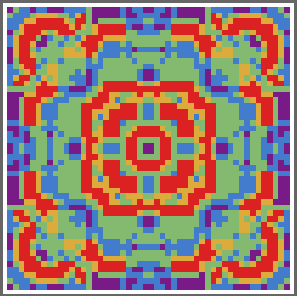
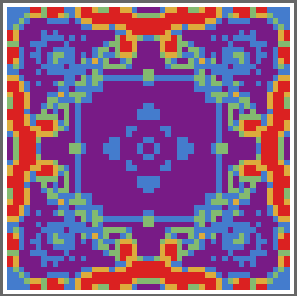
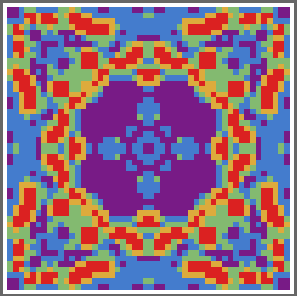
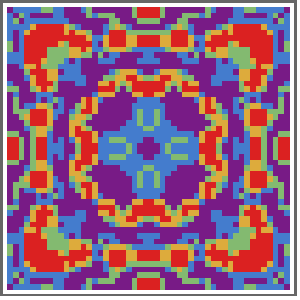
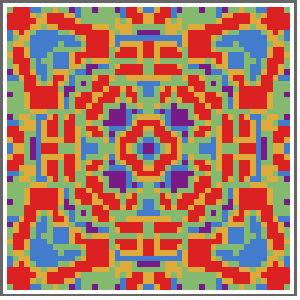
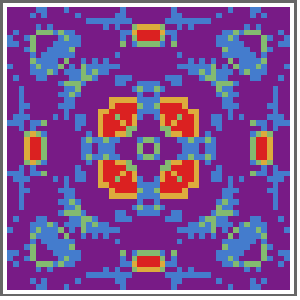
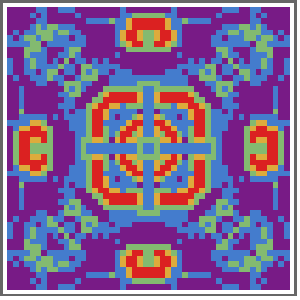
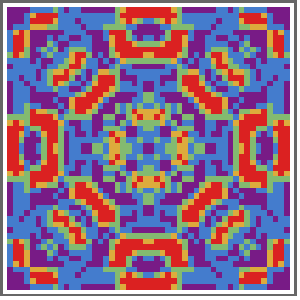
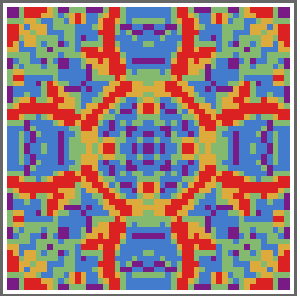
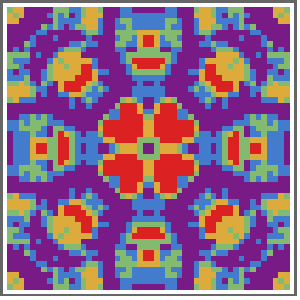
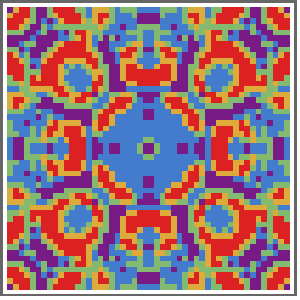
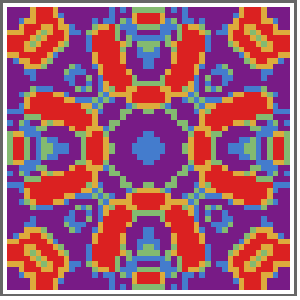
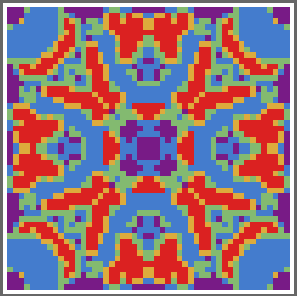
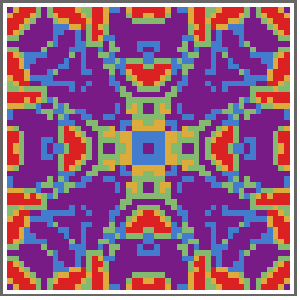
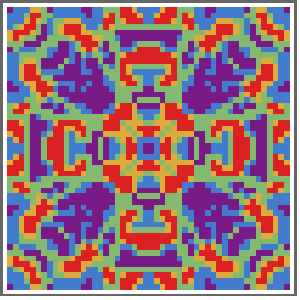
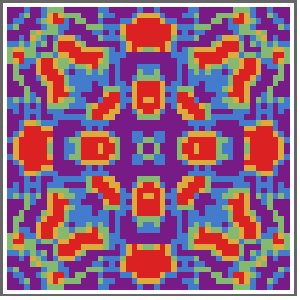
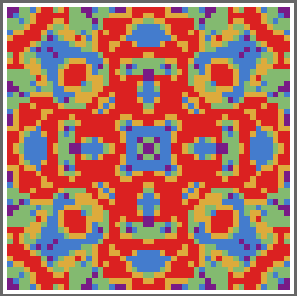
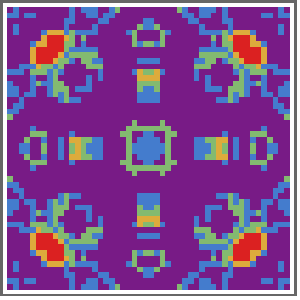
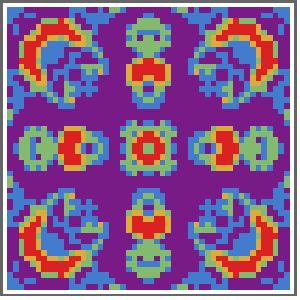
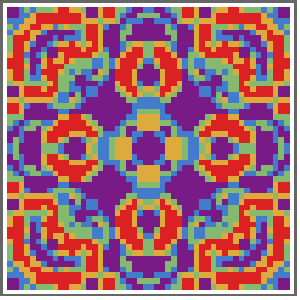
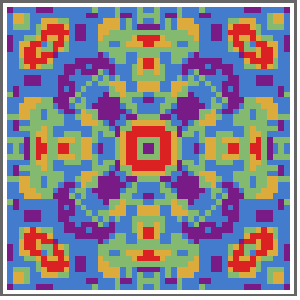
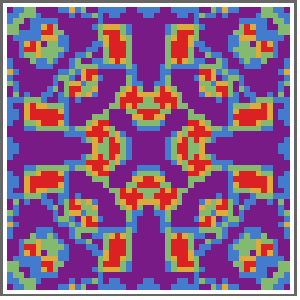
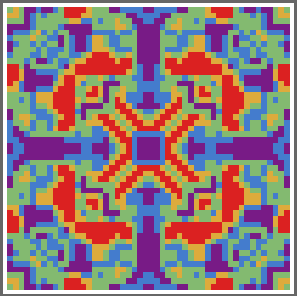
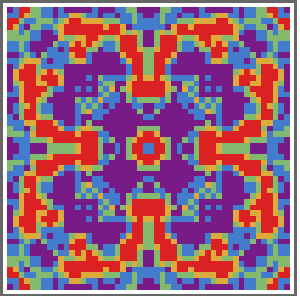
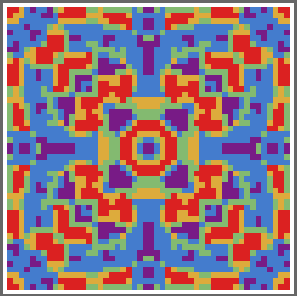
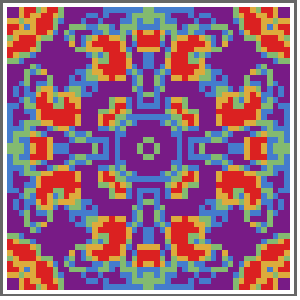
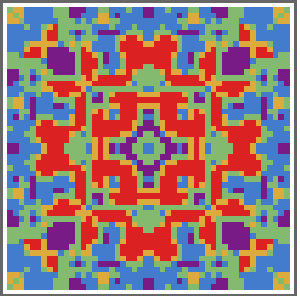
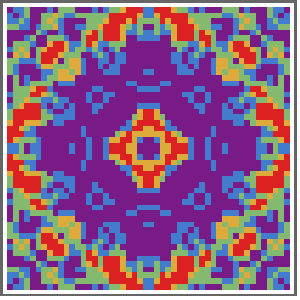
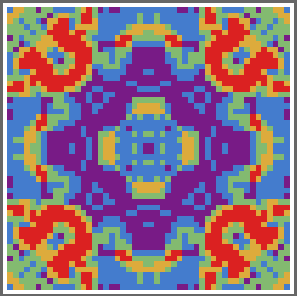
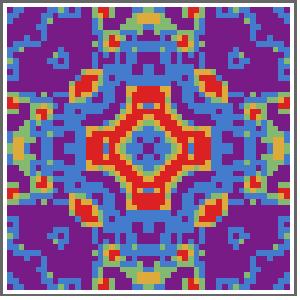
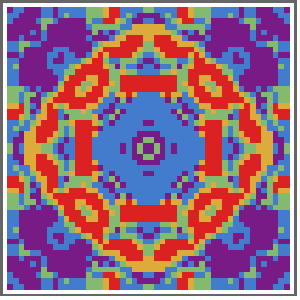
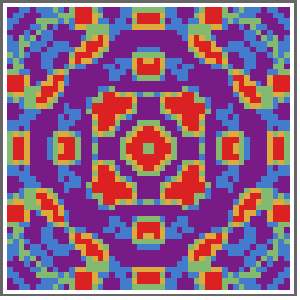
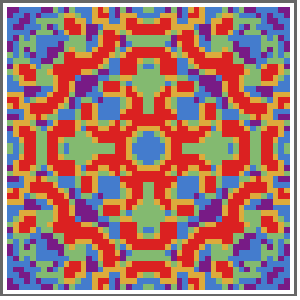
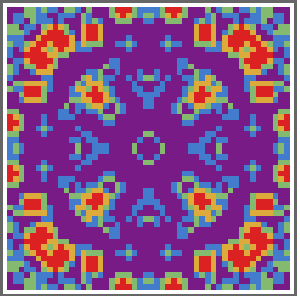
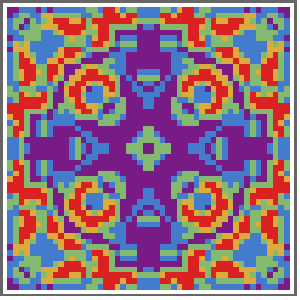
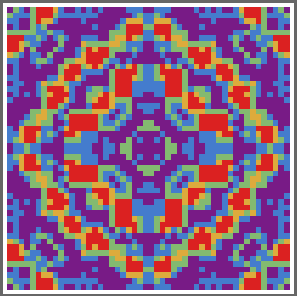
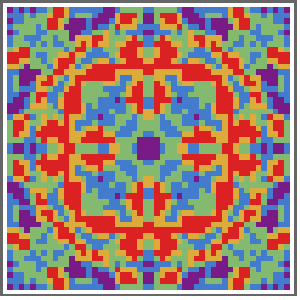
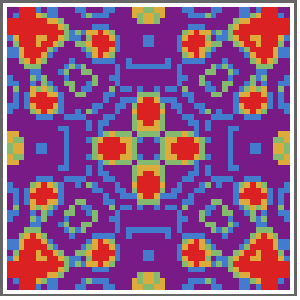
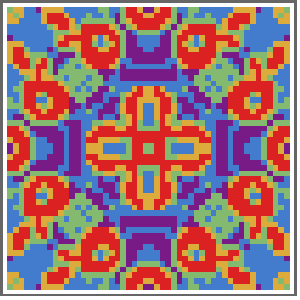
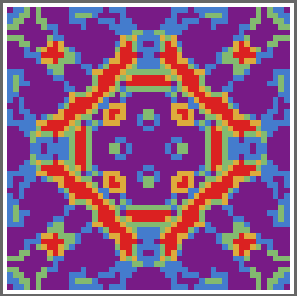
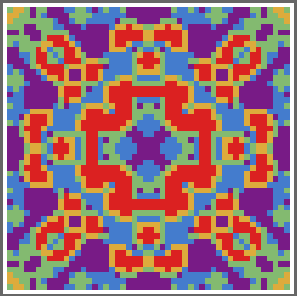
B.4. Looking at the patterns the intensity of the landscape generates
B.4. Looking at the patterns the intensity of the landscape generates
Out[]=
Coupled Evolution |

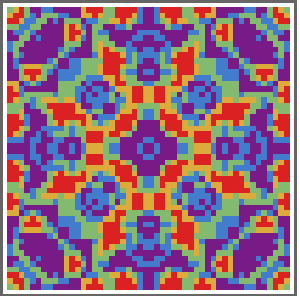
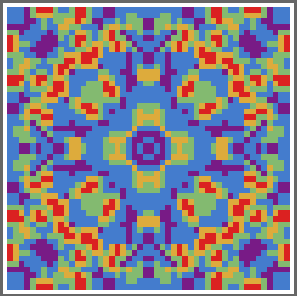
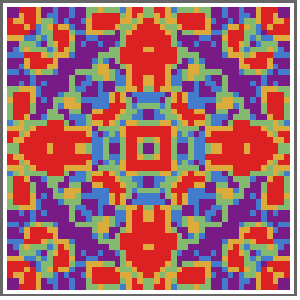
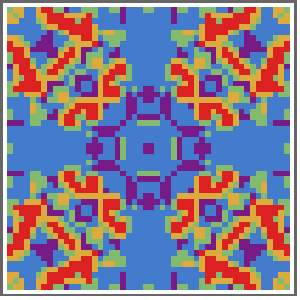
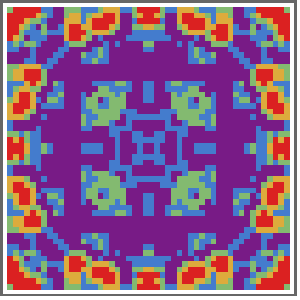
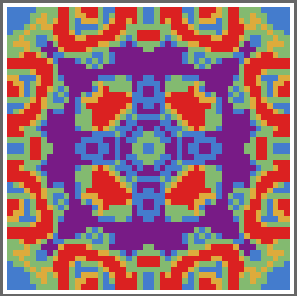
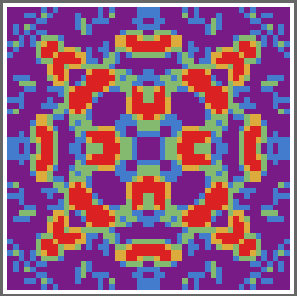
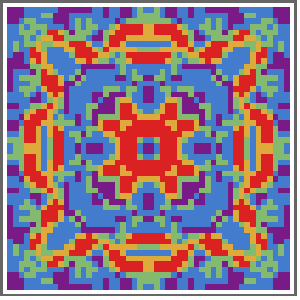
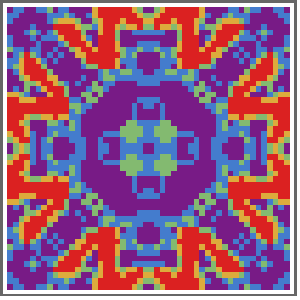
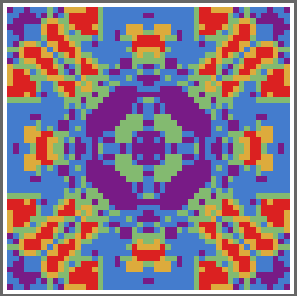
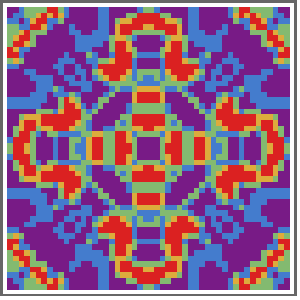
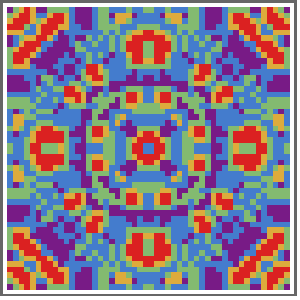
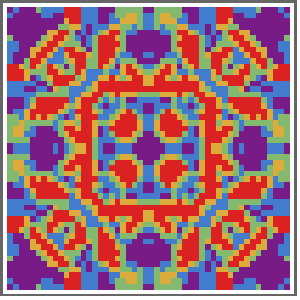
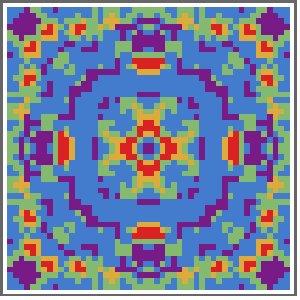
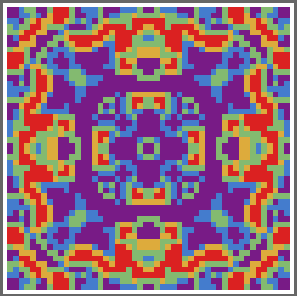
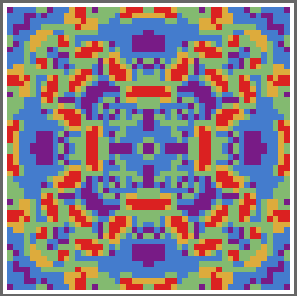

C. Textiles, the weaving hands that carry the *her*itage of the landscape (in collaboration with Júlia Campolim and Willem Nielsen)
C. Textiles, the weaving hands that carry the *her*itage of the landscape (in collaboration with Júlia Campolim and Willem Nielsen)
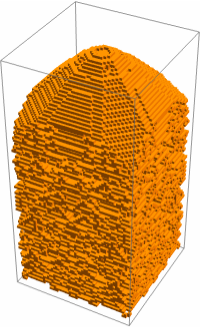
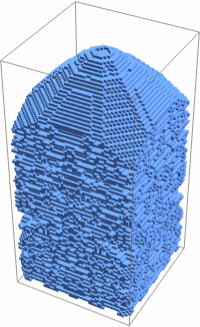
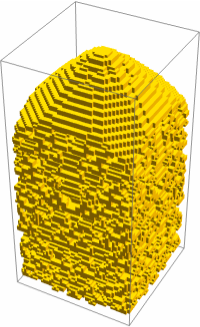
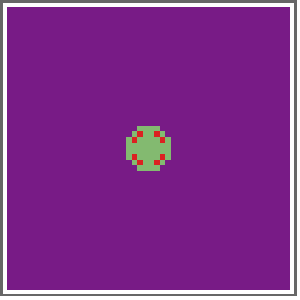
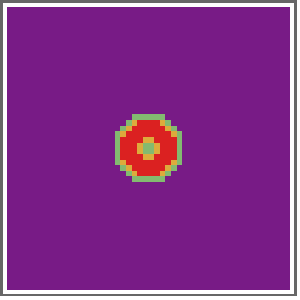
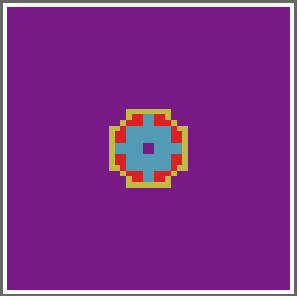
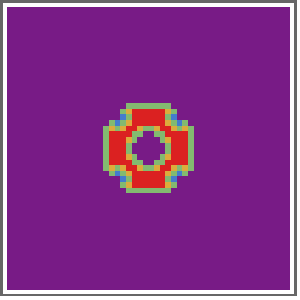
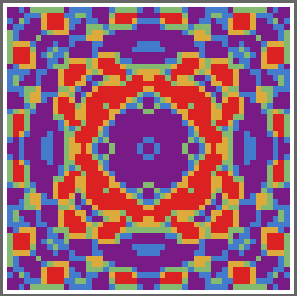
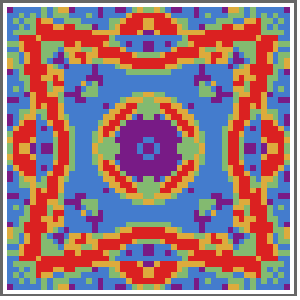
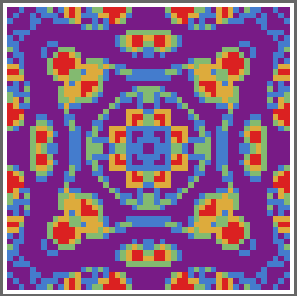
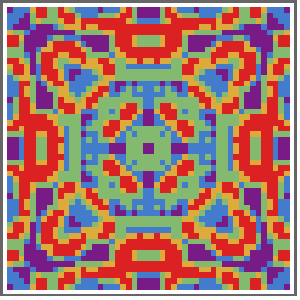
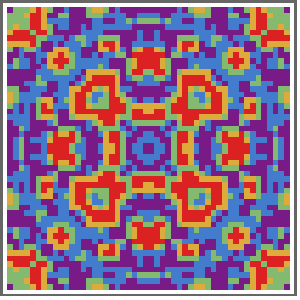
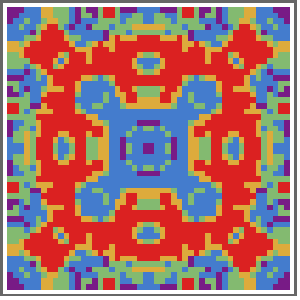
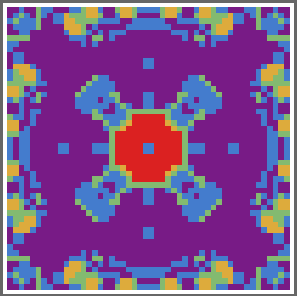
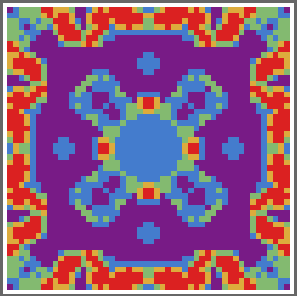
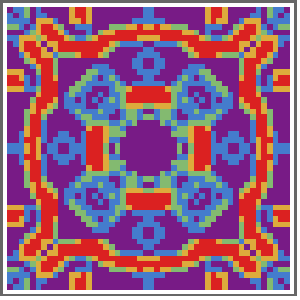
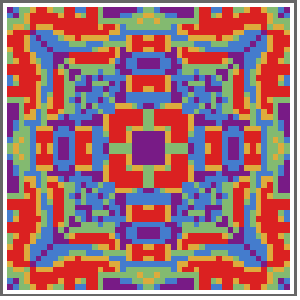
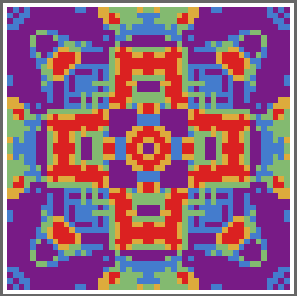
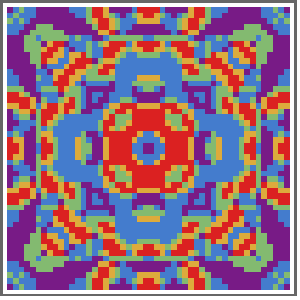
Based on Júlia Campolim (2025)’s fantastic work, showed in the above images, I realized something of a beauty I wasn’t expecting: a temporal series of cellular automaton functions like a fabric. A textile weave is precisely a network of local constraints, each thread only knows up, down, left, right, it doesn’t know the entire fabric, and yet a global structure emerges.
Therefore, textiles, those attached to any culture, those woven by women, are not just visualization, are autopietic models. Models developed by women way before computing and cellular automaton came to existence, based on the (erotic) experience of the infinite that computers cannot reproduce but that is at the core of an embodied, metabolic and homeostatic, experience of the landscape. An experience women, in the sense of a body permeable to its surroundings, any-body really, have carried out for centuries as the foundation of the *her*itage of the body-space continuum that constitutes the ethnobotany of any landscape - or phytoregion if we are to use Humbolt’s terminology in relation to the ecosystems studied under the previous section.
Therefore, in our model, temporal y-axis cuts will be made of the 3D cellular automata models were expected to be made to uncover the fabric that lays underneath the landscape under study.
To explore this idea further, I attempted to develop a second cellular automaton inspired by Júlia Campolim’s approach. While her work evolves a two-dimensional cellular automaton into a parallel geometrical form, my intention was to construct a three-dimensional cellular automaton whose temporal evolution would unfold into a perpendicular form. As a first approximation, this geometry was conceived as a simplified oval representing the Central Puna phytoregion, home to Puya raimondii, one of the most fragile and emblematic species of the ecosystem. The aim was to investigate a possible correspondence between time and textile, allowing the temporal evolution of the automaton to become woven into the geometry itself.
Unfortunately, technical limitations prevented the development of this second model, which therefore remains an avenue for future research. Nevertheless, the patterns generated by the first cellular automaton—initially interpreted as expressions of forces and intensities within the landscape—already evoke woven structures, opening a new angle on reflection around the intrinsic relationship between pattern formation, metabolic organization and women’s weaving *her*itage. A reflection where the interrelation between time, rhythm, memory and autopoietic intesity seems to be at the core.
D. Astronomical landscapes, the introduction of hypergraphs (preliminary exploration in collaboration with Alejandra Ortiz)
D. Astronomical landscapes, the introduction of hypergraphs (preliminary exploration in collaboration with Alejandra Ortiz)
While the cellular automaton makes it possible to observe how local interactions generate patterns of life preservation, hypergraphs introduce a different level of abstraction. Rather than focusing on the formation of the pattern itself, they make it possible to study how an existing pattern evolves and propagates through space as a network of relationships. In this sense, the interest of introducing hypergraphs into this research is to extend its logic beyond the local scale, allowing the autopoietic patterns already obtained to be observed as evolving relational structures in a three dimensional space.
Initially, this stage of the project aimed to investigate whether the patterns generated by the cellular automaton could themselves be systematised. The intention was to develop a method capable of recognising recurring morphologies and organising them into a larger family of evolving structures. However, the computational cost of such a process proved to be beyond the scope of the present research.
Instead, a first exploration was carried out through the observation of the hypergraphs developed within Wolfram Physics. Rather than generating new hypergraphs or defining new evolution rules, existing hypergraph structures were taken as a starting point onto which the autopoietic process described in the previous sections could be projected. In this way, the hypergraph became a support from which to observe how the intensity values obtained through the cellular automaton could propagate across a network.
Beyond this practical decision, hypergraphs were used to introduce a new conceptual perspective. Within Wolfram Physics dimensionality is intrinsic to the system itself—to the underlying network. Existing hypergraph models generally exhibit an average dimensionality of around 2.5, whereas a hypergraph capable of describing the complete causal structure of the universe would be expected to exhibit a three-dimensional structure. Although this remains part of the theoretical framework proposed by Wolfram and is not something developed within the present research, it offers an evocative way of thinking about landscape.
If the cellular automaton expresses the intensity with which a particular landscape contributes to the preservation of life, then the dimensionality emerging from the hypergraph could be interpreted, in a poetic sense, as suggesting how much of the larger cosmic network is present within that landscape. In other words, the life-preserving capacity described by the cellular automaton would refer to the local ecological conditions, while the dimensional richness of the hypergraph would hint at the degree to which those local conditions participate in a larger relational whole. This is not proposed as a measurable physical quantity but as a conceptual image linking ecological organisation with cosmological structure.
At this stage, the work remains intentionally preliminary. No new hypergraph evolution rules were written. The intensity matrix obtained from the cellular automaton was simply transferred onto existing graph structures in order to produce an initial visualisation. The modifications were limited to basic transformations of the nodes, allowing a first observation of how the autopoietic values might affect the morphology of the network.
The next step in this research would consist of defining explicit rules governing these transformations. Rather than simply assigning colours or thicknesses to the nodes, the hypergraph itself should evolve according to the ecological information generated by the cellular automaton. Similar rules could then be extended to the hyperedges, allowing colour, thickness and connectivity to become active variables within the same autopoietic process.
D.1. First attempt
D.1. First attempt
D.2. Second attempt
D.2. Second attempt
Concluding Remarks: How to build a house around a flower?
Concluding Remarks: How to build a house around a flower?
This project has explored space not as a pre-existing mathematical container but as an emergent, metabolic fabric born from continuous autopoietic interaction - those that evolved based on the needs of the most delicate element of a landscape, a flower, the main observer on this work. When considering how to translate the organic patterns and geometries generated by cellular automaton and hypergraphs into physical built environments, we must think about the purpose of spatial design practices as well as the role technology plays in the process.
As the designers Anthony Dunne and Fiona Raby (2013) argue the true potential of design lies beyond affirmative problem-solving, ergonomics, or market-driven production, against which the authors propose conceptual and speculative design acts as a critical medium—one that asks deeper questions, provokes debate, and shifts the focus from how the world is to how things could be. By using design as a catalyst for social and ecological dreaming, we can open up new perspectives on wicked problems, challenge prevailing social and ecological arrangements, and redefine our relationship to reality.
In this light introducing these algorithmically derived life-sustaining geometries as a basis for design cannot be done through a literal, mechanistic, or reductionist translation. It requires a careful, speculative approach that respects the inherent complexity of the ecosystems they model as well as of the technologies that we will need to set in motion for the building of new realities. Specifically, this spatial implementation must rigorously account for two critical dimensions: multi-temporality and multi-scalarity, or rather, the fundamentally caothic evershifting of both magnitudes.
In relation to multi-temporality, time in these models is not merely an added mathematical axis (x,y,z,t), but the very process and sedimentation that makes form possible. The intertwined ecological rhythms of water, soil, and vegetation demand a design approach that accommodates continuous temporal mutations and the sociobiological *her*itage of the landscape, rather than treating space as a static vacuum.
On multi-scalarity, the physical translation of these patterns must bridge the micro-scale of a single fragile flower’s metabolic needs with the macro-scale of the broader environment. As suggested by the shift from cellular automaton to hypergraphs, local life-preserving capacities must be woven into a larger relational and cosmological structure , treating every component as an active, interconnected metabolic unit.
Ultimately, these speculative geometries and landscapes serve as functional fictions —imaginative tools that help us step away from the logic of absolute optimization. By treating design as a form of social fiction , we can begin to envision and construct technologically built worlds where the organizing principles are anchored in rhythm, care, and continuous structural coupling.
Acknowledgements
Acknowledgements
This work has been made possible thanks to the supervision of Ellynne Dec, as well as the great programming skills and patience of Phileas Dazeley-Gaist, Júlia Campolim, Willem Nielsen, and Alejandra Ortiz. I would like to especially thank Stephen Wolfram and the Wolfram Foundation for the scholarship to attend the Summer Program. Finally, I would also like to thank the Entrecanales Foundation for covering the travel costs that allowed me to move from Buenos Aires to Boston to attend the program.
References
References
1
.Campolim (2025), “What shapes can organisms have? Studying biological evolution in the Wolfram evolution model”, available at: https://community.wolfram.com/groups/-/m/t/3496669
2
.Deleuze and Guattari (1980), Mil Mesetas: Capitalismo y esquizofrenia. Pre-Textos, Valencia.
3
.Dunne and Raby (2013), Speculative Everything: Design, Fiction, and Social Dreaming. MIT Press, Cambridge
4
.Maturana and Varela (1994), De máquinas y seres vivos. Editorial Universitaria, Santiago de Chile.
5
.Orejas (1991), “Arqueología del Paisaje: historia, problemas y perspectivas”. Archivo Español De Arqueología, 64(163-164), 191–230. https://doi.org/10.3989/aespa.1991.v64.503
6
.Tuan (1974), Topophilia: A Study of Environmental Perception, Attitudes, and Values. Prentice-Hall, Englewood Cliffs, NJ
7
.Wolfram (2017), “D’Arcy Wentworth Thompson: On Growth and Form”, available at: https://writings.stephenwolfram.com/2017/10/are-all-fish-the-same-shape-if-you-stretch-them-the-victorian-tale-of-on-growth-and-form/
8
.Wolfram (2025), “What’s special about life”, available at: https://writings.stephenwolfram.com/2025/11/whats-special-about-life-bulk-orchestration-and-the-rulial-ensemble-in-biology-and-beyond/
AI Disclosure
AI Disclosure
Although there has been attempts to dialogue with ChatGPT, Gemini and Claude IA for the conceptualization of the project, in the end there is been a realization that the knowledge needed for the development of the project exceeded LLMs capacity.
CITE THIS NOTEBOOK
CITE THIS NOTEBOOK
How to build a house around a flower? (an overview)
by Paula Botella Andreu
Wolfram Community, STAFF PICKS, July 16, 2026
https://community.wolfram.com/groups/-/m/t/3762876
by Paula Botella Andreu
Wolfram Community, STAFF PICKS, July 16, 2026
https://community.wolfram.com/groups/-/m/t/3762876