Bell's Equation and Inequality is well established in the physics community with 5 Sigma experimental verification. The purpose of this project is to demonstrate that Bell's Equation can be simulated in the Wolfram Model environment using the Multiway formalism. This will demonstrate that not only can Bell's Equation and fundamental aspects of the quantum world be demonstrated in the discrete Wolfram Model formalism, but also, new understandings can be derived.
Abstract: First, Bell‘s equation and inequality will be derived and simulated using standard formalism based on Duarte and Aspect's literature. Then, a simulation of the Bell experiment will be made using the Multiway formalism, and the results will show that they are equivalent with the standard approach. In order to accomplish this goal, new capabilities had to be added to the QuantumToMultway tools in order to handle the integration of continuous polarization measurements into the Multiway formalism. New aspects brought to light by the Wolfram Multiway graphs will be enumerated and discussed. Simulations were carried out both in the simple 2D basis, as well as the 4D Quantum Bell basis. In conclusion, by having the new tools which allow polarization measurements to be passed to the multiway system, not only could a huge variety of graphs be generated, but also, Bell's equation could be entered directly into the multiway system to generate the same graphs, thereby proofing their equivalence.
Abstract: First, Bell‘s equation and inequality will be derived and simulated using standard formalism based on Duarte and Aspect's literature. Then, a simulation of the Bell experiment will be made using the Multiway formalism, and the results will show that they are equivalent with the standard approach. In order to accomplish this goal, new capabilities had to be added to the QuantumToMultway tools in order to handle the integration of continuous polarization measurements into the Multiway formalism. New aspects brought to light by the Wolfram Multiway graphs will be enumerated and discussed. Simulations were carried out both in the simple 2D basis, as well as the 4D Quantum Bell basis. In conclusion, by having the new tools which allow polarization measurements to be passed to the multiway system, not only could a huge variety of graphs be generated, but also, Bell's equation could be entered directly into the multiway system to generate the same graphs, thereby proofing their equivalence.
Code
Code
Quantum Measurements and Derivation of Bell’s Equation & Inequality
Quantum Measurements and Derivation of Bell’s Equation & Inequality
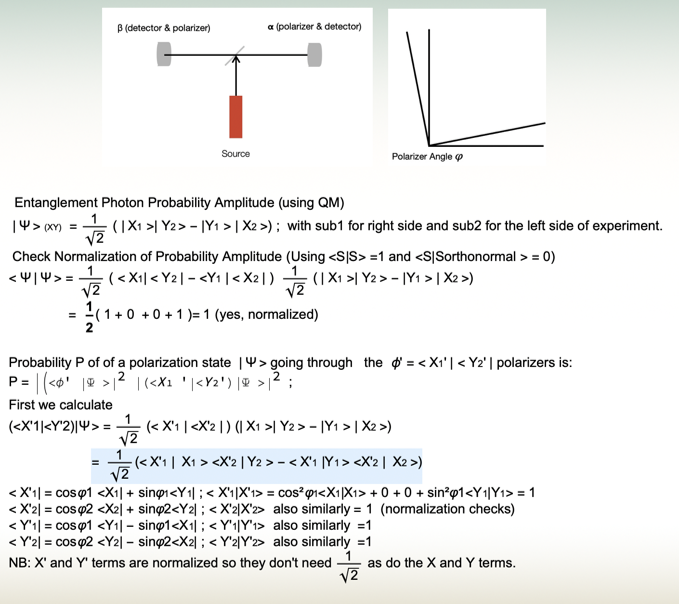
Measurement of entangled photons
Measurement of entangled photons
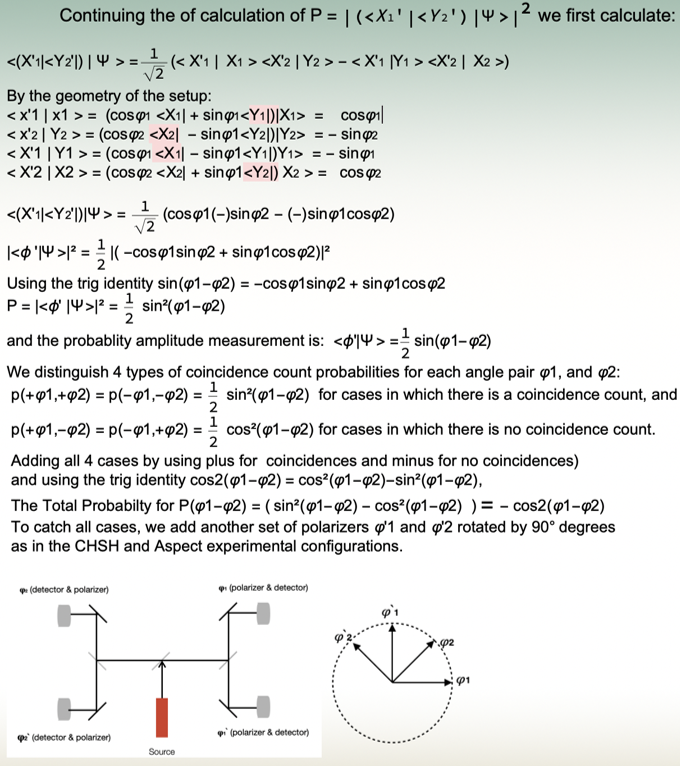
Derivation of Bell’s Equation; Graphing the Curve
Derivation of Bell’s Equation; Graphing the Curve
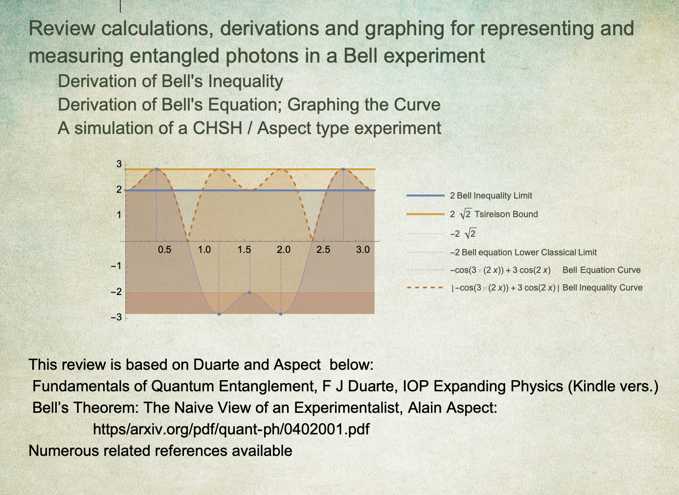
Derivation of Bell’s Inequality
Derivation of Bell’s Inequality
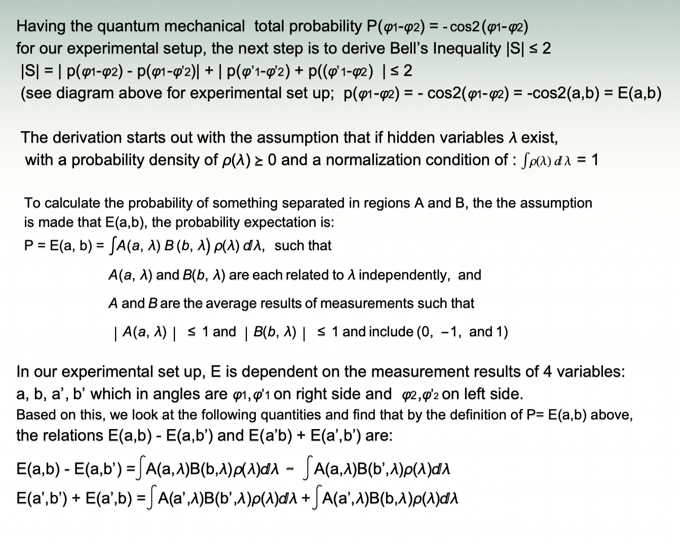
Derivation of Bell’s Equation and Curve Graph
Derivation of Bell’s Equation and Curve Graph
Continuation of Bell’s Equation and Curve Graph
Continuation of Bell’s Equation and Curve Graph
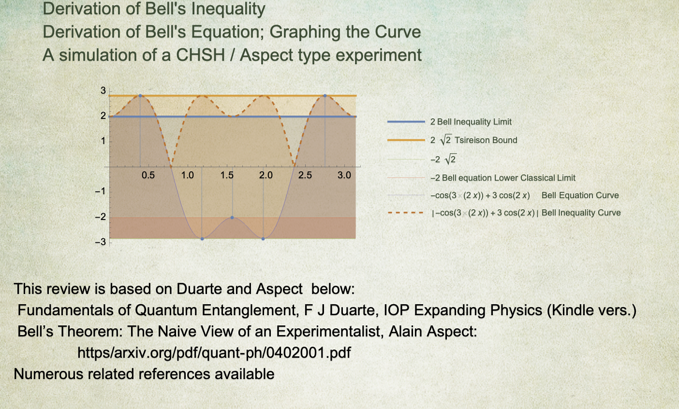
3 maxima and 4 minima (including those at graph edges
Graphing Bell’s Equation for photons (0 to π)
Graphing Bell’s Equation for photons (0 to π)
Bell’s Equation and Inequality graphed Together
Bell’s Equation and Inequality graphed Together
A “simulation“ of a 2nd generation Aspect experiment
A “simulation“ of a 2nd generation Aspect experiment
Imagine a Bell Inequality CHSH type experiment yielding the following data
Simulating the data fit in a Bell Inequality Graph
Simulating the data fit in a Bell Inequality Graph
(Dotted line is Bell's Inequality)
A simulation of CHSH-Aspect type experiments using Wolfram Multiway graphs
A simulation of CHSH-Aspect type experiments using Wolfram Multiway graphs
(Using the Newly Developed angle data transfer functionality)
Having the Multiway angle transfer capability yields an extremely rich variety of Multiway graphs (movies?)
Having the Multiway angle transfer capability yields an extremely rich variety of Multiway graphs (movies?)
The proof of the pudding comes from comparing specific Bell’s Equation output graphs to angle measurement graphs:
Using Bell’s Equation as a Multiway operator can generate the exact same graph sets as X`Y`angle measurement operator .
We shall see that in some cases below, all the graphs in the output sequence are identical, showing equivalence between the two.
Using Bell’s Equation as a Multiway operator can generate the exact same graph sets as X`Y`angle measurement operator .
We shall see that in some cases below, all the graphs in the output sequence are identical, showing equivalence between the two.
Below is the simplest form of Bell’s Equation where α = β.
This equation is generating the same forms as using separate alpha and beta Y`, X` measurement angles:
This equation is generating the same forms as using separate alpha and beta Y`, X` measurement angles:
Above is the Simplest Form of Bell’s Equation with α = β = 4Pi/8. This condition generates the
same graphs as those below, with alpha & beta angles of X`= Pi/8 and Y`= 3Pi/8Y`angle measurements.
The Wolfram Multiway method demonstrates the equivalence of Bell’s Equation and experimental angle measurements.
same graphs as those below, with alpha & beta angles of X`= Pi/8 and Y`= 3Pi/8Y`angle measurements.
The Wolfram Multiway method demonstrates the equivalence of Bell’s Equation and experimental angle measurements.
Graphs using a 4D basis and EvolutionEventsGraphStructure are shown below:
Concluding remarks
Concluding remarks
This project has demonstrated that the discrete Wolfram Multiway method can duplicate and shed light on the subtle aspects of quantum mechanics from both a locality and a non-realism perspective. It appears that the project is just starting, rather than ending. My hope is that with this start, it should be possible to discover new areas. One subtle point that is often ignored in Bell experiments is that the single non-coincident data half is ignored. This non-coincident data is like the interference patterns that show up in a double slit experiment when the intensity is turned down and only single photons are incident on the "screen" one by one. Perhaps exploration and measurements of "single photon" correlation in a Bell's experiment will shed some light on the nature of quantum mechanics and applications where the non-cloning law might be circumvented...
Future Exploration and Development
Future Exploration and Development
Because the Wolfram Multiway environment and ZX calculus is quickly evolving, everyone is waiting in great anticipation to the time in which the tools are available to easily perform their exploration. Two areas which are particularly interesting to this work is the ability to pass variable measurement values and results between the ZX area, the quantum area, and the multiway area. In this respect, it was exceedingly great that it was possible to send specific polarization angles from the quantum toolset to the multiway graph toolset. It would be great to have general functions (e.g. Sine and Cosine) to be passed along in their general unevaluated form as well. The other area which is fast developing are the ZX tools.
One additional area that could help in the development of both ZX tools and Multiway tools is the requirement to add new symbols to keep the evolution from stopping. In the experiments above, it was found that by replacing zeros with fractional values of both imaginary and real numbers such as 0.05i or 0.05 helped the representation of the phenomenon to continue without having to change bases. (The examples above show that by using this technique, the user can avoid a lot of tedious work. Perhaps the software could take care of this. This same problem also comes up when creating ZX diagrams.
Keywords
Keywords
◼
Bell's Equation, Bell's Inequality
◼
Entanglement
◼
ZX Calculus
Acknowledgment
Acknowledgment
My deepest gratitude goes to Stephen Wolfram for providing the encouragement, tools, and environment to study physics seriously again after so many years. Also to my Mentor, Hatem Elshatlawy, who above everything else, worked with Max Piskunov to develop updates to bring continuous polarization angle measurements into the QuantumToMultiwaySystem tool. I am also indebted to Jonathan Gorard, Xerxes Arsiwalla, and Manojna Namuduri for bringing me into the 21st century. Finally, all respect to my colleague, Takashi Yoneyama in Japan, who suggested that we study entanglement together and started me studying . (A big thank you to all the helpful WSS staff members: Erin, Danielle, and Jesse who were there in so many ways.)
References
References
◼
Bell's Theorem: The Naive View of an Experimentalist, Alain Aspect: https://arxiv.org/ftp/quant-ph/papers/0402/0402001.pdf
◼
Fundamentals of Quantum Entanglement, F J Duarte, IOP Expanding Physics (Kindle vers.)
◼
Marissa Giustina: Significant loophole-free test of Bell’s theorem with entangled photons: https://www.youtube.com/watch?v=tgoWM4Jcl-s
◼
Cosmic Bell Test Using Random Measurement Settings from High-Redshift Quasars, Dominik Rauch, Johannes Handsteiner, Armin Hochrainer, Jason Gallicchio, Andrew S. Friedman, Calvin Leung, Bo Liu, Lukas Bulla, Sebastian Ecker, Fabian Steinlechner, Rupert Ursin, Beili Hu, David Leon, Chris Benn, Adriano Ghedina, Massimo Cecconi, Alan H. Guth, David I. Kaiser, Thomas Scheidl, and Anton Zeilinger, Phys. Rev. Lett. 121, 080403 – Published 20 August 2018