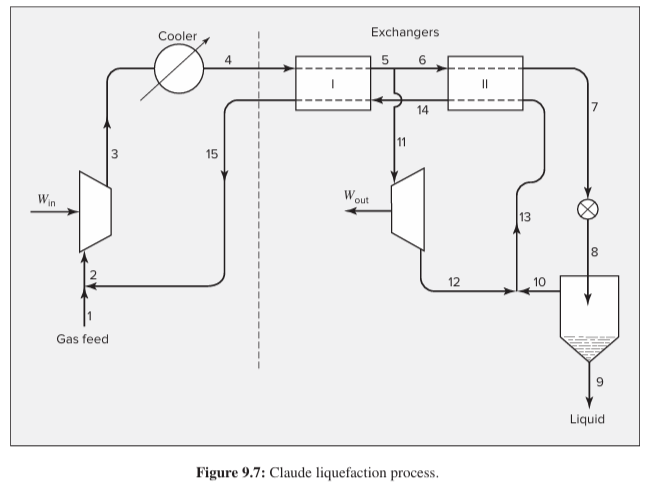
This problem is reproduced from Example 9.3 of Ref. 1.Methane is liquefied in a Claude process . Compression is to 60 bar and pre-cooling is to 300 K . The expander and throttle exhaust to a pressure of 1 bar . Recycle methane at this pressure leaves the exchanger system (point 15 in Figure below) at 295 K . We assume no heat leaks into the system from the surroundings, an expander efficiency of 75 %, and an expander exhaust of saturated vapor. For a draw-off to the expander of 25 % of the methane entering the exchanger system (x = 0.25), we determine the fraction z of the methane that is liquefied, as well as the temperature of the high-pressure stream entering the throttle valve (i.e., T7) . The quantity (x) is a design variable and must be specified before one can be solve for z. Finally, we perform a parametric study for this Claude liquefaction process in order to show numerically the effect of changing the draw-off ratio x on other process variables.
Thermophysical Properties of METHANE from: https://webbook.nist.gov/cgi/fluid.cgi?ID=C74828&Action=Page
saturation properties - temperature increment = 5 K
Temperature (K), Pressure (bar), Enthalpy (kJ/kg), Entropy (J/g*K), Enthalpy (kJ/kg), Entropy (J/g*K)
Temperature (K), Pressure (bar), Enthalpy (kJ/kg), Entropy (J/g*K), Enthalpy (kJ/kg), Entropy (J/g*K)
datasat=;
In[]:=
tblhl=Table[{datasat[[i]][[2]],datasat[[i]][[3]]},{i,1,Length[datasat]}];tblsl=Table[{datasat[[i]][[2]],datasat[[i]][[4]]},{i,1,Length[datasat]}];
In[]:=
fhl=Interpolation[tblhl];fsl=Interpolation[tblsl];
In[]:=
tblhv=Table[{datasat[[i]][[2]],datasat[[i]][[5]]},{i,1,Length[datasat]}];tblsv=Table[{datasat[[i]][[2]],datasat[[i]][[6]]},{i,1,Length[datasat]}];
In[]:=
fhv=Interpolation[tblhv];fsv=Interpolation[tblsv];
In[]:=
tbltp=Table[{datasat[[i]][[2]],datasat[[i]][[1]]},{i,1,Length[datasat]}];
In[]:=
fpt=Interpolation[tbltp];
In[]:=
fpt[1]
Out[]=
111.473
In[]:=
H12=fhv[1]
Out[]=
510.504
In[]:=
H9=fhl[1]
Out[]=
-0.658638
In[]:=
S12=fsv[1]
Out[]=
4.58013
isobaric properties - pressure = 60 bar
{Temperature (K), Pressure (bar), Enthalpy (kJ/kg), Entropy (kJ/kg*K), State)}
{Temperature (K), Pressure (bar), Enthalpy (kJ/kg), Entropy (kJ/kg*K), State)}
dataisobaric=;
In[]:=
pos=Position[dataisobaric,191.32]
Out[]=
{{113,1}}
In[]:=
tblhCOMP=Table[{dataisobaric[[i]][[1]],dataisobaric[[i]][[3]]},{i,1,Length[dataisobaric]}];tblsCOMP=Table[{dataisobaric[[i]][[1]],dataisobaric[[i]][[4]]},{i,1,Length[dataisobaric]}];
In[]:=
fhCOMP=Interpolation[tblhCOMP];fsCOMP=Interpolation[tblsCOMP];
In[]:=
H4=fhCOMP[300]
Out[]=
855.296
isobaric properties - pressure = 1 bar
{Temperature (K), Pressure (bar), Enthalpy (kJ/kg), Entropy (kJ/kg*K), State)}
{Temperature (K), Pressure (bar), Enthalpy (kJ/kg), Entropy (kJ/kg*K), State)}
dataisobaric=;
In[]:=
pos=Position[dataisobaric,111.51]
Out[]=
{{25,1},{26,1}}
In[]:=
tblhP1BAR=Table[{dataisobaric[[i]][[1]],dataisobaric[[i]][[3]]},{i,26,Length[dataisobaric]}];tblsP1BAR=Table[{dataisobaric[[i]][[1]],dataisobaric[[i]][[4]]},{i,26,Length[dataisobaric]}];
In[]:=
fhP1BAR=Interpolation[tblhP1BAR];fsP1BAR=Interpolation[tblsP1BAR];
In[]:=
H15=fhP1BAR[295]
Out[]=
902.945
In[]:=
S12v=fsv[1]
Out[]=
4.58013
In[]:=
S12l=fsl[1]
Out[]=
-0.00611638
In[]:=
EQ1=H12-H5-0.75(H12rev-H5)==0
Out[]=
510.504-0.75(H12rev-H5)-H50
In[]:=
EQ2=QUALITYrev==(fsCOMP[T5]-S12l)/(S12v-S12l)
Out[]=
QUALITYrev0.2180430.00611638+InterpolatingFunction[T5]


In[]:=
EQ3=H12rev==H9+QUALITYrev(H12-H9)
Out[]=
H12rev-0.658638+511.162QUALITYrev
In[]:=
EQ4=H5==fhCOMP[T5]
Out[]=
H5InterpolatingFunction[T5]

We compute T5, H5, quality, and H12rev using {EQ1, EQ2, EQ3, EQ4}
In[]:=
sol=FindRoot[{EQ1,EQ2,EQ3,EQ4},{T5,260},{H12rev,500},{H5,750},{QUALITYrev,0.8}]
Out[]=
{T5252.395,H12rev439.759,H5722.738,QUALITYrev0.8616}
In[]:=
x=0.25;
We get the fraction of the methane, which is liquefied or z:
z = 11.15 % when x or draw-off to the expander = 0.25
z = 11.15 % when x or draw-off to the expander = 0.25
In[]:=
z=(x(H12−H5)+H4−H15)/(H9−H15)/.sol
Out[]=
0.111451
H14
In[]:=
H14=(H5−H4)/(1-z)+H15/.sol
Out[]=
753.76
T14
In[]:=
FindRoot[fhP1BAR[T]==753.760,{T,600}]
Out[]=
{T226.059}
H7
In[]:=
H7=H5-(1-z)/(1-0.25)(H14-H12)/.sol
Out[]=
434.544
T7
In[]:=
FindRoot[fhCOMP[T]==H7,{T,600}]
Out[]=
{T199.36}
We get the fraction of the methane, which is liquefied or z:
z = 5.27 % for x = 0 (Linde process)
z = 5.27 % for x = 0 (Linde process)
In[]:=
z=(0.0(H12−H5)+H4−H15)/(H9−H15)/.sol(*YourecovertheparicularcaseofLindeProcessbysettingx=0*)
Out[]=
0.0527319
H7
In[]:=
H7=H5-(1-z)/(1-0.0)(H14-H12)/.sol
Out[]=
492.309
T7
In[]:=
FindRoot[fhCOMP[T]==H7,{T,600}]
Out[]=
{T202.747}
In[]:=
x=.;
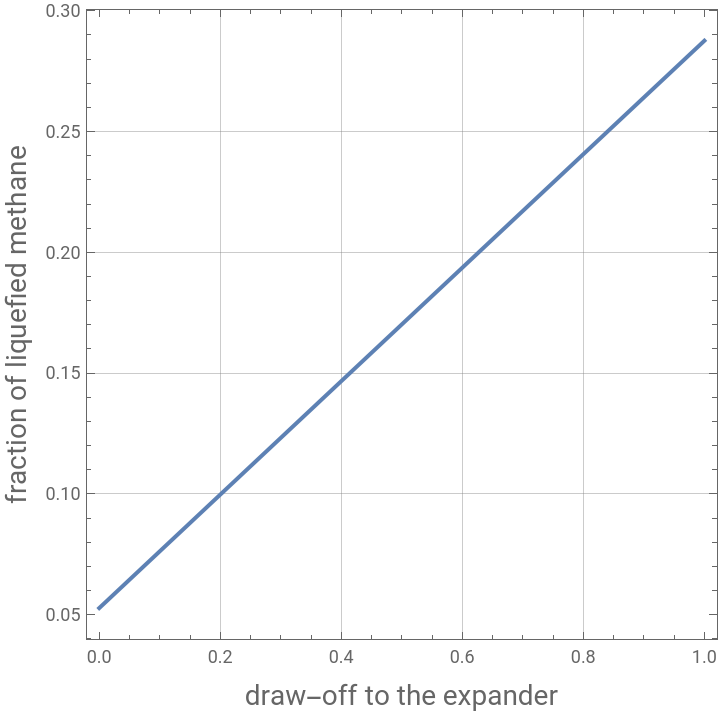
Parametric study for this Claude liquefaction process shows the effect of changing the draw-off ratio x on other process variables such as z.
In[]:=
Plot[(x(H12−H5)+H4−H15)/(H9−H15)/.sol,{x,0,1},Frame->True,AspectRatio->1,GridLines->Automatic,FrameLabel->{Style["draw-off to the expander",14],Style["fraction of liquefied methane",14]}]
Out[]=
References
References
◼
[1] J.M. Smith, Hendrick Van Ness, Michael Abbott and Mark Swihart, Introduction to Chemical Engineering Thermodynamics, 9th Edition, NY: McGraw Hill, 2022.
CITE THIS NOTEBOOK
CITE THIS NOTEBOOK
Claude process for Methane liquefaction
by Housam Binous and Ahmed Bellagi
Wolfram Community, STAFF PICKS, February 1, 2025
https://community.wolfram.com/groups/-/m/t/3375002
by Housam Binous and Ahmed Bellagi
Wolfram Community, STAFF PICKS, February 1, 2025
https://community.wolfram.com/groups/-/m/t/3375002