Abstract: We find spin networks with support on multiway branchial graphs, then we solve as a constraint for SU(3) representations that have support on the same base spin network. The interpretation of SU(3) representations network respecting their respective intertwiners at nodes is that of a charge network over the spin quantum number one. We implemented new functions to compute N-valent intertwiner for both SU(3) and SU(2) or SO(3) as well as a natural way to assign labels to branchial graphs from the causal structure in line with its quantum mechanics interpretation suggesting good asymptotics in the large spin/charge quantum number limit - here the large graph updating limit.
1 From Branchial Graphs to Spin Network Structure in a Simple Way
1 From Branchial Graphs to Spin Network Structure in a Simple Way
The Wolfram physics project suggested the Wolfram model as being a significant generalization of the concept of a spin network or spin foam in loop quantum gravity [1].However, with the crucial distinction that all salient algebraic and geometrical features of Wolfram model systems are purely emergent [1]. One idea to address the emergence of spin foam from Wolfram multiway systems recently proposed was to find a rule that generates a hypergraph as desired (tetrahedral populated edge to edge) and then attach the associated group and algebraic structures to compute quantum gravity amplitudes. But to find such a rule was a major difficulty in the implementation [2]. We implement a general N-valent intertwiner spin network on non-regular graphs, which allows us to address more general structures. Spin networks are about coupling and decomposition of tensorial representations of compact Lie groups and Lie algebras, which are direct related to quantum mechanics states.The place to look for connection of those states on multiway systems is with the branchial graphs where the connection with quantum mechanics is proposed to happen [3,4]. One of the mathematical roots of quantum mechanics is on the root system of Lie algebras [5], which generalize the SU(2) representation theory. In this spirit we generalize SU(2) spin networks to SU(3) ones, which could be more appropriated called charge network. But we implement a constraint that the spin network need to have support on branchial graph and the charge network must have support on the spin network, which is possible by solving one constraint equation for SU(3) labels over a SU(2) sub-group basis [6,7]. To give some more motivation, from loop quantum gravity results, a quantum state of geometry can be given by tri- or four-valent spin network states , where the notation is to assign spin j's to edges and additional number k, for the four-valent ones, to nodes of a graph . The full state is given by the superposition of all allowed combinations of j's and k's in SU(2) representation theory constrained by the triangular inequality and some other constraints on the nodes, (). is given explicitly by associating Wigner matrices to edges and Wigner 3j-symbol to nodes. For the four valent node there are two 3j-symbols coupled with a common internal indices k. We explore a generalization to arbitrary valence nodes on non-regular graphs: ().......()...() (1)where the indices q indexes the internal indices of the node space (for four-valent is 2, for five-valent is 3 and so on), the indices l is for the edges, where the notation is to specify the specific m's for the correct valence, having L edges with group elements and N nodes in the graph. The question about the minimum spin configurations for a general graph that give a valid spin network can be addressed by different algorithm but we are interested in connections with multiway systems. The multiway systems as an underlying pre-physical abstract substrate is a kind of system where the representations and the things that should be represented must be the same to be part of the reality engine. In this spirit we are looking for an additional constraint on the quantum gravity spin network states and in the multiway system. The constraint is that the spin number labeling configuration need to have support on the underlying causal and branchial structure. We call a multiway branchial graph from a causal multiway system by and a valid edge weight configuration from the causal and branchial structure by . A more elaborated problem is to find that gives a minimum spin network covering and then to find rules that evolve the graph such that always correspond to valid spin networks. The general problem we leave for future investigations and here we provide a simple example where we can implement the constraint and have explicitly examples of states ()~(). (2)Let us start, for simplicity, choosing a integer label decoration of a branchial graph from multiway substitutions systems (considering SO(3) instead of the full SU(2) for simplicity). The decoration will be given from the states graph. The magnitude on edges will be given by the number of ancestors in common at first backwards level. And we will choose rules that is already known to be causal invariant because any possible interpretation of branchial graphs in terms of common ancestors depends on having causal invariance.
Γ
Ψ
j,k
Γ
Γ
Ψ
U
l
∑
j,{k}
C
j,{k}
Γ
Ψ
j,{k}
Γ
Ψ
j,k
Γ
Ψ
j,{k}
U
l
1
{}
m
i
ι
k
1
1
k
1
q1
l
{}
m
i
ι
k
l
1
k
N
ql
j
1
D
{m}
′
m
1
U
1
j
L
D
{m}
′
m
L
U
L
l
{}
m
i
U
l
w
Γ
W()
w
Γ
W()
w
Γ
W()
w
Γ
Γ
Ψ
j,{k}
U
l
w
Γ
Ψ
W{j,{k}}
U
l
In[]:=
BranchialEdgeLabelsFromCausalGraph[gbranchial_,gcausal_]:=With[{vertexCausalIncidentsAdjacents=Map[AdjacencyList[gcausal,#]&,AdjacencyList[gbranchial,#]&/@VertexList[gbranchial],{2}],vertexCausalIncidentsCentral=AdjacencyList[gcausal,#]&/@VertexList[gbranchial]},Table[Table[Length[Intersection[vertexCausalIncidentsCentral[[i]],vertexCausalIncidentsAdjacents[[i]][[j]]]],{j,1,Length[vertexCausalIncidentsAdjacents[[i]]]}],{i,1,Length[vertexCausalIncidentsCentral]}]]
1.1 Branchial Graph Labeling for Fibonacci Golden Rule
1.1 Branchial Graph Labeling for Fibonacci Golden Rule
The Fibonacci Golden Rule is given below and the causal state graph and branchial graph computed to certain level in the update multiway system:
In[]:=
rule={"A""AB","B""A"};initialCondition="A";levelBranchial=5;gcausalFGR=ResourceFunction["MultiwaySystem"][rule,initialCondition,levelBranchial,"StatesGraph"];gbranchialFGR=ResourceFunction["MultiwaySystem"][rule,initialCondition,levelBranchial,"BranchialGraph"]
Out[]=
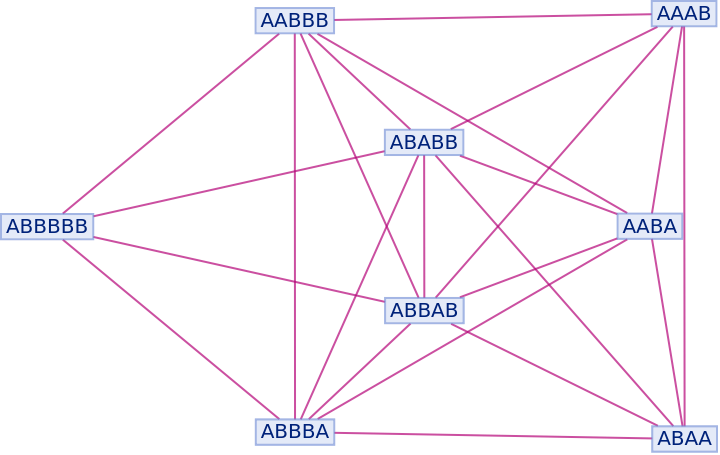
Now we use BranchialEdgeLabelsFromCausalGraph function to get the labeling:
In[]:=
branchialSpinLabels=BranchialEdgeLabelsFromCausalGraph[gbranchialFGR,gcausalFGR]
Out[]=
{{2,1,2,2,1},{2,1,2,1,1,1},{1,1,2,1,1,1},{2,2,1,2,1},{2,1,2,1,2,1,1},{1,1,1,2,2,2,1},{1,1,1,1,2,1},{1,1,1,1}}
branchialSpinLabels gives a list with the labels organized by intertwiner nodes.
1.2 Branchial Graph Labeling for wm148
1.2 Branchial Graph Labeling for wm148
Below a labeling for a Wolfram model rule, the rule wm148. We first compute the causal state graph and the branchial one:
In[]:=
gcausalWM148=ResourceFunction["MultiwaySystem"]["WolframModel"{{{x,y}}{{x,y},{y,z}}},{{{0,0}}},4,"StatesGraph"];gbranchialWM148=ResourceFunction["MultiwaySystem"]["WolframModel"{{{x,y}}{{x,y},{y,z}}},{{{0,0}}},4,"BranchialGraph"]
Out[]=
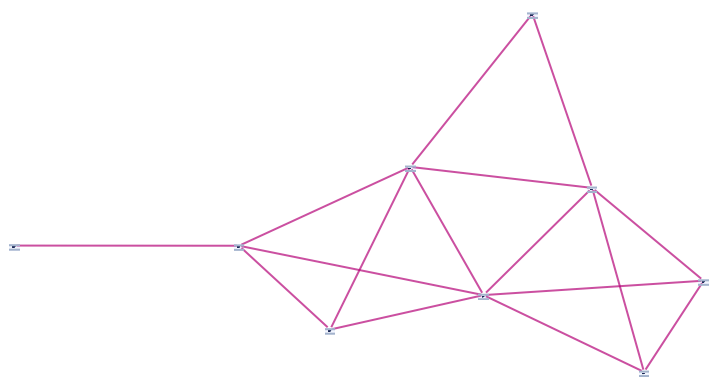
And then the assignment:
In[]:=
branchialSpinLabels2=BranchialEdgeLabelsFromCausalGraph[gbranchialWM148,gcausalWM148]
Out[]=
{{1},{1,1,1,1},{1,1,1,1,1},{1,1,1},{1,1,1,1,1,1},{1,1},{1,1,1,1,1},{1,1,1},{1,1,1}}
1.3 SU(2) Spin Networks on Non-Regular N-Valent Branchial Graphs
1.3 SU(2) Spin Networks on Non-Regular N-Valent Branchial Graphs
The explicit computations will be done in a specific basis but general procedures for bases transformations is well known in the recoupling theory literature. The coefficients are not normalized.
To check if the labels generated above correspond to valid spin network we implement some functions.
To check if the labels generated above correspond to valid spin network we implement some functions.
We can check that they give valid spin network states by recursively checking that three valent nodes respect usual threeJsymbol selection rules. Let's first check the three-valent one:
In[]:=
su2ThreeValentIntertwinerQ[intertwinerThreeValent_]:=Module[{return=False},(*Todo:needtoincludem'sindicestoworktheconditionwithmi={0,0,0}*)If[IntegerQ[Total[intertwinerThreeValent]]&&intertwinerThreeValent[[3]]≥Abs[intertwinerThreeValent[[2]]-intertwinerThreeValent[[1]]]&&intertwinerThreeValent[[3]]≤(intertwinerThreeValent[[2]]+intertwinerThreeValent[[1]]),return=True;];Return[return];]
For a general N-valence one we can decompose in a three-valent network, which correspond to choose a specific base:
In[]:=
su2NValentIntertwinerQ[intertwinerNValent_]:=Module[{return=False,kList},If[Length[intertwinerNValent]1,return=True];If[Length[intertwinerNValent]2,return=su2ThreeValentIntertwinerQ[Insert[intertwinerNValent,0,1]]];If[Length[intertwinerNValent]3,return=su2ThreeValentIntertwinerQ[intertwinerNValent]];If[Length[intertwinerNValent]3,return=su2ThreeValentIntertwinerQ[intertwinerNValent]];If[Length[intertwinerNValent]4,(*getlistofintermediaryallowedspins*)kList=Range[Abs[intertwinerNValent[[1]]-intertwinerNValent[[2]]],intertwinerNValent[[1]]+intertwinerNValent[[2]]];Do[If[su2ThreeValentIntertwinerQ[{intertwinerNValent[[1]],intertwinerNValent[[2]],kList[[i]]}]&&returnFalse,return=su2ThreeValentIntertwinerQ[{kList[[i]],intertwinerNValent[[3]],intertwinerNValent[[4]]}]],{i,1,Length[kList]}];];If[Length[intertwinerNValent]>4,kList=Range[Abs[intertwinerNValent[[1]]-intertwinerNValent[[2]]],intertwinerNValent[[1]]+intertwinerNValent[[2]]];Do[If[su2ThreeValentIntertwinerQ[{intertwinerNValent[[1]],intertwinerNValent[[2]],kList[[i]]}]&&returnFalse,return=su2NValentIntertwinerQ[Insert[Delete[intertwinerNValent,{{1},{2}}],kList[[i]],1]];],{i,1,Length[kList]}];];Return[return];]
To finish we need to go over all the nodes:
Now we can check if the decorations we have chosen are good:
For the evaluation will be useful to have a four-valent intertwiner, which evaluate independently the 2 three-valent ones with the intermediary spins (this function is not really necessary):
Now we can use the two functions above to implement a recursive function to compute the coefficients for nodes of general valence:
And then to evaluate a set of intertwiners:
Let us apply the functions above to calculate the coefficients for the Fibonacci golden rule:
For the wm148 rule:
Lets look at one of the parts that combine to build the states:
The data structure used here ended not being good to handle the indexations to build the tensorial product to have a state in final form, which will be improved later.
Testing valid spin network over large iterations:
Is this solution general for general large iteration? The answer is yes for the Fibonacci golden rule ={“A””AB”,”B””A”} because by construction we are going one ancestor back with BranchialEdgeLabelFromCausalGraph, which gives spins 1 or 2 for the edges weights. With su2NValentIntertwinerEvaluation we decompose general intertwiners on three-valent ones and with su2ThreeValentIntertwinerQ we can check that any combination with spin 1, 2 is valid.
The same mechanism apply for the wm148 rule but we leave open the question if causal invariance can provide this kind of solution for branchial graphs in general.
2 On Charge-Spin Networks - SU(3) Intertwiner with Support on SU(2) Spin Networks Over Branchial Graphs
2 On Charge-Spin Networks - SU(3) Intertwiner with Support on SU(2) Spin Networks Over Branchial Graphs
Now the N-valent intertwiner can be evaluated using the above functions and including trivial cases:
Finally the evolution of a set of intertwiners. Lets build the special representations labels where for a SU(3) representation (v,u) we look for (v,u,j) where j comes from SU(2) or SO(3) seed,
and we set u=0, which gives vi=j, vi=j+2,... , but we restrict to vi=j only:
and we set u=0, which gives vi=j, vi=j+2,... , but we restrict to vi=j only:
And we can find solution for consistent SU(3) configurations in this simple case by recursively decomposing the N-valent nodes in three-valent ones:
We note that in general the coefficients for SU(3) will have in their evaluation a 6j-symbol of the SU(2) seed [6]. That is interesting because that even with branchial graphs growing with only lower spins in the external intertwiner indices, the intertwiner internal indices can grow with the valence. Those internal indices from large valent SU(2) intertwiner will be seeds for SU(3) intertwiners and so a SU(2) 6j-symbol will play a hole in the rule updating limiting case, which is interesting for physics interpretation. Another option is to go more levels back in construction the weights, which would give large spins, but then the question on the limiting case would be open.
Concluding remarks
Concluding remarks
We found a notion of charge-spin networks with support on multiway branchial graphs. The possibility to build spin networks with arbitrary valence and to couple large groups open interesting perspectives of investigations fro the future. For example, would be interesting to study asymptotics of those networks and to prove that there are general rules that can works as support on the large iteration limit.
We found two explicitly solutions of simple multiway system that implement constraints (2) and (3), one for substitution system with the Fibonacci golden rule ={“A””AB”,”B””A”} and other for wm148 rule, WolframModel{{{x,y}}{{x,y},{y,z}}},{{{0,0}}}. A full charge-spin network state would be the superposition of all branchial graphs with the update process to infinity.
We found two explicitly solutions of simple multiway system that implement constraints (2) and (3), one for substitution system with the Fibonacci golden rule ={“A””AB”,”B””A”} and other for wm148 rule, WolframModel{{{x,y}}{{x,y},{y,z}}},{{{0,0}}}. A full charge-spin network state would be the superposition of all branchial graphs with the update process to infinity.
Keywords
Keywords
◼
Multiway Systems
◼
Branchial Graphs
◼
Spin Networks
◼
Compact Lie Groups
◼
Charge-Spin Networks
Acknowledgment
Acknowledgment
I acknowledge Raymond Aschheim, which worked in the same project proposal, for many useful discussions, Klee Irwin for the support, Stephen Wolfram and his group for suggesting a project on “Find spin networks consistent with a given (directed) graph and compact Lie group” and discussions and Jon Lederman for discussions and support.
References
References
◼
[1] How do your models relate to spin networks, spin foams and loop quantum gravity?
https://www.wolframphysics.org/questions/relations-to-other-approaches/how-do-your-models-relate-to-spin-networks-spin-foams-and-loop-quantum-gravity/
https://www.wolframphysics.org/questions/relations-to-other-approaches/how-do-your-models-relate-to-spin-networks-spin-foams-and-loop-quantum-gravity/
◼
[2] [WWS21] Relationship between causal multiway systems and spin foams in loop quantum gravity
https://community.wolfram.com/groups/-/m/t/2162776
https://community.wolfram.com/groups/-/m/t/2162776
◼
[5] Quantum Gravity at the Fifth Root of Unity,
M. Amaral, R. Aschheim, K. Irwin, arXiv:1903.10851 [hep-th] (2019).
M. Amaral, R. Aschheim, K. Irwin, arXiv:1903.10851 [hep-th] (2019).
◼
[6] Clebsch-Gordan coefficients of SU(3) in SU(2) and SO(3) bases,
D. J. Rowe and C. Bahri, Journal of Mathematical Physics 41, 6544 (2000).
D. J. Rowe and C. Bahri, Journal of Mathematical Physics 41, 6544 (2000).
◼
[7] An algebraic algorithm for calculating Clebsch-Gordan coefficients; application to SU(2) and SU(3),
D. J. Rowe and J. Repka, Journal of Mathematical Physics 38, 4363 (1997); doi: 10.1063/1.532099
D. J. Rowe and J. Repka, Journal of Mathematical Physics 38, 4363 (1997); doi: 10.1063/1.532099
CITE THIS NOTEBOOK
CITE THIS NOTEBOOK
On charge -spin networks from multiway systems branchial graphs
by Marcelo Amaral
Wolfram Community, STAFF PICKS, July 13, 2021
https://community.wolfram.com/groups/-/m/t/2311181
by Marcelo Amaral
Wolfram Community, STAFF PICKS, July 13, 2021
https://community.wolfram.com/groups/-/m/t/2311181