CartesianEquationSurface::usage="Determine the Cartesian equation for the ruled surface formed by the lines parallel to the XZ plane that are supported simultaneously on the circumference C and the line R, if:a Using lines parallel to the XZ plane as a generatrix.b Using ellipse parallel to the YZ plane as a generatrix.References:CastañedaDeIslaPuga,Érik.GeometríaAnalíticaenelEspacio.UNAM,FacultaddeIngeniería,3a.reimpresión:Ejerciciospropuestos,p.217,2006;Personal.;
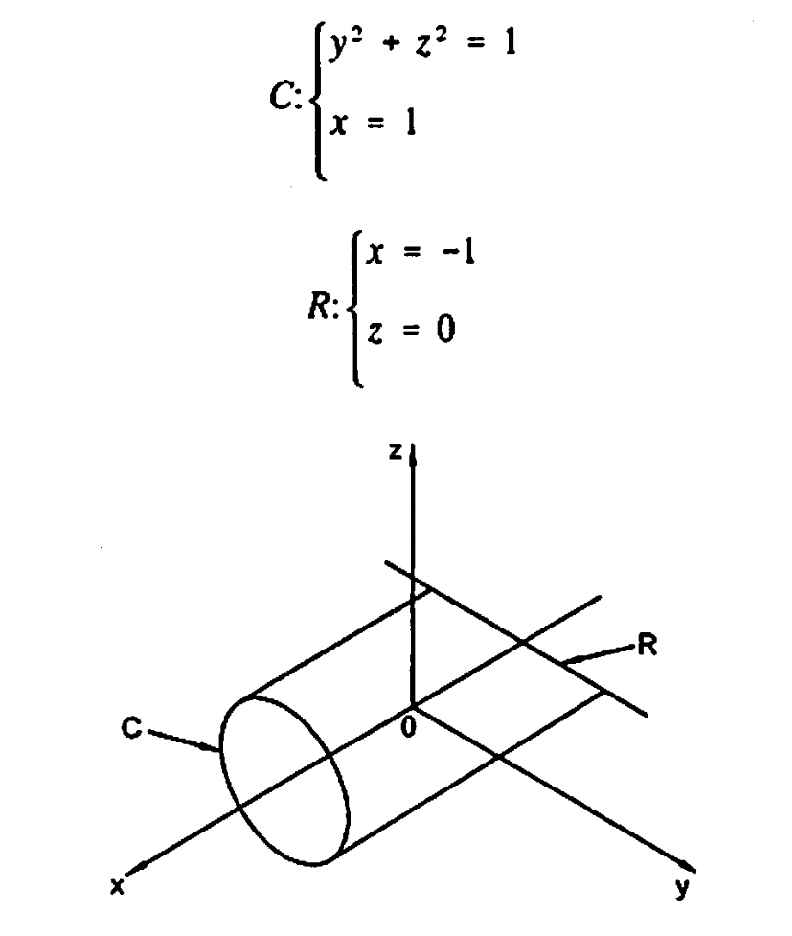
(a) Development:
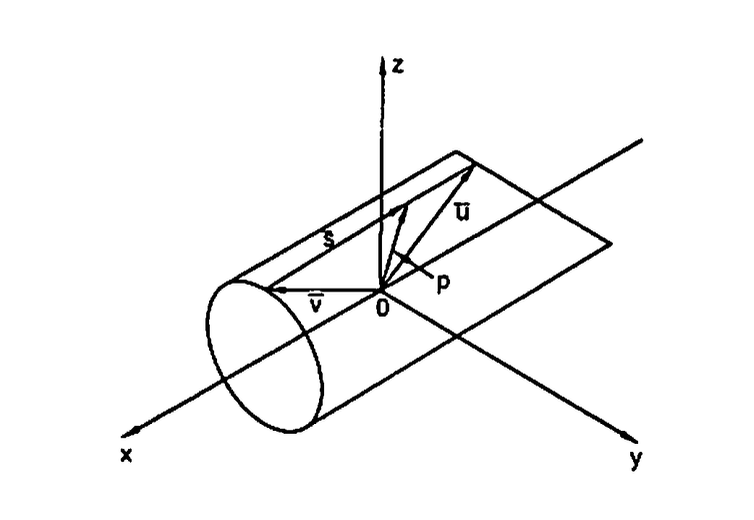
Based on the figure above:
v={1,Cos[t],Sin[t]};u={-1,Cos[t],0};s=u-v;
{-2,0,-Sin[t]};
The vector equation will be (the parameter ζ it is to extend the magnitude of s until you reach the point):
p=v+ζs;
{1-2ζ,Cos[t],Sin[t]-ζSin[t]};
The cartesian equation will be :
In[]:=
Eliminate[{x==1-2ζ,y==Cos[t],z==(1-ζ)Sin[t]},{ζ,t}]
1--4(-1+)+x(-2+2);
2
y
2
z
2
x
2
y
2
y
-4==+2x(-1+)+1(-1+);-4==(-1+);4=(1-);
2
z
2
x
2
y
2
y
2
z
2
(x+1)
2
y
2
z
2
(x+1)
2
y
(b) Development:
The vectorial equation = + ζ = { 1 - 2 ζ, Cos[t], (1 - ζ) Sin[t] } representa una familia de elipses paralelas al plano YZ: +=1 ; x = 1 - 2ζ con ζ ∈ [0, 1).
p
v
s
2
y
2
z
2
(1-ζ)
Animation:
In[]:=
Manipulate[σ[ζ_,t_]:={1-2ζ,Cos[t],Sin[t]-ζSin[t]};β[t_]:={-1,Cos[t],0};γ[t_]:={1,Cos[t],Sin[t]};Show[{ParametricPlot3D[σ[ζ,t],{t,0,2π},{ζ,0,t1},PlotStyle->Directive[Opacity[0.4],Specularity[White,30]],MeshFalse,ColorFunction->"BlueGreenYellow",PerformanceGoal->"Quality",PlotPoints->40],Table[ParametricPlot3D[σ[ζ,t],{t,0,2π},PlotStyle->Purple],{ζ,0,t1,0.03}]/.Line[pts_,rest___]:>Tube[pts,0.007,rest],ParametricPlot3D[β[t],{t,0,2π},PlotStyle->Black]/.Line[pts_,rest___]:>Tube[pts,0.007,rest],ParametricPlot3D[γ[t],{t,0,2π},PlotStyle->Black]/.Line[pts_,rest___]:>Tube[pts,0.007,rest]},AxesLabel->(Style[#,15,Blue]&/@{"X","Y","Z"}),AxesOrigin{0,0,0},AxesTrue,BoxedFalse,BoxRatiosAutomatic,PlotRangeAll,ImageSize900,ViewPoint{3,1,1}],Style["Ruled surface:",Bold,Large],{{t1,0.00002,"Value (t1)"},0.00001,1,0.03},ControlPlacementTop]
View from all angles (below):