ABSTRACT (original article): We identify a new element in quantum simulations of lattice gauge theories, arising from spacetime-dependent quantum corrections in the relation between the link variables defined on the lattice and their continuum counterparts. While in Euclidean spacetime simulations, based on Monte Carlo sampling, the corresponding tadpole improvement leads to a constant rescaled value per gauge configuration, in Minkowski spacetime simulations it requires a state- and time-dependent update of the coefficients of operators involving link variables in the Hamiltonian. To demonstrate this effect, we present the results of numerical simulations of the time evolution of truncated SU(2) plaquette chains and honeycomb lattices in 2+1D, starting from excited states with regions of high energy density, and with and without entanglement.. CITATION (original article): Marc Illa, Martin J. Savage, and Xiaojun Yao (2025), Dynamical Local Tadpole-Improvement in Quantum Simulations of Gauge Theories, arXiv:2504.21575. https://doi.org/10.48550/arXiv.2504.21575
Introduction
Introduction
A complete quantification of uncertainties in predictions from lattice gauge theories includes taking the continuum limit of ensembles of quantum simulations performed over a range of lattice spacings and volumes. Lattice spacing artifacts result from the classical discretization(s) of a Hamiltonian or Lagrangian over the spacetime, and also from quantum fluctuations. In this work, we focus on the second type, which come from ultraviolet divergences of tadpole diagrams that appear between the link variables defined on the lattice and their continuum counterparts. One way to mitigate these unwanted quantum renormalizations is to implement tadpole improvement, which involves numerically evaluating the expectation value of the plaquette operator in the gauge-field ensemble and renormalizing the coefficient of the plaquette operators. In real-time Hamiltonian simulations, previous discussions of lattice-spacing artifacts considered using the expectation value of the plaquette operator in the wavefunction but assumed it to be constant and uniform throughout a simulation (like in Euclidean simulations). However, we point out that this expectation value depends on the strong-interaction environment surrounding the plaquette, and the mean-field value (hence improvement factor) is generally different for each plaquette, and is time dependent. Not including the tadpole-improvement factors or using the expectation in the ground state of the Hamiltonian both lead to unquantified errors in subsequent predictions, including in the time-dependence and amplitude of observables.
The (leading order) Hamiltonian describing non-Abelian lattice gauge theories in 2+1 dimensions, such as quantum chromodynamics (QCD), on a cubic lattice is a sum over the chromo-electric and chromo-magnetic contributions,
H+2- +,
2
g
2
∑
b,links
2
(b)
E
1
2
2
a
2
g
∑
i
N
c
1
4
u
0,i
□
i
†
□
i
where is the coupling constant, is the lattice spacing between adjacent sites (set to 1), is the number of colors. The chromo-electric field is summed over each link, with the ) adjoint index, and the chromo-magnetic field is approximated by the square plaquette operator , summed over the lattice plaquettes, denoted by . The quantity denotes the plaquette renormalization factor (of the plaquette) that deviates from unity due to quantum fluctuations, and can be evaluated via the expectation value of the plaquette operator,
g
a
N
c
(b)
E
b
SU(
N
c
□
i
i
4
u
0,i
th
i
4
u
0,i
1
2
N
c
□
i
†
□
i
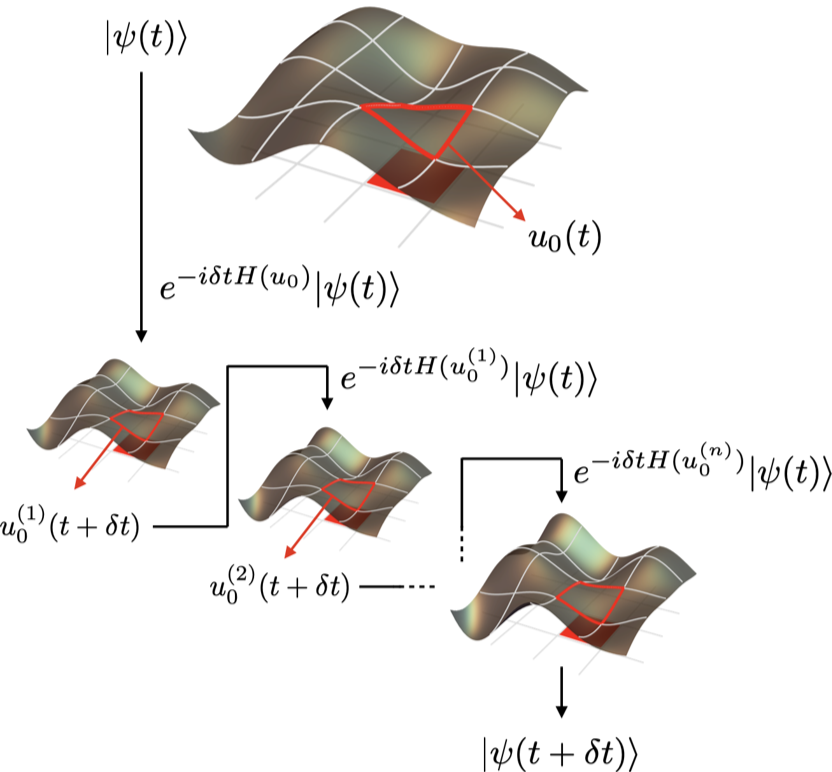
In real-time simulations from an arbitrary initial state, the (t) are time and position dependent. At each time slice, the (t) need to be determined self-consistently, adding additional steps in the (Trotterized) time evolution.For each Trotterized step forward in time, by an interval , the Hamiltonian is modified by the expectation values of the plaquette operators in the new state. This can be iterated to convergence, as displayed in the figure below. A set of good starting conditions for the iteration of (t+δt) are the converged values of (t). For a sufficiently small , due to the observed exponential convergence of the iteration procedure, a precise value of (t+δt) can be obtained with a small number of iterations. This introduces an element into the time evolution of quantum field theories that had not been previously identified.
u
0,i
u
0,i
δt
u
0,i
u
0,i
δt
u
0,i
This notebook will reproduce Figures 3 and 4 from the paper, where we study the effect of dynamical tadpoles on a chain of plaquettes for an SU(2) lattice gauge theory for two different initial states:- Case 1: the initial state is a product state of the first plaquette being excited (state), while the rest are in the trivial vacuum (state): - Case 2: the initial state is an entangled state, where we excite the first plaquette by a single application of the plaquette operator to the interacting ground state ( true vacuum,): (where is the corresponding normalization factor)
|1〉
|0〉
|1⊗|0
ψ
1
⊗-1
N
plaq
〉
|〉
ψ
GS
-¨rangleN
ψ
2
□
0
ψ
GS
N
Related publications
Related publications
Original paper introducing tadpole renormalization:
- G. P. Lepage and P. B. Mackenzie, On the viability of lattice perturbation theory, Phys. Rev. D 48, 2250 (1993), arxiv:hep-lat/9209022
- G. P. Lepage and P. B. Mackenzie, On the viability of lattice perturbation theory, Phys. Rev. D 48, 2250 (1993), arxiv:hep-lat/9209022
Papers that introduced the chain of plaquettes in SU(2), where we take the Hamiltonian from:
- N. Klco, J. R. Stryker, and M. J. Savage, SU(2) non-Abelian gauge field theory in one dimension on digital quantum computers, Phys. Rev. D 101, 074512 (2020), arXiv:1908.06935 [quant-ph]
- T. Hayata, Y. Hidaka, and Y. Kikuchi, Diagnosis of information scrambling from Hamiltonian evolution under decoherence, Phys. Rev. D 104, 074518 (2021), arXiv:2103.05179 [quant-ph]
- X. Yao, SU(2) gauge theory in 2+1 dimensions on a plaquette chain obeys the eigenstate thermalization hypothesis, Phys. Rev. D 108, L031504 (2023), arXiv:2303.14264 [hep-lat]
Chain of SU(2) plaquettes
Chain of SU(2) plaquettes
Definitions
Definitions
Import MaTeX for plot style
(*ResourceFunction["MaTeXInstall"][]*)
In[]:=
Needs["MaTeX`"]
Parameters of the simulation (length of the chain of plaquettes , coupling constant , and time step δt):
N
plaq
g
In[]:=
nplaq=10;gval=0.5;dt=0.025;
Definition of the operators as sparse arrays
In[]:=
id=SparseArray[IdentityMatrix[2]];σx=SparseArray[PauliMatrix[1]];σz=SparseArray[PauliMatrix[3]];
Total Hamiltonian of the system with plaquettes, ,- -1(2++)-1-- ,- -14I-+, with the plaquette operator, in terms of Pauli operators, is defined as +++(9+3+3+) ,with the projectors being (I±) .
N
plaq
H=+
H
E
H
B
H
e
3
2
g
8
N
plaq
∑
i0
Λ
1,i
Λ
1,i
Λ
0,i+1
Λ
0,i
Λ
1,i+1
3
2
g
8
N
plaq
∑
i0
3
2
z
σ
i
1
2
z
σ
i
z
σ
i+1
H
B
1
2
2
g
N
plaq
∑
i0
1
4
u
0,i
□
i
†
□
i
□
i
Λ
0,i-1
x
σ
i
Λ
0,i+1
1
2
Λ
1,i-1
x
σ
i
Λ
0,i+1
1
2
Λ
0,i-1
x
σ
i
Λ
1,i+1
1
4
Λ
1,i-1
x
σ
i
Λ
1,i+1
1
16
x
σ
i
z
σ
i-1
x
σ
i
x
σ
i
z
σ
i+1
z
σ
i-1
x
σ
i
z
σ
i+1
Λ
0/1,i
1
2
z
σ
i
In[]:=
chainplaqHam[nplaq_,gval_,ulist_]:=opI=ConstantArray[id,nplaq];opZ=ConstantArray[id,nplaq];opZ[[1]]=σz;opZZ=ConstantArray[id,nplaq];opZZ[[1]]=σz;opZZ[[2]]=σz;hel=SumKroneckerProduct[Sequence@@opI]-KroneckerProduct[Sequence@@RotateRight[opZ,i-1]]-KroneckerProduct[Sequence@@RotateRight[opZZ,i-1]],{i,nplaq};opX=ConstantArray[id,nplaq];opX[[1]]=σx;opXZ=ConstantArray[id,nplaq];opXZ[[1]]=σx;opXZ[[2]]=σz;opZX=ConstantArray[id,nplaq];opZX[[-1]]=σz;opZX[[1]]=σx;opZXZ=ConstantArray[id,nplaq];opZXZ[[-1]]=σz;opZXZ[[1]]=σx;opZXZ[[2]]=σz;hmag=Sum4KroneckerProduct[Sequence@@opI]-(9KroneckerProduct[Sequence@@RotateRight[opX,i-1]]+3KroneckerProduct[Sequence@@RotateRight[opXZ,i-1]]+3KroneckerProduct[Sequence@@RotateRight[opZX,i-1]]+KroneckerProduct[Sequence@@RotateRight[opZXZ,i-1]]),{i,nplaq};Return[hel+hmag];
3gval^2
8
3
2
1
2
1
2gval^2
2
16*ulist[[i]]
Electric Hamiltonian for an individual plaquette, (2++++)2---
h
e
3
2
g
8
Λ
1,i
Λ
1,i
Λ
0,i+1
Λ
0,i
Λ
1,i+1
Λ
1,i-1
Λ
0,i
Λ
0,i-1
Λ
1,i
3
2
g
8
z
σ
i
1
2
z
σ
i
z
σ
i+1
1
2
z
σ
i-1
z
σ
i
In[]:=
chainplaqEl[nplaq_,gval_]:=opI=ConstantArray[id,nplaq];opZ=ConstantArray[id,nplaq];opZ[[1]]=σz;opZZ=ConstantArray[id,nplaq];opZZ[[1]]=σz;opZZ[[2]]=σz;hel=Table2KroneckerProduct[Sequence@@opI]-KroneckerProduct[Sequence@@RotateRight[opZ,i-1]]-KroneckerProduct[Sequence@@RotateRight[opZZ,i-1]]-KroneckerProduct[Sequence@@RotateRight[opZZ,i-2]],{i,nplaq};Return[hel];
3gval^2
8
1
2
1
2
Plaquettes operator from the magnetic Hamiltonian for an individual plaquette, +++(9+3+3+)
□
i
Λ
0,i-1
x
σ
i
Λ
0,i+1
1
2
Λ
1,i-1
x
σ
i
Λ
0,i+1
1
2
Λ
0,i-1
x
σ
i
Λ
1,i+1
1
4
Λ
1,i-1
x
σ
i
Λ
1,i+1
1
16
x
σ
i
z
σ
i-1
x
σ
i
x
σ
i
z
σ
i+1
z
σ
i-1
x
σ
i
z
σ
i+1
Colors, legend and figures for the plots
Initialize the electric and magnetic Hamiltonians for each plaquette, as well as the initial state
Compute the expectation value of the electric Hamiltonian without tadpole renormalization (i.e., set to 1)
Compute tadpole renormalization for the ground state, and use it for the time evolution
Iteratively compute the tadpole renormalization for each plaquette after each time evolution
CITE THIS NOTEBOOK
CITE THIS NOTEBOOK
Dynamical local tadpole-improvement in quantum simulations of gauge theories
by Marc Illa, Martin J. Savage & Xiaojun Yao
Wolfram Community, STAFF PICKS, May 29, 2025
https://community.wolfram.com/groups/-/m/t/3470012
by Marc Illa, Martin J. Savage & Xiaojun Yao
Wolfram Community, STAFF PICKS, May 29, 2025
https://community.wolfram.com/groups/-/m/t/3470012