The everything-on edition: the multi-weapon scenario studio, blast / thermal / radiation / fireball rings, the WSEG-10 fallout plume with isotopic fractionation, blast-wave arrival rings, dose timelines, live winds, terrain shadows and overlap-aware casualties – every output below is produced by the call shown above it. Physics: Glasstone & Dolan (1977); Sublette FAQ §5; WSEG-10 (Hanifen 1980); Freiling.
Purpose. Educational, order-of-magnitude civil-defence awareness. Effects only, from open literature; no design information.
Not affiliated with NUKEMAP. NUKEMAP is a project by Alex Wellerstein (nuclearsecrecy.com/nukemap). This notebook is an independent, educational reimplementation of the weapon-effects physics from the open literature – not affiliated with, endorsed by, or derived from the NUKEMAP source code.
Beyond the original NUKEMAP: place and overlay several weapons at once with overlap-aware casualties; draw blast-wave arrival-time rings; read out the fission-product isotopes and their downwind fractionation; the "when can I leave?" dose timeline; terrain line-of-sight shielding from real elevation; real upper-air winds; rain/snow scavenging; crater, EMP and fireball radii; and a real WorldPop gridded-population casualty count. Everything is derived from first principles in §3 and fully sourced.
How to read this notebook. §1 loads the packages; §2 is the live interactive studio (screenshots show what it looks like – evaluate the cells to use it); §3 derives every effect from first principles – air blast, thermal, prompt radiation, fireball/crater/EMP, fallout and casualties – each equation a live, evaluated formula ending in a "Sound?" check against published data; §4–8 are fallout/isotopes, live weather, multi-weapon casualties, terrain shadows and a weapons gallery; §9 maps every equation to its source; §10–11 are the limitations and how to reproduce it. Every output is produced
NukemapSnapshotGeoPosition[{40.71,-74.01}],1000,
1 – Setup
1 – Setup
Run these two cells first; they load the physics, weather, map and scenario packages from wolfram/ so every cell below is live.
SetDirectory[NotebookDirectory[]];
Get["nukemap_helpers.wl"]
2 – The scenario studio
2 – The scenario studio
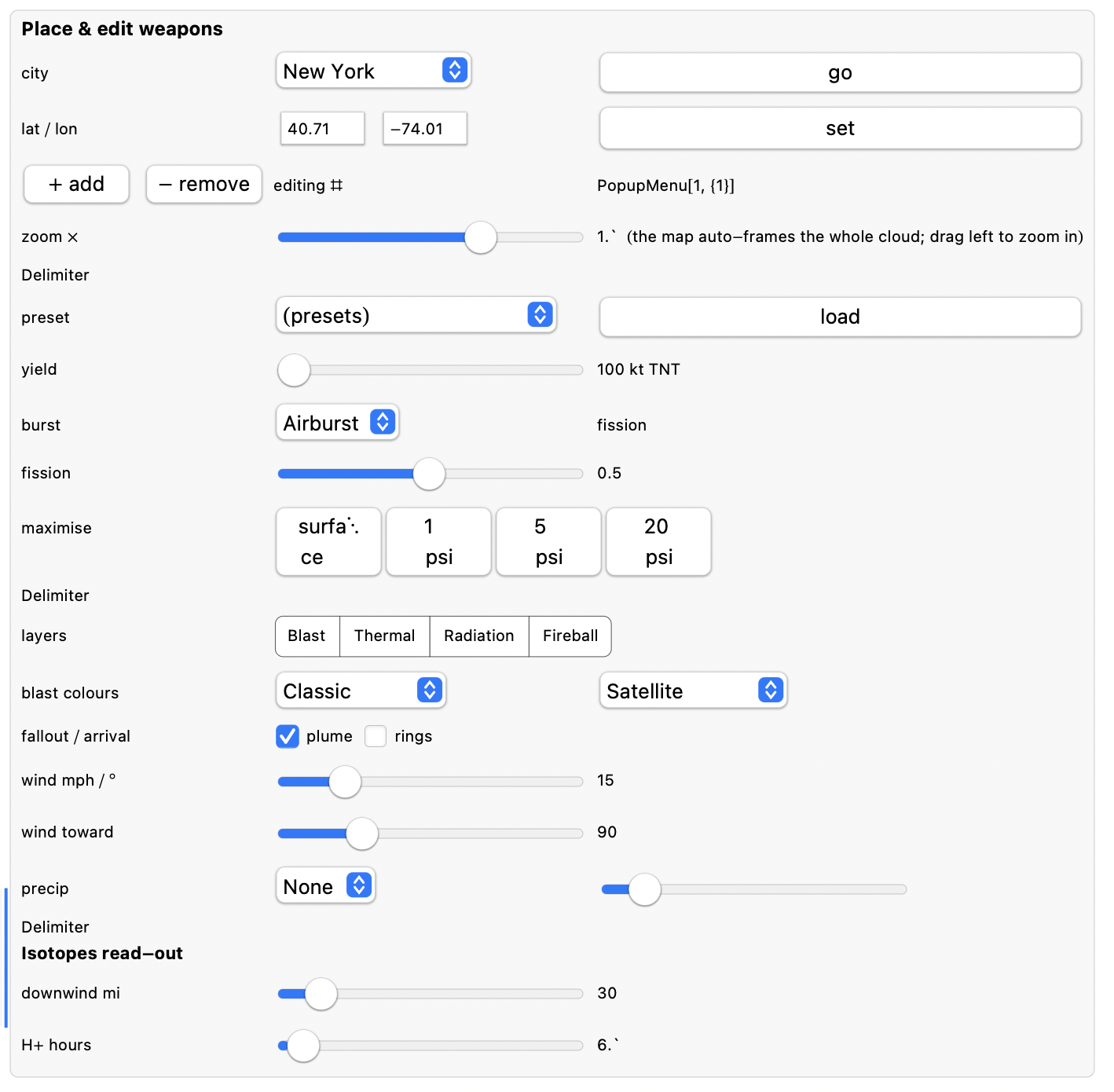
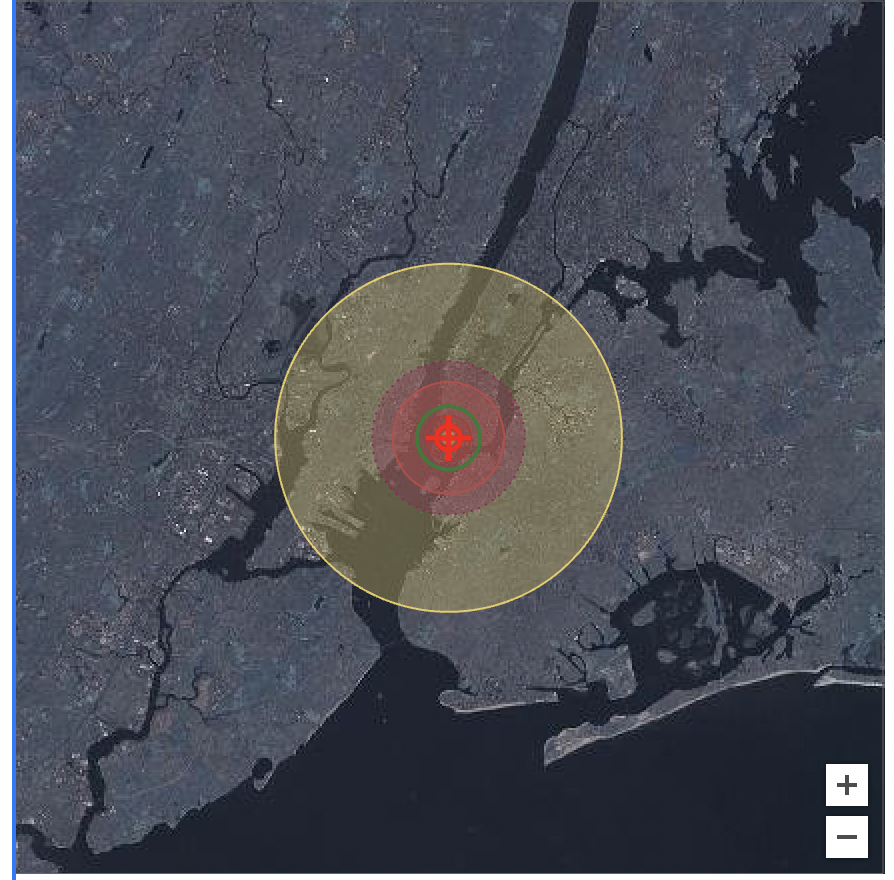
The full cockpit: place several weapons by clicking the map, by city menu or by lat/lon; per-weapon yield (kt/Mt TNT), burst type, fission fraction and maximise surface / 1 / 5 / 20 psi buttons; classic or temperature blast palettes; satellite or street basemaps; wind-driven fallout with auto-framing so the plume is never cut off; blast arrival rings; rain/snow scavenging factors; the downwind isotope read-out; and overlap-aware casualties on population density taken from the location itself.
These panels are live and interactive – evaluate the cells below (after running the Setup cell) to bring them up in desktop Mathematica or the free Wolfram Player. They are Dynamic objects, so they do not run in a web preview – open the notebook to use them. The static map below shows the kind of output they render.
In[]:=
NukemapScenario[]
And the streamlined single-weapon panel:
In[]:=
NukemapInteractive[]
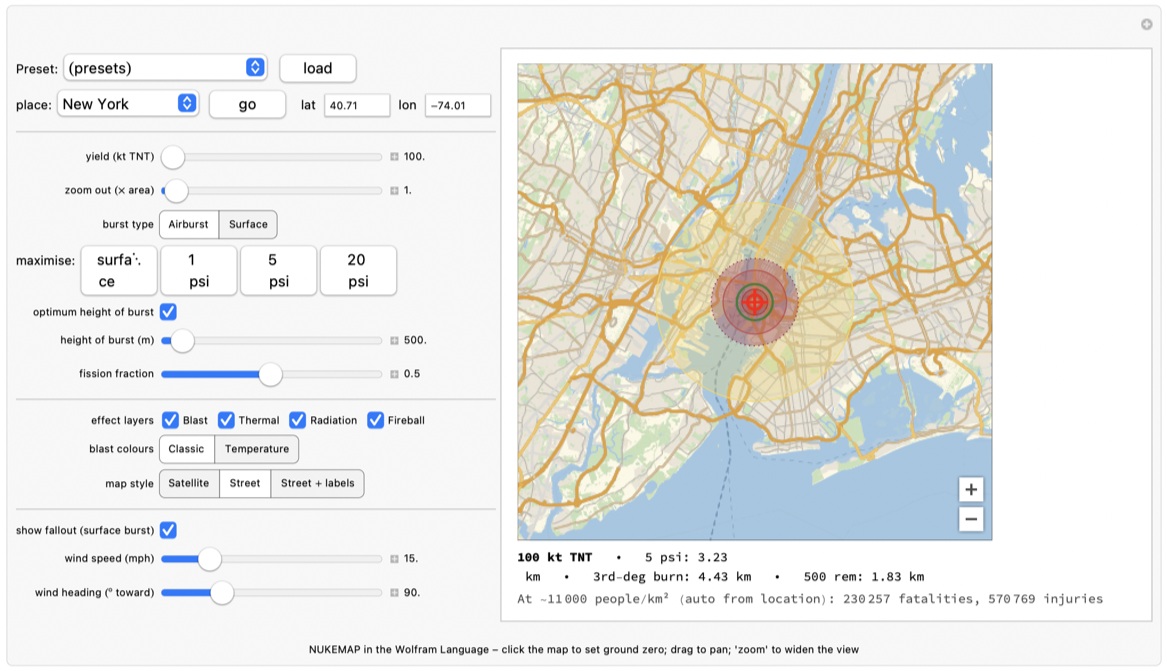
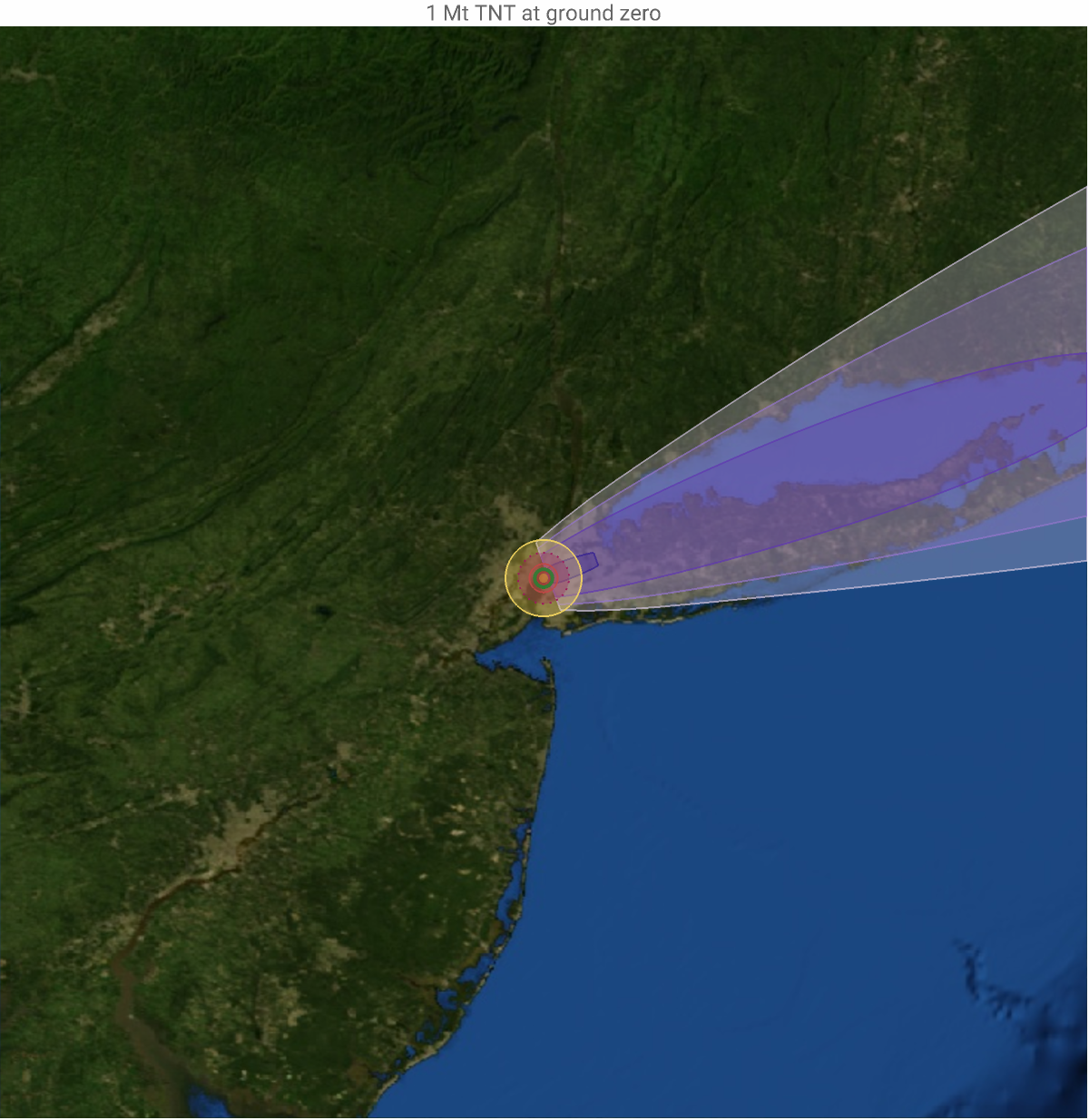
Both draw the same layered footprints from the static renderer NukemapSnapshot – a 1 Mt surface burst on New York with a 20 mph west wind, blast/thermal/radiation rings and the WSEG-10 fallout plume over the Atlantic:
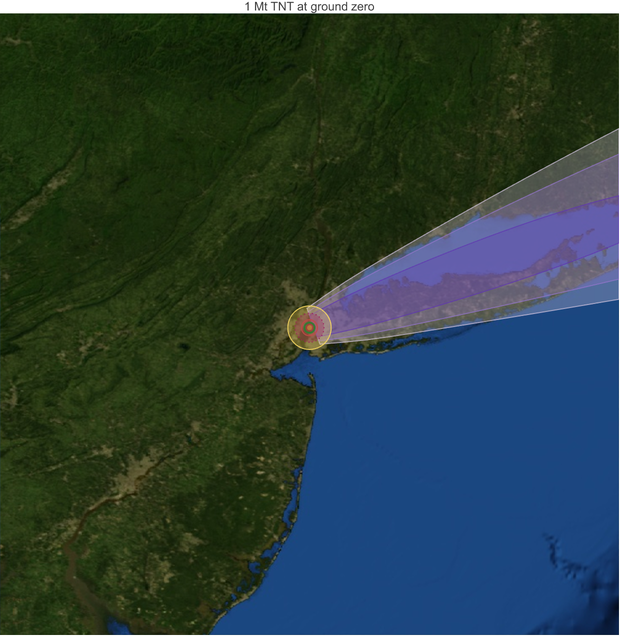
Screenshot. Example rendered output of NukemapSnapshot.
3 – The physics in detail
3 – The physics in detail
This section derives every effect from first principles – conservation laws, scaling arguments and the standard weapons-effects literature – and then checks each result against published anchors so you can see the model is sound, not merely plausible. Throughout, Y is the yield in kilotons, W = Y/1000 in megatons, R a distance, and Δp the peak static overpressure above ambient P₀ = 14.7 psi.
1. Air blast – from energy release to overpressure rings
1. Air blast – from energy release to overpressure rings
Where the blast comes from. Within a microsecond the weapon deposits its energy in a small mass of matter, which becomes an intensely hot, high-pressure gas – the fireball. That overpressure drives a shock wave into the surrounding air: a near-discontinuous jump in pressure, density and velocity that runs outward faster than sound, carrying roughly 50% of the total yield (the rest goes to thermal and nuclear radiation).
Cube-root (Sachs) scaling – derived. Idealise the burst as a point release of energy E into uniform air of ambient pressure P₀ and density ρ₀. The only dimensionless way to combine a distance R, the energy E and a reference pressure P₀ is R (P₀/E)^(1/3). Hence any fixed overpressure level occurs at a radius that scales as
– the cube-root law: doubling the radius needs eight times the yield (Glasstone §3.61–3.63; Sachs 1944). It holds because energy fills a volume ∝ R³. Equivalently, in the strong-shock limit the Sedov–Taylor similarity solution gives the shock radius as R(t) = ξ₀ (E t²/ρ₀)^(1/5), whose locus of fixed overpressure again reduces to R ∝ Y^(1/3).
The shock jump – Rankine–Hugoniot. Cross the shock front in its own frame. Conservation of mass, momentum and energy across the discontinuity (the Rankine–Hugoniot conditions) for a perfect gas of ratio of specific heats γ = 1.4 relate the front speed U, the density ratio, the wind (particle) speed uₚ behind it and the dynamic pressure q to the overpressure alone:
The overpressure–distance curve. The map from range to overpressure is not a single power law – it steepens near the fireball and flattens far out. The standard tabulation is the Lovelace least-squares fit (CEX-62.2, Fletcher et al. 1962), a log–log cubic in the overpressure that reproduces Glasstone's 1-kt reference curves (Fig. 3.73):
with one coefficient set for a contact surface burst (Eq. 2.5) and one for the optimum-height airburst envelope (Eq. 2.61). These are the curves the original NUKEMAP uses.
Height of burst and the Mach stem. A burst above the ground sends the shock down; it reflects and, beyond a critical angle, the reflected wave overtakes and merges with the direct one into a single, stronger, vertical Mach stem (Glasstone §3.24–3.29). Because the Mach stem carries roughly twice the reflected overpressure, there is an optimum burst height that maximises the ground range of each overpressure level – which is why an airburst out-ranges a surface burst at low overpressure (it is the surface-burst rings that enable fallout, though). The textbook "5 psi ≈ 7 km at 1 Mt" is the optimum-airburst value; the contact surface burst reaches 5 psi at only ~4.4 km:
Sound? Reproduces Glasstone to the digit: 1 Mt airburst gives 2.8 / 7.0 / 21.7 km at 20 / 5 / 1 psi; the cube-root law gives exactly 10× the radius for 1000× the yield; the shock speed returns 340.3 m/s at zero overpressure and q(10 psi)=2.2 psi matches Glasstone Eq. 3.55.1.
2. Thermal radiation – the fireball as a blackbody
2. Thermal radiation – the fireball as a blackbody
A radiating sphere. The fireball surface reaches 6000–7000 K – roughly the temperature of the Sun's surface – and radiates as a near-blackbody. The Stefan–Boltzmann law P = σ T´ × 4πr² and Planck's law fix the power and the spectrum (peaking in the visible/near-UV, Wien's law). A fraction f ≈ 0.35–0.45 of the total yield escapes as this thermal pulse for an airburst, dropping to 0.18 for a contact surface burst where the ground absorbs much of it (Glasstone §7.04, §7.101).
Why two flashes. A nuclear thermal pulse has two maxima. The first, lasting ~a millisecond, is cut off as the expanding shock front compresses and ionises the surrounding air into an opaque, cooler shell that hides the hotter interior. As the shock weakens and the air becomes transparent again, the still-incandescent fireball reappears – the second, dominant maximum, which carries ~99% of the thermal energy (Glasstone §7.03). The time to that second maximum and the effective pulse length (80% of the energy) scale as
(Glasstone §7.85–7.86) – about 0.9 s and 9 s for 1 Mt. A longer pulse matters because skin sheds heat by conduction during the flash, so a bigger weapon needs a higher radiant exposure for the same burn (§12.64). Validate the pulse timing:
Radiant exposure and the inverse-square law. Energy f Y spread over a sphere of radius R, attenuated by atmospheric transmittance τ, gives the radiant exposure (Glasstone §7.95, with 10^12 cal/kt):
Atmospheric transmittance – derived. Light is removed from the direct beam by scattering and absorption following the Beer–Lambert law τ = e^(-κR). The extinction coefficient κ is tied to the visual range (visibility) V by the Koschmieder relation κ = 3.912/V (the 3.912 = ln(1/0.02) sets the 2% contrast threshold of the eye). This matches Glasstone's own tabulated coefficients (§7.96 footnote) to ~2%. But a bare exponential is too harsh: forward- and multiple-scattering redirect light back toward the target (Glasstone §7.14–7.15), so we apply a scattering build-up factor:
The build-up is calibrated to Glasstone's worked example (§7.43: a 1 Mt burst igniting paper at 8 cal/cm² ~7 miles away on a 12-mile-visibility day needs τ ≈ 0.30, where the bare beam would give only 0.10). Check it, then the 3rd-degree-burn radius for 1 Mt (~11 km):
Sound? τ returns 0.28 at the Glasstone §7.43 point; the 1 Mt 3rd-degree radius is 11.4 km, matching Sublette's clear-day fit r = 0.67 Y^0.41 km (§5.6.1).
3. Initial nuclear radiation – neutrons and gammas
3. Initial nuclear radiation – neutrons and gammas
The sources. In the first ~minute the detonation emits prompt fission neutrons (~10^23 per kt, ~2 MeV mean), prompt fission gammas, secondary gammas from neutron capture in the air and weapon (n + ^14N → ^15N + γ), and early fission-product gammas. These are intensely penetrating but short-ranged in air.
Transport – geometry times attenuation. For a point source emitting S particles, the unscattered fluence at range R is the inverse-square spreading times an exponential attenuation over the mean free path λ, multiplied by a build-up factor B for scattered radiation (Glasstone §8.32; Cember, Health Physics):
Glasstone presents this only graphically (Figs. 8.33/8.64, from Monte-Carlo air-transport with a factor-of-2 uncertainty). Sublette (§5.6.3.3) condenses it to a 1000-rad reference range and a tenth-value distance d₁₀ (the range over which dose falls 10×):
The two forms are identical with λ = d₁₀/ln 10 ≈ 150–300 m – precisely the mean free path of MeV neutrons and gammas in sea-level air.
Why the radius barely grows (Y^0.19). Three effects suppress the yield scaling far below blast's Y^(1/3): (i) exponential air attenuation means the radius grows only logarithmically with the source strength; (ii) the fireball swells with yield and self-absorbs its own output; (iii) the fission fraction (hence the prompt source) is a smaller part of a larger thermonuclear yield. There is one compensating effect – hydrodynamic enhancement: late gammas travel out through air already rarefied by the passing shock, so they are attenuated less, which makes d₁₀ rise with yield (330 → 700 m). So for big weapons the 500-rem LD50 ring (Glasstone §12.108) is swallowed by blast and fire. Validate against Sublette's worked example (10 Mt @ 5000 m → 35 rad):
Sound? 20 kt / 1000 rad → 1.24 km and 10 Mt @ 5 km → 35 rad reproduce Sublette exactly. Neutron-bomb option uses Sublette's enhanced constants (620 m, 385 m).
4. Fireball, crater and electromagnetic pulse
4. Fireball, crater and electromagnetic pulse
Fireball. The luminous ball grows until breakaway, when the shock front outruns the radiating surface; the maximum luminous radius is about twice the breakaway radius. From the Bethe–Brode early-fireball theory the radius scales as Y^0.4 (not the naive Y^(1/3), because the radiative/shock energy partition shifts with yield), giving R ≈ 67 Y^0.4 m for an airburst, ×1.32 on the surface where ground reflection couples ~twice the energy (Glasstone §2.127, Eqs. 2.127.1/2):
Crater. A surface or near-surface burst couples energy into the ground, vaporising and ejecting it. For small events strength dominates and the crater scales as Y^(1/3); for large ones gravity limits the throw-out and the exponent drops to 1/3.4 = 0.294 (Cooper 1976; Schmidt & Housen 1987). In dry soil the apparent radius is ~60 ft at 1 kt (Glasstone §6.09):
High-altitude EMP. A burst far above the atmosphere emits prompt gammas downward; they Compton-scatter off air molecules at ~30 km altitude, ejecting forward-moving Compton electrons. The Earth's magnetic field bends these into a coherent transverse current that radiates an intense, fast (~ns) E1 pulse over the entire line-of-sight footprint (Glasstone §11.13–11.15; Longmire 1978). The footprint radius is the horizon distance from altitude h, and the peak field is ~50 kV/m (IEC 61000-2-9):
Sound? Fireball 1062 m (= 2× breakaway, Glasstone); crater 60 ft at 1 kt; EMP horizon 1133 km from 100 km altitude, matching Glasstone Table 11.72.
5. Fallout – activation, decay and the WSEG-10 plume
5. Fallout – activation, decay and the WSEG-10 plume
The source. Each fission makes two radioactive fragments; ~1.45×10^23 fissions per kt produce ~3×10^8 curies of activity at one hour (H+1) per kt of fission yield. A surface burst sucks pulverised soil into the fireball; the fission products condense onto these particles and fall out downwind. (An airburst keeps the fireball off the ground, so little local fallout forms – which is why fallout is a surface-burst phenomenon.) Check the H+1 source:
Way–Wigner decay – why t^-1.2. The debris is a statistical mixture of hundreds of β-decay chains with a smooth spread of half-lives. Way & Wigner (1948) showed that summing them – using the systematics of decay energy versus half-life – gives an aggregate activity (and dose rate) that falls as a near power law from ~10 minutes to ~6 months:
This is the "7–10 rule" (Glasstone §9.146): every 7-fold increase in time cuts the dose rate ~10-fold (7^1.2 = 10.3). The total dose accumulated by someone who stays from t₁ to t₂ integrates the power law,
so the dose from H+1 to infinity is just 5 D₁ (the factor 5 = 1/(1.2−1)). This is the "when can I leave?" calculation – most of the lifetime dose lands in the first day.
The WSEG-10 plume. The smoke cloud stabilises at a height set by the buoyant rise; WSEG-10 (Pugh & Galiano 1959; transcribed equation-by-equation from Hanifen 1980) models the stabilised cloud as a Gaussian disk and transports it with a single effective wind. Working in megatons W, the cloud-centre height (Hanifen Eq. 1) is
The downwind transport length is L₀ = wind × T_c (cloud time-constant T_c, Hanifen Eq. 8); the along-wind spread σ_x and a shape exponent n (Eq. 15) set the elliptical "hotline", and a wind-shear term broadens it crosswind. The H+1 dose-rate field (Hanifen Eq. 22) is
with F the fission fraction, ϕ an upwind error-function correction, g the along-wind deposition profile and f_y the crosswind Gaussian. Contours of 1–1000 rad/hr trace the familiar cigar.
Fractionation. Refractory elements (Zr, Ce, Y) condense first, into the molten particle volume, and fall near ground zero; volatiles with gaseous precursors (I-131, Cs-137, Sr-90) condense late onto particle surfaces and ride the smallest, farthest-travelling particles downwind (Freiling 1961). So the isotopic mix near the burst differs sharply from that far downwind – our model captures this trend illustratively.
Sound? Cloud centre 42.8 kft at 1 Mt; H+1 activity 3×10¸ Ci/kt; the t^-1.2 law gives the 710 drop; every transport equation is verbatim from Hanifen 1980 (DTIC ADA083515).
6. Casualties – from overpressure to people
6. Casualties – from overpressure to people
Which mechanism. Direct overpressure rarely kills outright – the lungs tolerate a remarkable ~35–62 psi before 50% lethality (Glasstone Table 12.38; Bowen 1968). Almost all blast deaths are indirect: collapsing buildings, flying glass and bodily translation, which set in an order of magnitude lower, around the 5 psi level where ordinary structures fail. So the casualty curve is a building-vulnerability curve, not a lung-injury curve.
The probit model. Dose-response in toxicology and blast injury is conventionally log-normal (a probit): the fraction affected at overpressure Δp is the normal CDF of ln Δp. We use two such curves – an any-casualty curve (median 2.2 psi) and a fatality curve – and take the injured as the difference:
Calibration to Hiroshima. The empirical anchor is the Hiroshima/Nagasaki mortality-versus-distance data (Oughterson & Warren 1956): 50% died at ~1.24 km, which is ~6 psi in our own blast model, and ~30% died at the 5 psi line (Postol 1986). That pins the fatality LD50 at ~6.5 psi (the default "Hiroshima" calibration). The alternative "NUKEMAP" calibration (6 psi) reproduces NUKEMAP's published totals, which its author notes "might be too high". Reassuringly the two nearly coincide – so the dominant uncertainty is the population data
Integrating over people. City population thins from the centre by Clark's law ρ(r) = ρ₀ e^(-r/b) (Clark 1951; b ≈ 10 km for a large metropolis). Integrating P_fatal(Δp(r)) ρ(r) over the blast field gives the fatalities; this is why a big weapon, whose rings reach the sparse edge, kills a smaller fraction than a small one confined to the dense core. For the highest fidelity, GriddedPopulationCasualties replaces ρ(r) with a real WorldPop raster (coastline-aware). For 150 kt over New York:
Sound? P_fatal(6.5 psi)=0.50 by construction; P_fatal(5 psi)=0.28 matches Postol's Hiroshima figure; and the radial integral with the "NUKEMAP" calibration reproduces NUKEMAP's 150 kt / NYC total to a few percent. These are blast-only counts – thermal, radiation and fallout deaths are extra.
4 – Fallout: plume, decay, and when you can leave
4 – Fallout: plume, decay, and when you can leave
A surface burst lofts debris that drifts downwind. We use WSEG-10 (Pugh & Galiano 1959, transcribed verbatim from Hanifen 1980, DTIC ADA083515; yield in megatons). The H+1 dose rate is Hanifen Eq. 22, decaying by the Way–Wigner t^-1.2 rule (Way & Wigner, Phys. Rev. 73, 1948; Glasstone §9.146):
The question that matters downwind is when fallout arrives and how fast the dose accumulates. Thirty miles downwind of a 1 Mt surface burst, fallout lands after two hours; someone in the open crosses the 100 rem sickness line within an hour or two more:
Explore any point and weapon interactively:
Which isotopes land where
Which isotopes land where
Freiling fractionation: refractory species (Zr, Ce, Y) rain out near ground zero; volatiles with gaseous precursors (I-131, Cs-137, Sr-90) ride the small particles far downwind; Ba-140, Mo-99, Te-132 sit in between:
The isotope model is deliberately illustrative – activity × principal gamma energy over the dozen most dose-relevant nuclides, not a Bateman-chain radiochemistry.
5 – Live weather
5 – Live weather
The fallout wind can come straight from the Wolfram Knowledgebase – current surface wind, a 7-day forecast – or, more rigorously, from the GFS/ECMWF pressure-level profile mass-weighted over the cloud column:
Rain or snow scrubs the cloud – intensifying local hotspots while depleting the downwind tail:
6 – Multiple weapons, honest casualties
6 – Multiple weapons, honest casualties
Casualties come from the blast field alone (OTA-1979 / DCPA-1973 model; OTA, The Effects of Nuclear War, 1979). These are indirect (building-collapse) casualties – not direct blast-lung lethality, which is LD50 ~35–62 psi (Glasstone Table 12.38). Two log-normal (probit) curves – an any-casualty curve and a fatality curve – are integrated over the blast field; the injured are the difference. The default "Hiroshima" fatality curve (median 6.5 psi) is anchored to the Oughterson & Warren (1956) mortality data; CalibrationModel"NUKEMAP" reproduces NUKEMAP's published totals:
For a 150 kt airburst over the centre of New York the two calibrations bracket the estimate (the empirical default is the lower, less-lethal one):
Overlapping attacks must not double-count shared rings: each grid cell combines the per-weapon rates as 1-∏(1-Pᵢ), with density taken automatically from the location:
That uses a smooth radial density. For the real thing, GriddedPopulationCasualties integrates the WorldPop 100 m raster over the exact blast field (as NUKEMAP does with LandScan), so coastlines, parks and density gradients all count – here over Chicago, half of whose footprint is Lake Michigan:
Left unevaluated so the notebook stays quick to run – evaluate it for a few live WorldPop calls (it falls back to the radial estimate offline). WorldPop (2020 residential) and NUKEMAP's LandScan (2011 ambient) are different products, so totals differ.
7 – Terrain shadows
7 – Terrain shadows
Thermal radiation is line-of-sight; ridges cast shadows (with the Earth-curvature bulge accounted for). Denver looking into the Rockies:
Blast diffracts around terrain – hills reduce it (Nagasaki vs Hiroshima) but never cleanly cut it off.
8 – Weapons in perspective
8 – Weapons in perspective
Hiroshima to Tsar Bomba is seven orders of magnitude. The same city, four eras of weapon, at a common scale – in temperature colours on satellite imagery:
9 – Where every equation comes from
9 – Where every equation comes from
Each effect radius and dose traces to the open literature – foundations are Glasstone & Dolan (1977, cited by section) and Sublette's FAQ §5 (closed-form fits). The repository's SOURCES.md gives the full citations.
◼
Air blast – Lovelace fits CEX-62.2 Eqs. 2.5/2.61 (Fletcher 1962), fit to Glasstone Fig. 3.73; cube-root scaling §3.61; shock velocity §3.55.
◼
Thermal – Q=fW×10^12τ/4πR² §7.95; partition §7.04/7.101; Koschmieder + scattering transmittance §7.14–7.15/7.43; pulse §7.85; burn thresholds §12.64.
◼
Prompt radiation – 700 Y^0.19 + tenth-value distances, Sublette §5.6.3.3 (fit to Glasstone Figs. 8.33/8.64); LD50 §12.108.
◼
Fireball / crater / EMP – 67 Y^0.4 §2.127; 18.3 Y^0.294 §6.09; EMP horizon + 50 kV/m §11.15/11.73 (Longmire 1978).
◼
Fallout – WSEG-10 (Pugh & Galiano 1959; Hanifen 1980); decay t^-1.2 (Way & Wigner 1948); fractionation Freiling (1961).
◼
Casualties – OTA 1979 Fig. 1; Hiroshima anchor Oughterson & Warren 1956; urban density Clark 1951.
10 – What this can and cannot tell you
10 – What this can and cannot tell you
Idealised, clear-day, mostly flat-earth models: Lovelace fits to Glasstone's height-of-burst curves (intermediate burst heights use a smooth interpolation, not the full Speicher–Brode surface); clear-air transmittance; a smooth single-wind WSEG-10 plume; qualitative fractionation; first-order rain and terrain corrections; no sheltering in the casualty integral; and no thermal-precursor ("dusty blast") enhancement. Even the primary data carry a factor-of-2 uncertainty (Glasstone §8.33), so read every number as order of magnitude.
11 – Reproduce it
11 – Reproduce it
The whole project is plain-text Wolfram Language. From the repository root, each step is a single command line:
wolframscript -file tests/effects_tests.wls — run the 63 physics checks
wolframscript -file wolfram/run_all.wls — regenerate the figures
CITE THIS NOTEBOOK
CITE THIS NOTEBOOK
NUKEMAP-extended: nuclear weapons effects engine with WSEG-10 fallout, terrain & GridPop
by Marco Thiel
Wolfram Community, STAFF PICKS, June 24, 2026
https://community.wolfram.com/groups/-/m/t/3737756
by Marco Thiel
Wolfram Community, STAFF PICKS, June 24, 2026
https://community.wolfram.com/groups/-/m/t/3737756