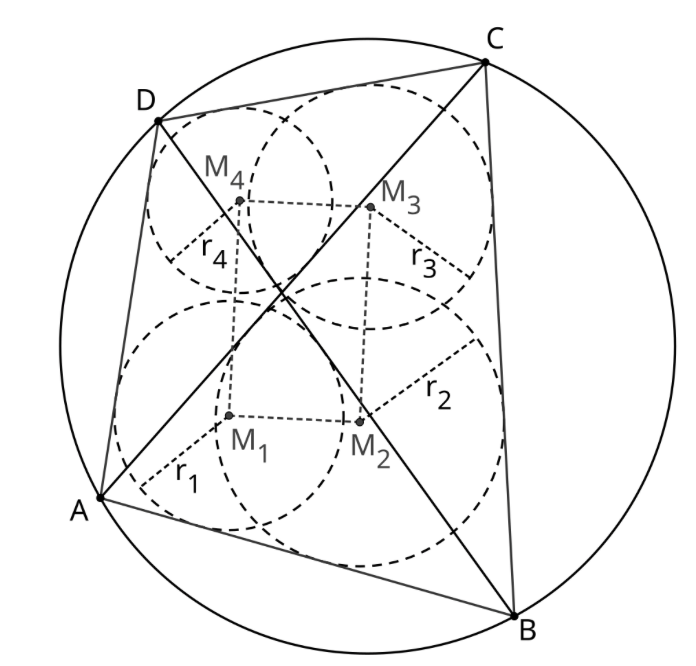
JapaneseTheoremOfAQuadrilateralInscribedInACircle::usage=" By triangular an arbitrary cyclic quadrilateral through its diagonals, four overlappiing triangles are obtained (each diagonal create two triangles). The centers of the inscribed circles of these triangles form a rectangle. To make sure they are concyclic points, we will take them from Conway's circumference. References: Wataru Uegaki: [[hdl:10076/4917|\"Japanese Theoremの起源と歴史\"]] (On the Origin and History of the Japanese Theorem). Departmental Bulletin Paper, Mie University Scholarly E-Collections, 2001-03-01; Personal.";
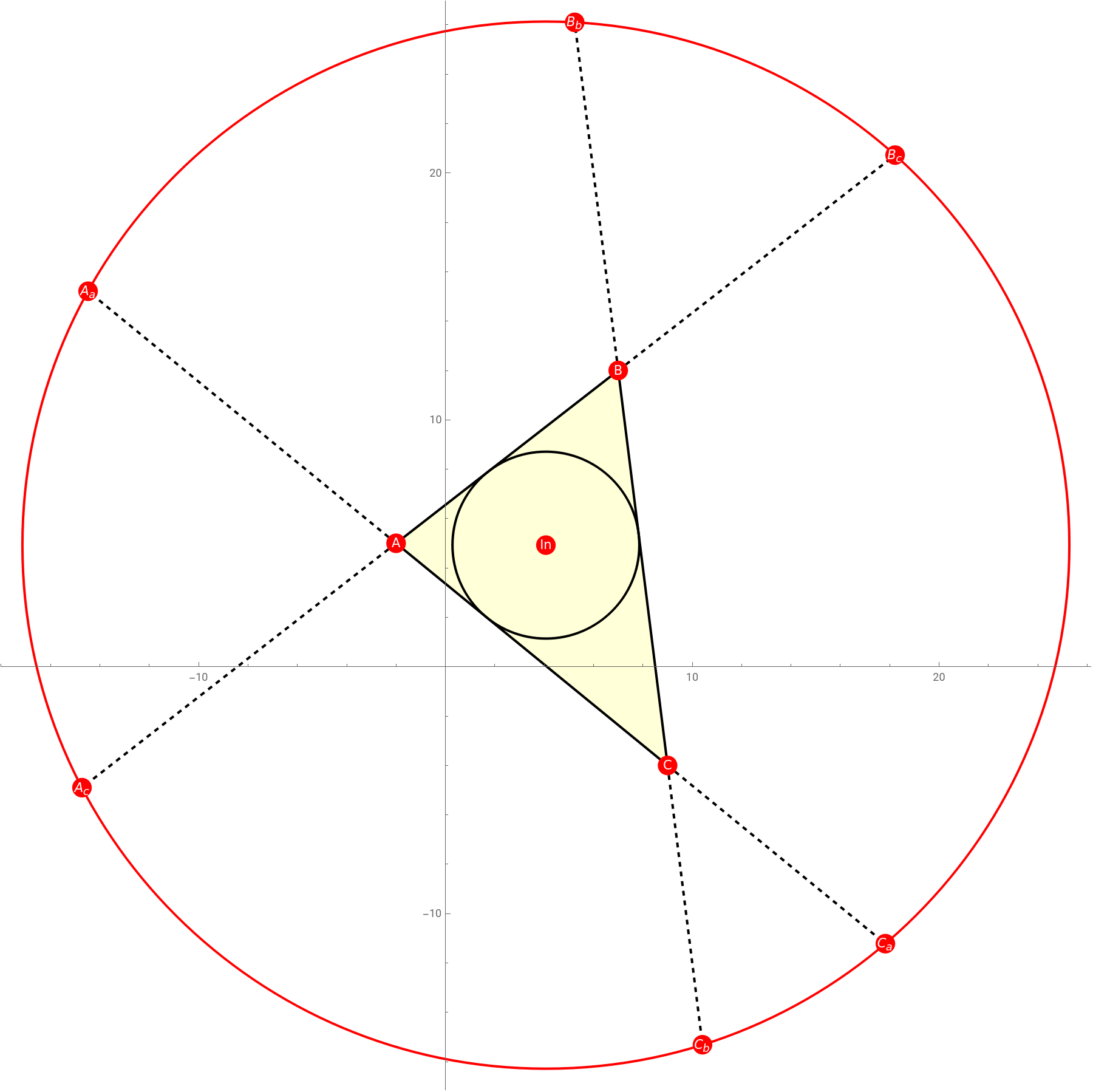
Conway circle:
In[]:=
ConwayCircle[tri={{x1_,y1_},{x2_,y2_},{x3_,y3_}}]:=Module{},Test=Det[{{x1,y1,1},{x2,y2,1},{x3,y3,1}}];IfTest==0,Print[PasteButton["It's not a triangle"]],A={x1,y1};B={x2,y2};C1={x3,y3};c11=Norm[A-B];b11=Norm[B-C1];a1=Norm[A-C1];r1=;xAc=x1+;yAc=y1+;r2=;xBc=x2+;yBc=y2+;r3=;xBa=x3+;yBa=y3+;r4=;xCa=x1+;yCa=y1+;r5=;xAb=;yAb=;r6=;xCb=x2+;yCb=y2+;Ac={xAc,yAc};Bc={xBc,yBc};Ba={xBa,yBa};Ca={xCa,yCa};Ab={xAb,yAb};Cb={xCb,yCb};γ=TriangleCenter[tri,"Incenter"];xin=γ[[1]];yin=γ[[2]];I1={xin,yin};γ1=TriangleMeasurement[tri,"Inradius"];rin=γ1;rcirc=Norm[I1-Ab];Print[" "];Print[PasteButton["The coordinates of the concyclic points are:"]];Print[" "];l=Grid[{{,,,,,},{N[Bc],N[Ac],N[Ba],N[Ca],N[Ab],N[Cb]}},ItemSize15,ItemStyle15,FrameAll];Print[l];Print[" "];Print[PasteButton["The center and radius of the Conway's circle (red colored):"]];Print[" "];m=Grid[{{Center,Radius},{N[I1],N[rcirc]}},ItemSize15,ItemStyle15,FrameAll];Print[m];Print[" "];label[sym_,Point[pos_]]:={PointSize[Scaled[0.018]],Hue[1,1,1],Point[pos],Text[Style[sym,White,FontSizeScaled[0.012]],pos]};Show[{Graphics[{LightYellow,EdgeForm[{Thick,Black}],Polygon[{A,B,C1}]}],Graphics[{Black,Thick,Circle[I1,rin]}],Graphics[{Red,Thick,Circle[I1,rcirc]}],Graphics[{Black,Thick,Dashed,Line[{B,Ab}]}],Graphics[{Black,Thick,Dashed,Line[{B,Ac}]}],Graphics[{Black,Thick,Dashed,Line[{A,Ba}]}],Graphics[{Black,Thick,Dashed,Line[{A,Bc}]}],Graphics[{Black,Thick,Dashed,Line[{C1,Ca}]}],Graphics[{Black,Thick,Dashed,Line[{C1,Cb}]}],Graphics[{MapThread[label,{{"A","B","C","","","","","","","In"},{Point[A],Point[B],Point[C1],Point[Ac],Point[Bc],Point[Ba],Point[Ca],Point[Ab],Point[Cb],Point[I1]}}]}]},AxesTrue,BoxRatiosAutomatic,AxesOrigin{0,0},ImageSize900,PlotRangeAll]
c11
c11+a1
x2-x1
r1
y2-y1
r1
c11
c11+b11
x1-x2
r2
y1-y2
r2
a1
b11+a1
x1-x3
r3
y1-y3
r3
a1
a1+c11
x3-x1
r4
y3-y1
r4
a1
a1+b11
r5x3-x2
r5-1
r5y3-y2
r5-1
b11
b11+c11
x3-x2
r6
y3-y2
r6
PointA
c
PointB
c
PointA
a
PointC
a
PointB
b
PointC
b
B
c
A
c
A
a
C
a
B
b
C
b
In[]:=
ConwayCircle[tri={{-2,5},{7,12},{9,-4}}]
PointA c | PointB c | PointA a | PointC a | PointB b | PointC b |
{-14.7279,-4.89949} | {18.2188,20.7257} | {-14.4797,15.2107} | {17.8245,-11.22} | {5.23714,26.1029} | {10.4142,-15.3137} |
Center | Radius |
{4.06947,4.92508} | 21.21 |
Out[]=
Japanese Theorem:
We will take the points: Aa, Ac, Bc and Cb:
We will take the points: Aa, Ac, Bc and Cb:
In[]:=
Ac={xBc,yBc};Aa={xBa,yBa};Bc={xAc,yAc};Cb={xCb,yCb};tri1={Aa,Cb,Ac};tri2={Aa,Bc,Cb};tri3={Ac,Aa,Bc};tri4={Ac,Bc,Cb};α1=TriangleCenter[tri1,"Incenter"];xi1=α1[[1]];yi1=α1[[2]];In1={xi1,yi1};α11=TriangleMeasurement[tri1,"Inradius"];ri1=α11;α2=TriangleCenter[tri2,"Incenter"];xi2=α2[[1]];yi2=α2[[2]];In2={xi2,yi2};α22=TriangleMeasurement[tri2,"Inradius"];ri2=α22;α3=TriangleCenter[tri3,"Incenter"];xi3=α3[[1]];yi3=α3[[2]];In3={xi3,yi3};α33=TriangleMeasurement[tri3,"Inradius"];ri3=α33;α4=TriangleCenter[tri4,"Incenter"];xi4=α4[[1]];yi4=α4[[2]];In4={xi4,yi4};α44=TriangleMeasurement[tri4,"Inradius"];ri4=α44;Lado1=Norm[In1-In3];Lado2=Norm[In2-In4];Lado3=Norm[In3-In2];Lado4=Norm[In1-In4];V1=In3-In1;V2=In2-In3;V3=In4-In2;V4=In1-In4;Print[" "];Print[PasteButton["Verification that it is a rectangle:"]];Print[" "];z=Grid[,,,,.,.,{N[Lado1],N[Lado2],N[Lado3],N[Lado4],N[V1.V2],N[V3.V4]},ItemSize15,ItemStyle15,FrameAll];Print[z];Print[" "];label[sym_,Point[pos_]]:={PointSize[Scaled[0.018]],Hue[1,1,1],Point[pos],Text[Style[sym,White,FontSizeScaled[0.012]],pos]};Show[{Graphics[{Red,Thick,Circle[I1,rcirc]}],Graphics[{LightBlue,EdgeForm[{Thick,Black}],Polygon[{Ac,Aa,Bc,Cb}]}],Graphics[{Black,Thick,Line[{Ac,Bc}]}],Graphics[{Black,Thick,Line[{Aa,Cb}]}],Graphics[{Black,Thick,Dashed,Circle[In1,ri1]}],Graphics[{Black,Thick,Dashed,Circle[In2,ri2]}],Graphics[{Black,Thick,Dashed,Circle[In3,ri3]}],Graphics[{Black,Thick,Dashed,Circle[In4,ri4]}],Graphics[{LightBlue,Opacity[0.01],EdgeForm[{Thick,Black,Dashed}],Polygon[{In1,In3,In2,In4}]}],Graphics[{MapThread[label,{{"Ac","","","","","","",""},{Point[Ac],Point[Aa],Point[Bc],Point[Cb],Point[In1],Point[In2],Point[In3],Point[In4]}}]}]},AxesTrue,BoxRatiosAutomatic,AxesOrigin{0,0},ImageSize900,PlotRangeAll]
In
1
In
3
In
2
In
4
In
3
In
2
In
1
In
4
Vector
In
1
In
3
Vector
In
3
In
2
Vector
In
2
In
4
Vector
In
4
In
1
A
a
B
c
C
b
In
1
In
2
In
3
In
4
*It is due to the accuracy of the calculations, but it can be considered as zero.