CITE THIS NOTEBOOK: Perturbation Effects in the Branchial Graphs of String Substitution Systems by Cosmin Andrei. Wolfram Community JAN 13 2023.
Noise can have significant effects on the dynamics of a physical system and can lead to complex behaviors. In this project, we aim to study the spread of perturbation effects in the branchial graphs of string substitution systems . By introducing additional localized substitution rules to these systems, we can analyze the changes in the structure of their branchial graphs and gain insight into their robustness and recovery capabilities. Through this investigation, we hope to create a tool for studying and characterizing the evolution of quantum systems in the presence of noise
Introduction
Introduction
According to the Wolfram Model [1], one can draw analogies between the time dynamics of the eigenstates of quantum systems and the incremental evolution of multi-way string substitution systems. By analyzing different evolution steps in multi-way space, also known as foliations, one could in principle describe the degree of entanglement between the associated quantum states. In realistic systems however, it is almost impossible to completely isolate a quantum system from the surrounding environment. This results in the coupling of the system to external degrees of freedom which cause unwanted noise effects. Therefore, after a finite characteristic time known as the decoherence lifetime, the external “bath” becomes so entangled with the quantum system to the extent that quantum information is lost.
In multi-way string substitution systems, entanglement can be defined in the form of common ancestry for the strings within a foliation. The Wolfram Model defines the “branchial” graph as a tool for analyzing common ancestry within foliations of the multi-way systems. To study the analogous effects to decoherence in multi-way systems, we track the evolution of small perturbation states within the branchial graph and visualize the degree of entanglement with unperturbed states. The goal of this work is to develop a flexible framework for introducing perturbation into multi-way system that can be adapted with ease to different types of noise.
In multi-way string substitution systems, entanglement can be defined in the form of common ancestry for the strings within a foliation. The Wolfram Model defines the “branchial” graph as a tool for analyzing common ancestry within foliations of the multi-way systems. To study the analogous effects to decoherence in multi-way systems, we track the evolution of small perturbation states within the branchial graph and visualize the degree of entanglement with unperturbed states. The goal of this work is to develop a flexible framework for introducing perturbation into multi-way system that can be adapted with ease to different types of noise.
Background: Generating perturbations
Background: Generating perturbations
A substitution systems is characterized by a set of initial conditions that evolve according to a given set of substitution rules. In the case of strings, we consider as an example the set of rules {A AB, B A} with “A” as an initial condition. The multi-way graph evolution in this example is described by:
In[]:=
ResourceFunction["MultiwaySystem"][{"A"->"AB","B"->"A"},"A",4,"EvolutionGraph"]//LayeredGraphPlot
Out[]=
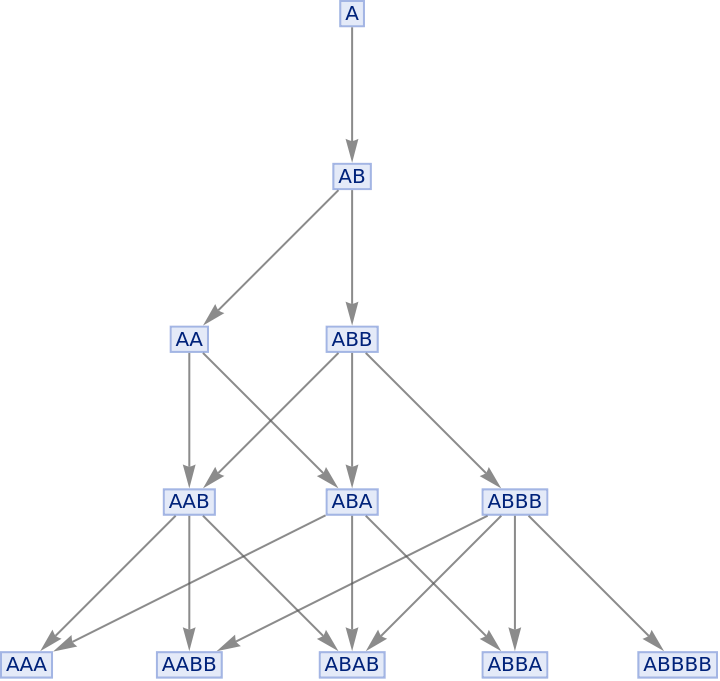
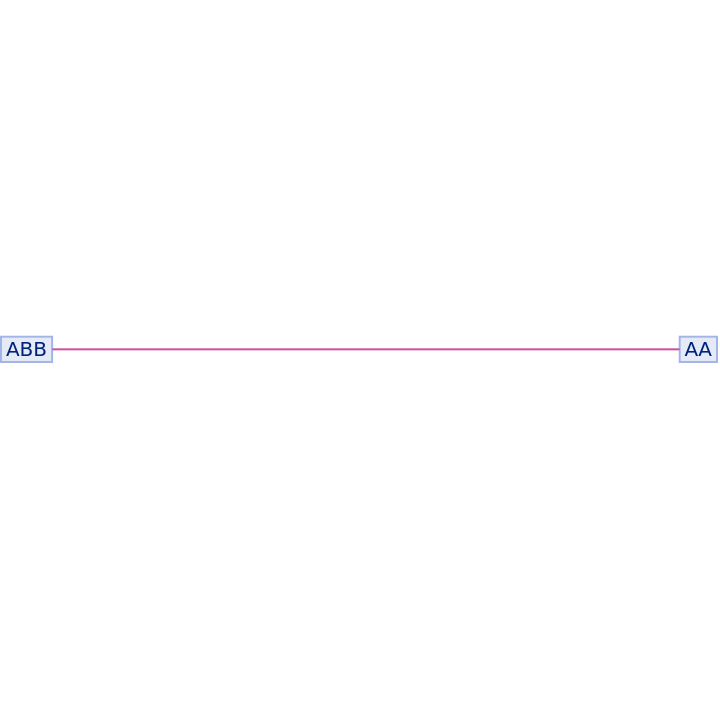
where the system has evolved for 4 generations. In order to study the interconnectedness of the strings within a given generation ,we use a branchial graph which is defined as links between the states that have common ancestors. Hence, the branchial graph for the last 3 generations is given by:
In[]:=
Table[ResourceFunction["MultiwaySystem"][{"A" -> "AB", "B" -> "A"}, {"A"}, t, "BranchialGraph"], {t, 2, 4}]
Out[]=
,
,
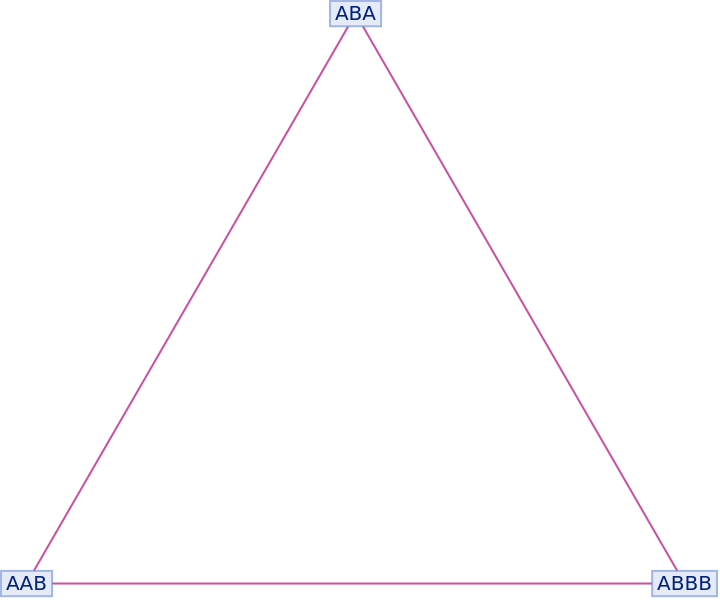
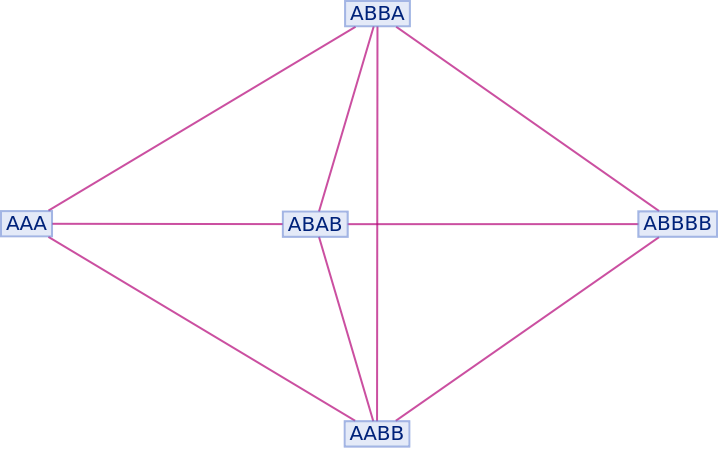
In a quantum system, operators are used to describe the interactions and relationships between quantum states, and in a multiway system, the substitution rules can be thought of as an equivalent concept. The number of edges in the branchial graph thus gives an indication of the degree of entanglement in the multiway system, and can be thought of as a measure of the interactions and relationships between quantum states in the system. In the example described above, we can say there are two operators and acting on the system corresponding to A BA and B A . Since the evolution of the initial condition “A” diverges to an increasing number of states as we increase the number of generations, we say that the two operators do not commute.When studying quantum decoherence, we often characterize the evolution of a quantum system using the Liouville-von Neumann equation instead of the Schrodinger equation. This happens because the state might not undergo unitary evolution, hence the Hamiltonian describing the system can be separated into a non-interacting component[2 ] and an interacting fluctuating component +. Due to its fluctuating nature the interacting component can be turned on and off, at different time steps, with different interaction strengths. In our multi-way system, we can interpret as the collection of operators that generate the substitution rules (responsible for “coherent” evolution), while can be regarded as a set of perturbative substitution rules that can act on an arbitrary amount of foliations. The structure of the perturbative rules should be characterized by the types of noises present in the system. We can think that each noise type can correspond to a set of possible substitution rules.
O
1
O
2
H
H
0
H
int
H
0
H
int
Results
Results
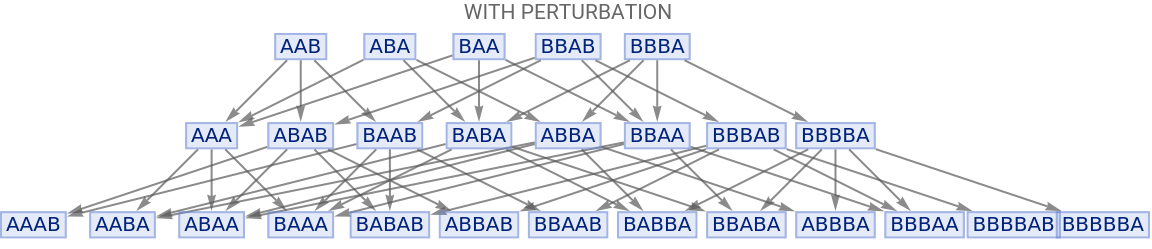
As an example, consider the the substitution rules A BA and B A evolving coherently for 2 generations. If we allow the system to evolve for one more generation, we getHowever, if in addition to the other rules we also applied the perturbation A AB to the second generation, we would’ve gotten instead: If we now turn-off the perturbation, and allow the system to evolve coherently, we can notice how the perturbed system gained more states and complexity compared to the unperturbed system.
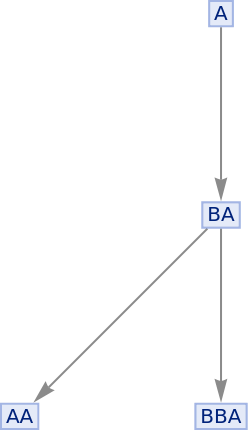
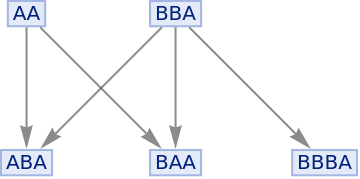
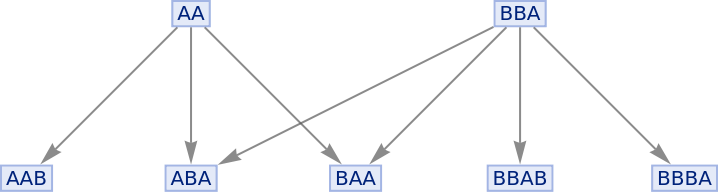
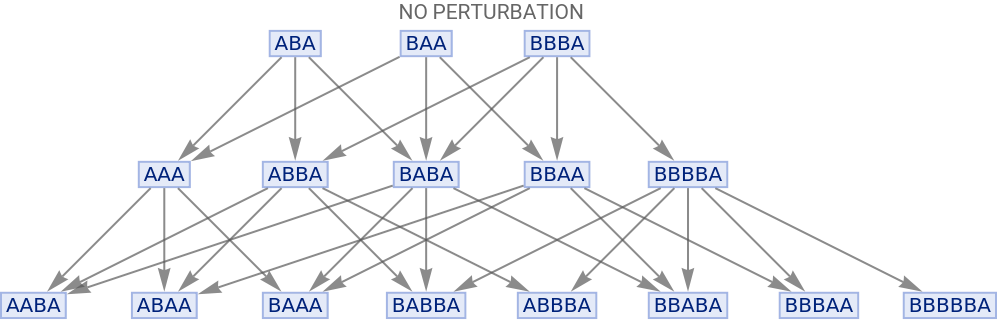
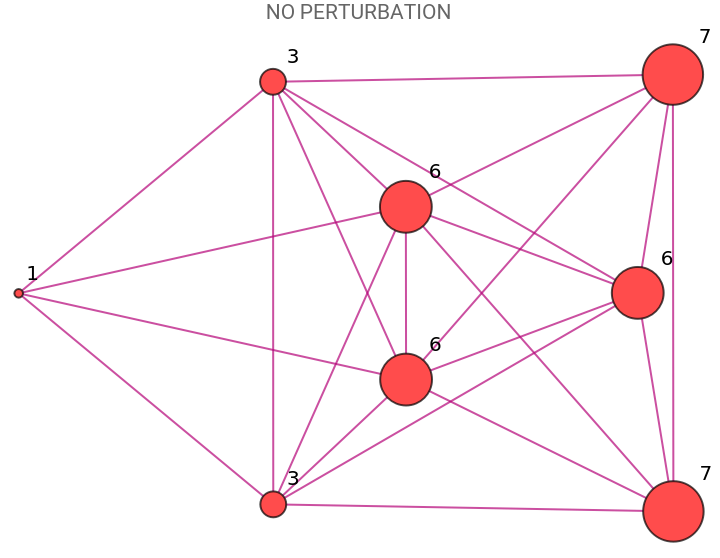
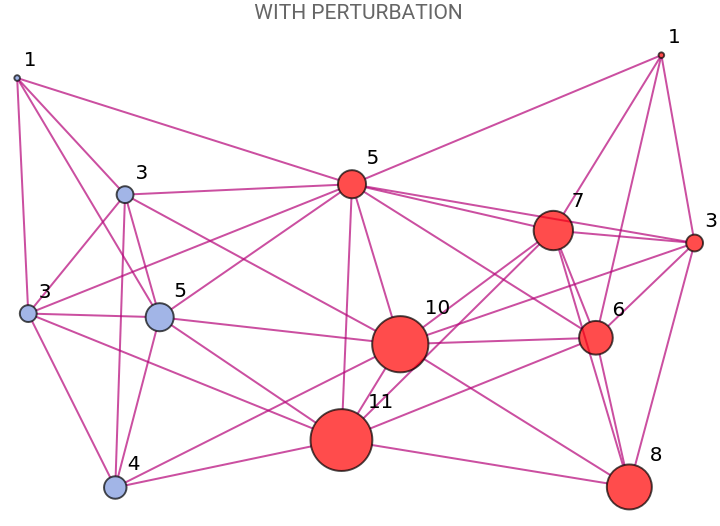
The corresponding branchial graphs of the resulting states, where each vertex is weighted by the number of reachable independent paths from the initial condition states: The red states correspond to the unperturbed states, while the blue states come from introducing the perturbation rules. Note how in this case, the noisy states are coupled to the unperturbed states, however, they do remain fairly localized in branchial space (the blue dots are not mixed with the red dotes). One possible way to interpret this result is that the perturbation does couple to the system, however it does not produce a high degree of entanglement.In the previous section we suggested that, in general, the perturbation can be more complex than just one substitution rule acting during one generation. Moreover, the size of the perturbation can also impact the degree on entanglement, meaning that instead of having a rule corresponding to a 1- letter string transforming into a 2- letter string( A AB), it could be the case that a letter string corresponds to an letter string where and can be two arbitrary non-zero numbers. With this in mind we note how, just like in real systems, we might have noise sources that the system is completely immune to (in the case that our perturbation rule was AAAAA ABB we would have seen no effect).In this report, we analyze a simplified case where we apply a perturbation of the type and during only one particular generation . Our code controls the coherent evolution of the system through the arbitrary substitution rules . The perturbation rule is of the form where is a string of a pseudorandom size (that satisfies the condition from above) composed of a pseudorandomly generated sequence of A’s and B’s. Furthermore, we are only considering the branchial graphs resulting from only two generations after applying the perturbation, just like in the example from above.
n
m
n
m
n1
m≤
maxSize
gen
unpertRule
"A"pertString
pertString
m
Interesting cases with unperturbed rule ABA, BA and gen = 3
Interesting cases with unperturbed rule ABA, BA and gen = 3
m = 1
m = 1
pertString = "B"
pertString = "B"
Code
Code
Conclusion and Future Work
Conclusion and Future Work
In conclusion, we notice that by introducing a perturbation in a string substitution system, in a very special parameter regime, the noise tends be either completely decoupled or only partially entangled to the unperturbed states. In order to gain more insight into this phenomenon a more general treatment that increases the complexity of the perturbation is needed. As suggested in the previous section, further work could involve the inclusion of noise at multiple foliations and for longer durations. Perhaps our result is only a consequence of the fact that the noise did not act in a large enough region of multi-way space (it was only applied during one generation), hence the noise did not have enough “time” to spread through the system.
Keywords
Keywords
◼
Branchial graphs
◼
Random perturbation
◼
Entanglement
Acknowledgment
Acknowledgment
I would like to thank Stephen Wolfram for providing me the opportunity to approach my research area from a different point of view. I would also like to thank my mentor WilliamMunizzi and the other staff members of the WWS 2023 for providing very valuable advice regarding my project and for stimulating discussions.
References
References
◼
[1] Wolfram, Stephen. “A class of models with the potential to represent fundamental physics.” arXiv preprint arXiv:2004.08210 (2020).
◼
[2] Brasil, Carlos Alexandre, Felipe Fernandes Fanchini, and Reginaldo de Jesus Napolitano. “A simple derivation of the Lindblad equation.” Revista Brasileira de Ensino de Física 35 (2013): 01-09.