1879 Josef Stefan found experimentally a radiation law (he derived this law from the measurements of the French physicists Dulong and Petit), which was theoretically derived by Ludwig Boltzmann in 1884 . Wilhelm Wien found in 1896 his famous spectral radiation law using Maxwells ideas of energy distribution in gases, but was falsified by experiments 1899. 1917 Einstein showed, that Wien’s law would have been correct if there would not be stimulated emission of radiation and vice versa. If Plancks law is right, then there must be stimulated emission of radiation. 1899/1900 Planck found the correct spectral radiation law by interpolation and explained it with the assumption of quantized emission and absorption of radiation. This was the birth of quantum mechanics and perhaps the greatest revolution in physics beside Einsteins relativity.
J=σ
4
T
j/λ∼
-5
λ
-β/(Tλ)
The aim is to find formulas of Stefan-Boltzmann radiation law and Planck’s spectral radiation law in every dimension.
Planck’s spectral energy density inside a closed (big enough) three dimensional cavity is:
u/f=·-1
8π
2
f
3
c
hf
hf
kT
Planck’s spectral radiation intensity (radiation escaping from a cavity through a small hole) in three dimension (here Lambert’s law comes into play):
j
f
c
4
2π
2
f
2
c
hf
hf
kT
and with (and )
c=λ·f
f/λ=-c/
2
λ
j
λ
2πh
2
c
5
λ
1
hc
λkT
Stefan-Boltzmann:
J=f=λ=σ
∞
∫
0
j
f
∞
∫
0
j
λ
4
T
Wien’s displacement law (1893):
/λ=0
j
λ
λ
max
b=2.898Km
-3
10
Lambert’s law (from spectral energy density to spectral radiation intensity):
Lambert’s law (from spectral energy density to spectral radiation intensity):
This is the general case with dimension :
n
In[]:=
lambert=FullSimplifyCos[ϑ]ϑϑ
π/2
∫
0
n-2
Sin[ϑ]
π
∫
0
n-2
Sin[ϑ]
Out[]=
Let’s see what happens if :
n1
In[]:=
Limit[lambert,n1,Direction"FromAbove"]
Out[]=
1
2
Let’s see what happens if :
n=2
In[]:=
lambert/.n2
Out[]=
1
π
Let’s see what happens if :
n=3
In[]:=
lambert/.n3
Out[]=
1
4
The radiation escapes with light speed , therefore we have the Lambert-factor:
c
In[]:=
LambertFactor[n_]:=
cGamma
n
2
2
π
Gamma1+n
2
These are the Lambert-Factors for dimension 1 to 5:
In[]:=
Map[LambertFactor,Range[5]]
Out[]=
,,,,
c
2
c
π
c
4
2c
3π
3c
16
In[]:=
Framed[DiscretePlot[LambertFactor[n]/.c1,{n,1,10},PlotRangeAll],RoundingRadius5,BackgroundLighter[LightBlue,0.5]]
Out[]=
Counting the number of standing waves in the cavity of dimension n in the frequency space:
Counting the number of standing waves in the cavity of dimension in the frequency space:
n
This is the hyper-area of a -sphere:
n
In[]:=
n-1
r
π
∫
0
m-2
Sin[ϑ]
Out[]=
2
n/2
π
-1+n
r
Gamma
n
2
This formula is also true for :
n=1
In[]:=
[n_]:=
n-1
r
2
n/2
π
Gamma
n
2
Let’s check:
In[]:=
Map[,Range[5]]
Out[]=
2,2πr,4π,2,
2
r
2
π
3
r
8
2
π
4
r
3
And the hyper-volume:
In[]:=
[n_]:=[n]
r
n
Let’s check:
In[]:=
Map[,Range[5]]
Out[]=
2r,π,,,
2
r
4π
3
r
3
2
π
4
r
2
8
2
π
5
r
15
There is a limit for :
n0
In[]:=
Limit[[n],n0]
Out[]=
1
In[]:=
Framed[Show[Plot[[n]/.r1,{n,0,15},PlotLabel"Volume of the unit sphere in n dimensions.",AxesLabel{"n","V"}],DiscretePlot[[n]/.r1,{n,1,15}]],RoundingRadius5,BackgroundLighter[LightBlue,0.5]]
Out[]=
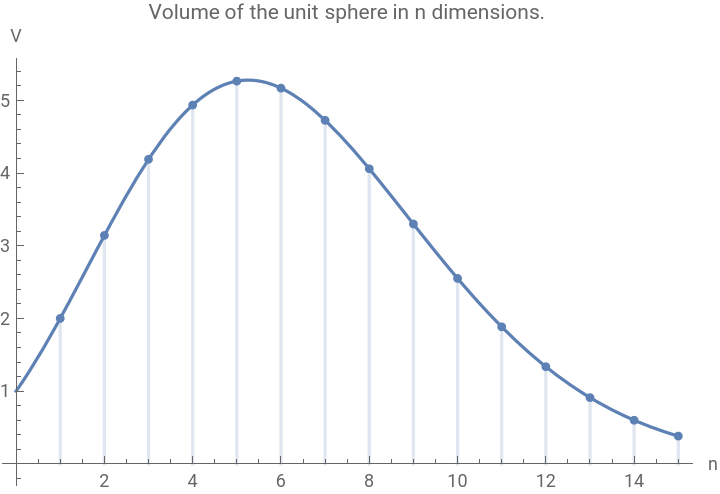
The number of standing waves is proportional to the volume in frequency space:
The Planck energy distribution (Bose-Einstein-statistics):
Putting it all together
Putting it all together
Planck’s energy density as a function of the frequency:
Planck’s spectral energy density in freqzency space from 1 to 7 dimensions:
And therefore the spectral energy density as a function of wavelength in three dimensional space:
The spectral intensity escaping from a tiny hole out of a cavity is:
The Stefan-Boltzmann-radiation law in three dimension:
The Stefan-Boltzmann-radiation law from 1 to 7 dimensions:
Wien’s displacement law from 1 to 7 dimensions:
A transcendental equation has to be solved. It it sufficient to take the numerator equal to zero:
Aftermath: From Stefan-Boltzmann radiation law we can conclude that there are three extended spatial dimensions. Possible extra spatial dimensions have to be small enough, that they cannot contain standing electromagnetic waves, which gives an upper bound of how big they are.