This problem is reproduced from Problem 9.15 and 9.16 of Ref. 1.
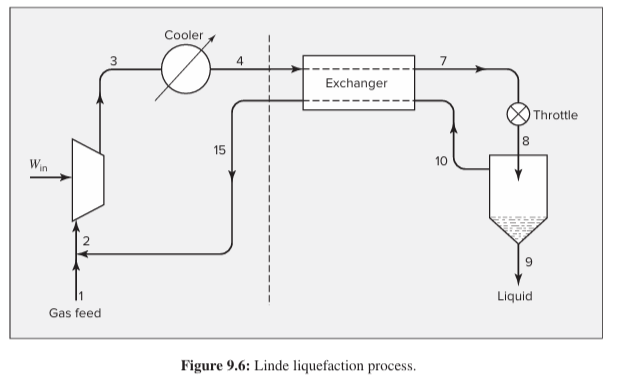
Dry methane is supplied by a compressor and pre-cooling system to the cooler of a Linde liquid - methane system (see Fig. below) at 180 bar and 300 K . The low-pressure methane leaves the cooler at a temperature 6 °C lower than the temperature of the incoming high-pressure methane . The separator operates at 1 bar, and the product is saturated liquid at this pressure . What is the maximum fraction of the methane entering the cooler that can be liquefied?
Dry methane is supplied by a compressor and pre-cooling system to the cooler of a Linde liquid - methane system (see Fig. below) at 180 bar and 300 K . The low-pressure methane leaves the cooler at a temperature 6 °C lower than the temperature of the incoming high-pressure methane . The separator operates at 1 bar, and the product is saturated liquid at this pressure . What is the maximum fraction of the methane entering the cooler that can be liquefied?
Rework the preceding problem for methane entering at 200 bar and precooled to 240 K by external refrigeration
Thermophysical Properties of METHANE from: https://webbook.nist.gov/cgi/fluid.cgi?ID=C74828&Action=Page
saturation properties - temperature increment = 5 K
Temperature (K), Pressure (bar), Enthalpy (kJ/kg), Entropy (J/g*K), Enthalpy (kJ/kg), Entropy (J/g*K)
Temperature (K), Pressure (bar), Enthalpy (kJ/kg), Entropy (J/g*K), Enthalpy (kJ/kg), Entropy (J/g*K)
datasat=;
In[]:=
tblhl=Table[{datasat[[i]][[2]],datasat[[i]][[3]]},{i,1,Length[datasat]}];tblsl=Table[{datasat[[i]][[2]],datasat[[i]][[4]]},{i,1,Length[datasat]}];
In[]:=
fhl=Interpolation[tblhl];fsl=Interpolation[tblsl];
In[]:=
tblhv=Table[{datasat[[i]][[2]],datasat[[i]][[5]]},{i,1,Length[datasat]}];tblsv=Table[{datasat[[i]][[2]],datasat[[i]][[6]]},{i,1,Length[datasat]}];
In[]:=
fhv=Interpolation[tblhv];fsv=Interpolation[tblsv];
In[]:=
tbltp=Table[{datasat[[i]][[2]],datasat[[i]][[1]]},{i,1,Length[datasat]}];
In[]:=
fpt=Interpolation[tbltp];
In[]:=
fpt[1]
Out[]=
111.473
In[]:=
H9=fhl[1]
Out[]=
-0.658638
In[]:=
S12=fsv[1]
Out[]=
4.58013
isobaric properties - pressure = 180 bar
{Temperature (K), Pressure (bar), Enthalpy (kJ/kg), Entropy (kJ/kg*K), State)}
{Temperature (K), Pressure (bar), Enthalpy (kJ/kg), Entropy (kJ/kg*K), State)}
dataisobaric=;
In[]:=
pos=Position[dataisobaric,191.32]
Out[]=
{{109,1}}
In[]:=
tblhCOMP=Table[{dataisobaric[[i]][[1]],dataisobaric[[i]][[3]]},{i,1,Length[dataisobaric]}];tblsCOMP=Table[{dataisobaric[[i]][[1]],dataisobaric[[i]][[4]]},{i,1,Length[dataisobaric]}];
In[]:=
fhCOMP=Interpolation[tblhCOMP];fsCOMP=Interpolation[tblsCOMP];
In[]:=
H4=fhCOMP[300]
Out[]=
747.91
isobaric properties - pressure = 1 bar
{Temperature (K), Pressure (bar), Enthalpy (kJ/kg), Entropy (kJ/kg*K), State)}
{Temperature (K), Pressure (bar), Enthalpy (kJ/kg), Entropy (kJ/kg*K), State)}
dataisobaric=;
In[]:=
pos=Position[dataisobaric,111.51]
Out[]=
{{25,1},{26,1}}
In[]:=
tblhP1BAR=Table[{dataisobaric[[i]][[1]],dataisobaric[[i]][[3]]},{i,26,Length[dataisobaric]}];tblsP1BAR=Table[{dataisobaric[[i]][[1]],dataisobaric[[i]][[4]]},{i,26,Length[dataisobaric]}];
In[]:=
fhP1BAR=Interpolation[tblhP1BAR];fsP1BAR=Interpolation[tblsP1BAR];
In[]:=
H15=fhP1BAR[294]
Out[]=
900.72
We get the fraction of the methane, which is liquefied or z:
z = 16.95 %
z = 16.95 %
In[]:=
z=(H4−H15)/(H9−H15)
Out[]=
0.169529
isobaric properties - pressure = 200 bar
{Temperature (K), Pressure (bar), Enthalpy (kJ/kg), Entropy (kJ/kg*K), State)}
{Temperature (K), Pressure (bar), Enthalpy (kJ/kg), Entropy (kJ/kg*K), State)}
dataisobaric=;
In[]:=
pos=Position[dataisobaric,191.32]
Out[]=
{{109,1}}
In[]:=
tblhCOMP=Table[{dataisobaric[[i]][[1]],dataisobaric[[i]][[3]]},{i,1,Length[dataisobaric]}];tblsCOMP=Table[{dataisobaric[[i]][[1]],dataisobaric[[i]][[4]]},{i,1,Length[dataisobaric]}];
In[]:=
fhCOMP=Interpolation[tblhCOMP];fsCOMP=Interpolation[tblsCOMP];
In[]:=
H4=fhCOMP[240]
Out[]=
501.046
In[]:=
H15=fhP1BAR[234]
Out[]=
770.601
In[]:=
H9=fhl[1]
Out[]=
-0.658638
We get the fraction of the methane, which is liquefied or z:
z = 34.95 %
z = 34.95 %
In[]:=
z=(H4−H15)/(H9−H15)
Out[]=
0.3495
References
References
◼
[1] J.M. Smith, Hendrick Van Ness, Michael Abbott and Mark Swihart, Introduction to Chemical Engineering Thermodynamics, 9th Edition, NY: McGraw Hill, 2022.
CITE THIS NOTEBOOK
CITE THIS NOTEBOOK
Linde process for Methane liquefaction
by Housam Binous and Ahmed Bellagi
Wolfram Community, STAFF PICKS, February 3, 2025
https://community.wolfram.com/groups/-/m/t/3375026
by Housam Binous and Ahmed Bellagi
Wolfram Community, STAFF PICKS, February 3, 2025
https://community.wolfram.com/groups/-/m/t/3375026