The Binary Bias and the Arity Chasm
The Binary Bias and the Arity Chasm
The history of pure mathematics seems to have produced an immense amount of binary structures. From the primitive and mundane to the modern and sophisticated, most areas of mathematics are built — almost exclusively — on objects that are binary in nature: Arithmetic: 1 + 1 = 2, operations are binary, invertibility and divisibility relations are binary... Algebra: a · b, dominated by binary operations, symbolic equality is a binary relation... Calculus: f : , functions are binary assignments, standard constructions are functions of functions or binary operations of functions... Set Theory: R ⊂ A × B, relations between sets are binary, Cartesian product is binary, successor function is atomically binary... Logic: ({0,1}, ∧, ∨, , ¬), two truth values, logical constructions are functions of propositions or binary operations of propositions... Category Theory: A B, morphisms are arrows, isomorphism is a binary relation, higher categories built with arrows of arrows, extensive theory of duality... Areas of mathematics that resist saturation by binary structures are those that deal with spatial information such as Geometry or Topology. Although modern treatments of these subjects are dominated by techniques and notations with a very strong binary flavour, one could argue that this is the result of applying methods from some of the disciplines listed above and not a fundamental feature of the realm of space, shape and structure.One way to illustrate the bias towards binarity in mathematics is to focus on the abstract algebra literature and get some bibliometric data about the arity of the operations considered. From a purely formal point of view, there is no a priori reason to focus on binary operations over operations of higher arities beyond simplicity and ease of manual computation. If one assumes that the mathematical community has conducted research on abstract algebra in a parsimonious way, the number of publications dealing primarily with operations of some fixed arity (histogram labels) would be expected to look something like this:
Out[]=
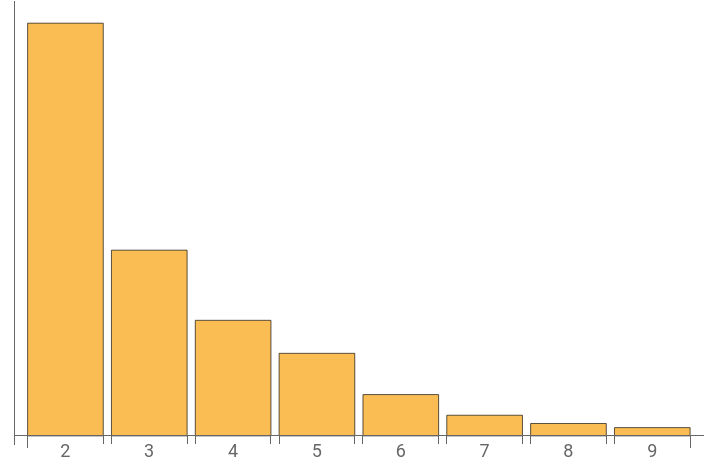
Where we expect a decreasing amount of work with increasing arity due to the additional computational complexity involved. Any simple parsing of the bibliometric data, e.g. checking for higher arity structures mentioned in titles of arXiv preprints on abstract algebra, instead reveals a very different picture:
Out[]=
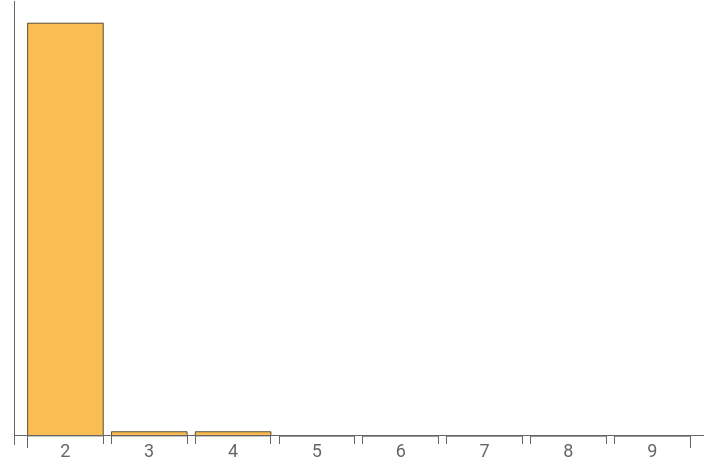
This discrepancy in the expected bibliometric data is what I would like to call the Arity Chasm. Naturally, this lack of abstract algebra literature leads to a lack of higher arity structures in other areas of mathematics and science.There are several plausible contributing factors that may explain the Arity Chasm: Biological Predispositions: bilateral symmetry, chirality, sexual reproduction Cognitive Predispositions: sequential thinking, causality perception, sameness perception, limited working memory Written Language: character-based scripts in civilizations where mathematics was developed, bilateral symbolic adjacency, lack of articulated 2-dimensional diagrammatic communication Printing Technology: intellectual communication constrained to be implemented in character-based scripts, efficient diagrammatic communication only recently possible via digital technology Dissemination Bias: ideas that are communicated efficiently, i.e. those that can be captured effectively in printed character-based script, spread more rapidly Productivity Bias: simple and powerful ideas generate many results rapidly and often lead to overstretching of their natural domain of applicability Historical Bias: the field of abstract algebra is still relatively young, most areas of mathematics dominated by binarity are still in active development, disciplinary inertia of the modern academic ecosystemThis project aims to show that there is great potential for mathematical discovery and scientific development beyond binarity.
Some Examples of Ternary Phenomena
Some Examples of Ternary Phenomena
As the next step in the arity ladder, ternary structures appear as the obvious thing to explore beyond binarity. Here are some natural ternary notions that appear in several branches of pure mathematics. We note that these three examples are very different in nature and belong to separate mathematical realms.
Topology: Borromean Rings
Topology: Borromean Rings
In the context of Knot Theory one can define the linkedness relation between two rings in the obvious way. It is possible to arrange three rings to form a trio of pair-wise linked rings. This is an example of a ternary relation between rings that is fundamentally binary as seen from the fact that if any of the rings is removed, the other two remain (pair-wise) linked.
The arrangement of three rings known as the Borromean Rings is a fundamentally ternary linkedness relation since when any of the rings is removed the other two are unlinked.
The arrangement of three rings known as the Borromean Rings is a fundamentally ternary linkedness relation since when any of the rings is removed the other two are unlinked.


Category Theory: Trisomorphisms
Category Theory: Trisomorphisms
The notion of isomorphism in the context of Category Theory is based on the following commutative diagram:
Out[]=
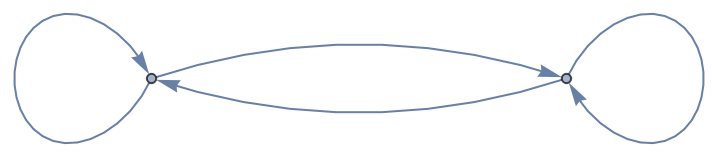
This diagram involving two objects can be easily generalised to an arbitrary number of objects. In the case of three objects, one obtains a commutative diagram of the form:
Out[]=
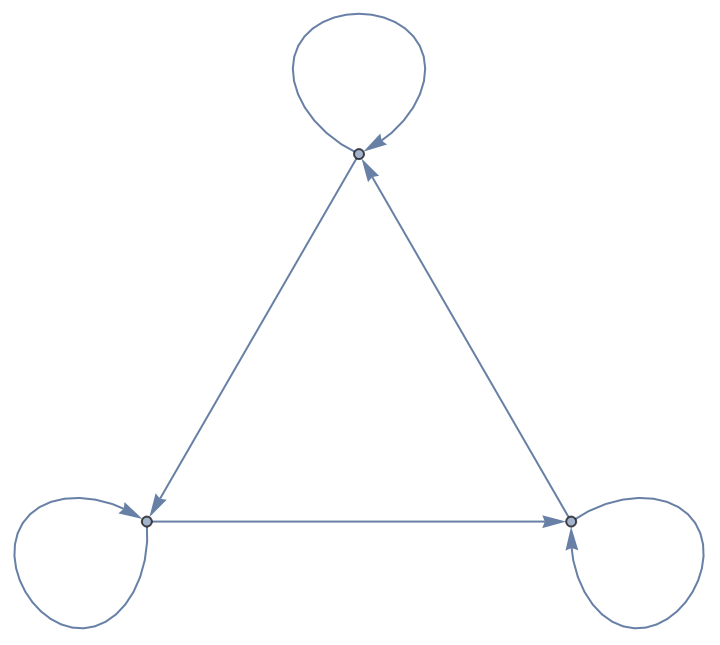
This is called a trisomorphism. The requirement that the triple composition of arrows at each object gives the identity, i.e. that the diagram is indeed commutative, in fact implies that the arrows of a trisomorphism are all isomorphisms in their own right. This shows that although the notion of trisomorphism is ternary (as it requires three objects in general) it is somehow not independent of the notion of isomorphism: it is a stronger condition, since a trio of pair-wise isomorphisms between three objects need not form a trisomorphism in general.
Algebra: 3-Lie Algebras
Algebra: 3-Lie Algebras
The theory of n-Lie algebras is well known and there is a sizable literature about it. For n = 2 we recover the standard notion of Lie algebra. The next step in arity is a 3-Lie algebra: a vector space equipped with a skew-symmetric trilinear form [,,] satisfying the (higher order) Jacobi identity:[x,y,[a,b,c]] = [[x,y,a],b,c] + [a,[x,y,b],c] + [a,b,[x,y,c]] ∀ x,y,a,b,c ∈ There are two natural examples of 3-Lie algebras. Firstly, we simply find the 4-dimensional analogue of the cross product in and the canonical complex structure in . Wolfram Language has this product implemented as the built-in symbol Cross[ ]. We can check the ternary Jacobi identity for the canonical 3-Lie algebra bracket in directly:
3
2
4
In[]:=
x=Array[ξ,4];y=Array[ψ,4];a=Array[α,4];b=Array[β,4];c=Array[γ,4];
These examples are particularly relevant from the point of view of physics: the 4-dimensional cross product exists naturally as an algebraic tool in space-time formalisms involving a Lorentzian manifold and the Nambu bracket captures the Hamiltonian dynamics of well-known mechanical systems like the asymmetric spinning top.
An Open Problem: What is a Ternary Group?
An Open Problem: What is a Ternary Group?
Ternary Relations
Ternary Relations
Recall that a standard (binary) relation between two sets A and B is a subset of their Cartesian product R ⊂ A × B. We can use a (hyper)graph notation to depict the relation R as a link:
Relations can be composed by demanding that pairs have a common shared middle element. Diagrammatically this is expressed simply as the fact that concatenating two links gives another link:
A ternary relation between three sets A, B and C is a subset of their triple Cartesian product T ⊂ A × B × C. Similarly to binary relations, we can use a hypergraph notation to represent ternary relations:
Using conditions that demand common elements between triples, we can define several kinds of composition operations for ternary relations. For example, given two ternary relations T ⊂ A × X × Y, T’ ⊂ X × Y × B we can define their binary T ◆ T’ composition by demanding that triples share pairs from X × Y, i.e. diagrammatically:
When two middle objects X and Y are considered, the triple composition looks like this:
And, finally, the composition for three middle objects X, Y and Z:
If we represent ternary relations as triangles whose vertices correspond to the objects they relate, the triple compositions above correspond to the following spatial arrangements of trios of triangles:
Cubix Algebra
Cubix Algebra
A cubix, known in the literature as a cubic matrix, is a 3-dimensional array of numbers. Cubices fit naturally in the sequence: 0 scalar, 1 vector, 2 matrix, 3 cubix,... It is important not to confuse them for conventional higher order tensors: cubices may be related to 3-tensors in concrete situations but they are more general objects. In fact, this is a point that is often misunderstood in the cubix literature. This seemingly subtle issue is symptomatic of the lack of a good theory of triality (the ternary analogue of duality) in the context of vector spaces, which is just another manifestation of the underdevelopment of ternary mathematics. Addressing the topic of triality is beyond the scope of this work but it is a natural follow-up line of research.
For our purposes, cubices will simply act as a source of examples of ternary phenomena, and a way to give a computation-friendly analogue of the triple compositions of ternary relations from the section above. Let’s consider a fixed dimension for our arrays:
For our purposes, cubices will simply act as a source of examples of ternary phenomena, and a way to give a computation-friendly analogue of the triple compositions of ternary relations from the section above. Let’s consider a fixed dimension for our arrays:
and let’s define some generic cubices as symbolic arrays:
We can see that the smallest non-trivial cubix has 8 elements arranged in a 2 × 2 × 2 cube
The binary multiplication of ordinary matrices generalizes to a ternary multiplication of cubices in three possible ways, in precise analogy with the three possible triple products of ternary relations. The hypergraph combinatorics of the relation picture now become the combinatorics of summing over free indices: 3 objects, carrying 3 indices each, must be combined to give a single object carrying 3 indices subject to the constraint that not all indices of any single object can be summed over (which will correspond to one of the cubices being traced out). There are four possible ways to do this, three of them give the fundamental triple cubix multiplications:
The fourth combinatorial possibility corresponds to a further contraction of the second or third product above:
Since we have fixed the dimension of the cubices, n, there are multiple notions of identity cubix. The most obvious one, which directly generalizes the identity matrix, is called the tridentity defined in the obvious way:
The tridentity is the cubix expression of the canonical triality pairing of vectors, which we shall not discuss further here. Partial identities are obtained by considering parallel arrays of identity matrices in each of the three spatial directions. These are called the red, green and, blue identities, or RGB identities for short:
These act as partial identities of all three products up to a normalization factor in the following sense: for the first two multiplication we have
whereas for the third multiplication
This is a strictly more general phenomenon than ordinary identity since for any given multiplication no pair of RGB identities acts as an identity when placed on any pair of arguments. For instance:
Thus we see that it really is the trio of RGB identities that carry the algebraic information of indentitiness.
Beyond Associativity
Beyond Associativity
The standard notation of multiplications as operations with three arguments in brackets may give the impression that the operations defined in the previous two sections are direct extensions of multiple nested compositions. If that were to be the case, a form of associativity would have to be recovered for the cubix multiplications above. We can check directly that none of the operations defined so far satisfies the (naive) ternary associativity property:
These cubix operations are defined from products and sums, just like ordinary matrix multiplication, one should expect that the associativity and distributivity properties will induce some compatibility conditions for these ternary multiplications. Using the code implementation of cubices used in this project will allow for a systematic search for properties of cubix multiplication which will, in turn, inform the properties to be verified by the ternary relation compositions. A thorough investigation of the possible compatibility conditions satisfied by these operations should lead to a transparent definition of the ternary analogue of a category.
Science Through a Ternary Lens
Science Through a Ternary Lens
The explorations carried out during this project have shown very strong evidence hinting at an entire realm of ternary mathematical structures waiting to be discovered. The algebraic richness displayed by ternary relations and cubices, even in their most basic constructions, suggests that ternary structures may be fertile ground for a brand new outgrowth of abstract algebra. We can only speculate that these new ideas will lead to the resolution of long standing problems like the integration of 3-Lie algebras or the development of a complete theory of triality. A deeper understanding of ternary structures and the confirmation of some genuine mathematical novelty in them will set a strong precedent that shall irrevocably legitimize the serious investigation of higher arity structures in general.
Although our discussion has focused exclusively on the highest level of abstraction, one of the main motivations to consider ternary (and higher) structures comes from their application to be used as models of physical reality or as integral parts of computational paradigms. To conclude, we summarize here some of the potential areas where higher arity structures, and particularly ternary ones, could see some direct application:
Although our discussion has focused exclusively on the highest level of abstraction, one of the main motivations to consider ternary (and higher) structures comes from their application to be used as models of physical reality or as integral parts of computational paradigms. To conclude, we summarize here some of the potential areas where higher arity structures, and particularly ternary ones, could see some direct application:
◼
Fundamental Physics. One of the earliest motivations for ternary structures in physics was in the context of modelling the dynamics of the strong nuclear interaction. Nambu, who later identified the bracket that bears his name, was looking for a classical theory that would reflect, upon quantization, the ternary nature of what ended up being called colour and quarks. It is well-known that cubices and ternary structures have some fringe applications in mathematical physics but recent work on reformulations and generalizations of the Standard Model, particularly by John Baez, hints at triality potentially playing a key role. If Lie groups and groupoids have been so successful at capturing the essential structure of fundamental physics, one can only speculate what use ternary or higher analogues could find in the future.
◼
Computer Science. Most computing paradigms are sequential in nature, even if they involve parallel processes, they are fundamentally step-wise binary (input-output). I will be very interesting to see computation done in graphs and, more generally, hypergraphs. It is not hard to imagine processes that are built in a network of computing nodes which require, say, tree inputs and produce three outputs. There may be unexplored processor architectures that are particularly effective in carrying out ternary computations. It will be interesting to see whether they turn out to be more or less efficient for conventional (binary) computation. Stephen Wolfram has suggested on several occasions that more general computational paradigms are worth exploring.
◼
Complexity Science. Systems with many interacting parts are often complex enough that successful theories commonly rely on modelling interactions by the simplest mathematical devices at hand, e.g. graphs and categories, as evidenced by the immense success of network theory and applied category theory. If simple ternary (or higher) devices were readily available, models could turn out to be fundamentally different since they will be atomically made of formally different structures. It seems reasonable to expect that this could lead to qualitatively different models of emergence and true alternatives to current network-based binary models. There may be fundamental reasons for the preponderance of binary structures in nature but those need to be spelled out. The work of Nils Baas on hyperstructures is a great example of this kind of approach.
◼
Cognitive Science and Biology. One of the areas in which the interaction of multiple entities to generate other of similar nature abounds is in the modelling of life and mind. Thoughts, ideas, individuals or genes are commonly described as combining and forming aggregates in a myriad of ways. All this diversity is somewhat lost, however, when scientists turn to conventional mathematics for inspiration and modelling tools. Too often, descriptions in the field of theoretical biology or mathematical consciousness rely on functions, sets, binary relations, or, at best, categories; all of them, however fundamentally binary in nature. Providing some extra formal devices in this direction would mean a more faithful translation from the conceptual into the mathematical stages of modelling.