Conventional treatments of the quantum phase space are riddled with various notions of quasi-probability, and its negative values serve as evidence that purely quantum properties have no place in classical statistics. The following is an attempt at demystifying such claims by introducing quantum phase space from the ground up, starting from a classical notion of negativity for 2-dimensional systems, followed by higher-dimensional geometric interpretations of probabilities and their quantum counterparts, and ending with a computational exploration of its various properties in view of this classically inspired approach with some general discussion of probabilities and their role in quantum theory.
Classical negativity
Classical negativity
Imagine a classical binary random variable, like a coin that can land either with a red or green painted side facing up :
X∈🔴,🟢
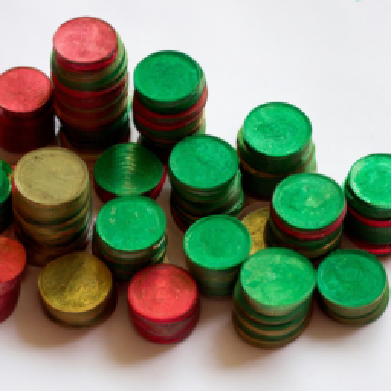
Some coins are fair and land on either side with 50% probability, but some are biased and slightly favor one side over another, with the green side twice as probable as the red one, for instance. Some coins are completely rigged and land with only the red side facing up or only the green side all the time.
The space of all possible coins is a line interval between these two deterministic choices and , with every point coordinates equal to corresponding probabilities that always sum up to 1:
The space of all possible coins is a line interval between these two deterministic choices
🟢={0,1}
🔴={1,0}
Out[]=
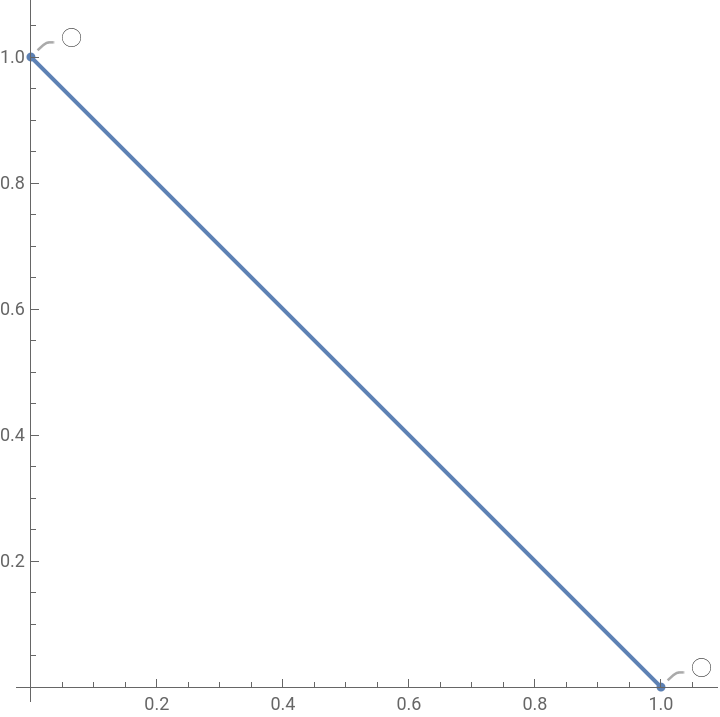
Any point can also be represented by a linear combination of and , as they form a natural basis for this space. For example a coin with coordinates can be written as 🔴+🟢:
{p,1-p}
🔴
🟢
{1/3,2/3}
1
3
2
3
Out[]=
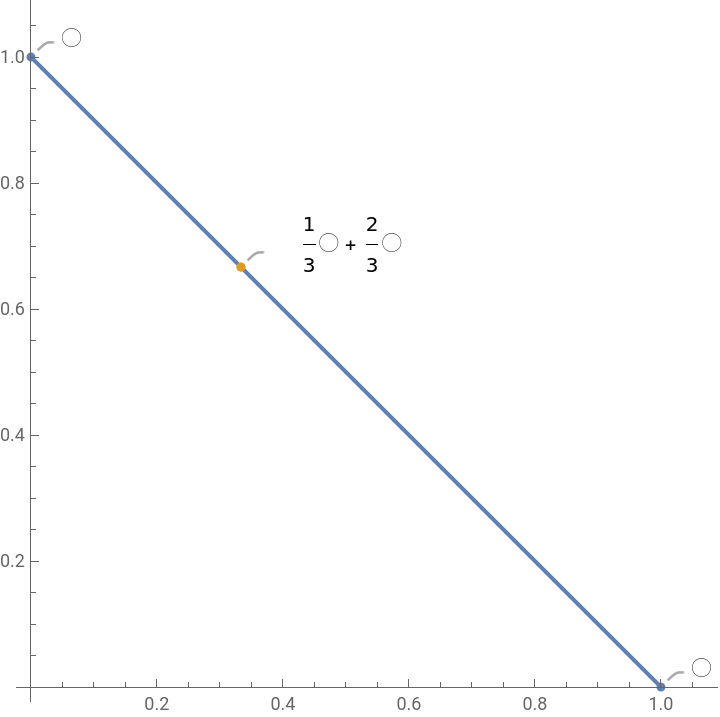
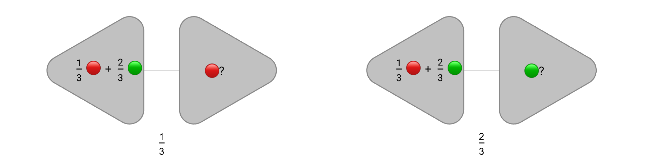
This basis of deterministic coins is very convenient, as it also represents two possible outcomes of a coin toss with coefficients interpreted as frequencies of these outcomes, which is the most intuitive interpretation of probabilities. With our example coin 🔴+🟢 expressing probability or frequency of for this coin to land with the red side facing up and for the green.
1
3
2
3
1
3
2
3
In the spirit of generalized probabilities theories (GPTs, not of the Transformer variety) a basis also can be thought of as a sort of interrogation of the state with yes-no questions with uncertain answers:
In[]:=
coin={1/3,2/3};isItRed={1,0};isItGreen={0,1};
To what degree is the coin red?
In[]:=
isItRed.coin
Out[]=
1
3
How certain it is that it’s green?
In[]:=
isItGreen.coin
Out[]=
2
3
With deterministic coins yielding maximally certain answers under each interrogation effect, either 1 or 0.
This action of effects on states can be depicted using diagrammatic approach akin to quantum circuits, but interpreted probabilistically instead:
In[]:=
states=QuantumState"0","Label"->"🔴",QuantumState"1","Label"->"🟢";effects=QuantumState"0",QuantumBasis[1,"I"],"Label"->"🔴?",QuantumState"1",QuantumBasis[1,"I"],"Label"->"🟢?";
In[]:=
circuits=QuantumCircuitOperator/@Tuples[{states,effects}];Labeled[#["Diagram","WireLabels"->None,ImageSize->Tiny],#["Scalar"]]&/@circuits//GraphicsRow
Out[]=

Out[]=
But mathematically and is not the only valid linear basis one can construct, one can take any two points instead:
🔴
🟢
Out[]=
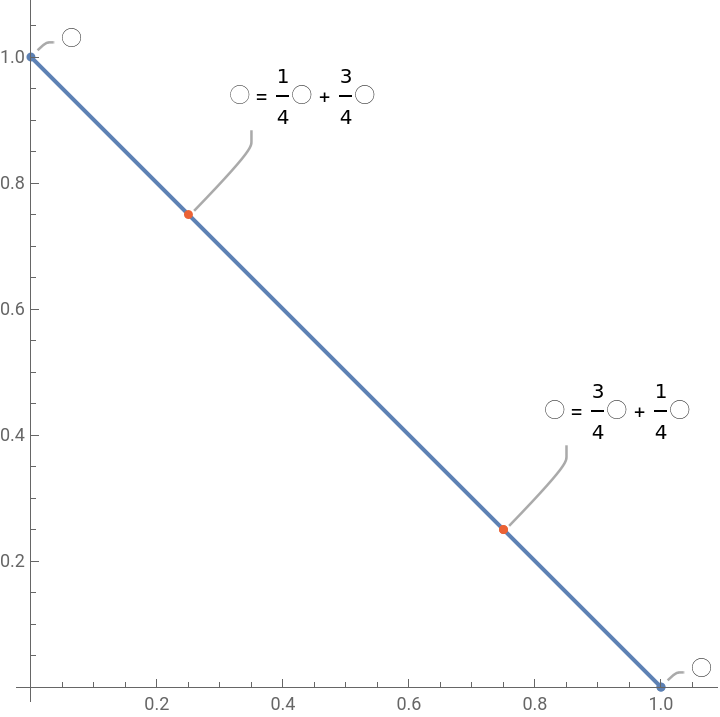
Taking these coins as a basis comes with some major downside though. They’re no longer intuitively encoding the outcomes of a single toss and therefore not representative of some actual real physical event. Nevertheless any coin can still be technically decomposed in this basis using conventional linear algebra:
In[]:=
(basis=Transpose@{{1/4,3/4},{3/4,1/4}})//MatrixForm
Out[]//MatrixForm=
1 4 | 3 4 |
3 4 | 1 4 |
In[]:=
x=LinearSolve[basis,{1/3,2/3}]
Out[]=
,
5
6
1
6
In[]:=
basis.x=={1/3,2/3}
Out[]=
True
Out[]=
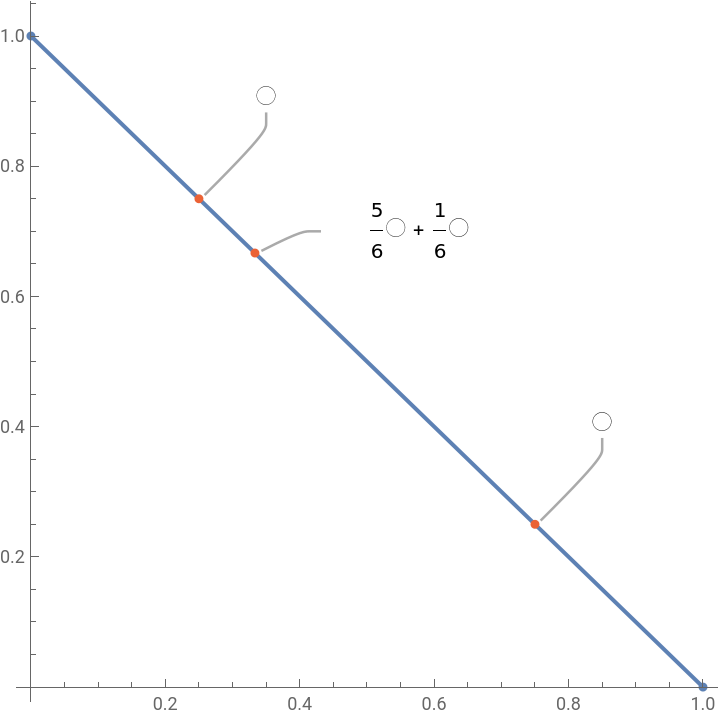
But any coin not bounded by the basis element would contain coefficients that no longer interpretable as probabilities! A probability which is greater than 1 or less than 0 doesn’t make sense anymore:
Under such effects, questions about the interrogated coin no longer produce answers interpretable as probabilistic uncertainties:
One can say that this is the consequence of questions being non-calibrated against all existing possibilities, or in other words, questions not covering all possible states with some states being “out of reach” for an interrogator, questions that do not imply their existence, which as a result, produce weird values for uncertainties of such states (amusingly this also justifies some people’s seemingly outrageous claims of “110% certainty” in something, and even those rare ones that would deny an alternative by being “-10% certain” in its outcome).
Here is an example of such a quasi-probability for a random qubit with a negative entry:
But wait, what we have done right now has nothing to do with quantum theory and its formalism! It was just a mathematical trick that allowed us to define such an unphysical basis and look at reality through its distorted lens. It’s an artifact of simply picking bad questions about experimental outcomes and one should clearly just to recalibrate them in order to cover for all possible events.
We could have as well picked the very questionable basis with one of the elements being very far away from being a normal physical coin:
Or even this shocking one, with both basis elements represented by a completely “imaginary”, made-up coins:
The use of linear algebra allows for such a freedom of choice, disregarding all common sense in the process.
Then why is it allowed to prescribe similar objects, with unexplainable probabilistic properties, some real physical meaning in the conventional quantum theory? Isn’t it a simple matter of picking the right basis corresponding to the right set of questions that can describe any uncertain state in existence without referring to some weird non-interpretable math?
Equipped with this classical intuition about uncertainty of simple coins, and by extension any other realization of a binary random variable one can imagine, we can now generalize these ideas to higher dimensional probability distributions and briefly explore their geometries.
Geometry of probabilities
Geometry of probabilities
If probability vector of a random binary variable is a 1-dimensional line embedded in 2D:
Probability vector of a random ternary variable, variable with three possible outcomes, is a 2-dimensional triangle embedded in 3D:
It can be confirmed by checking whether all coordinates of some random point on that region do sum up to 1:
Having some geometric intuition in mind and an idea of classical probability space structure, it is time to introduce its quantum counterpart.
Quantum phase space
Quantum phase space
A quantum state is like a probability distribution, a state with inherent uncertainty. The simplest kind of state can even be easily understood geometrically; it is a qubit or a 2-dimensional (d=2) quantum state.
A random qubit is represented by a vector inside a ball, the Bloch ball:
A so called pure states are those that are on its surface, the Bloch sphere:
Every qubit can represented as a vector in three dimensions, the Bloch vector:
Therefore a natural way of embedding quantum representation of uncertainty of this form is to somehow squeeze the Bloch ball into a simplex of the same dimensionality. Because the actual embedding dimension of the 3-dimensional simplex is 4, means that the 3-dimensional Bloch vector is only a projection from some 4-dimensional object representing all valid quantum states:
The simplex subset corresponding to all valid quantum states is called a qplex. And in qubit case at least it is the same as its inner ball.
Given an arbitrary quantum state defined by a matrix:
The process of doubling can be depicted like simply having a conjugate copy of underlying vector by its side:
And it is the case for a pure state, but for a general mixed state doubling would not be separable like this, so it is depicted with some dashed line in between:
Or the Feynman basis, one of the first ever phase space representations defined for a qubit:
Change of basis of the doubled state is then equivalent to a phase transformation:
Therefor the inverse transformation of a Bloch vector to a probability vector may consist of scaling it by the inner-ball radius, translating across an axis and a rotating it away from the same axis towards barycenter of the simplex:
This probability vector can also be obtained using the GellMannBlochMIC phase space basis inspired by this simple geometric transformation, but generalized to all higher dimensions:
MIC stands for Minimal Information-ally Complete basis, which is dual to MIC-POVM measurement constructed using the Gram matrix (matrix of inner products) of basis elements:
Similarly to the classical case this phase space transformation or measurement can be thought as interrogation effects of the multiple clones of the state, constructed from the inverse basis elements, which diagrammatically can be depicted as follows:
Which obviously forms a measurement basis for a qubit as these four projections do lie on the Bloch sphere. But for qutrits and larger qudits, if one would try to reconstruct the quantum state corresponding to these inner simplex points (with Weyl transformation serving as a general backward transformation from any phase space state), the resulting density matrix doesn’t guarantee to be positive semidefinite anymore and therefor can not represent a valid quantum state.
For qubits the reconstruction of a state from these inner simplex vertices does produce a valid pure state:
For qubits the reconstruction of a state from these inner simplex vertices does produce a valid pure state:
But for a qutrit the analogous procedure does not longer produce a pure or even a mixed one, it’s simply not quantum anymore:
This is because underlying matrices are not positive and contain negative eigenvalues:
Or triangle faces of a tetrahedron:
And as there is no more room to expand in that direction, as it would move the point outside the simplex, this is the maximum purity along the line between the center and any center of the 8-dimensional face.
Quantum Bayesianism
Quantum Bayesianism
But without worrying too much about high dimensional geometry and assuming SICs do exist in any dimension, what do they actually represent? For example, what are these elements of a 5-dimensional phase space basis, found with a numeric search by QBists:
As for the GellMannBlochMIC above, each basis element corresponds to a type of measurement one can perform on a system:
With each POVM element being a pure effect, or a set of questions used to completely determine the state. Effects being pure is the most crucial part of POVM being a SIC, otherwise each effect would be a mixture of multiple questions instead of a single one:
Compare MIC vs SIC:
Under action of these effects, any quantum state communicates its uncertainty about being in a state, which is inferred by each question or a single SIC measurement:
That’s where the Bayes rule comes in!
If one converts a computational measurement to the same SIC basis and computes the usual trace, which in phase space simply means discarding the extra qudits corresponding to an unobserved environment:
If one converts a computational measurement to the same SIC basis and computes the usual trace, which in phase space simply means discarding the extra qudits corresponding to an unobserved environment:
One gets a matrix that relates these two probability vectors in 25 and 5 dimensions:
It’s a column-quasi-stochastic matrix, meaning it is a real matrix with columns summing up to 1 but with negative probabilities:
More that 1000 iterations is required to get close enough for the machine precision no longer be able to distinguish it from the right answer:
But no matter the interpretation, it seems like the backward inference part has a crucial role in any quantum process. And not just measurement, similar stochastic decomposition can be performed on any unitary operator or even arbitrary quantum channel:
Any quantum computation with states, operators, channels and measurements can be transformed into purely probabilistic form, where instead of quantum states being manipulated in complex Hilbert spaces, probability vectors of higher dimension are being manipulated instead:
Where each quantum process is not only capable of forward stochastic inference of predicting the next probability vector by looking up values in some conditional probability table but also intrinsically inferring a vector from its prediction in a backward direction.
In the end, various formalisms of quantum theory are all neatly brought together to make its finite-dimensional structure very clear, categorial quantum theory with its pretty diagrams and the doubling map, phase space picture with its basis transformations and sensible evolution, and QBism with its optimal breakdown of the underlying mathematics in terms of probabilities alone.
CITE THIS NOTEBOOK
CITE THIS NOTEBOOK
Classical origins of the quantum phase space
by Nikolay Murzin
Wolfram Community, STAFF PICKS, April 8, 2024
https://community.wolfram.com/groups/-/m/t/3155154
by Nikolay Murzin
Wolfram Community, STAFF PICKS, April 8, 2024
https://community.wolfram.com/groups/-/m/t/3155154