Problem
Problem
ABC and ABD are two right triangle shares the same hypotenuse AB. C and D are on the same side of AB
◼
P is a point on segment AB with AP = AC and BP = BD.
◼
X is the circumcenter of triangle PDA
◼
Y is the circumcenter of triangle PBC
◼
M is the intersection of segment XY and segment CD.
Prove that point M is the mid point of segment CD
Geometric Scene Construction
Geometric Scene Construction
From the description of the problem we see it is quite complicated geometric configuration with very unusual constraints. But no worry, let’s use the synthetic feature of Wolfram language to build a proper geometric scene first step by step.
gs=RandomInstance[GeometricScene[{a{0,0},b{4,0},o{2,0},p,c,d,x,y,m},{PlanarAngle[{a,c,b}]90Degree,PlanarAngle[{a,d,b}]90Degree,Style[CircleThrough[{a,b,c}],Dashed],EuclideanDistance[a,p]==EuclideanDistance[a,c],EuclideanDistance[b,p]==EuclideanDistance[b,d],xTriangleCenter[{p,d,a},"Circumcenter"],yTriangleCenter[{p,b,c},"Circumcenter"],Line[{{a,c},{b,d},{x,m,y},{c,m,d},{a,p,b}}]}],RandomSeeding7]
Out[]=
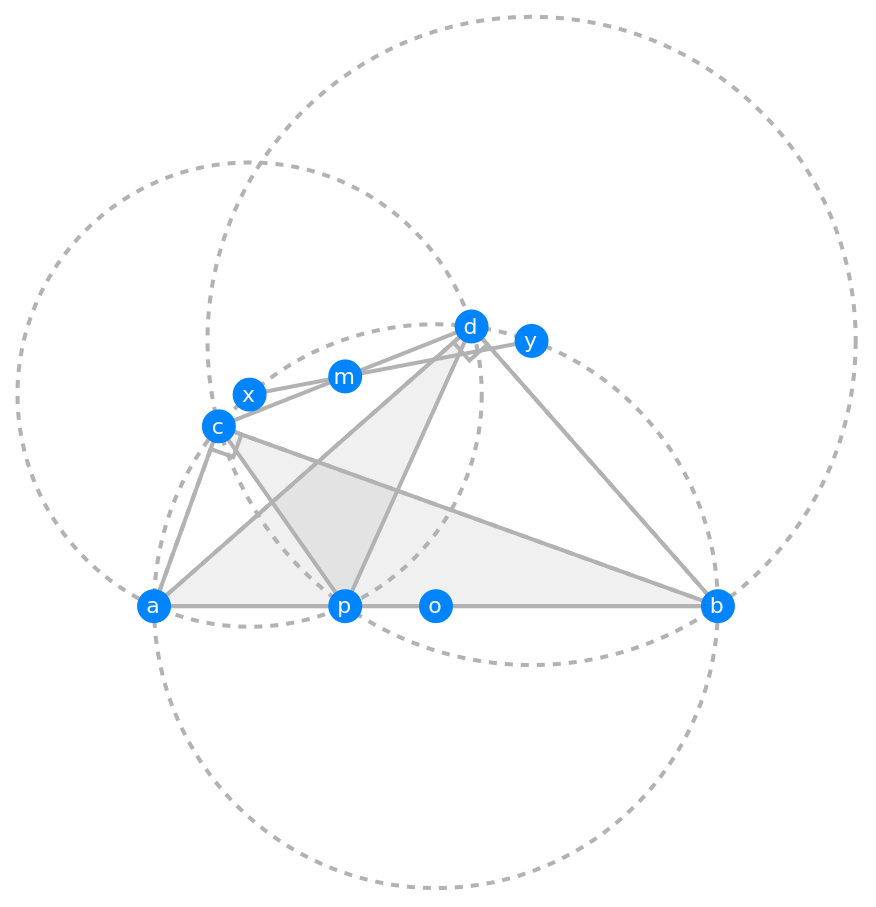
The result is the same as the illustration attached at the beginning of the article. Extract the coordinates of point C and D with GeometricScene’s “Points” attribute, we compute the mid point of segment CD directly
NumberForm[Midpoint[{c,d}]/.gs["Points"],4]
Out[]//NumberForm=
{1.356,1.63}
Let’s quickly check the coordinate of M.
NumberForm[m/.gs["Points"],4]
Out[]//NumberForm=
{1.356,1.63}
We can conclude that M is the mid point of segment CD. You may play around the code above by removing the RandomSeeding to generate more valid configurations and verify the assertion in the problem.
Proof
Proof
The challenge of the problem indeed comes from the sequence of the statement. If we follow the steps in the original statement, it seems that we are given two arbitrary right triangle first and find a proper P on segment AB. You may try this on paper first and find how weird it is. However, thinking other way round, if we can set up P first on segment AB, and then use P to determine C and D, we immediately see how to proceed.
Surprisingly, after we breaks down the problem to find the solution only depends upon one variable : the abscissa of point P. We are going to see exactly how it works in the following animation.
With this switched procedure in mind, we can create sweep through frames with incremental abscissa of P along x-axis. To make the animation a little faster to load on webpage, we can drop every the other frame in the iconized animation list (precomputed to save your time)
reducedFrames=Take,{1,-1,2};
Use Grid function to display the configuration in a neat 3 by 3 block.
In[]:=
Style[Grid[Partition[reducedFrames,3,3]],ImageSizeMultipliers0.6]
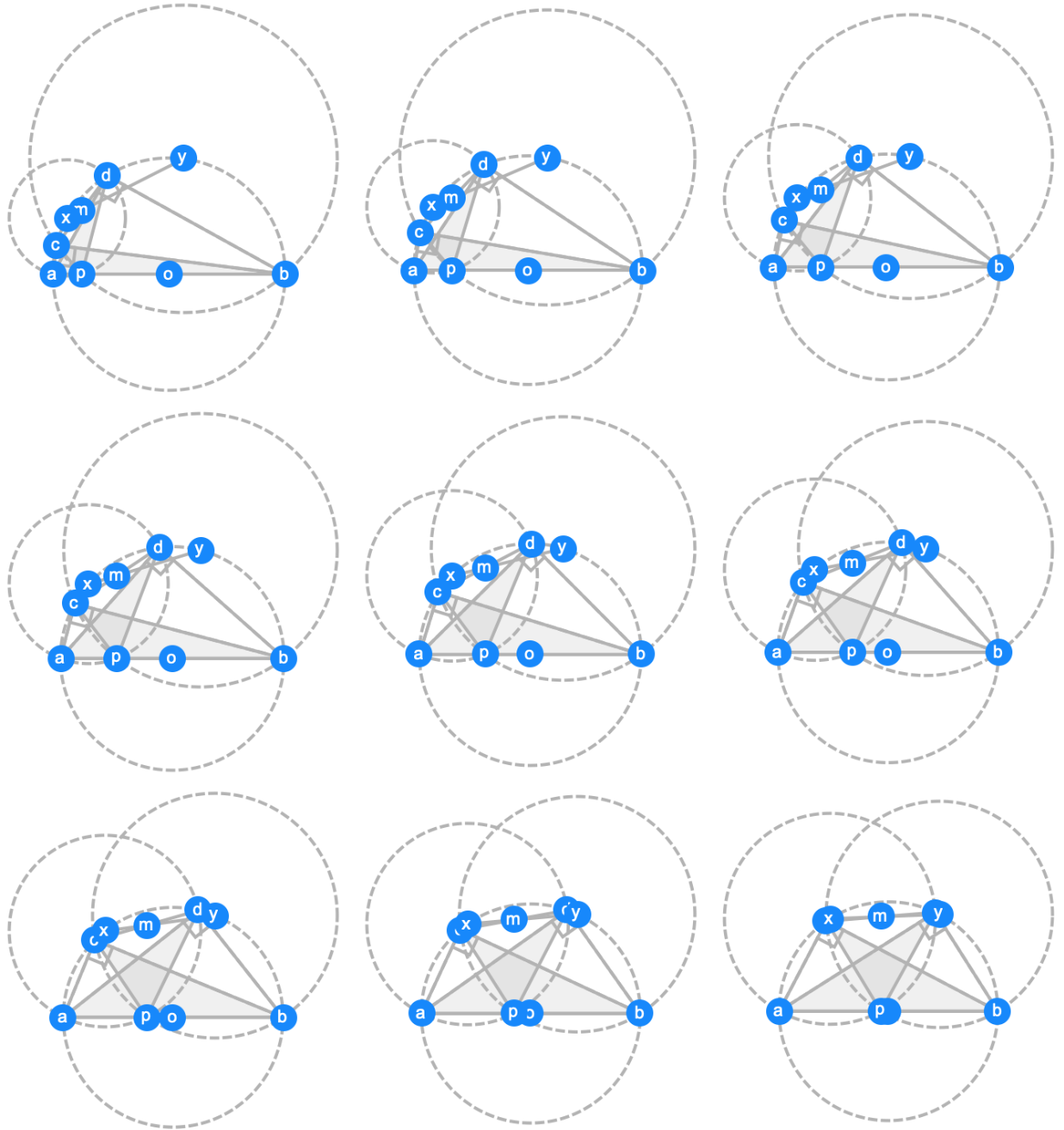
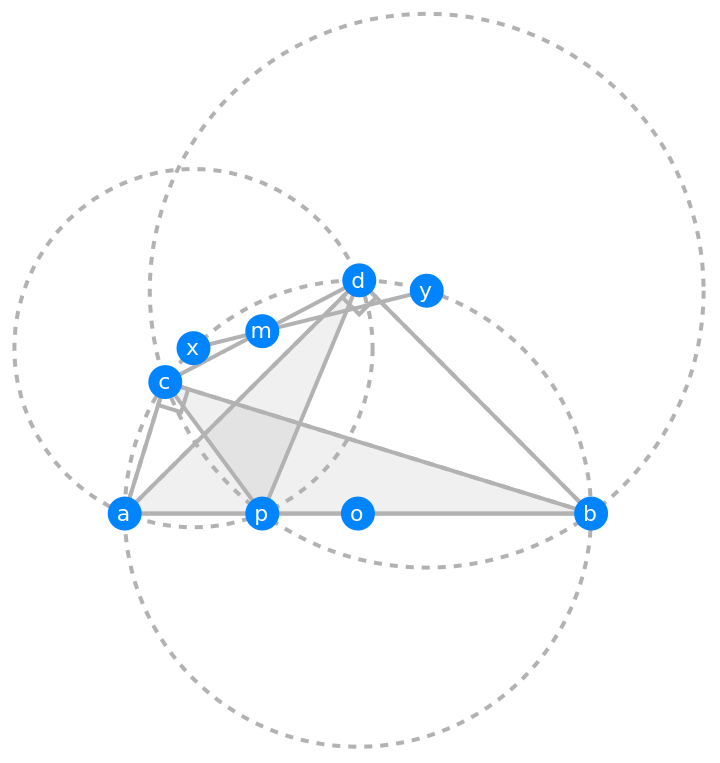
Simply wrap up the animation frames in a ListAnimate function to create a smooth movie. Notice that, due to symmetry, we do not need to move point M past O in terms of x-direction.
ListAnimate[reducedFrames,ImageSize400]
Out[]=
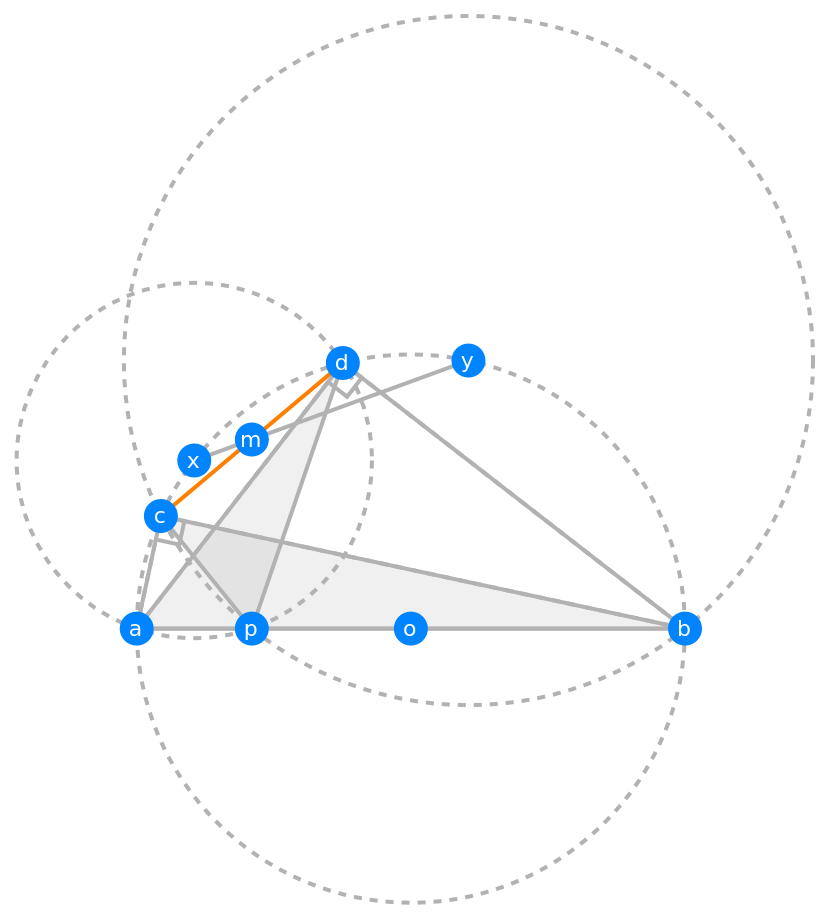
We can take out a frame, which is also a GeometricScene object, and use it with FindGeometricConjecture to spot the result we are looking for.
FindGeometricConjectures5,mMidpoint[{__}]
Out[]=
Coordinate bash, not too bad
Coordinate bash, not too bad
WLOG, let the radius of circumcircle of triangle ABC be 2 and the coordinate of the center O is {2,0}. Also let AB sit on x axis with A {0,0} and B {4,0}. Look at the right triangle ABC you will see it is quite straight forward to determine the coordinate of C if you can fix P = {λ, 0} first.
The next step is to find the coordinate of X and Y. There are many ways to find the circumcenter given the necessary information to determine a triangle in Wolfram Language. In our case, we would like to use the build-in function to compute the center given three coordinates of a triangle
Otherwise, you may use the entity framework to find more information if you know the side lengths and apply some linear algebra rotation transformation to get the actual coordinate of the circumcenter.
So far we have the coordinate of A, P and D, then the circumcenter X is computed easily with:
Similarly, we have the coordinate of C, P, and B, then the circumcenter Y is computed easily with:
In our example, if we supply the function with C, D, X, Y in turn, u will be the length ratio of MC and CD, v be that of MX and XY
Also
◼
λ = 2 is interesting because XY is part of CD and their mid points align perfectly
◼
The x coordinate of M is also λ, which implies that MP is always perpendicular to AB
◼
The trajectory of N, the mid point of segment XY
The implicit function can be found by
Where is π that we have mentioned in the title? Here we go:
◼
π is the filled area under the dome (bounded by y = 0, x = 1 and x = 3 ).
BTW, if you are interested in expressing x in terms of y
Eventually, expr’s integration over {0,3} is nothing more than
◼
Similarly, we can inspect the area bound by the trajectory of M , the mid point of segment CD, and x-axis
Review of the Key Ideas
Review of the Key Ideas
◼
Determine the proper control point
◼
Use build-in triangle center function to find circumcenter
◼
Use simple affine coordinate to solve for intersection between two segments
◼
Use antiderivative of trigonometry functions to find area under curve
Other Geometry Problems
Other Geometry Problems