In the Wolfram Physics Project, an observer is a pocket of computational reducibility in an irreducible universe: predictable enough to persist, embedded in a process that admits no shortcut. Do such pockets form by themselves? Computational Awareness Monism (CAM), my interpretation of the project, sharpens the question: it takes an observer to be a predictable boundary around an unpredictable process, in contact with the activity beyond it. This post looks for that structure in graph-rewriting automata, cellular automata whose connections rewire, with instruments built for the purpose: a labeler that marks which activity is irreducible, and detectors that look for boundaries around it. They are released here as a tested Wolfram Language package. In three pre-registered test series, the automata produced sustained irreducible activity, thousands of small persistent structures and many enclosures, but no rule passed the containment test that each series fixed in advance. The enclosures that stayed open to their surroundings dissolved quickly, and nearly all that lasted were sealed off from them. In these samples, on networks of up to 8,192 nodes, staying open and lasting did not go together: a first result, not a verdict. The instruments, and what I learned from the ways they fooled me before they worked, apply to any search for structure in rewriting systems, Wolfram models included.
Setup. To run the cells, download the archive of this post from Zenodo ( doi: 10.5281/zenodo.23686423 ), unzip it and open this notebook from its notebook folder; or set $repository to the unzipped folder before evaluating this cell. The package needs version 14.3 or later. It compiles its kernels in about a minute the first time, then loads them from a cache.
With[{repository=Which[StringQ[$repository],$repository,StringEndsQ[$InputFileName,".wl"],ParentDirectory[DirectoryName[$InputFileName],2],True,With[{dir=Quiet[NotebookDirectory[]]},If[StringQ[dir],ParentDirectory[dir],None]]]},If[StringQ[repository]&&FileExistsQ[FileNameJoin[{repository,"wl","GRA","GRA.wl"}]],$repository=repository;Get[FileNameJoin[{$repository,"wl","GRA","GRA.wl"}]];(*thepackage'sfunctionswiththeircontexts,sincethiscellisreadbeforethepackageisloaded*)GRA`Kernels`compileKernels[];$cellData=GRA`Analysis`cellData[FileNameJoin[{$repository,"notebook","data"}]];,Print["The package was not found. Download the archive of this post from Zenodo (doi:10.5281/zenodo.23686423), "<>"unzip it and open this notebook from its notebook folder, or set $repository to the unzipped folder."];(*stop,anddropthecellsstillwaitingtobeevaluated*)If[$FrontEnd=!=Null,FrontEndTokenExecute["EvaluatorAbort"]];Abort[]]]
1. The question
1. The question
Physics has had observers inside its theories for a long time. In quantum cosmology there is no outside to observe from: the information gathering and utilizing systems of Gell-Mann and Hartle are subsystems of the universe that coarse-grain and record the world they are part of [3].
The Wolfram Physics Project builds the observer computationally, around one idea: computational irreducibility. Many simple rules, Rule 30 among them, behave, as far as anyone knows, in ways no shortcut can predict; the only way to know what they do is to compute every step. Where a shortcut exists, for instance because a pattern repeats, the behavior is computationally reducible. In the observer theory Wolfram has developed, an observer lumps many states of the world into the few it can tell apart, has limited computational power, and stays itself through time, which requires that it embody reducibility: observers are pockets of computational reducibility in an irreducible universe [1]. Wolfram is also explicit about where this account stops. Shown a system from outside, one cannot tell whether there is an observer in it; one would have to be inside it. What an observer is from the inside, he deliberately sets aside, or brackets.
CAM is a proposal for that inside, set out in full in an essay on Zenodo [2]. Its three postulates are:
1
.Awareness is the sole substrate, manifesting locally as streams of qualia; its dynamics are the universe's total computational causal process.
2
.Qualia (specific experiences) are computationally irreducible processes involving locally connected network regions: update patterns that cannot be predicted without step-by-step computation.
3
.Observers are computationally reducible structures: boundaries whose predictable dynamics format how irreducible processes manifest as coherent experiential streams.
Put plainly: specific experiences are irreducible processes, and observers are the predictable boundaries that shape how those processes appear as coherent experience. The third postulate has structural content, which can be looked for in a model: a reducible boundary around an irreducible process. In CAM, a boundary shapes the process it encloses through its contact with what lies beyond it, the rest of an irreducible universe, so the configuration must also include contact with irreducible activity outside. The question I set myself is whether such a configuration arises by itself, without being built in, at a scale that can be simulated.
No simulation can show that a process is an experience; that claim is philosophical, and nothing below tests it or CAM. What the experiments ask is the structural question, and most of the work went into instruments that could ask it without fooling me.
2. From cellular automata to graphs
2. From cellular automata to graphs
Before graphs, I worked with cellular automata, in two series of Wolfram Engine tests over 2025 and 2026 [2, §7]. In them I built instruments that label each cell of a space-time diagram as void, regular structure or irreducible, and asked whether the irreducible activity next to a structure differs from the irreducible activity elsewhere. Six different measurements found nothing that survived their controls.
I came to think that two things were wrong. Every measurement compared pieces of the diagram, while what I was looking for is a configuration of the whole. And the models could not express it. In a cellular automaton every cell keeps the same neighbors forever, so which cell can influence which is fixed by the lattice, whatever the rule: the states change, but the wiring never does. A boundary that forms around a process, and stays in contact with what lies beyond it, needs connections that can rearrange while the whole stays connected.
The cell below makes the point with the causal graph, which records, for each update, the states it was computed from. Three cellular automata with different rules produce different patterns but exactly the same causal graph, edge for edge, because every update reads the same neighbors whatever the rule. Once the connections can change, the rule shapes the causal graph: the same rule for states, with three different rules for which links rewire (§3 describes how), gives three different ones.
(*Section2.Acellularautomaton'scausalgraphisthesamewhateveritsrule;oncethelinksrewire,theruleshapesthecausalgraph.*)codes=<|"identity"->"00001111 000","additive"->"01011010 000","chaotic"->"01100100 000","commute {0, 0}"->"01100100 100","commute {0, 1}"->"01100100 010","commute {1, 1}"->"01100100 001"|>;m0=Take[Keys[codes],3];m1=Drop[Keys[codes],3];simulate[seed_,w_,cycles_,names_]:=(SeedRandom[seed];With[{init=RandomInteger[1,ww]},torusSimulation[parseRule[codes[#]],w,w,init,cycles]&/@AssociationMap[#&,names]]);(*asmalltorus:oftheseeds1..200,thefirstwhosethreerewiringgraphsdifferfromeachotherandfromthefixednetwork'swithinthecyclesdrawn*)drawnEdges[sim_]:=Select[Sort[causalEdges[sim]],#[[4]]<=Length[sim["cycles"]]&];seed=SelectFirst[Range[200],DuplicateFreeQ[Values[drawnEdges/@simulate[#,4,3,Append[m1,First[m0]]]]]&];small=simulate[seed,4,3,Keys[codes]];(*thesamecomparisonatfullsize*)full=Sort[causalEdges[#]]&/@simulate[2,24,30,m0];causalGraphsFigure[small,m0,m1,{SameQ@@Values[full],Length[First[full]],30,24}]
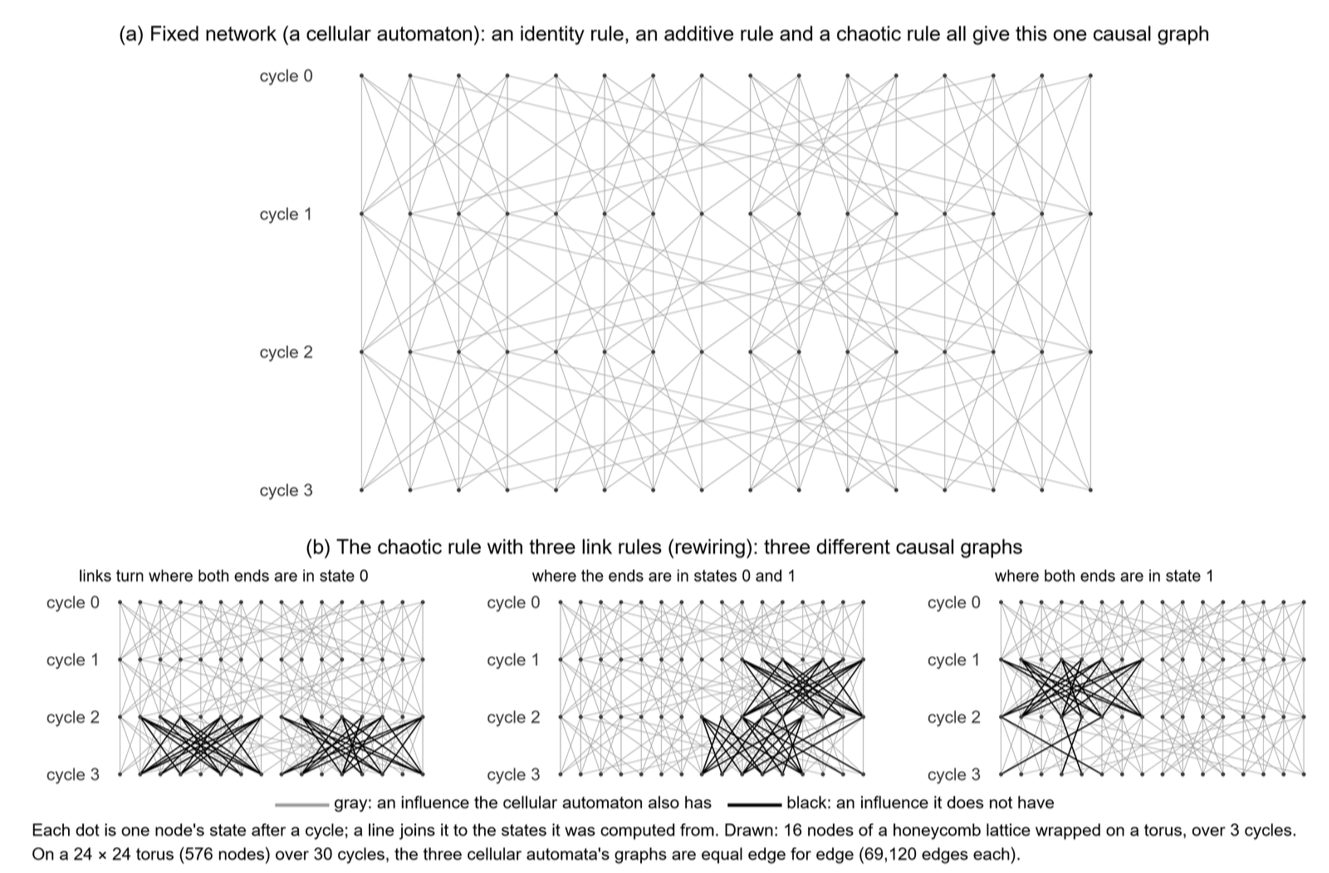
Graph-rewriting automata, introduced by Tomita, Kurokawa and Murata [4, 5], add exactly that property to cellular automata: connections that change under local rules.
3. The model
3. The model
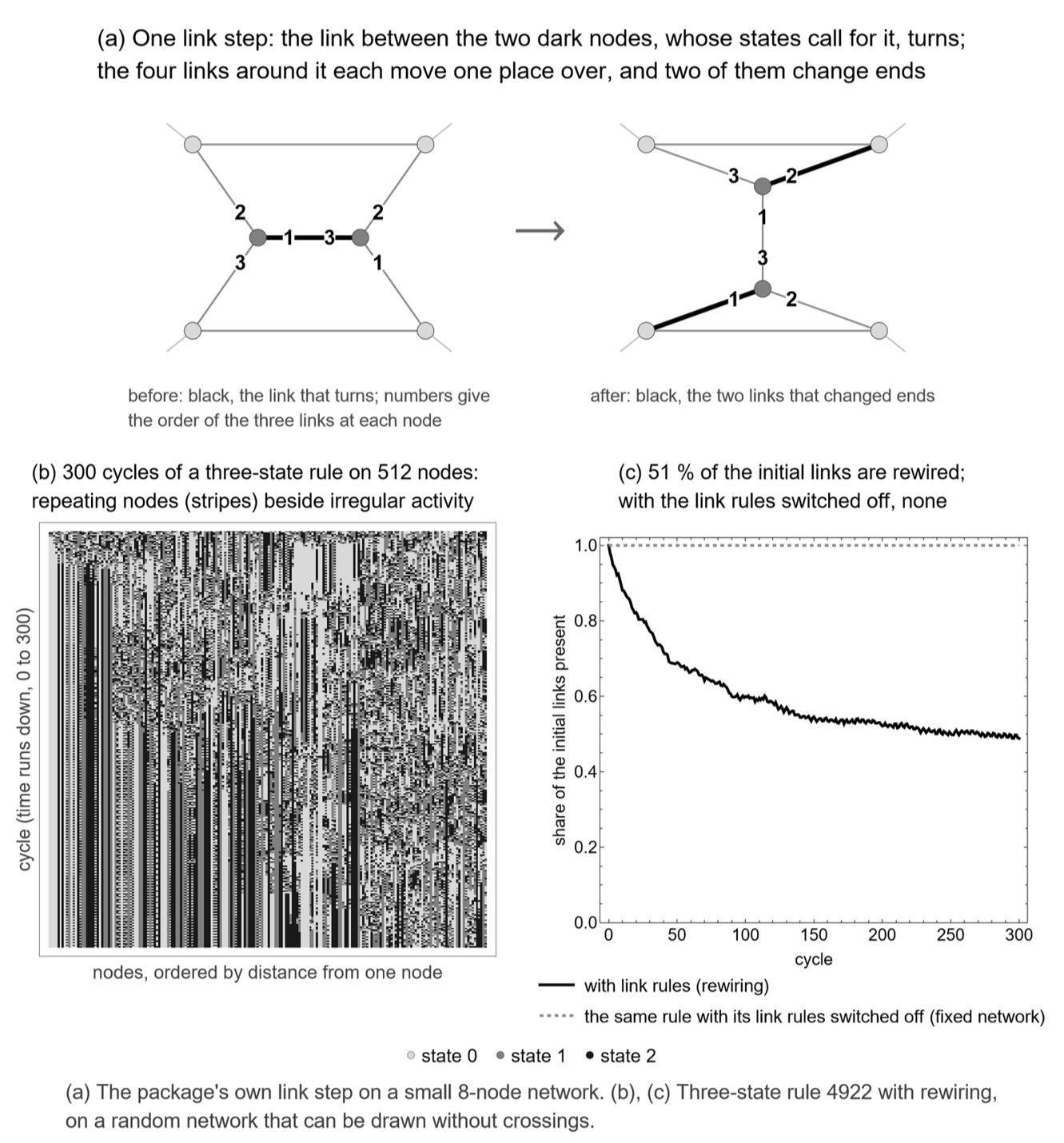
A graph-rewriting automaton is a cellular automaton on a network that rewires itself. Every node holds a state and has exactly three links, and in the test series the network can always be drawn without crossings. Time alternates between two kinds of step. In a node step, every node updates its state from its own state and its neighbors' states, as in a cellular automaton. In a link step, the rule reads the states at the two ends of each link, and a link whose end states call for it turns, unless one of its end nodes has another such link, in which case neither turns. When a link turns, the four links around it each move one place over (the cell below shows how), so that two of them change ends and different nodes become neighbors. Some rules can also split a node into three (division) or remove two linked nodes (annihilation), so that the network grows or shrinks. A node step and a link step make one cycle, the unit of time throughout this post. The test series used three families: states only, on a fixed network (a cellular automaton); states and rewiring; and rewiring with growth and shrinkage (M0, M1 and M2 in the record, the archived code, data and reports of the test series [14]). Rules are referred to by number; a number only identifies a rule, and the record gives its table.
The cell below shows one link step close up, then 300 cycles of one three-state rule on 512 nodes: some nodes settle into short oscillations beside irregular activity, and about half of the initial links are rewired. For comparison, the same rule with its link rules switched off, so that only the node states change, keeps every link it started with: its network stays fixed, as in a cellular automaton.
(*Section3.Themodel:onelinkstepcloseup,then300cyclesofathree-staterulewithrewiringon512nodes,besidethesamerulewithitslinkrulesswitchedoff.*)(*atinynetworkwhereexactlyonelinkcallsforalinkstep:thestatesstay,andalinkwhoseendsareboth1turns*)oneLink=parseRule["00001111 001"];tiny=engineStep[oneLink,prismMap[4,ReplacePart[ConstantArray[0,8],{1->1,2->1}],2],0]["map"];linkStep=engineStep[oneLink,tiny,1];(*thelargersimulation,onecycle(anodestepandalinkstep)atatime*)rule=parseRule["020220012100011121001110201111220 101001",3];frozen=parseRule["020220012100011121001110201111220 000000",3];SeedRandom[7];big=scrambledPrism[512,3];m1s=FoldList[engineRun[rule,#1,2,"Start"->2#2]["map"]&,big,Range[0,299]];m0s=FoldList[engineRun[frozen,#1,2,"Start"->2#2]["map"]&,big,Range[0,299]];survival=Prepend[Transpose[{sharedLinks[#,big]&/@Rest[m1s],sharedLinks[#,big]&/@Rest[m0s]}],{1.,1.}];modelFigure[tiny,linkStep,m1s,survival]
The test series ran as long computations on cloud machines that had no Wolfram Engine, so the engine and the instruments were written in Python. For this post, they were ported to the Wolfram Language as a package, which reproduces the Python results exactly: every network, label and enclosure of the reference files, checked by 192 tests (two of the checks are in the appendix). Some parts were not ported (§12); the cells that need their results take them from the record.
4. Measuring irreducibility, with a horizon
4. Measuring irreducibility, with a horizon
To find a boundary around an irreducible process, I first have to say which nodes are irreducible. The labeler reads a simulation in windows of 64 cycles and gives each node one of three labels. A node is void if nothing happens to it in the window: its state never changes and it takes part in no rewiring. An active node is irreducible if its recent history, and that of its immediate neighborhood, compresses poorly, measured against random sequences of the same length and alphabet, by a cutoff set from rules whose behavior is known, and if the local pattern around it is rare in the network at that time. Every other active node is labeled regular structure, or structure for short. The labels do not depend on how the nodes happen to be numbered.
The labeler came in two versions. The first passed its checks, with the nodes of a rule in which nothing changes coming out void, a blinking rule's structure and a chaotic rule's irreducible, and it was still wrong where it mattered. A node that repeats every 20 cycles shows its pattern only three times in a 64-cycle window, too few for compression to tell it from irreducible activity. The first series on graphs labeled such nodes irreducible, and some of what it reported as an enclosed irreducible process was periodic.
The second labeler keeps the first one's labels and then tests every active node, with its neighborhood, for repetition along its history, up to 1,024 cycles back (less early in a simulation, when there is less history); nodes that repeat become structure. Its answer comes with a horizon: "irreducible" means "no repetition found within 1,024 cycles", and nothing more.
The cell below shows the trap on one two-state rule, on 512 nodes over 2,200 cycles. In the last window the first labeler calls 51 of the 512 nodes irreducible and the second none: read with their neighborhoods, the 51 repeat with periods from 8 to 72 cycles, and the few with the shortest periods passed the first labeler's cutoffs only narrowly. In the notebook, a slider steps through the windows. At the scale of the test series, 8,192 nodes, the same rule shows the same trap. An irreducibility label is a statement about a horizon, and the horizon belongs with every result.
5. What the automata do by themselves
5. What the automata do by themselves
Before asking for enclosures, it helps to know what these automata do when left alone. A census classified rules by their long-run behavior on small networks (1,024 nodes over 1,000 cycles for the rules with rewiring): all 2,048 two-state rules with rewiring, from three random starts each, a random sample of 20,000 three-state rules with rewiring, and rules that grow and shrink, from random networks and from small seeds. Its main classes are bounded irreducible (at least half of the nodes irreducible in each of the last windows; "bounded" refers to the network's size, not to an enclosure), mixed (irreducible and structure side by side), reducible (almost no irreducible nodes), intermittent (none of these), and classes for rules that die out, come to rest, cycle or grow without bound. Rules drawn from the bounded irreducible and mixed classes, the census rules with irreducible activity, were then followed in larger and longer simulations, up to 8,192 nodes and 10,000 cycles. Three things stand out.
Sustained irreducible activity while the connections rewire. I drew 32 two-state and 31 three-state rules at random from the census rules with irreducible activity and followed each from five random starts. In 6 of the 32 and 24 of the 31, an irreducible process, aperiodic up to 1,024 cycles, persisted in at least four of the five simulations, while the network kept a bounded size and stayed in one piece. Among the rules that can grow and shrink, it persisted in only 3 of 31 two-state and 1 of 6 three-state rules: the two-state ones have no rules for growth or shrinkage at all, and the three-state one stopped changing size early, so in each the process was carried by rewiring alone.
Small persistent structures. In 565 simulations of 113 rules (most of them with rewiring, on 4,096 nodes), the record counts 11,928 persistent localized structures: groups of at most 64 nodes whose configuration repeats with a period of at most 32 cycles, for at least 500 cycles unless a collision ended them sooner. Most repeat every 2 cycles and hold a handful of nodes, like the oscillators of the Game of Life. A third of them persist with the link rules switched off; the rest need the rewiring.
Collisions that are rare and mostly destructive. Across 1,164 simulations, the record has only 102 collisions between structures whose outcome could be followed: 66 destroyed both structures and 16 destroyed one; 8 formed composites, 7 passed through each other, 5 transformed, and none emitted a new structure.
6. Measuring containment, and how detectors get fooled
6. Measuring containment, and how detectors get fooled
Two detectors look in every window for the configuration of §1, drawn schematically in the cell below. Both need three parts, and they differ only in which nodes may form the boundary: the label-based detector takes nodes labeled structure, and the form-based detector, introduced below, takes nodes that take part in no rewiring.
◼
An enclosed process: a connected set of nodes, smaller than a quarter of the network (an eighth for rules that grow), with at least 16 irreducible nodes, which make up at least half of it.
◼
A boundary, itself smaller than a quarter of the network, that cuts the set off from the rest, so that every path out of it passes through the boundary.
◼
Contacts, the nodes just beyond the boundary: at least half of them must be irreducible, and at least half of those must belong to an irreducible region that spans at least a quarter of the network.
I call the enclosed process with its boundary an enclosure. Its contacts decide whether it is open, in touch with irreducible activity that extends through the network, or sealed, with nothing beyond it but void, regular structure, or irreducible activity that is itself confined. Open, in this sense, is judged from labels; whether anything actually crosses the boundary is a separate question, taken up at the end of this section.
An enclosure forms in the window in which a detector first finds it, and is then followed from window to window; I call that sequence of windows its track. It counts as a candidate if:
◼
it formed after the burn-in, the first 1,000 cycles of a simulation, in which the network settles from its random start;
◼
its enclosed process, boundary and contacts met their conditions for at least 16 windows in a row, 1,024 cycles;
◼
the nodes where it meets the outside kept rewiring in at least half of those windows;
◼
it is not a leftover of the starting network;
◼
at its last window, at most half of its enclosed process repeats.
The criterion of the test series asked for such a candidate in at least 3 of a rule's 10 seeds, the simulations from different random starts, and for a candidate to be found again, at most 1.5 times as large, when the rule was simulated from fresh random starts on a network twice as large (up to three tries); I call this the size check. A rule that met the criterion passed only after an independent review, and in the third series' main test only after meeting it again on 10 fresh seeds.
Most of these conditions are there because something fooled an earlier version. Before either detector was used on any rule, it was tested on scenes built by hand. In the main ones, a chaotic rule runs on the whole network until, at a set cycle, a ring is planted around a disk of that activity: a band of nodes switches to states that keep a regular rhythm and never rewire. The ring's nodes take in the states beyond them at every cycle, now and then, more rarely, or never; how often they do is how strongly the ring is coupled to the outside. The detectors should find the disk enclosed, and reject look-alikes, from pockets sealed by void to rings that exist only for a while. These scenes validate the detectors and say nothing about what the automata do; they are collected in the appendix.
One scene broke the label-based detector. Its ring is coupled to the outside at every cycle, and because outside influence reaches it so often, the labeler marks part of the ring irreducible: 28 of its 73 nodes. Since the label-based detector accepts only structure nodes as boundary, the ring has gaps: a path of nodes not labeled structure runs from the disk to the outside, and the detector finds no enclosure in any window, although the ring never changes shape.
The fix came from a second sense of "reducible". A boundary can be reducible in its states, which is what the labels measure, or in its form: its nodes take part in no rewiring while the process inside it runs irreducibly. The form-based detector reads the boundary that way: a node holds its form in a window when it takes part in no rewiring there and is not void (a node in which nothing happens would hold its form trivially). It finds the disk enclosed in every window, from the window in which the enclosure forms to the end of the simulation.
Reading form has a cost in quiet rules, whose links rarely rewire: there, nodes hold their form by chance. In a quiet control on 1,024 nodes, a rule built to offer enclosures by chance, about four nodes in ten hold their form in any window, and the form-based detector finds three to twelve small enclosures in every window; 168 of their 169 tracks end after one window, so none comes near the 16 windows a candidate needs.
Labels are one way to judge whether an enclosure is open; the other is causal. In a copy of the simulation, I change the states of the irreducible nodes at a given distance outside the boundary, 1 to 4 links, and record when the copy first differs from the original inside. In the test scenes, the change arrived after 48 to 317 cycles through the rings coupled now and then or more rarely, and after 4 to 7 cycles through the ring coupled at every cycle; none of 12 was seen to arrive through the uncoupled ring while its enclosure lasted. This measurement was recorded for every candidate, but it was never part of the criterion: openness counted only as judged from labels. Turning it into a validated test is an open problem (§10).
7. What the experiments found
7. What the experiments found
Three test series asked whether such containment arises by itself, each with better instruments: the first with the first labeler and an earlier detector, the second with the second labeler and the label-based detector, and the third with the form-based detector beside the label-based one, applied to the second series' simulations of its main sample (the paired comparison of the appendix). Each fixed its tests and its sample before running them. The main samples were 100 rules drawn at random from the census rules with irreducible activity, each simulated from 10 seeds on networks of 8,192 nodes (rules of the growth family started from 256 nodes, capped at 8,192) for 10,000 cycles. Searches over rule space added selected rules, and the third series followed 11 rules for 40,000 cycles.
No rule passed. In the first series, rules that met the criterion as written were disqualified on independent review: their enclosures were pockets sealed off by void and compartments of periodic backgrounds, configurations the later detectors were built to reject. In the second and third series, the enclosures followed a pattern that the second series stated as two findings, measured on different enclosures: how long the open ones lasted, and what lay beyond the lasting ones. The third series tested both again. The opening picture shows an example of each.
Open enclosures don't last. In the second series, 548 open enclosures met every condition but the 16 windows, and 491 of them lasted a single window. In the third series' long simulations, most enclosures lasted a single window: 96 % of those the form-based detector found, and 70 % of those the label-based detector found. Every open enclosure there that held for 16 windows or more had formed during the burn-in, the first 4,000 cycles of those simulations, except one, which was not found again on a network twice as large.
Lasting enclosures aren't open. In the second series, 87 enclosures in 7 rules formed after the burn-in, were not leftovers of the starting network, and held for 16 to 108 windows. Beyond every one of them lay only void, or no irreducible activity that extended through the network. The third series added a qualification: an enclosure can look open by its labels and last, while no disturbance planted outside is seen to reach it. The case in point is the two-state rule 1810, the closest the third series came to a pass. Its enclosures held their form for 16 to 32 windows and looked open by their labels, yet no disturbance planted outside was seen to reach them while they lasted. The rule met the criterion on 4 of its 10 seeds, but on only 2 of 10 fresh seeds, so it did not pass.
One lasting enclosure was open by both tests, its labels and a disturbance. In one simulation of a rule found by the third series' search, the label-based detector followed an enclosure that formed after the burn-in and stayed open for 18 windows. Of four disturbances planted outside it, the farthest, 4 links out, reached the inside 254 cycles later while the enclosure was intact; the three closer ones also reached it, but each time the enclosure was gone by the end of the window in which the disturbance arrived. Such a candidate appeared in only 1 of the rule's 10 seeds, against the 3 required, and the form-based detector, which carried the verdict in that test, found no candidate in the rule.
What this licenses is a weak fact: not found, in these samples, at these scales (networks of up to 8,192 nodes, simulations of up to 40,000 cycles), at this horizon, with these instruments and their stated limits. It does not say that these automata cannot produce such containment.
8. Lessons for measuring rewriting systems
8. Lessons for measuring rewriting systems
Most of what I learned is about measurement, and it applies beyond these automata, Wolfram models included.
◼
State the horizon. "Irreducible" always means "no repetition found within some horizon". A 64-cycle window called periodic activity irreducible, and a whole test series read its results through it.
◼
Check what lies beyond a boundary, and check it causally. A detector that only looks inward is satisfied by pockets sealed by void and by compartments of a regular background. And labels are not causes: an enclosure can look open by its labels while no disturbance from outside reaches it as long as it lasts.
◼
Tell form from state. A boundary can hold its form while its states look irreducible, and in a quiet rule nodes hold their form by chance: one window of stillness is not a boundary.
◼
Test the instruments before trusting them. Independent reviews, scenes built by hand and controls caught several of these failures before a final verdict. Two automated searches optimized the wrong thing. The second series' search over three-state rules drifted to rules in which nearly every node is irreducible. The third series' search rewarded form held beside irreducible activity, and drifted to quiet rules, in which form is held by chance. And fixing every test in advance meant that none could change silently after its result was seen: every change is a logged amendment with its reason.
9. The interpretation
9. The interpretation
This section interprets the results, physics first, then Wolfram, then CAM, and each asks more of what it calls an observer than the one before. In quantum cosmology, an observer needs a world regular enough to be coarse-grained and recorded [3]. In Wolfram's observer theory, an observer must itself embody reducibility to persist [1]. CAM's third postulate asks for more: an observer, in CAM's sense, is a reducible boundary that shapes the irreducible process it encloses, through its contact with the activity beyond it.
On this interpretation, an observer would not be among the first things a rewriting model produces. It would come at the end of a long path: stable structures first, then interactions rich enough to build boundaries, and only then a boundary that encloses an irreducible process and stays the same boundary while doing so. The essay set out this path before the first test on graphs ran [2, §9], and the automata stalled at its second step. Sustained irreducible activity and small persistent structures formed of their own accord, but the structures rarely collided, and their collisions mostly destroyed them. And nearly all the enclosures that lasted were sealed, which is not what the third postulate describes.
The essay did not anticipate the finding of §7, that staying open and lasting did not go together, but one account fits it. Suppose a boundary in these automata survives only while nothing disturbs it. Where irreducible activity reaches it, its nodes take that activity on, either in their states, so that they come to look irreducible, or in their links, which start to rewire; the boundary breaks, and the region inside merges with the outside. Then the only boundaries that last are those that nothing reaches. Apart from the one exception of §7, that fits what the test series found: the lasting enclosures they examined were sealed by their labels, or no disturbance planted outside was seen to reach them. A boundary that stays open and lasts would have to be rebuilt as fast as the processes on both sides of it wear it down. That is what living cells do: in the theory of autopoiesis, a cell is a network of processes that produces its own components, including the membrane that bounds it [15]. And to stay reducible while it is rebuilt, such a boundary would have to answer many different disturbances with a few kinds of repair. That is a coarse-graining of what reaches it, much as an observer in Wolfram's sense lumps many states of the world into the few it can tell apart [1].
CAM's reading would expect a boundary of this kind: in the essay, a boundary is, in physical terms, "a subsystem that holds its form against dispersal", and a single-celled organism is the obvious case [2, §§6, 8]. If the account is right, what these automata lack may be maintenance rather than scale; the last problem in §10 proposes a test.
None of this bears on the second postulate, which identifies qualia with irreducible processes. Nor is the fit between this account and CAM's reading evidence for CAM: most views would expect a boundary that nothing maintains to wear away. These experiments ask a structural question, and so far the answer is the weak fact of §7.
10. Open problems with a way in
10. Open problems with a way in
Each of the first four problems comes with a cell you can run as a starting point.
◼
Wolfram models. Wolfram models rewrite hypergraphs and have no node states, so whether a node is irreducible would have to be read from the changing pattern of its connections alone. The cell writes the 8-node network of the link step shown in §3 as relations, the lists of elements that Wolfram models rewrite, and shows that one link step rewrites 4 of its 12 link relations, those of the four links that move one place over.
◼
Openness, measured causally. In a copy of a simulation, change the state of one node outside an enclosure and follow where the copy and the original differ. In one test scene, the difference first reaches the enclosed process after 75 cycles; in the measurements of §6, none was seen to cross the uncoupled ring while its enclosure lasted. Once validated, this test could replace the label-based judgment of openness, the contacts condition of §6.
◼
Form held over several windows. In the quiet control of §6, the share of nodes that hold their form for k windows in a row falls with k, but far more slowly than if windows were independent: for 8 windows in a row it is 3.7 %, about 33 times the share expected under independence. Since form held by chance persists, it is not known whether any number of windows in a row can tell it apart from a boundary.
◼
Larger sizes. At a horizon of 128 cycles, the package's labeler costs about 6 to 8 µs per node and cycle at every size up to 8,192 nodes, so its cost grows in proportion to the size of the network. Its cost at the full horizon of 1,024 cycles, and on networks larger than 8,192 nodes, remains to be measured.
◼
Repair. Damage the boundary of a lasting enclosure and see whether it is repaired: whether the enclosure forms again and is still followed as the same one. A search over rules could then reward recovery from damage; the third series' search rewarded held form instead, and drifted to quiet rules (§8). The present detectors would lose such a boundary while it is broken, since they ask each boundary node to take part in no rewiring (form-based) or not to look irreducible (label-based) in every window. They can link an enclosure that forms again to the earlier one, but they restart its count of windows; a detector for repair would have to follow the boundary as a whole. A model whose boundary is known to repair itself would serve as a positive control, for instance the model cell of Varela, Maturana and Uribe, in the corrected form reviewed by McMullin, in which a catalyst inside a membrane produces the components that keep repairing it [15, 16].
11. Related work
11. Related work
Graph-rewriting automata come from Tomita, Kurokawa and Murata, who introduced them as a natural extension of cellular automata and showed self-replication in them [4, 5]; the engine of the test series reproduces one of their published growth results and a self-replicating rule. Cousin and Maignan studied organic structures that emerge in bio-inspired graph-rewriting automata [6]. The labelers descend from computational mechanics, from the domain and particle analysis of cellular automata to local causal states [7, 8, 9].
Four proposals take up consciousness computationally, three of them in the setting of the Wolfram models. Wolfram's own account ties it to a computationally bounded observer that integrates the parallel updating of the hypergraph and the branching histories of the multiway system into a single, sequential thread of experience [10]. Neither it nor his observer theory [1] offers an ontology that identifies an experience with any part of the hypergraph, which is the bracket noted in §1. On this Community, Chis-Ciure treats observers like us as experiential equivalence engines within the ruliad and proposes a computational pre-phenomenology, a meta-theory in which the structures that theories of consciousness propose can be investigated formally [11]. Senchal's category-theoretic extension of observer theory gives it an account of consciousness in the manner of integrated information theory, with qualia as integrated information above a threshold [12]; CAM identifies qualia with irreducible processes, with no threshold. The fourth, Shah's Beyond ϕ, also on this Community, comes closest in outline to the criterion tested here: its candidate for a subject is an equivalence class of causally irreducible processes, and closure at its boundary and persistence over a time window are among its tests [13]. But its irreducibility is the kind that integrated information theory measures, by cutting a system into parts, not computational irreducibility, and it is realized in stochastic kernels and quantum channels rather than graphs. As far as I know, none of these proposals looks inside a rewriting model for a structure that encloses an irreducible process, which is what the instruments in this post were built to do.
12. Code, data, pre-registrations and disclosure
12. Code, data, pre-registrations and disclosure
The Wolfram Language package and the cells of this notebook, the Python engine and instruments, the reference files, and every pre-registration, report and table of the three series are on Zenodo [14]. Some parts of the Python code were not ported to the package, among them the test for leftovers of the starting network, the size check, the builder of the test scenes, the disturbance measurement and the census and search machinery; the cells that need their results take them from the record.
Each series ran in five or six stages. Every stage has a pre-registration, logged with its hash before its tests ran, and a report; the one exception is a pre-registration of the third series, logged unchanged after a single trial simulation, which was then computed again with the rest. Every amendment is logged with its reason. From the third stage of each series on, a positive verdict counted only after an independent review by a fresh Claude agent, which saw only the inputs listed for it, not the reasoning of the session it reviewed.
The Python engine and instruments, the three test series and the Wolfram Language port were written and run by Claude Code sessions using Anthropic's Claude Opus 5.5, from briefs I wrote with Claude, which also reviewed the plans and the results with me. I set the questions and the criteria, made the decisions at every review point, and take responsibility for the results and their interpretation.
Appendix: the checks and the test scenes
Appendix: the checks and the test scenes
These cells document the instruments rather than the automata, for readers who want to check them.
The two checks of the port: with the link rules switched off, the engine agrees with CellularAutomaton at every step; and a simulation that grows and shrinks gives the same digest of the network, a SHA-256 fingerprint of all its states and links, as the Python engine at every step.
The two ring scenes, window by window: the ring coupled to the outside now and then, which both detectors find, and the ring coupled at every cycle, which only the form-based detector finds.
The quiet control: chance enclosures in a rule whose links rarely rewire, and why none of them is a candidate.
How detectors get fooled: the scenes built by hand, what each detector had to do with them, and what it did.
The census relabeled: how the second labeler moves census entries, each a rule from one random start, into the reducible class of §5, most of them out of the mixed class.
Why enclosures fail: for each detector, the conditions that the tracks of the third series' paired comparison did not meet.
References
References
[1] S. Wolfram (2023), "Observer Theory," Stephen Wolfram Writings, 11 December 2023. writings.stephenwolfram.com/2023/12/observer-theory. doi:10.31855/afd076b9-7b8.
[2] P. Cosyn (2026), "Observers from the Inside: Computational Awareness Monism as an Interpretation Layer for the Wolfram Physics Project," Zenodo, version 1.0, 28 September 2026. doi:10.5281/zenodo.22959903.
[3] M. Gell-Mann and J. B. Hartle (1990), "Quantum mechanics in the light of quantum cosmology," in Complexity, Entropy and the Physics of Information, SFI Studies in the Sciences of Complexity vol. VIII, ed. W. H. Zurek, Addison-Wesley, pp. 425–458.
[4] K. Tomita, H. Kurokawa and S. Murata (2002), "Graph automata: natural expression of self-reproduction," Physica D 171, 197–210. doi:10.1016/S0167-2789(02)00601-2.
[5] K. Tomita, H. Kurokawa and S. Murata (2009), "Graph-rewriting automata as a natural extension of cellular automata," in Adaptive Networks, ed. T. Gross and H. Sayama, Springer, pp. 291–309. doi:10.1007/978-3-642-01284-6_14.
[6] P. Cousin and A. Maignan (2022), "Organic structures emerging from bio-inspired graph-rewriting automata," arXiv:2211.13619.
[7] J. E. Hanson and J. P. Crutchfield (1997), "Computational mechanics of cellular automata: an example," Physica D 103, 169–189.
[8] C. R. Shalizi, K. L. Shalizi and R. Haslinger (2004), "Quantifying self-organization with optimal predictors," Physical Review Letters 93, 118701.
[9] A. Rupe and J. P. Crutchfield (2018), "Local causal states and discrete coherent structures," Chaos 28, 075312.
[10] S. Wolfram (2021), "What Is Consciousness? Some New Perspectives from Our Physics Project," Stephen Wolfram Writings, 22 March 2021. writings.stephenwolfram.com/2021/03/what-is-consciousness-some-new-perspectives-from-our-physics-project.
[11] R. Chis-Ciure (2024), "[WWS24] Computational Pre-phenomenology: A Meta-Structural Foundation of Consciousness Science," Wolfram Community, Staff Picks, 11 January 2024. community.wolfram.com/t/wws24-computational-pre-phenomenology-a-meta-structural-foundation-of-consciousness-science/23408.
[12] S. A. Senchal (2025), "Observer Theory and the Ruliad: An Extension to the Wolfram Model," Community Essay, Wolfram Institute, 16 May 2025. wolframinstitute.org/output/observer-theory-and-the-ruliad-an-extension-to-the-wolfram-model.
[13] R. Shah (2026), "Beyond ϕ: invariant causal process structures as the substrate of subjectivity," Wolfram Community, Staff Picks, 24 September 2026. community.wolfram.com/t/beyond-invariant-causal-process-structures-as-the-substrate-of-subjectivity/28167.
[14] P. Cosyn (2026), code, data and records of the three test series and of this notebook, Zenodo, version 1.0. doi:10.5281/zenodo.23686423.
[15] F. G. Varela, H. R. Maturana and R. Uribe (1974), "Autopoiesis: the organization of living systems, its characterization and a model," BioSystems 5, 187–196. doi:10.1016/0303-2647(74)90031-8.
[16] B. McMullin (2004), "Thirty years of computational autopoiesis: a review," Artificial Life 10, 277–295. doi:10.1162/1064546041255548.
CITE THIS NOTEBOOK
CITE THIS NOTEBOOK
Measuring irreducibility, structure and containment in graph-rewriting automata
by Peter Cosyn
Wolfram Community, STAFF PICKS, October 27, 2026
https://community.wolfram.com/t/28437