This short article is inspired by Lesko’s[1] article on CMJ.
ln(3)1+-++-+...
1
2
2
3
1
4
1
5
2
6
ln(4)1++-+++-+...
1
2
1
3
3
4
1
5
1
6
1
7
3
8
ln(5)1+++-+++-+...
1
2
1
3
1
4
4
5
1
6
1
7
1
9
4
10
...
The key to generate the series is to use a u-substitution for where . Thus the integration from to is mapped to to .
du
u
u1+x++...+
2
x
n-1
x
x0
x1
u1
un
u[n_]:=Total[x^Range[0,n-1]]
For instance :
n5
D[u[5],x]
u[5]
Out[]=
1+2x+3+4
2
x
3
x
1+x+++
2
x
3
x
4
x
Integrate the expression to show it is what we need
Integrate[%,{x,0,1}]
Out[]=
Log[5]
Use Apply[List,...] to convert the rational quotient function to Taylor series and extract each term from the series:
List@@Series,{x,0,20}//Normal
D[u[5],x]
u[5]
Out[]=
{1,x,,,-4,,,,,-4,,,,,-4,,,,,-4,}
2
x
3
x
4
x
5
x
6
x
7
x
8
x
9
x
10
x
11
x
12
x
13
x
14
x
15
x
16
x
17
x
18
x
19
x
20
x
Item-wise integration generates the reduced fraction we need in the form for at the beginning:
ln5
(Integrate[#,{x,0,1}]&/@%)
Out[]=
1,,,,-,,,,,-,,,,,-,,,,,-,
1
2
1
3
1
4
4
5
1
6
1
7
1
8
1
9
2
5
1
11
1
12
1
13
1
14
4
15
1
16
1
17
1
18
1
19
1
5
1
21
ComplexPlot,{x,1.4},ColorFunction"ShiftedCyclicLogAbs",ImagePadding{{20,3},{15,3}}
D[u[5],x]
u[5]
Out[]=
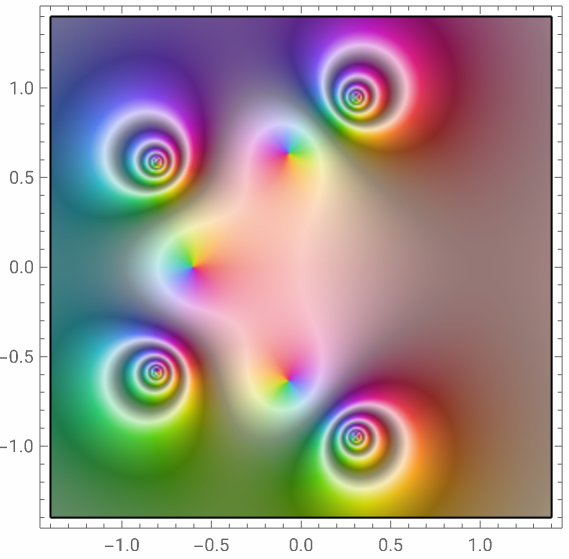
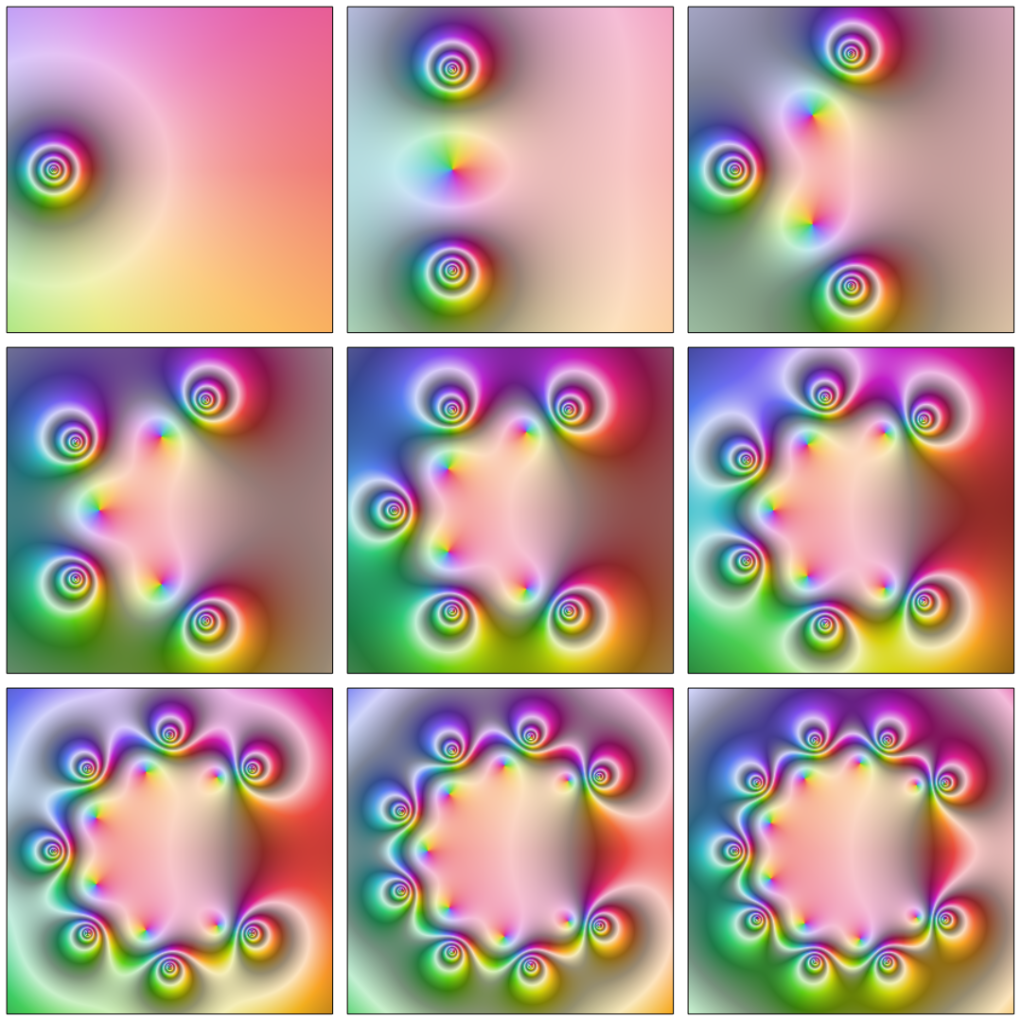
Create a gallery for several ’s:
n
ImageAssemble@PartitionTableComplexPlot,{x,1.4},ColorFunction"ShiftedCyclicLogAbs",Frame->False,FrameTicksNone,{i,2,10},3,3
D[u[i],x]
u[i]
Out[]=
Reference
Reference
[1] Lesko, James. “A Series for Ln k.” The College Mathematics Journal 32, no. 2 (2001): 119–22. https://doi.org/10.2307/2687117.