Introduction
Introduction
In this notebook we ingest the text of the slip opinion No. 23-219, "Donald J. Trump, petitioner, v. Norma Anderson, et al." of the Supreme Court of the United States, [SCUS1], and analyze it using Large Language Models (LLMs).
In order to do the LLM analysis we ingest and file two dedicated prompts from the GitHub repository "Fabric", [DMr1]:
The prompts are publically deployed as Wolfram cloud resource objects: see “ExtractArticleWisdom” and “FindHiddenMessage”.
The computations are done with Wolfram Language (WL) chatbook. The LLM functions used in the workflows are explained and demonstrated in [AAn1, AAn2, AAn3]. The workflows are done with OpenAI's models. Currently the models of Google's (PaLM) and MistralAI cannot be used with the workflows below because their input token limits are too low.
Structure
Structure
The structure of the notebook is as follows:
1
.Getting the opinion text and setup
Standard ingestion and setup.
2
.Opinion's structure
TL;DR via a table of themes.
3
.Extract wisdom
Get a summary and extract ideas, quotes, references, etc.
4
.Hidden messages and propaganda
Reading it with a conspiracy theorist hat on.
Setup
Setup
Here we define a text statistics function:
In[]:=
Clear[TextStats];TextStats[t_String]:=AssociationThread[{"Chars","Words","Lines"},{StringLength[t],Length@TextWords[t],Length@StringSplit[t,"\n"]}];
Ingest text
Ingest text
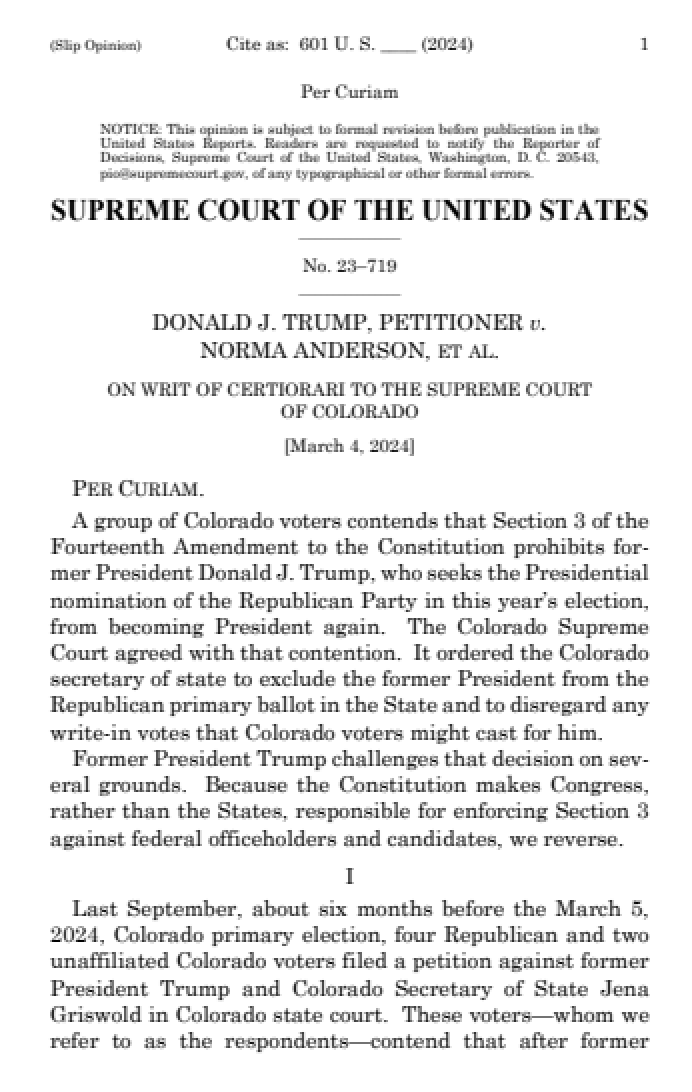
Here is how the slip opinion looks like:
In[]:=
Import["https://www.supremecourt.gov/opinions/23pdf/23-719_19m2.pdf","PageImages"]//First
Here we ingest the opinion as plain text:
In[]:=
opinion=Import["https://www.supremecourt.gov/opinions/23pdf/23-719_19m2.pdf","Plaintext"];TextStats[opinion]
Out[]=
Chars38870,Words6437,Lines593
LLM access configuration
LLM access configuration
Here we configure LLM access -- we use OpenAI's model "gpt-4-turbo-preview" since it allows inputs with 128K tokens:
In[]:=
conf=LLMConfiguration[<|"Model"->"gpt-4-turbo-preview","MaxTokens"->4096,"Temperature"->0.6|>]
Out[]=
LLMConfiguration

Remark: Additional setup code below.
Opinion's structure
Opinion's structure
In this section we summarize the opinion by making a (computable) table of themes.
Here we make an LLM request for finding and distilling the themes of the opinion (similar to [AAn1, AAn2]):
In[]:=
llmParts=LLMSynthesize[{"Split the following slip opinion into thematic parts:",opinion,"Return the parts as a JSON array.","For each thematic part use a theme-content pair.",LLMPrompt["NothingElse"]["JSON"]},LLMEvaluator->conf];
In[]:=
llmParts=FromJSON[llmParts];DeduceType[llmParts]
Out[]=
Vector[Struct[{theme,content},{Atom[String],Atom[String]}],8]
Here we tabulate the found themes:
In[]:=
ResourceFunction["GridTableForm"][Values/@llmParts,TableHeadings->Keys[llmParts[[1]]]]
Out[]=
# | theme | content |
1 | Introduction and Overview | A summary of the case background, the parties involved, and the core legal issue regarding former President Donald J. Trump's eligibility to run for presidency based on the Fourteenth Amendment's Section 3. |
2 | Case Background | Details about the initial petition against Trump and Colorado Secretary of State by Colorado voters, the basis of their challenge under the Fourteenth Amendment, and the decisions of the state District Court and Colorado Supreme Court. |
3 | Supreme Court's Analysis | The Supreme Court's reasoning for reversing the Colorado Supreme Court's decision, focusing on the Constitution's allocation of enforcement responsibility for Section 3 of the Fourteenth Amendment to Congress, not the States. |
4 | Discussion on Federal vs. State Powers | An examination of the balance of powers between the federal government and the states, particularly in relation to enforcing Section 3 of the Fourteenth Amendment against federal officeholders and candidates. |
5 | Implications for Presidential Elections | The potential consequences of allowing states to enforce Section 3 on the uniformity and fairness of presidential elections, emphasizing the national scope of presidential elections. |
6 | Conclusion and Mandate | The final decision to reverse the judgment of the Colorado Supreme Court and a statement on the unanimous agreement among all nine Justices on the outcome. |
7 | Concurring Opinion by Justice Barrett | Justice Barrett's concurrence in part with the majority opinion, emphasizing the sufficiency of the principle that states lack the power to enforce Section 3 against presidential candidates to resolve the case. |
8 | Concurring in Judgment (Sotomayor, Kagan, Jackson) | A concurrence in the judgment by Justices Sotomayor, Kagan, and Jackson, criticizing the majority for deciding more than was necessary and for setting potentially limiting precedents on the enforcement of Section 3. |
Prompt filing and deployment
Prompt filing and deployment
Prior to creating this notebook we filed and deployed the prompts "ExtractArticleWisdom" and "FindHiddenMessage". The prompts texts are taken from [DMr1].
Remark: The filing and deployment of new prompts is fairly streamlined using the resource notebooks for Wolfram Prompt Repository.
Here we verify that those two prompts are ready for use:
In[]:=
LLMPrompt/@{"ExtractArticleWisdom","FindHiddenMessage"}
Out[]=
TemplateObject,TemplateObject
Extract wisdom
Extract wisdom
Here we use the Fabric prompt extract_article_wisdom , [DMr1], that summarizes and extracts ideas, quotes, and references (i.e. wisdom) from any text.
The prompt is a function:
But since its argument has a default value we can use it in "simple" LLM synthesis by as a string template without arguments:
Here we synthesize an LLM answer based on that prompt:
Here we print out the LLM result above (as Markdown formatted text):
Rendered output
Rendered output
SUMMARY
SUMMARY
The Supreme Court of the United States issued a ruling in the case DONALD J. TRUMP, PETITIONER v. NORMA ANDERSON, ET AL., reversing the Colorado Supreme Court's decision to exclude former President Donald J. Trump from the Republican primary ballot in Colorado for the 2024 presidential election. The case revolves around the application of Section 3 of the Fourteenth Amendment, which was argued to disqualify Trump due to his actions related to the January 6 Capitol breach.
IDEAS:
IDEAS:
◼
States cannot unilaterally enforce Section 3 of the Fourteenth Amendment to disqualify federal officeholders or candidates.
◼
The Supreme Court emphasizes the exclusive power of Congress, not individual states, to enforce Section 3 against federal candidates.
◼
Section 3 of the Fourteenth Amendment was designed to prevent individuals who engaged in insurrection against the United States from holding office.
◼
The decision reflects a concern about creating a "patchwork" of eligibility across states that could disrupt national elections.
◼
The Supreme Court's ruling showcases the delicate balance between state powers and the overarching authority of the federal government.
◼
The ruling underscores the importance of uniformity in determining the eligibility of presidential candidates across all states.
◼
The Fourteenth Amendment fundamentally altered the balance of state and federal power, expanding federal authority at the expense of state autonomy.
◼
The decision highlights the historical context of Section 3, intended to prevent former Confederates from returning to power after the Civil War.
◼
The Supreme Court's ruling illustrates the potential constitutional chaos that could result from varied state interpretations of federal officeholder qualifications.
◼
The opinion of the court acknowledges the necessity of a formal process to determine the application of Section 3 to specific individuals.
QUOTES:
QUOTES:
◼
"Because the Constitution makes Congress, rather than the States, responsible for enforcing Section 3 against federal officeholders and candidates, we reverse."
◼
"Section 3 aimed to prevent such a resurgence by barring from office those who, having once taken an oath to support the Constitution of the United States, afterward went into rebellion against the Government of the United States."
◼
"States have no power under the Constitution to enforce Section 3 with respect to federal offices, especially the Presidency."
◼
"The Constitution empowers Congress to prescribe how those determinations should be made."
◼
"Nothing in the Constitution delegates to the States any power to enforce Section 3 against federal officeholders and candidates."
◼
"Section 3 works by imposing on certain individuals a preventive and severe penalty—disqualification from holding a wide array of offices—rather than by granting rights to all."
◼
"The relevant provision is Section 5, which enables Congress, subject of course to judicial review, to pass 'appropriate legislation' to 'enforce' the Fourteenth Amendment."
◼
"The judgment of the Colorado Supreme Court therefore cannot stand."
◼
"Responsibility for enforcing Section 3 against federal officeholders and candidates rests with Congress and not the States."
◼
"All nine Members of the Court agree with that result."
HABITS:
HABITS:
◼
The court meticulously analyzes historical context and legislative intent behind constitutional amendments.
◼
Engaging in a thorough examination of the balance between state and federal powers.
◼
Taking into consideration the potential national implications of state actions on federal elections.
◼
Prioritizing uniformity and coherence in the application of constitutional provisions across states.
◼
Demonstrating judicial restraint and caution in interpreting the scope of constitutional powers.
◼
Emphasizing the importance of formal processes and legislative action in enforcing constitutional disqualifications.
◼
Relying on precedents and historical practices to guide contemporary constitutional interpretation.
◼
Ensuring that decisions are grounded in a clear understanding of the Constitution's text and its framers' intentions.
◼
Collaborating as a unified bench to reach a consensus on nationally significant issues.
◼
Highlighting the necessity of judicial review in maintaining the constitutional balance between different branches of government and levels of governance.
FACTS:
FACTS:
◼
Section 3 of the Fourteenth Amendment prohibits individuals who have engaged in insurrection or rebellion against the United States from holding office.
◼
The Supreme Court reversed the Colorado Supreme Court's decision to exclude Trump from the primary ballot, emphasizing Congress's exclusive enforcement role.
◼
The Fourteenth Amendment was proposed in 1866 and ratified by the States in 1868, expanding federal power and altering the balance of state and federal authority.
◼
The Enforcement Act of 1870, enacted by Congress, provided a mechanism to enforce Section 3 disqualifications.
◼
There is limited historical precedent for state enforcement of Section 3 against federal officeholders or candidates.
◼
Section 3 includes a provision allowing Congress to remove the disqualification by a two-thirds vote in each house.
◼
The Supreme Court's ruling was unanimous, with all nine justices agreeing on the outcome.
◼
The case raises questions about the potential chaos that could result from varied state interpretations of qualifications for federal officeholders.
◼
The Supreme Court's decision reflects concerns about maintaining uniformity in presidential eligibility across all states.
◼
The ruling underscores the importance of a formal process to ascertain the application of Section 3 to specific individuals.
REFERENCES:
REFERENCES:
◼
The Fourteenth Amendment to the United States Constitution.
◼
The Enforcement Act of 1870.
◼
The Supreme Court's decision in DONALD J. TRUMP, PETITIONER v. NORMA ANDERSON, ET AL.
◼
Historical precedents and legislative actions related to Section 3 of the Fourteenth Amendment.
◼
The Colorado Supreme Court's decision that was reversed by the Supreme Court.
RECOMMENDATIONS:
RECOMMENDATIONS:
◼
States should defer to Congress regarding the enforcement of Section 3 of the Fourteenth Amendment against federal candidates.
◼
A uniform national approach is essential for determining the eligibility of presidential candidates to ensure fairness and consistency.
◼
Congress may consider clarifying the enforcement mechanisms for Section 3 to prevent future legal ambiguities.
◼
Future legislative actions related to Section 3 should ensure that they are congruent and proportional to the goals of preventing insurrection or rebellion.
◼
Voters and political parties should be aware of the constitutional qualifications and disqualifications for federal officeholders.
◼
Legal scholars should continue to explore the balance between state and federal powers in the context of election laws.
◼
Judicial review remains a critical tool for interpreting and applying constitutional provisions in contemporary contexts.
◼
Public awareness and education about the implications of the Fourteenth Amendment and Section 3 are essential for informed civic participation.
◼
Policymakers should consider the historical context and intent behind constitutional amendments when proposing related legislation.
◼
The legal community should monitor and analyze the impact of the Supreme Court's decision on future elections and candidate qualifications.
Hidden messages and propaganda
Hidden messages and propaganda
Here we use the Fabric prompt find_hidden_message , [DMr1], that tries to find hidden messages (propaganda) in any text.
Here we print out the LLM result above (as Markdown formatted text):
Rendered output
Rendered output
OVERT MESSAGE: Supreme Court reverses Colorado's decision to exclude Trump from ballot based on Section 3.
HIDDEN MESSAGE: The court aims to preserve federal control and avoid state-driven electoral chaos.
HIDDEN OPINIONS:
HIDDEN OPINIONS:
◼
Federal authority should override state decisions in presidential qualifications.
◼
States should not independently interpret constitutional disqualifications.
◼
Uniform national standards are crucial for presidential elections.
◼
The Fourteenth Amendment's enforcement is primarily Congress's responsibility.
◼
Judicial restraint is necessary in politically charged cases.
◼
The history of the Fourteenth Amendment supports federal oversight.
◼
State-driven electoral decisions could undermine national unity.
◼
The potential for varying state laws creates an unstable electoral process.
◼
The Supreme Court acts to prevent speculative future constitutional crises.
◼
Federalism principles must guide interpretations of presidential disqualifications.
SUPPORTING ARGUMENTS and QUOTES:
SUPPORTING ARGUMENTS and QUOTES:
◼
The court emphasizes the unique national interest in presidential elections, quoting Anderson v. Celebrezze.
◼
The decision refers to the Fourteenth Amendment expanding federal power at the expense of state autonomy.
◼
The lack of historical precedent for state enforcement against federal officeholders supports the court's decision.
◼
The ruling highlights the potential chaos of conflicting state outcomes.
◼
The opinion notes the Reconstruction Amendments were designed to expand federal power, not state sovereignty.
◼
The court warns against a patchwork of state decisions affecting national elections.
DESIRED AUDIENCE OPINION CHANGE:
DESIRED AUDIENCE OPINION CHANGE:
◼
Trust in the Supreme Court's ability to maintain electoral integrity.
◼
Recognize the importance of federal oversight in presidential qualifications.
◼
See the potential dangers in states having too much power in federal elections.
◼
Understand the historical context of the Fourteenth Amendment.
◼
Appreciate the need for judicial restraint in politically sensitive cases.
◼
Value uniformity in the electoral process across states.
◼
Acknowledge the complexity of constitutional enforcement.
◼
Support the role of Congress in enforcing the Fourteenth Amendment.
◼
Recognize the Supreme Court's role in preventing electoral chaos.
◼
Understand the balance between state rights and federal oversight in elections.
DESIRED AUDIENCE ACTION CHANGE:
DESIRED AUDIENCE ACTION CHANGE:
◼
Support federal legislation clarifying presidential qualifications.
◼
Oppose state efforts to independently disqualify presidential candidates.
◼
Advocate for national standards in election laws.
◼
Encourage Congress to take a more active role in defining electoral qualifications.
◼
Urge state officials to defer to federal guidelines in election matters.
◼
Promote understanding of the Fourteenth Amendment's historical context.
◼
Encourage scholarly examination of federalism in the context of elections.
◼
Support judicial restraint in politically charged decisions.
◼
Advocate for legal reforms to prevent electoral inconsistencies.
◼
Encourage civic education on the balance of power in the U.S. electoral system.
MESSAGES: The Supreme Court wants you to believe it is preserving electoral integrity, but it is actually emphasizing federal control over states.
PERCEPTIONS: The Supreme Court wants you to believe it is cautious and non-partisan, but it's actually protective of federal authority and wary of state independence.
"NOTE: This AI is tuned specifically to be cynical and politically-minded. Don't take it as perfect. Run it multiple times and/or go consume the original input to get a second opinion.
(Slip Opinion)
Cite as: 601 U. S. __ (2024)
References
References
Articles, slip opinions
Articles, slip opinions
[AA2] Anton Antonov, "LLM aids for processing of the first Carlson-Putin interview" , (2024), RakuForPrediction at WordPress .
[OAIb1] OpenAI team, "New models and developer products announced at DevDay" , (2023), OpenAI/blog .
[SCUS1] Supreme Court of the United States, No. 23-219, Donald J. Trump, petitioner, v. Norma Anderson, et al. , (2024), Supreme Court of the United States Opinions .
Notebooks
Notebooks
[AAn2] Anton Antonov, "LLM aids for processing of the first Carlson-Putin interview", (2024), Wolfram Community.
[AAn3] Anton Antonov, "LLM aids for processing Putin's State-Of-The-Nation speech given on 2/29/2024", (2024), Wolfram Community.
Repositories
Repositories
CITE THIS NOTEBOOK
CITE THIS NOTEBOOK
LLM over Trump vs. Anderson: analysis of the slip opinion of the Supreme Court of the United States
by Anton Antonov
Wolfram Community, STAFF PICKS, March 6, 2024
https://community.wolfram.com/groups/-/m/t/3136094
by Anton Antonov
Wolfram Community, STAFF PICKS, March 6, 2024
https://community.wolfram.com/groups/-/m/t/3136094