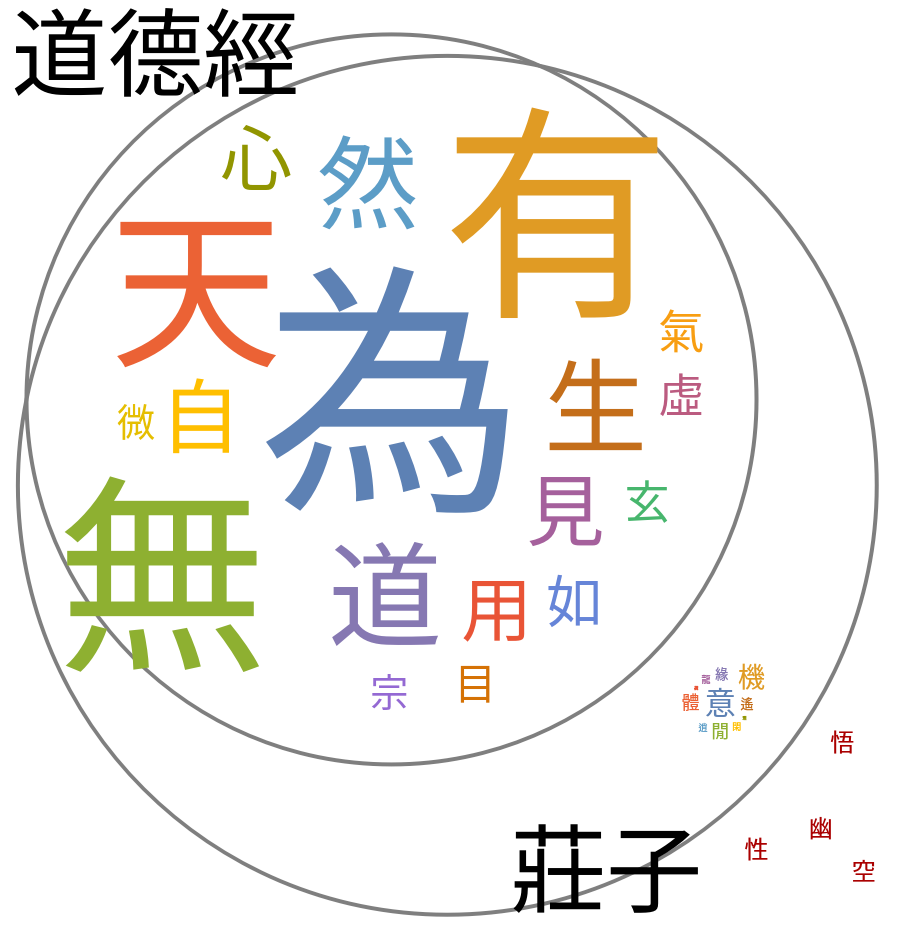
Is August an unusually great month to publish a bestselling book? It so happens that Stephen Wolfram's "The Second Law" is #1 in Amazon’s “Thermodynamics” category, while David Hinton's "Way of Ch'an" is #1 in “Zen Philosophy”. The two books are not as different as you might think, because both authors seem to care deeply about history and ontology. What is Ontology? In a sense, Ontology is allied with Cosmology, because making progress requires a person to follow the arrow of time backwards toward the origin of everything. But what is the “arrow of time”? The purpose of this memo is to give a context-specific, humanistic answer to this question through quantitative analysis of the original Taoist texts (sourced from https://ctext.org/). In doing so, we need to use David’s lexicon of important symbols to filter down the entire state space to manageably few symbols, thanks again David!
Importing
Importing
It would be much better to have a dataset prepared by an expert, because then we could claim to have rigorous counts exactly matching canonical forms. Not only that, but it would mean less cut-and-scrape work, and more time for analysis. However, rough estimates are all we really need to make a figure such as seen above, so instead of complaining too much, we will just do the work. The formatting at https://ctext.org/ is good for manual import and the function turns out easy:
ReadInCText[link_,sym_]:=ReverseSortCountsCatenateDeleteCasesCharacters[StringSplit[#,"\n"][[2]]],",""。"":""!"";""」""「""《""》""『""』"&/@StringSplit[Import[link],sym<>":"]
Once the import is done to okay quality, the data can be iconized and the read function never needs to be used again.
Lao Tzu
Lao Tzu
In[]:=
(*Iconize[ReadInCText["https://ctext.org/dao-de-jing?en=off","道德經"]]*)
In[]:=
LaoTzuCharacters=;
Chuang Tzu (inner chapters)
Chuang Tzu (inner chapters)
In[]:=
ChuangTzuInner="逍遙遊","齊物論","養生主","人間世","德充符","大宗師","應帝王";
In[]:=
InnerLinks={"https://ctext.org/zhuangzi/enjoyment-in-untroubled-ease?en=off","https://ctext.org/zhuangzi/adjustment-of-controversies?en=off","https://ctext.org/zhuangzi/nourishing-the-lord-of-life?en=off","https://ctext.org/zhuangzi/man-in-the-world-associated-with?en=off","https://ctext.org/zhuangzi/seal-of-virtue-complete?en=off","https://ctext.org/zhuangzi/great-and-most-honoured-master?en=off","https://ctext.org/zhuangzi/normal-course-for-rulers-and-kings?en=off"};
In[]:=
(*Iconize[ReverseSort[Merge[MapThread[ReadInCText,{InnerLinks,ChuangTzuInner}],Total]]]*)
In[]:=
ChuangTzuInnerCharacters=;
Bulk Analysis
Bulk Analysis
If we just look at the five most common characters, no surprise really, 道德經 and 莊子 already look to have very similar lexicons:
In[]:=
Take[#,5]&/@{LaoTzuCharacters,ChuangTzuInnerCharacters}
Out[]=
之247,不243,以161,其143,而117,之600,而428,也355,不346,其298
It’s also not surprising that the most common characters are typically connector words, which don’t carry too much meaning in-and-of themselves. It’s already apparent that we need to do some filtering, but first let’s see a few plots about overall statistics:
Intersection:
Intersection:
In[]:=
ListPlot[Take[KeyDrop[LaoTzuCharacters,Complement[Keys[LaoTzuCharacters],Keys[ChuangTzuInnerCharacters]]],10]]
Out[]=
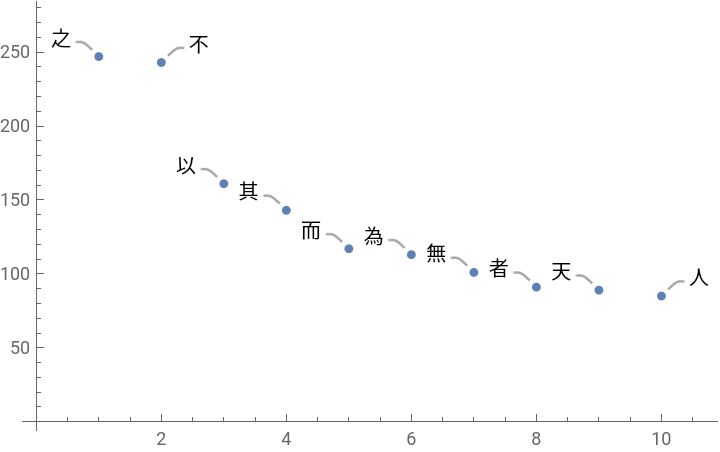
Already we see some interesting signs showing up, for example 為 can not always appear in the sage’s characteristic binomial 無為, because the count of 為 is about 10 higher than of 無. (Of course, this assumes the discrepancy is not due to loose data import.)
Complements
Complements
In[]:=
Take[KeyDrop[LaoTzuCharacters,Keys[ChuangTzuInnerCharacters]],10]
Out[]=
柔11,靜10,谷9,衆9,盈8,慈7,智7,樸7,希6,抱6
In[]:=
ListPlot[Take[KeyDrop[LaoTzuCharacters,Keys[ChuangTzuInnerCharacters]],10]]
Out[]=
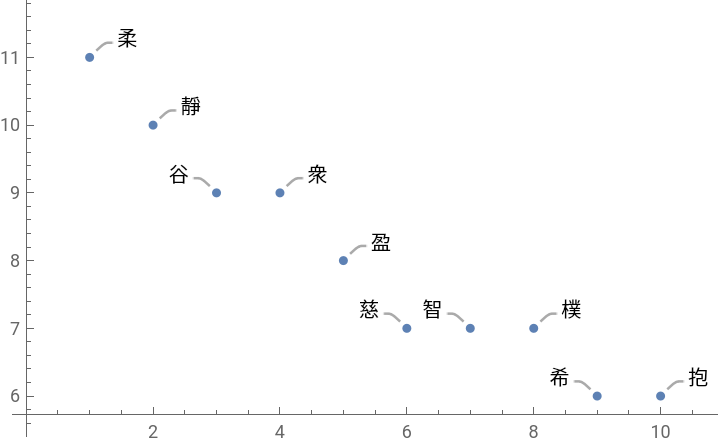
This graph automatically filters out helper words. We don’t need to go very far before finding a symbol left out of David’s selection: 慈. This character combines the “Parallel-Mystery-Enigma” radical and the “heart-mind” radical. Compare with 幽, which combines “Parallel-threads” and “Mountain”, and 意 which clouds “heart-mind” similarly to 患, yet seems through the 立 radical to indicate the sage’s plausible sublimation of causal thinking (more on this later). Although 慈 doesn’t appear in the inner chapters of Chuang Tzu, it does appear in the outer chapters.
In[]:=
ListPlot[Take[KeyDrop[ChuangTzuInnerCharacters,Keys[LaoTzuCharacters]],10]]
Out[]=
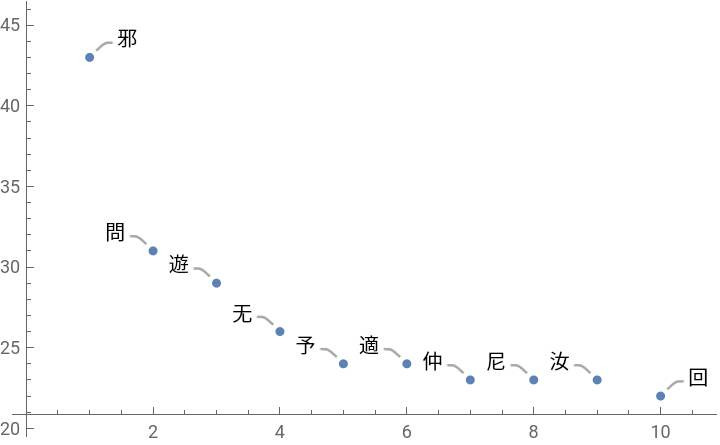
Here we can already see the language evolving, because helper words are not entirely filtered out. We get all the way to number ten, before noticing 回, which later becomes a component to 迴. In addition to his selection from seminal Taoist texts, David also gives a Ch’an-specific lexicon (starting roughly with Kumarajiva in peace-perpetua) in which 迴 appears explicitly in the binomial 輪迴.
Plotting the arrow of time
Plotting the arrow of time
It’s well known, and discussed in David’s book, that 道德經 is the earlier text and that 莊子 is a response or possibly even a commentary about what is not found when a sage refuses to leave his or her ancestral home. It’s also fairly well accepted, but not definitively known, that the outer chapters of Chuang Tzu were commentary to the inner chapters, and most likely written by subsequent followers in a 道-centric lineage of artist-intellectuals. By limiting ourselves to about 30 characters, we can actually plot the cloud of ideas and watch as it expands into an ever larger state space, where entropy is obviously increasing (even according somehow to Boltzmann’s formula?). The generously-given filter is:
This allows us to immediately reduce the counts lists to a readable form:
The set intersection with totaled counts is then found positively:
And a negative space is in the same symmetry class:
The anti-symmetric set operation is again performed both-ways, revealing strict inclusion of the former in the later:
From these redactions, we can immediately plot two word-clouds:
Other than 意, which we’ve briefly mentioned, the new-in-version-Chuang-Tzu word cloud has relatively large 機, which David translates as loom-of-origins, perhaps adding some mystery where appropriate. The symbol 機 again reveals the parallel-thread radical, which is later reconfigured anti-parallel in the symbol 佛 for Buddha or teacher. For a brief digression about looms--what is seen here, although an impressive teaching and simple work of art, it is not quite as “ancestral” as what is seen here.
So what more needs to be done to plot the headliner image, as seen above? Well, first, we shouldn’t forget to mention the outer chapters, which do contain the characters: 空, 悟, 幽, and 性, as well as (sorry!) one of my favorite parables, 田子方 .8 (good for students with imperfect grade cards). Since we haven’t counted occurrences, we have to introduce an obvious bias by adding them in manually at a fixed size and color. Meanwhile, the inner chapter word-cloud needs to be re-scaled so that its largest character is about the same size as the smallest character in the intersection word cloud:
This picture seems to be showing the tiny discrepancy between 無 and 為 exploding or unfurling into the 10,000 things and the sage’s woven experience of them. Once a choice has been made to go forward with a project of finding out more about our place in nature and in human-nature, one possibility how to do so is immediately pointed out successively in the “Way of Ch’an”. The potentially is of course much larger than any one thread, and given thousands of years, it’s easy to see the many threads not only as woven, but also as branching.
Much, much later...
Much, much later...
It’s a gigantic question what the adepts in south China (for example, near here?) hoped to accomplish by breaking with tradition, but we can guess (even infer from 天地 .11?) that they had some interest in working with Confucians to make more machines, including ones that would expedite their printing process. And indeed by 868AD, Tang Buddhists were well on their way to someday transforming across space and time into the hearts and minds of computer users in America. One can imagine how the adepts would laugh about a calculation such as follows:
A reason now to now pay special attention to this character is that the radical 业 (merge-mountain) can be extracted, and put into a set of three:
What scheme could these primitives be useful for now? Well, with David Smith’s recent discovery of the Hat tiling, we now have important new English-language concepts to (mis-)translate into Chinese. The seemingly-obvious 帽 is no-good because the shape isn’t correct, and there’s nothing stone about it. Meanwhile, these overlays look pretty cool (as long as 业 is reflected):
The symbols can then be overlaid on the cluster-tiles:
And extrapolated to larger-and-larger super-tiles via substitution rules (in one form or another):
In this mountain range, enough space is left for the tiger-head radical 虍, which seems well placed here:
This configuration deserves a special name. Once it is obtained, it grows quite rapidly by forced-choosing into a configuration of 7 or 8 tiles. The emptiness in the remaining 1/3 leads to a non-forced choice from the 10 vertex theorem and HatTrialityTree, whether the cluster should be identified as H7 or H8 (which we also discussed here).
This translation is just a suggestion, and only time will tell if it sticks. In any case, many more exciting things are bound to happen in this range of the present-day word-cloud, especially considering more recent discoveries as reported via hedraweb. Personally, I’m moving slowly and hoping to prove hat/山业 tiling properties before moving on to the Spectre. But of course I’m curious, how would Spectre be translated into Chinese? More discussion and plotting is always welcome...
CITE THIS NOTEBOOK
CITE THIS NOTEBOOK
Extracting an ontological arrow of time from Taoist source texts
by Brad Klee
Wolfram Community, STAFF PICKS, August 7, 2023
https://community.wolfram.com/groups/-/m/t/2984199
by Brad Klee
Wolfram Community, STAFF PICKS, August 7, 2023
https://community.wolfram.com/groups/-/m/t/2984199