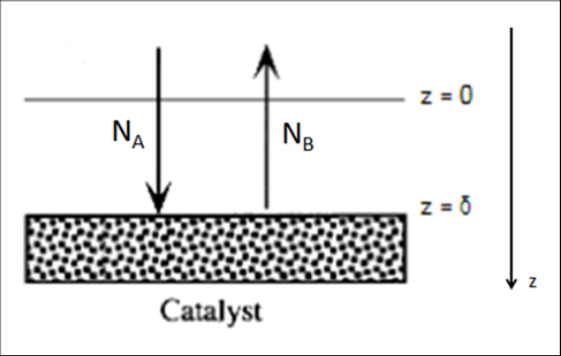
We study the disappearance of a species A reacting on a catalytic surface according to the irreversible gas - phase reaction : 2 A → B.
It is assumed that the reaction is instantaneous at the surface and that the phenomenon is limited only by the one - directional diffusion of the molecules through a film of thickness δ .
1) Give the instantaneous relationship between N_A, z and N_B, z from simple stoichiometric considerations .
2) What is the sign of N_B, z?
3) Deduce the simplified equation giving the transfer flux of A (i . e ., N_A, z) .
4) Integrate this equation between z = 0 and z = δ, and give the expression for N_A, z at steady state .
5) Numerically calculate this value of the flux N_A, z in SI units .
Data : δ = 10 ⁻⁴ m; D_AB = 10 ⁻⁵ m²/s; P = 1 atm; y_A (z = 0) = 0.8; T = 150 °C
It is assumed that the reaction is instantaneous at the surface and that the phenomenon is limited only by the one - directional diffusion of the molecules through a film of thickness δ .
1) Give the instantaneous relationship between N_A, z and N_B, z from simple stoichiometric considerations .
2) What is the sign of N_B, z?
3) Deduce the simplified equation giving the transfer flux of A (i . e ., N_A, z) .
4) Integrate this equation between z = 0 and z = δ, and give the expression for N_A, z at steady state .
5) Numerically calculate this value of the flux N_A, z in SI units .
Data : δ = 10 ⁻⁴ m; D_AB = 10 ⁻⁵ m²/s; P = 1 atm; y_A (z = 0) = 0.8; T = 150 °C
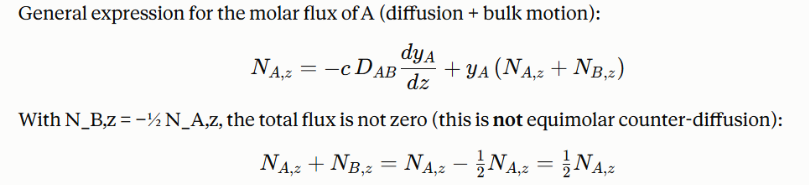
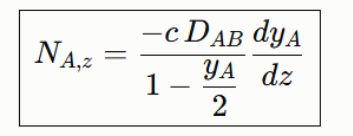
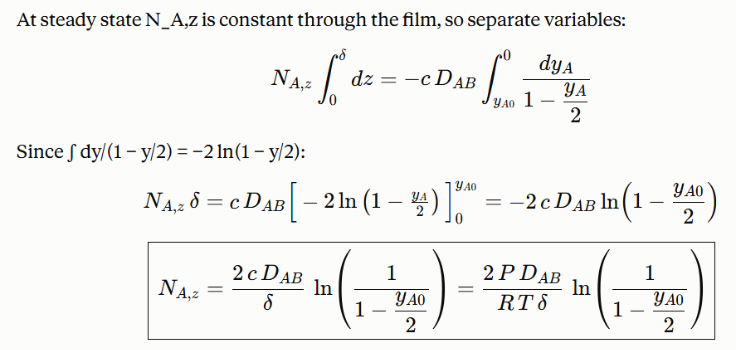
Take z = 0 at the outer edge of the film (bulk gas side), z = δ at the catalytic surface.• At z = 0: y_A = 0.8• At z = δ: the reaction is instantaneous ⇒ A is consumed as soon as it arrives ⇒ y_A(δ) = 01) Stoichiometric relationThe reaction 2 A → B consumes 2 moles of A for every mole of B produced. At the surface, whatever arrives as A must leave as B in that ratio:N_B,z = -0.5*N_A,z hence N_A,z = -2*N_B,z2) Sign of N_B,zA diffuses toward the surface, in the +z direction, so N_A,z > 0. B is produced at the surface and diffuses away from it, i.e. in the −z direction: N_B,z < 03) Simplified equation giving the transfer flux of A
Hence,
In[]:=
Integrate[1/(1-y/2),y]
Out[]=
-2Log[-2+y]
In[]:=
Integrate[1/(1-y/2),{y,0,0.8}]
Out[]=
1.02165
In[]:=
2Log[(-2+0)/(-2+yA0)]/.yA00.8
Out[]=
1.02165
In[]:=
eq=NAzδ==P/(R*T)DAB2Log[(-2+0)/(-2+yA0)]
Out[]=
NAz
10000
-7
10
In[]:=
δ=10^-4;R=8314;T=150+273.15;P=1.0132510^5;DAB=10^-5;yA0=0.8;
In[]:=
Solve[eq,NAz](*kgmol/s/m2*)
Out[]=
{{NAz0.00294249}}