ORIGINAL ARTICLE: Jarek Duda, Álvaro G. López (2024), Deterministic and statistical models of tunneling
DETERMINISTIC based on https://arxiv.org/pdf/2401.05616
STATISTICAL based on https://arxiv.org/pdf/2401.01239 , https://community.wolfram.com/groups/-/m/t/3124320
DETERMINISTIC based on https://arxiv.org/pdf/2401.05616
STATISTICAL based on https://arxiv.org/pdf/2401.01239 , https://community.wolfram.com/groups/-/m/t/3124320
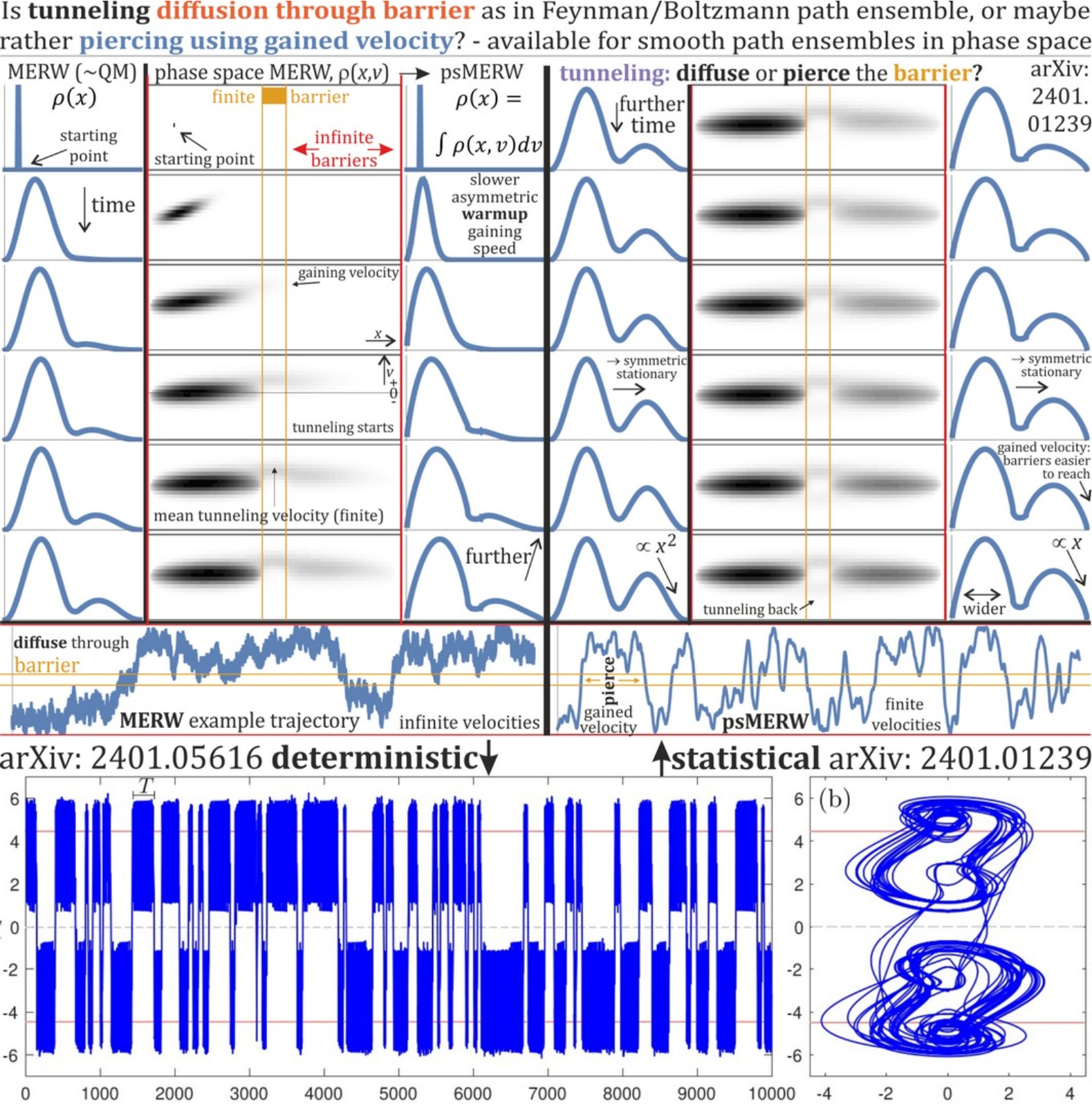
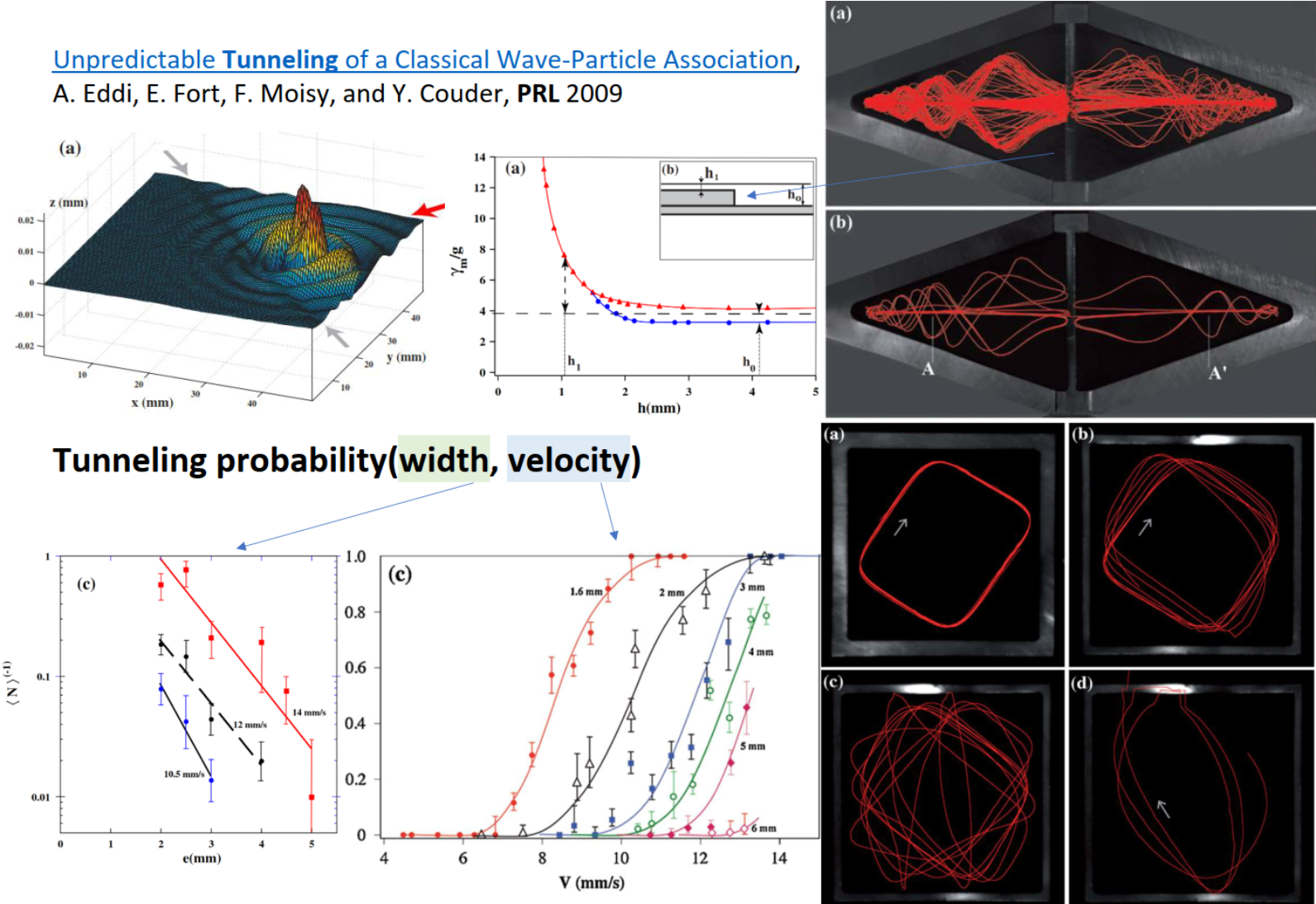
While tunneling is generally seen as a quantum phenomena, there is a growing number of approaches to try to understand its hidden dynamics. For example in 2009 (PRL) its exponential decrease of probability of passing a barrier was shown experimentally for walking droplets - bouncing droplets coupled with waves they created, leading to quantum-like phenomena for these wave-particle duality objects, e.g. interference, orbit quantization, or tunneling by complex dependence from history through the coupled field. This history dependence can be simplified into ordinary differential equation (arXiv:2401.05616), leading to a relatively simple model e.g. of tunneling - presented below as deterministic approach. There will be also shown statistical approach from arXiv:2401.01239 - using Boltzmann ensemble of smooth paths, getting proper transition probability dependence from barrier width and initial velocity.
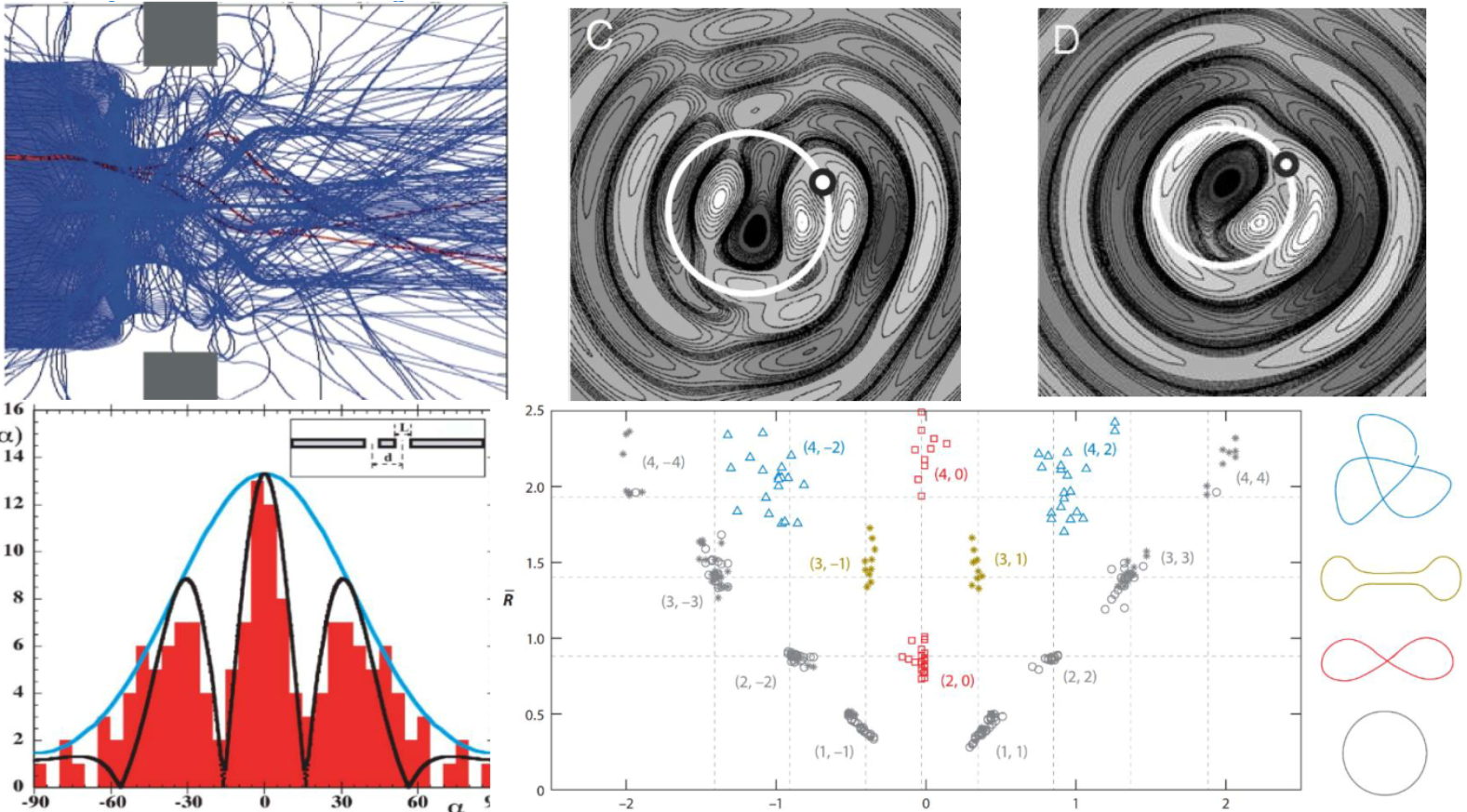
Quantum mechanics (QM) is equivalent with Feynman path ensembles, however, it uses diffusion-like paths of infinite velocity, kinetic energy. To imagine such paths we can use “Wick rotated” Boltzmann path ensembles (MERW) leading to the same stationary probability distribution as QM - below are shown such example trajectories for tunneling, and evolution of their densities. We can see such infinite velocity paths (MERW) diffuse through barrier, there is also shown phase space psMERW as using Boltzmann ensemble of smooth paths - randomly gaining velocity to pierce the barrier. At the bottom there is also shown example trajectory from discussed further deterministic model - much closer to psMERW than MERW. We can compare them with hydrodynamics quantum analogs - popular experiments started by Yves Couder, using shaken fluid tank with droplet - bouncing infinitely for proper parameters. This way they get classical object with wave-particle duality, for which they recreate many quantum-like phenomena (gathered articles, good talk by John Bush MIT), for example: - Interference in particle statistics of double-slit experiment (PRL 2006) - corpuscle travels one path, but its “pilot wave” travels all paths - affecting trajectory of corpuscle (measured by detectors).- Unpredictable tunneling (PRL 2009) due to complicated state of the field (“memory”), depending on the history - they observe exponential drop of probability to cross a barrier with its width.- Landau orbit quantization (PNAS 2010) - using rotation and Coriolis force as analog of magnetic field and Lorentz force (Michael Berry 1980). The intuition is that the clock has to find a resonance with the field to make it a standing wave (e.g. described by Schrödinger’s equation).- Zeeman-like level splitting (PRL 2012) - quantized orbits split proportionally to applied rotation speed (with sign).- Double quantization in harmonic potential (Nature 2014) - of separately both radius (instead of standard: energy) and angular momentum. E.g. n=2 state switches between m=2 oval and m=0 lemniscate of 0 angular momentum.- Recreating eigenstate form statistics of a walker’s trajectories (PRE 2013). Here are gathered some diagrams from these articles - left: walker’s ensemble of trajectories passing a slit, and their statistics for double slits - getting interference pattern. Right: Landau orbit quantization due to resonance condition that the coupled wave has to become a standing wave (like in stationary Schrödinger equation), and double quantization of both radius and angular momentum. In this notebook we are interested in the tunneling experiment from https://journals.aps.org/prl/abstract/10.1103/PhysRevLett.102.240401 - due to complex history dependence through coupled waves, probability of passing a barrier (as shallow zone) indeed dropped exponentially with width of the barrier:
Deterministic - ODE with history dependence
Deterministic - ODE with history dependence
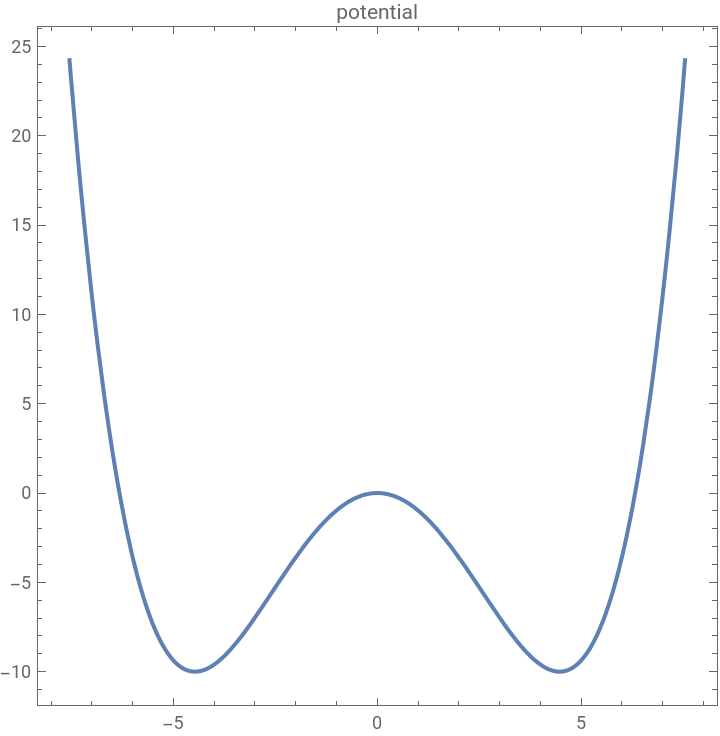
Let us start with standard deterministic trajectories in potential with barrier in the center. We can see they travel lines of constant total energy :
V+/2
2
v
H=10.;B=2.;A=/4/H;tm=20;V=Integrate[A*-B*x,x];pl=Table[{x[t],X[t],V/.x->s}/.NDSolve[{x'[t]==X[t],X'[t]==-A*+B*x[t],x[0]==s,X[0]==0},{x,X},{t,0,tm}],{s,-7,7}];Plot[V,{x,-8,8},FrameTrue,AspectRatio1,AxesNone,PlotLabel->"potential"],ShowPlot3DV+2,{x,-8,8},{v,-7,7},ImageSize->Medium,ParametricPlot3D[pl,{t,0,tm},PlotStyle"Rainbow"]
2
B
3
x
3
x[t]
2
v
Out[]=

,
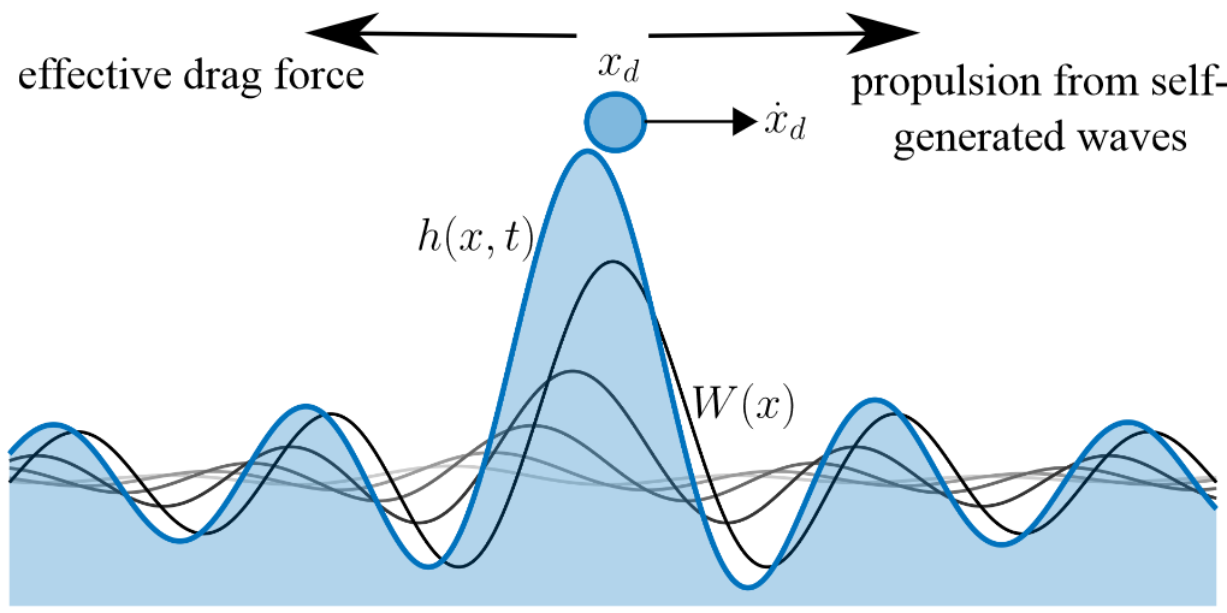
Now in analogy to walking droplets, as in diagram above we add drag and dependence from the past with strength weakening exponentially with time difference, :
f(x)sin(x)

This delayed ordinary differential equation with integration seems difficult to solve, fortunately it turns out it can be transformed to 4 variable ODE (arXiv:2401.05616, derivation: arXiv:2110.09754 ) for :
f(x)sin(x)
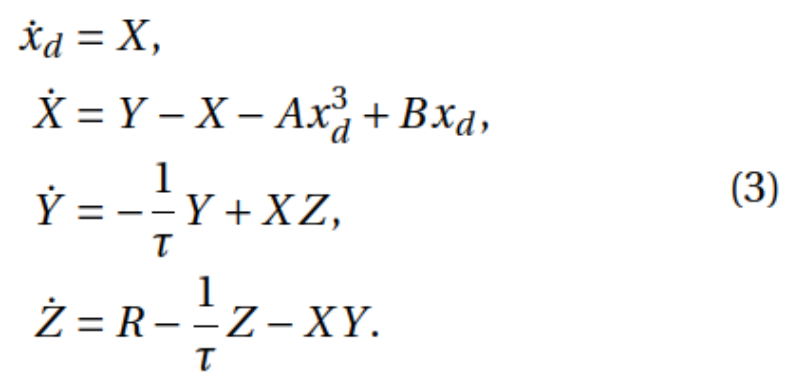
where is the particle velocity,
x
d

is the wave-memory force on the particle (proportional to the wave gradient at the particle location) and
Statistical - smooth path ensembles
Statistical - smooth path ensembles
Boltzmann smooth path ensemble (psMERW)
Boltzmann smooth path ensemble (psMERW)
Transition probability(width,velocity)
Transition probability(width,velocity)