V36 Mayhem 421 (2010) is quite interesting problem and we can study slightly more general cases with WL. Original question: Find the solution of +=4 for
1
x
3
x
x∈R
Analysis
Analysis
It is straightforward to use the quick substitution and make the equation a little easier to handle.
t
1
x
We can choose a proper visualization function to study the graph before we dig into the algebra. This usually gives us a good hint about the solution:
Plot[Floor[t]+Floor[3*t],{t,0,4},GridLines{Range[15]/3,{4}},Ticks->{Range[15]/3,Range[15]},ImagePadding{{10,0},{30,0}},ExclusionsStyle{{Red,Dashed},Blue}]
Out[]=
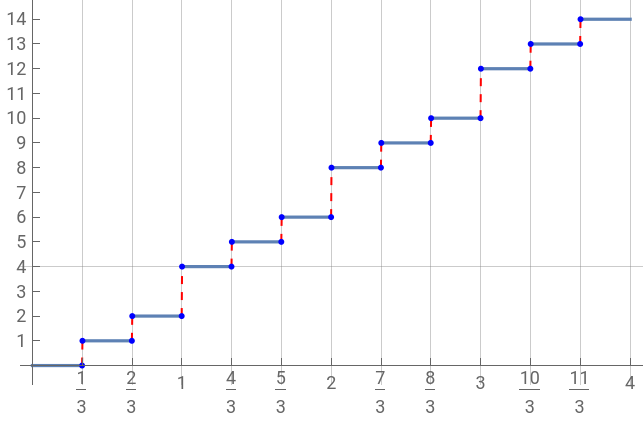
The important thing here are:
1
.Vertical grid lines indicating the boundary of each possible solution for +=⌊t⌋+⌊3·t⌋=n
1
x
3
x
2
.Some integers cannot be on the RHS of the equation. For instance the graph shows there is no solution for , or
n
n3
n7
n11
Notice that these number are of the form . The reason is that if , where is the integer part of and is the fractional part . Then
4k+3
tm+ϵ
m
t
ϵ
ϵ∈[0,1)
⌊t⌋+⌊3·t⌋m+⌊3m+3ϵ⌋4m+⌊3ϵ⌋
The range of the floor function term is:
FunctionRange[{Floor[3*ϵ],0<=ϵ<1},ϵ,y]
Out[]=
y0||y1||y2
The range means only are valid values on the RHS. The corresponding root for , and . In the original problem we let and choose the first interval for t: [1,4/3). Thus is in (3/4,1].
{4·m+0,4·m+1,4·m+2}
m≤t<m+
1
3
m+≤t<m+
1
3
2
3
m+≤t<m+1
2
3
m=1
x
Reduce[{Floor[t]+Floor[t*3]==4,t==1/x},{x,t},Reals]
Out[]=
3
4
1
x
Meanwhile, when :
n=3
Reduce[{Floor[t]+Floor[t*3]==3},t,Reals]
Out[]=
False
Generalization:
Generalization:
For a more generalized form: +=n, only works for and the corresponding intervals for x’s are for .
1
x
k
x
n∈{(1+k)·m+0,(1+k)·m+1,⋯,(1+k)·m+(k-1)}
m∈N
m+≤<m+
i-1
k
1
x
i
k
1≤i<k-1