Intro
Intro
Since its inception, I've been following the Wolfram Physics Projects and the Ruliad concept.
I think it will be useful for others to look at these ideas from different angles, to think about some analogies.
The mathematical and philosophical basis of Ruliad concept Mr. Wolfram was described in these articles: [1] [2]
This has sparked several significant associations for me.
I think it will be useful for others to look at these ideas from different angles, to think about some analogies.
The mathematical and philosophical basis of Ruliad concept Mr. Wolfram was described in these articles: [1] [2]
This has sparked several significant associations for me.
In fact, the teaching of Abderites goes far beyond primitive atomism.
Atoms and ameres
Physical atom did not match with a mathematical point. According to Democritus,
atoms had different sizes and shapes. Some were larger, others smaller. Democritus thought,
that atoms are physically indivisible, but mentally
they can be separated into ameres - a minimal quantity, further an indivisible.
In the smallest atom there were 7 ameres: top, bottom, left, right, front,
back, middle. From the ameres, Democritus composed long lines, and further planes etc.
In fact, this was the first theory of discrete space.
Multiverse
Ancient sources report that Democritus believed in an infinite number of “worlds” (kosmoi)
formed by atoms clumping in different ways and at different times.
Some worlds were different from ours (no sun/moon, different sizes, etc.).
These “worlds” were not just other planets — the concept already suggested a plurality of f
undamentally distinct realms arising from atomic arrangements.
Isonomia
Democritus’ pessimistic or neutral stance toward human life and cosmic significance
does suggest a radical contingency of configurations:
only atoms and void exist; everything else is accidental and structural.
This applies to all possible worlds and rules of atomic combinations -
"since there is no basis, why should they were rather like they were than different ".
Atoms and ameres
Physical atom did not match with a mathematical point. According to Democritus,
atoms had different sizes and shapes. Some were larger, others smaller. Democritus thought,
that atoms are physically indivisible, but mentally
they can be separated into ameres - a minimal quantity, further an indivisible.
In the smallest atom there were 7 ameres: top, bottom, left, right, front,
back, middle. From the ameres, Democritus composed long lines, and further planes etc.
In fact, this was the first theory of discrete space.
Multiverse
Ancient sources report that Democritus believed in an infinite number of “worlds” (kosmoi)
formed by atoms clumping in different ways and at different times.
Some worlds were different from ours (no sun/moon, different sizes, etc.).
These “worlds” were not just other planets — the concept already suggested a plurality of f
undamentally distinct realms arising from atomic arrangements.
Isonomia
Democritus’ pessimistic or neutral stance toward human life and cosmic significance
does suggest a radical contingency of configurations:
only atoms and void exist; everything else is accidental and structural.
This applies to all possible worlds and rules of atomic combinations -
"since there is no basis, why should they were rather like they were than different ".
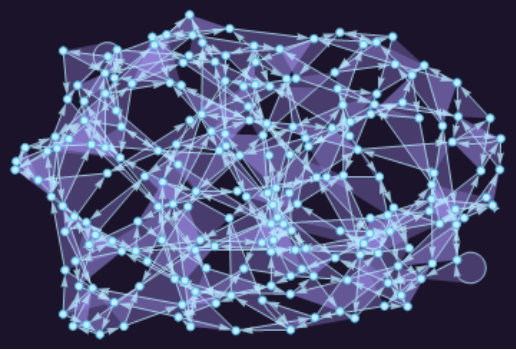
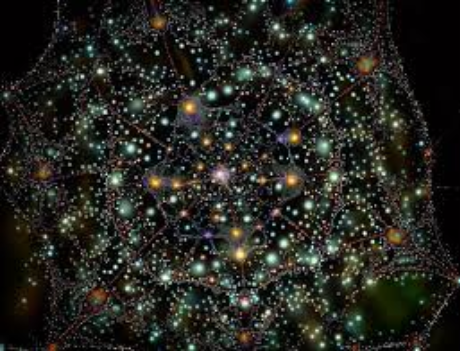
Far away in the heavenly abode of the great god Indra, there is a wonderful net
which has been hung by some cunning artificer in such a manner that it stretches out infinitely in all directions.
In accordance with the extravagant tastes of deities, the artificer has hung a single glittering jewel in each "eye" of the net,
and since the net itself is infinite in dimension, the jewels are infinite in number.
There hang the jewels, glittering "like" stars in the first magnitude, a wonderful sight to behold.
If we now arbitrarily select one of these jewels for inspection and look closely at it,
we will discover that in its polished surface there are reflected all the other jewels in the net, infinite in number.
Not only that, but each of the jewels reflected in this one jewel is also reflecting all the other jewels,
so that there is an infinite reflecting process occurring.
which has been hung by some cunning artificer in such a manner that it stretches out infinitely in all directions.
In accordance with the extravagant tastes of deities, the artificer has hung a single glittering jewel in each "eye" of the net,
and since the net itself is infinite in dimension, the jewels are infinite in number.
There hang the jewels, glittering "like" stars in the first magnitude, a wonderful sight to behold.
If we now arbitrarily select one of these jewels for inspection and look closely at it,
we will discover that in its polished surface there are reflected all the other jewels in the net, infinite in number.
Not only that, but each of the jewels reflected in this one jewel is also reflecting all the other jewels,
so that there is an infinite reflecting process occurring.
Nothing has independent, permanent, or absolute existence.
Everything is part of a limitless web of interconnections and undergoes a continual process of transformation.
Every appearance arises from complex causes and conditions, and in turn combines with others to produce countless effects.
By interrupting the causal chain at certain key points,
the course of existence can be altered and effects prevented by eliminating their causes.
When this is, that is .
From the arising of this comes the arising of that .
When this isn' t, that isn' t .
From the cessation of this comes the cessation of that .
Everything is part of a limitless web of interconnections and undergoes a continual process of transformation.
Every appearance arises from complex causes and conditions, and in turn combines with others to produce countless effects.
By interrupting the causal chain at certain key points,
the course of existence can be altered and effects prevented by eliminating their causes.
When this is, that is .
From the arising of this comes the arising of that .
When this isn' t, that isn' t .
From the cessation of this comes the cessation of that .
Ruliades examples
Ruliades examples
Net of solid atoms
Net of solid atoms
In[]:=
atomEmes={{0},{1}};
Atomic rules are 2-emes, all possible pair combinations.
Here we don’t allow merge: element {1, 0} does not exist,
and rule of type {1} {1, 0} not allowed.
Here we don’t allow merge: element {1, 0} does not exist,
and rule of type {1} {1, 0} not allowed.
In[]:=
atomRules=Flatten@Outer[Rule,atomEmes,atomEmes,1]
Out[]=
{{0}{0},{0}{1},{1}{0},{1}{1}}
The rules themselves include all possible combinations of atomic rules.
The order in this case is not important, but repetitions are possible: by definition ruliad is a multiway system.
The order in this case is not important, but repetitions are possible: by definition ruliad is a multiway system.
In[]:=
atomMultiwayRules=Subsets[atomRules,{1,∞}]
Out[]=
{{{0}{0}},{{0}{1}},{{1}{0}},{{1}{1}},{{0}{0},{0}{1}},{{0}{0},{1}{0}},{{0}{0},{1}{1}},{{0}{1},{1}{0}},{{0}{1},{1}{1}},{{1}{0},{1}{1}},{{0}{0},{0}{1},{1}{0}},{{0}{0},{0}{1},{1}{1}},{{0}{0},{1}{0},{1}{1}},{{0}{1},{1}{0},{1}{1}},{{0}{0},{0}{1},{1}{0},{1}{1}}}
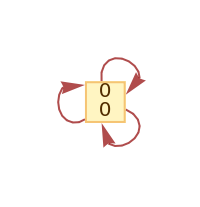
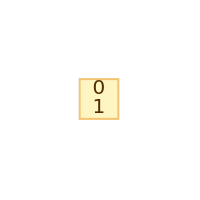
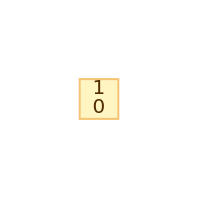
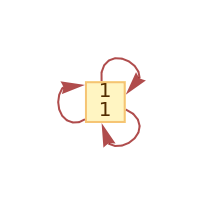
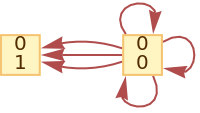
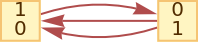
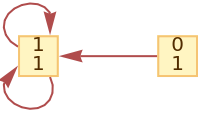
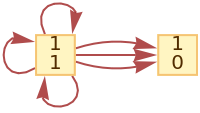
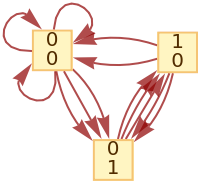
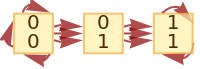
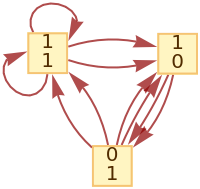
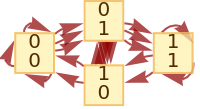
By applying all the rules to all atoms we will see,
that our model is not tautology, as it may seem.
But it is actually quite simple, and most importantly, completely self-closed.
that our model is not tautology, as it may seem.
But it is actually quite simple, and most importantly, completely self-closed.
In[]:=
Grid[Partition[ms[#,{#[[1,1]]},4,"CausalGraph",ImageSize->100]&/@atomMultiwayRules,5]]
Out[]=
Sets combinations
Sets combinations
Start from the previous emes and let's construct sets.
Sets merge same elements and non-ordered.
So {0, 0} ≡ {0} and {0, 1} ≡ {1, 0}.
And they are non-flatten so {0} ≠ {{0}} and {0, {1, 0}} ≠ {{0}, 1, 0} ≠ {0, 1}
Sets merge same elements and non-ordered.
So {0, 0} ≡ {0} and {0, 1} ≡ {1, 0}.
And they are non-flatten so {0} ≠ {{0}} and {0, {1, 0}} ≠ {{0}, 1, 0} ≠ {0, 1}
Natural numbers
Natural numbers
In[]:=
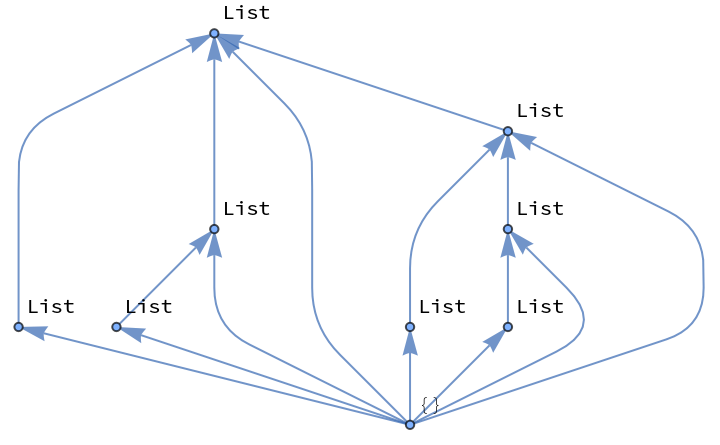
Clear@numsFromSet;numsFromSet[mx_]:=NestList[Union[#,{#}]&,{},mx];
In[]:=
MapIndexed[{First@#2,ToString@#1}&,numsFromSet@4]//TableForm
Out[]//TableForm=
1 | {} |
2 | {{}} |
3 | {{}, {{}}} |
4 | {{}, {{}}, {{}, {{}}}} |
5 | {{}, {{}}, {{}, {{}}}, {{}, {{}}, {{}, {{}}}}} |
In[]:=
Block[{g=ExpressionGraph[Last@numsFromSet@4,VertexLabelsAutomatic,EdgeShapeFunction->(Arrow@Reverse@#&),DirectedEdges->True]},VertexContract[g,getVertsByAV[g,{}]]]
Out[]=
Powersets
Powersets
In[]:=
setEmes={0,1};
If we use Subsets recursively, we will get huge arrays very quickly, for example:
In[]:=
Nest[Subsets,setEmes,2]
Out[]=
{{},{{}},{{0}},{{1}},{{0,1}},{{},{0}},{{},{1}},{{},{0,1}},{{0},{1}},{{0},{0,1}},{{1},{0,1}},{{},{0},{1}},{{},{0},{0,1}},{{},{1},{0,1}},{{0},{1},{0,1}},{{},{0},{1},{0,1}}}
but Nest[Subsets, setEmes, 3] has length .
16
2
To get an observable structure, we limit subsets with size 1.2 and
enter the definition as in Aczel's anti-foundation set model: {e} ≡ {{e}}
enter the definition as in Aczel's anti-foundation set model: {e} ≡ {{e}}
In[]:=
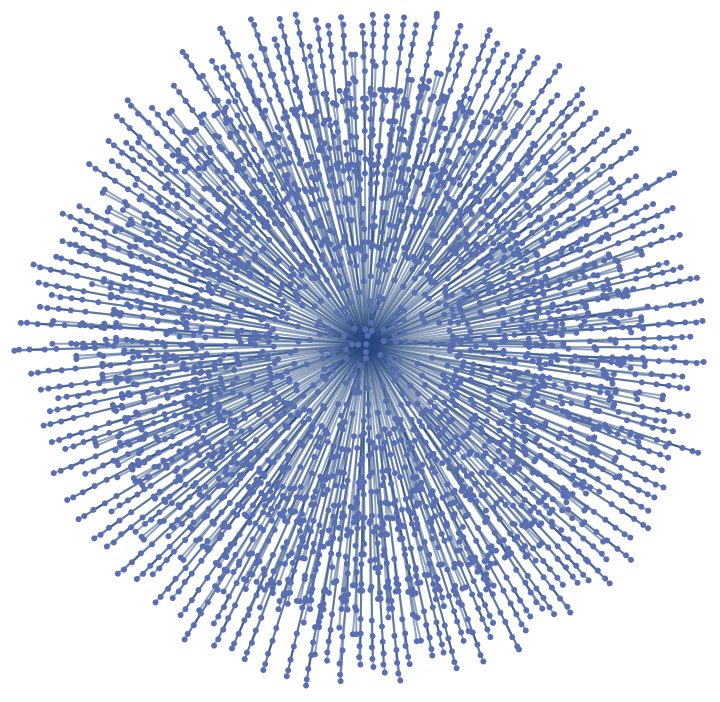
(powerSets12=Nest[Subsets[#,{1,2}]//.{{e___}}:>{e}&,setEmes,4])//Short
Out[]//Short=
{{0},{1},{0,1},226,{{{{0},{1}},{{0},{0,1}}},{{{0},{0,1}},{{1},{0,1}}}},{{{{0},{1}},{{1},{0,1}}},{{{0},{0,1}},{{1},{0,1}}}}}
In[]:=
ExpressionGraph@powerSets12
Out[]=
Sequences
Sequences
The research in Wolfram Physics Projects is based on another model - hypergraphs.
The closest to them are not atoms and many, but sequences substitution model ***
Sequences are:
- always flatten
- no union and merging
- ordered
- rules work on any depth and for any matching patterns
The closest to them are not atoms and many, but sequences substitution model ***
Sequences are:
- always flatten
- no union and merging
- ordered
- rules work on any depth and for any matching patterns
If we use {{0}, {1}} and all the possible multiway rules, we get a structure,
similar atoms, completely enclosed.
But if you add new solid atoms, nothing will change. Even if they are combinations of the previous ones
because atoms are impenetrable (as they are supposed to be).
And now, from the sequences something new will come.
Use all 1- 2-tuples:
similar atoms, completely enclosed.
But if you add new solid atoms, nothing will change. Even if they are combinations of the previous ones
because atoms are impenetrable (as they are supposed to be).
And now, from the sequences something new will come.
Use all 1- 2-tuples:
In[]:=
seqEmes={{0},{1},{0,0},{0,1},{1,0},{1,1}};
Taking into account seq's features we can filter rules deleting tautology:
In[]:=
Clear@removeTautos;removeTautos=DeleteCases[#,s_/;First@s==Last@s,1]&;
(seqRules=DeleteCases[Flatten[Outer[removeTautos@{Rule[#1,#2]}&,seqEmes,seqEmes,1],1],{}])//Short
Out[]//Short=
{{{0}{1}},{{0}{0,0}},{{0}{0,1}},{{0}{1,0}},{{0}{1,1}},20,{{1,1}{0}},{{1,1}{1}},{{1,1}{0,0}},{{1,1}{0,1}},{{1,1}{1,0}}}
Apply all rules to all emes:
In[]:=
oneStepRes=Flatten[Outer[{#1,#2,ms[#1,#2,1]}&,seqRules,seqEmes,1],1];
In[]:=
Graph[First@Last@#->Last@Last@#&/@oneStepRes,GraphLayout->"SpringElectricalEmbedding",VertexLabels->"Name"]
Out[]=
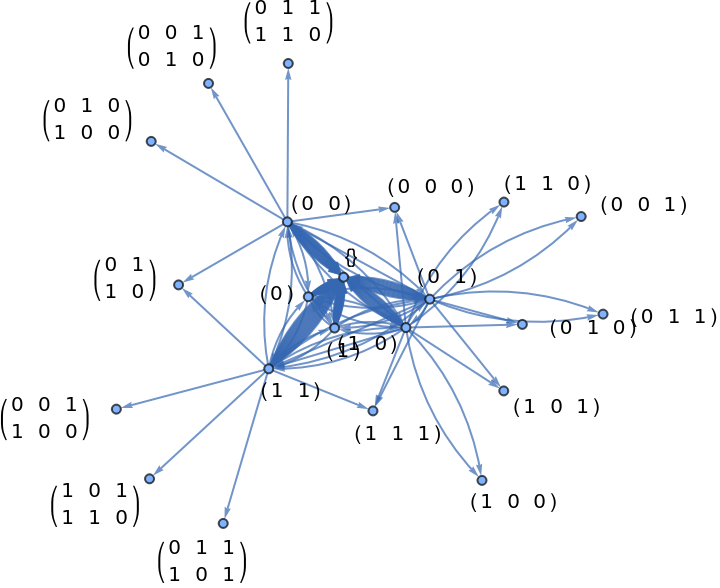
We see several features of such systems:
- Most combinations degenerate into an empty sequence
- Multiway evolution is observed
- Original emes set expands, new items appear
Remove non-degenerative and non-linear combinations and see what happens to them in a few steps:
- Most combinations degenerate into an empty sequence
- Multiway evolution is observed
- Original emes set expands, new items appear
Remove non-degenerative and non-linear combinations and see what happens to them in a few steps:
Of course, we can get increasingly complex ruliades using powersets of rules etc.
On the other hand, the application of rules has its own rules (meta-rules).
For example, SequenceReplace in Wolfram language uses what is called lefmost rewriting (see description).
Other meta-rules:
- parallel substitution
- greedy algorithm
- priority (Markov) algorithm
etc.
And all of them can be applied both individually and multiway.
But we will make even stronger enlargement:
On the other hand, the application of rules has its own rules (meta-rules).
For example, SequenceReplace in Wolfram language uses what is called lefmost rewriting (see description).
Other meta-rules:
- parallel substitution
- greedy algorithm
- priority (Markov) algorithm
etc.
And all of them can be applied both individually and multiway.
But we will make even stronger enlargement:
Going to Omniverse
Going to Omniverse
We will apply one rules to others.
Using the simplest meta-rule for applying R1 to R2:
R1 simply acts as lefmost rewriting on all sequences (LHS and RHS) in R2
Due to the huge complexity and diversity of processes, this section will only cover one-way method.
The analysis of multiway rules-to-rules systems I hope will interest readers.
Using the simplest meta-rule for applying R1 to R2:
R1 simply acts as lefmost rewriting on all sequences (LHS and RHS) in R2
Due to the huge complexity and diversity of processes, this section will only cover one-way method.
The analysis of multiway rules-to-rules systems I hope will interest readers.
Apply all seqRules to each other:
We see a diverse and interisting structure.
We can extend it further by combining rules using powersets etc.
But here again we will leave this direction open, having considered a very important issue:
We can extend it further by combining rules using powersets etc.
But here again we will leave this direction open, having considered a very important issue:
Observers like us
Observers like us
In a previous post, we discussed binary sequences as the results of rules action in detail.
It has been found that simple rules can produce complex sequences,
especially the amazing-looking with turtle graphic (AnglePath) presentation.
It has been found that simple rules can produce complex sequences,
especially the amazing-looking with turtle graphic (AnglePath) presentation.
Mr. Wolfram mentioned that "we" are the observers embedded in Ruliade, being itself a complex generated structure.
I am not at all offended or humiliated by associating myself with one of the beautiful structures shown above.
But we will not discuss such acute philosophical questions here. Let’s pay attention to this:
What are the characteristics {possibly numericall) of "us" as observers in Ruliade?
It is primarily an self-identity, but I propose to model it in another study.
The second is "The Edge of Chaos" .
All living, thinking systems exist on the edge of chaos balancing between a complex, fractal structure
and possible instability in the form of chaos.
There are many criteria for assessing how close the system is to the edge of chaos.
We will choose a statistical complexity measure based on the balance between entropy
and the distance to the chaos equilibrium .
The method presented in the article has been modified:
- Calculations are performed for all blocks from 2-tuples up to the specified length maxLen
- Both entropy and distance are normalized within 0..1
- The final result is formed as a product of mean distances (across all blocks) and entropy
The integrated criterion of such a measure performs the following functions:
I am not at all offended or humiliated by associating myself with one of the beautiful structures shown above.
But we will not discuss such acute philosophical questions here. Let’s pay attention to this:
What are the characteristics {possibly numericall) of "us" as observers in Ruliade?
It is primarily an self-identity, but I propose to model it in another study.
The second is "The Edge of Chaos" .
All living, thinking systems exist on the edge of chaos balancing between a complex, fractal structure
and possible instability in the form of chaos.
There are many criteria for assessing how close the system is to the edge of chaos.
We will choose a statistical complexity measure based on the balance between entropy
and the distance to the chaos equilibrium .
The method presented in the article has been modified:
- Calculations are performed for all blocks from 2-tuples up to the specified length maxLen
- Both entropy and distance are normalized within 0..1
- The final result is formed as a product of mean distances (across all blocks) and entropy
The integrated criterion of such a measure performs the following functions:
We will take all Subsets[seqRules,{1,3}] and evaluate LMCMeasure for non-repeating cases
If possible it's better to start parallel kernels:
Look at the results histogram:
We see that most rules generate primitive sequences - either too chaotic or too poor .
But there is a notable array of rules generating rich, interesting outcomes .
By following the visual criteria, we can select the most interesting ones.
And after removing those that generate the same sequences, look at turtle graphics:
But there is a notable array of rules generating rich, interesting outcomes .
By following the visual criteria, we can select the most interesting ones.
And after removing those that generate the same sequences, look at turtle graphics:
We see different behaviors, not chaotic and not primitive.
I think that observers like us exist in this niche between order and chaos.
I think that observers like us exist in this niche between order and chaos.
TO DO
TO DO
In fact, neither for living matter nor in the whole Ruliad there is no "analysis of a ready array".
There are mutations and selection. And of course, mutations do not come from "outside."
I think the most obvious option is to apply existing rules to each other
and selection based on the criteria that determine the type of evolution.
But it is a topic for the next separate post.
There are mutations and selection. And of course, mutations do not come from "outside."
I think the most obvious option is to apply existing rules to each other
and selection based on the criteria that determine the type of evolution.
But it is a topic for the next separate post.
CITE THIS NOTEBOOK
CITE THIS NOTEBOOK
The Ruliad concept: some ideas and observations
by Denis Ivanov
Wolfram Community, STAFF PICKS, March 17, 2026
https://community.wolfram.com/groups/-/m/t/3663446
by Denis Ivanov
Wolfram Community, STAFF PICKS, March 17, 2026
https://community.wolfram.com/groups/-/m/t/3663446