Non-Sinusoidal Oscillation: A Balloon on a String
Non-Sinusoidal Oscillation: A Balloon on a String



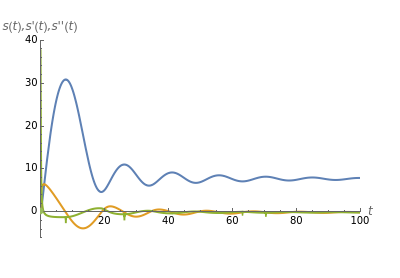
Picture a buoyant balloon trailing a string with some mass per unit length. As the balloon rises, more string is lifted off the floor and the weight of the balloon-string system increases. As the balloon sinks, string returns to the floor and the weight of the balloon-string system decreases. In effect, the mass of the system depends on its position.
Details
Details
Snapshot 1: no damping; the displacement curve (blue) might look like a simple harmonic oscillator at first glance, but look at its derivatives and ; note that energy is not conserved even in the absence of damping, as the rope is making inelastic collisions with the floor
s(t)
s'(t)
s''(t)
Snapshot 2: massless string (and no damping); up, up, and away: in this case, the balloon is under the constant acceleration of its own lift
Snapshot 3: heavy string, small balloon, significant damping; the balloon reaches equilibrium around
t=50
External Links
External Links
Permanent Citation
Permanent Citation
Dillon Tracy, Mark Robertson-Tessi
"Non-Sinusoidal Oscillation: A Balloon on a String"
http://demonstrations.wolfram.com/NonSinusoidalOscillationABalloonOnAString/
Wolfram Demonstrations Project
Published: March 14, 2008