Elementary cellular automata produce diverse, complex behaviors originating from simple, deterministic local rules. When initialized from a single active cell, the resulting vertical center columns serve as a focal point for studying computational complexity and pseudo-randomness. However, the validity of this randomness relies fundamentally on the absence of repeating cycles, or periodicity. This essay systematically maps the presence, absence, and underlying structure of periodicity across both the elementary and totalistic cellular automata rule spaces. By examining these distinct computational domains, this project identifies the exact thresholds where predictable, local symmetries dissolve into structurally complex, non-repeating randomness. Future work proposes extending the analytical framework through graph-theoretic de Bruijn state-space decomposition and periodicity analysis of other columns (like diagonals) in cellular automata.
Introduction
Introduction
Beneath the intricate patterns generated by cellular automata lies a profound paradox: how can entirely deterministic, simple local rules give rise to macroscopic unpredictability? When initialized from a single active cell, these systems unfold across space and time, producing behaviors that range from uniformity to deep, irreducible chaos. Over time, researchers have looked to the vertical center column of these evolutions as a testing ground of structural complexity. If a simple rule can generate a central sequence that completely evades predictability, it challenges our fundamental understanding of randomness and computational complexity. This intersection of simplicity and disorder forms the foundation of modern pseudo-random number generation and cryptographic design, most famously exemplified by ECA Rule 30.
This project identifies deceptive low-order repetitions by validating stability thresholds across expanded observation windows. However, evaluating the validity of this randomness requires answering the question “Does the central column eventually lock into a repeating loop, or does its behavior remain forever non-periodic?” which is the central point explored in this computational essay. By designing algorithms to detect the exact lengths of the periods of repetition and transient states, this computational essay maps the exact thresholds where predictable, nested symmetries turn into irregular, incompressible sequences. This exploration of both the elementary and totalistic rule domains leads to an investigation of the rules where local, deterministic patterns collapse, leading to non-periodic behavior and analysis of whether this non-periodicity is truly random.
This project identifies deceptive low-order repetitions by validating stability thresholds across expanded observation windows. However, evaluating the validity of this randomness requires answering the question “Does the central column eventually lock into a repeating loop, or does its behavior remain forever non-periodic?” which is the central point explored in this computational essay. By designing algorithms to detect the exact lengths of the periods of repetition and transient states, this computational essay maps the exact thresholds where predictable, nested symmetries turn into irregular, incompressible sequences. This exploration of both the elementary and totalistic rule domains leads to an investigation of the rules where local, deterministic patterns collapse, leading to non-periodic behavior and analysis of whether this non-periodicity is truly random.
Defining Period and Transient
Defining Period and Transient
A transient is the initial, non-repeating segment of a sequence that occurs before a stable pattern establishes itself. In the context of a cellular automaton's center column, the transient measures how many time steps the local deterministic rules take to filter out starting conditions and settle into a permanent behavior regime. For example, in the sequence {5, 4, 3, 1, 0, 1, 0, 1, 0}, the transient length is 3 because the first three elements {5, 4, 3} form a temporary prelude and never reappear once the steady pattern begins.
A period is the length of the smallest repeating block of values that characterizes the long-term, steady-state behavior of a sequence. Once a center column evolution clears its transient phase, the system enters a perfectly predictable loop where the states repeat precisely every “p” steps. For example, in the continuing sequence {1,1,1,1,0,0,1,0,0,1,0,0,1,0.0}, the sequence loops the identical pattern {1, 0,0} after a transient phase of {1,1,1} which gives it a fixed period length of 3.
A period is the length of the smallest repeating block of values that characterizes the long-term, steady-state behavior of a sequence. Once a center column evolution clears its transient phase, the system enters a perfectly predictable loop where the states repeat precisely every “p” steps. For example, in the continuing sequence {1,1,1,1,0,0,1,0,0,1,0,0,1,0.0}, the sequence loops the identical pattern {1, 0,0} after a transient phase of {1,1,1} which gives it a fixed period length of 3.
Elementary Cellular Automata
Elementary Cellular Automata
Elementary cellular automata are the simplest class of cellular automata consisting of a one-dimensional array of cells where each cell transitions between binary states over discrete time steps. The future state of any given cell is controlled by a local transition function operating solely on the current state of the cell itself and its immediate left and right neighbors. Despite the strict simplicity of this neighborhood configuration, which yields only 2^3 = 8 possible local input states and a finite space of exactly 2^8 = 256 distinct rules, these systems create an extraordinarily wide spectrum of macroscopic behaviors. Their evolutions range from simple uniform and periodic to highly intricate complex structures and mathematically irreducible, chaotic noise.
By focusing exclusively on this central column, the complex two-dimensional evolution of each automaton is reduced to a clean, one-dimensional binary sequence due to which I could deploy algorithmic techniques to systematically analyze each rule for transient lengths, long-term stability, and the presence or absolute absence of periodicity. This investigation focuses on the vertical center column produced from a single black cell, reducing each automaton to a binary sequence that can be analyzed for periodicity and long term behavior.
By focusing exclusively on this central column, the complex two-dimensional evolution of each automaton is reduced to a clean, one-dimensional binary sequence due to which I could deploy algorithmic techniques to systematically analyze each rule for transient lengths, long-term stability, and the presence or absolute absence of periodicity. This investigation focuses on the vertical center column produced from a single black cell, reducing each automaton to a binary sequence that can be analyzed for periodicity and long term behavior.
Detecting periodicity in the central column
Detecting periodicity in the central column
middleCol :- Extracts the central column of a given rule number for a certain number of steps.
In[]:=
middleCol[rn_,steps_]:= CellularAutomaton[rn,{{1},0},{steps,{-steps,steps}}][[All,steps+1]]
While my initial investigations rely on rn_ representing a standard elementary rule number from 0 to 255, the function is designed with broader compatibility in mind. Since it utilizes the in-built CellularAutomaton function, this extraction mechanism natively supports any valid rule specification accepted by the Wolfram Language, including but not limited to multi-state totalistic rules.
In[]:=
middleCol[30,5]
Out[]=
{1,1,0,1,1,1}
findPeriodAndTransient :- Returns a list of both the period of repetition and transient for a given inputted list.
In[]:=
findPeriodAndTransient[list_List, transient_Integer:0] := With{per = Length@FindRepeat[list, 2]}, Which Length[list]<2, {Infinity, 0}, transient>=Length[list]*34, {Infinity, 0}, per > 0, {per, transient}, True ,findPeriodAndTransient[Rest[list], transient+1]
For example, ECA rule 30 is known to have a central column that appears to be totally random.
In[]:=
findPeriodAndTransient[middleCol[30,10]]
Out[]=
{∞,0}
perAndTransTab :- Returns the period of all 256 rules for an inputted “n” number of steps.
In[]:=
perAndTransTab[n_]:=Table[findPeriodAndTransient[middleCol[rn, n]], {rn, 0, 255}]
Case of Rule 137 and its Symmetric Equivalent 193
Case of Rule 137 and its Symmetric Equivalent 193
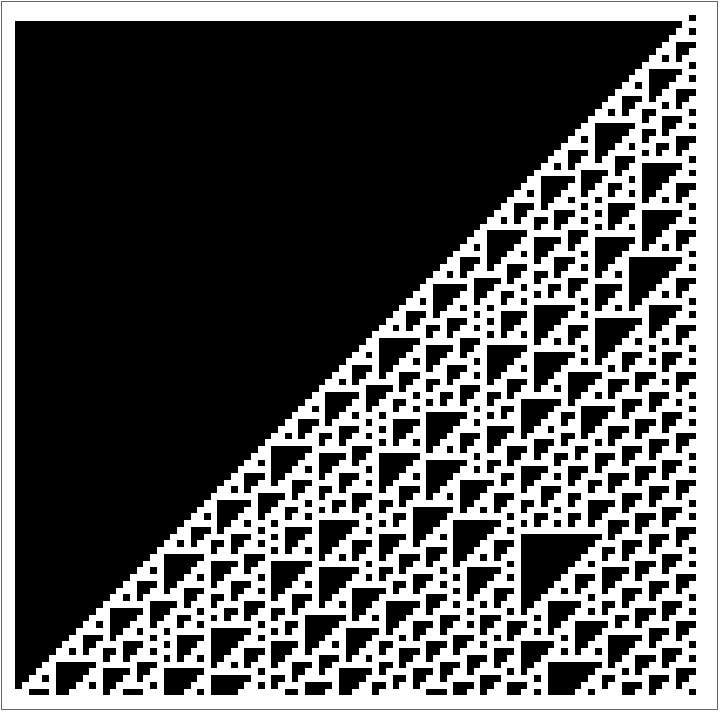
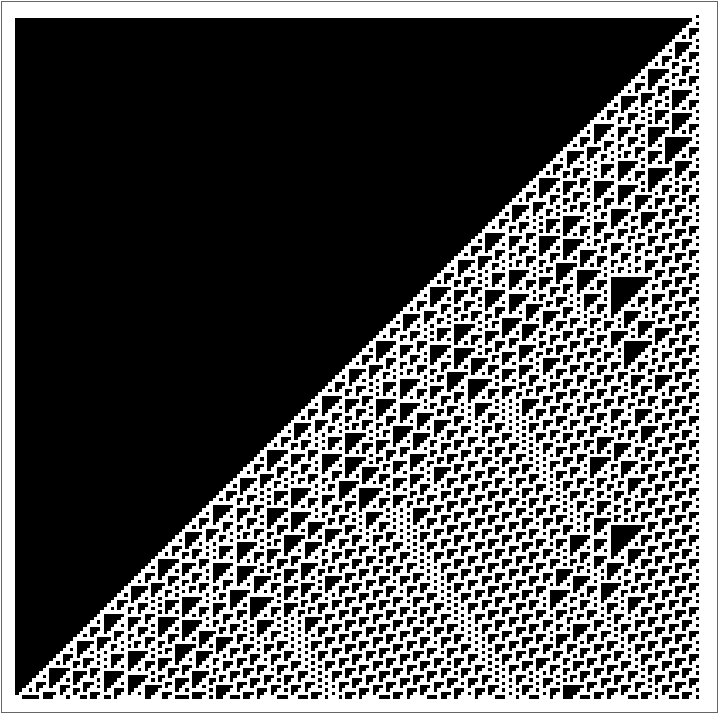
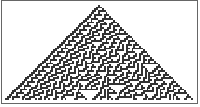
During a screening of the center column periodicities across all 256 Elementary Cellular Automata rules, an unexpected signal emerged. While the vast majority of rules rapidly settle into simple, highly predictable behaviors, such as Period 1 or brief, low-order repetitions (Periods 2, 3, or 4), Rule 137 and its symmetrical equivalent, Rule 193, had a large period reading of 44. However, further exploration showed that the correct period was infinity. The idea that followed was that if a sequence is really periodic, the period should remain constant as one examines larger sequences.
In[]:=
findPeriodAndTransient[middleCol[137,100]]
Out[]=
{44,13}
In[]:=
ArrayPlot[CellularAutomaton[137,{{1},0},100]]
Out[]=
In[]:=
ArrayPlot[CellularAutomaton[137,{{1},0},200]]
Out[]=
In[]:=
mc137=middleCol[137,300]
Out[]=
{1,0,1,0,1,0,0,1,0,1,0,1,0,0,1,0,1,0,1,0,0,1,0,1,0,1,0,0,1,0,1,0,1,0,0,1,0,1,0,1,0,0,1,0,1,0,1,0,0,1,0,1,0,1,0,0,1,0,1,0,1,0,1,0,0,1,0,1,0,1,0,0,1,0,1,0,1,0,0,1,0,1,0,1,0,0,1,0,1,0,1,0,0,1,0,1,0,1,0,0,1,0,1,0,1,0,0,1,0,1,0,1,0,0,1,0,1,0,1,0,0,1,0,1,0,1,0,0,1,0,1,0,1,0,0,1,0,1,0,1,0,0,1,0,1,0,1,0,0,1,0,1,0,1,0,0,1,0,1,0,1,0,0,1,0,1,0,1,0,0,1,0,1,0,1,0,0,1,0,1,0,1,0,0,1,0,1,0,1,0,0,1,0,1,0,1,0,0,1,0,1,0,1,0,0,1,0,1,0,1,0,0,1,0,1,0,1,0,1,0,1,0,0,1,0,1,0,1,0,0,1,0,1,0,1,0,0,1,0,1,0,1,0,0,1,0,1,0,1,0,0,1,0,1,0,1,0,0,1,0,1,0,1,0,0,1,0,1,0,1,0,0,1,0,1,0,1,0,0,1,0,1,0,1,0,0,1,0,1,0,1,0,0,1,0,1,0,1,0,0,1}
Thus, isolating long-term behavioral trends purely from early visual steps or short time-series windows can be profoundly deceptive. When the number of operational steps is limited to standard shallow cutoffs, Rule 137 and Rule 193 frequently return completely false readings, wrongly classifying their highly complex, delayed cycles. To overcome this limitation, a new wrapper function and a testRule function were devised such that a rule’s period and transient are only accepted if they hold true and remain completely unchanged across two distinct evaluation windows evaluated at an incrementing difference of 500 steps.
To overcome these misleading readings, the wrapper function reruns the test for successively larger windows to see if the results become consistent.
To overcome these misleading readings, the wrapper function reruns the test for successively larger windows to see if the results become consistent.
wrapper :- takes in a list of the period, transient, rule number, and a base number of steps and gives the period and transient with the number of steps incremented by 500.
In[]:=
wrapper[list_List:{}]:= With{rn=list[[2]],n=list[[3]]+500}, {findPeriodAndTransient[middleCol[rn,n]],rn,n}
In[]:=
wrapper[{{},30,0}]
Out[]=
{{∞,0},30,500}
The wrapper function is designed to contain its own parameters which enables it to be used as an argument to FixedPoint.This means we can keep increasing the window size until the results do not change.
testRule :- Takes the rule number as the input and uses the function wrapper to return the period, transient, and number of steps taken to reach repetition with stability.
In[]:=
testRule[rn_Integer] := FixedPoint[wrapper, {{}, rn, 0}, 10, SameTest -> (#1[[1]] == #2[[1]] &)]
testRule returns the {period, transient}, the rule number, and the number of iterations at which the calculation stabilized.
In[]:=
testRule[12]
Out[]=
{{1,0},12,1000}
Collects the empirical data from a variable named allRules, converts it into a cloud object and configures global permissions.
In[]:=
allRules=Table[testRule[rn],{rn,0,255}];
Two rules (137 and 193) in particular took longer than the others to give stable answers.
In[]:=
Rules={testRule[137],testRule[193]}
Out[]=
{{{∞,0},137,2000},{{∞,0},193,2000}}
Except for rule number 137 and 193 which stabilize at 2000 steps, all other rules reach consistent periods and transients at a 1000 steps.
representativeRule:- a sample rule to display for each different period.
In[]:=
representativeRule=<|1->0,2->1,3->57,4->54,Infinity->30|>;
Strips away the transient value (t) and the steps value (s), leaving behind a simple list of pairs containing just {period, ruleNumber}.
In[]:=
periodRulePairs=allRules/.{{p_,t_},r_,s_}:>{p,r};
Groups the rules together based on their period (First item in the pair) and maps it to a list of all rule numbers (Last item in the pair) that share that same period length.
In[]:=
periodGroups=GroupBy[periodRulePairs,First->Last];
Grabs a list of all the unique periods found (the keys) and sorts them from smallest to largest.
In[]:=
sortedPeriods=SortBy[Keys[periodGroups],If[#===Infinity||#===∞,Infinity,#]&];
Out[]=
Rules Grouped by Period Length along with Visual Representation |


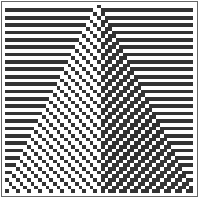
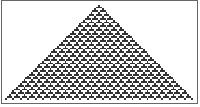
aDataset :- Converts the raw compiled results into a structured queryable dataset for easier analysis.
Constructs an interactive graphical interface allowing real-time querying of the rule dataset based on transient and period values.
Extracting all the periods of the elementary rules from allRules and making a histogram of the same.
Extracting all the transients of the elementary rules from allRules and making a histogram of the same.
Non-Periodic Behavior
Non-Periodic Behavior
Non-periodic behavior arises when a rule progresses to create complexity which does not follow a consistent pattern. For rules belonging to this class, the sequence of states generated down the center timeline remains perpetually irregular across an infinite time horizon. In the space of elementary cellular automata, simple localized update rules frequently yield highly complex, non-periodic behavior from a single cell initial state. This absence of cyclic stabilization often corresponds to Class 3 (chaotic) or Class 4 (complex) behaviors.
Checking whether non-periodic center columns of rules are random
Checking whether non-periodic center columns of rules are random
While non-periodic center columns are easily defined by their failure to repeat, a critical question remains: Does this endless irregularity constitute pseudo-random chaos, or does it merely mask a deeply subtle, long-range structural order? To distinguish between the two, the non-periodic center columns must be subjected to empirical statistical tests which leads us to the following topic of exploration.
Extracts the center column of each cellular automaton rule and runs them through three statistical randomness tests alongside an entropy calculation.
It automatically appends a "Status" column that marks a rule as "Pass" if all its test p - values are above the standard 0.05 significance threshold, or "Fail" otherwise .
The empirical tests reveal a clear split among the non-periodic center columns: while several rules exhibit high entropy and genuinely random distribution metrics, others remain non-periodic yet structurally ordered. This proves that a failure to stabilize into a repeating loop does not automatically equate to true randomness; instead, many rules maintain a pattern.
Summary
Summary
A deep dive into the vertical central columns of Elementary Cellular Automata (ECA) reveals a diverse array of behaviors. While the vast majority of ECA rules converge to static, period-1 configurations, a smaller subset settles into low-integer periodic orbits of periods 2, 3, and 4. Beyond these predictable regimes, a significant number of rules exhibit completely non-periodic behavior, registering an effective period of infinity. However, non-periodicity must not be associated with true structural randomness. Statistical analysis reveals that 6 out of the 15 non-periodic rules exhibit non-random behavior, indicating the presence of long-range structural order. Furthermore, this analysis highlights a critical methodology warning: isolating long-term behavioral trends purely from early visual steps or short time-series windows can be profoundly deceptive. This transient deception is vividly demonstrated by Rules 137 and 193, where short-term patterns mask their true, long-term non-periodic behavior.
Totalistic Rules
Totalistic Rules
Expanding the exploration of totalistic cellular automata to a system with k=3 with a standard local neighborhood of three cells introduces a significantly richer, yet still computationally tractable, rule space of exactly 3^7 = 2187 distinct rules. In this setup, each cell can occupy one of three states (typically denoted as 0, 1, or 2), meaning the maximum possible sum of any local neighborhood is 6, yielding seven possible aggregate values (0 through 6) that map to a corresponding next-state output. When initializing this system from a single active cell, such as a solitary ‘1’ or ‘2’ centered in a uniform background of zeros, the vertical central column again serves as a vital one-dimensional time-series indicator of the system’s core dynamics.
This structural constraint reduces the complexity of the rule space while still preserving the capacity to generate intricate, emergent behavior. By examining totalistic rules within the context of this study, it can be investigated whether this symmetric dependence on neighboring cells fundamentally alters, simplifies, or mirrors the periodic structures and long-term dynamics observed in the vertical central columns of standard elementary cellular automata.
trcv :- Converts the totalistic rule number into the correct formatting for the Cellular Automaton function
Testing the applicability of the middleCol and findPeriodAndTransient functions to totalistic rules using the trcv function
perAndTransTabTr :- This function iterates the findPeriodAndTransient function over all 2187 totalistic rules
testRuleT :- Takes the rule number as the input and uses the function wrapper to return the period, transient, and number of steps taken to reach repetition with stability.
The steps taken to reach stable repetition are multiples of 500 with the minimum value of steps in order to establish stable repetition being 1000.
The steps taken to reach stable repetition are multiples of 500 with the minimum value of steps in order to establish stable repetition being 1000.
Collects the empirical data from a variable allRulesT which has the period, transient, rule number and steps to stability, converts it into a cloud object and configures global permissions
Extracting all the periods of the elementary rules from allRules and making a histogram of the same.
Extracting all the transients of the elementary rules from allRules and making a histogram of the same.
Observing at the graphs of the totalistic rules, unlike the ECA, there appear to be several rules with long transients that then resolve into period 1 (constant) behavior.
Converts the raw compiled results into a structured queryable dataset for easier analysis.
Constructs an interactive graphical interface allowing real-time querying of the rule dataset based on transient and period values.
Summary
Summary
A deep dive into the vertical central columns of 3-state totalistic cellular automata reveals a rich array of behaviors within its 2,187-rule space . While a substantial majority of these totalistic rules converge rapidly to static, period-1 states or simple low-integer periodic orbits, the introduction of a third state allows a distinct subset to settle into highly stable, multi-phase periodic regimes. While a substantial majority of these totalistic rules converge rapidly to static, period-1 configurations or trivial low-integer periodic orbits, the introduction of a third state expands the system’s algebraic complexity, allowing a distinct subset to settle into highly stable, multi-phase periodic regimes.
Beyond these predictable cycles, a noteworthy contingent of rules exhibits completely non-periodic behavior along the central axis, registering an effective period of infinity. Furthermore, this broad exploration reinforces a critical methodological warning ie; evaluating long-term evolutionary dynamics solely from initial visual generations or short time-series windows can be profoundly deceptive. Complex transients often masquerade as stable, low-period cycles before collapsing under the weight of long-range feedback, fracturing into true, long-term non-periodic regimes or high-period orbits that only stabilize after hundreds of discrete time steps.
Beyond these predictable cycles, a noteworthy contingent of rules exhibits completely non-periodic behavior along the central axis, registering an effective period of infinity. Furthermore, this broad exploration reinforces a critical methodological warning ie; evaluating long-term evolutionary dynamics solely from initial visual generations or short time-series windows can be profoundly deceptive. Complex transients often masquerade as stable, low-period cycles before collapsing under the weight of long-range feedback, fracturing into true, long-term non-periodic regimes or high-period orbits that only stabilize after hundreds of discrete time steps.
Computability and Nilpotency Limits
Computability and Nilpotency Limits
Investigating the structural dynamics of cellular automata (CA), specifically when searching for periodicity within their vertical central columns, unavoidably intersects with the foundational bounds of computability theory. This pursuit is inherently constrained by computational irreducibility, a phenomenon wherein the long-term behavior of a system cannot be bypassed or predicted through shorthand formulas, necessitating explicit step-by-step simulation. At its limit, this unpredictability aligns with the classical Halting Problem, as determining whether a specific column will eventually settle into a periodic cycle or continue infinitely in an aperiodic state is algorithmically undecidable. This challenge is deeply tied to the broader problem of nilpotency, where a CA eventually collapses into a single, uniform configuration. Since deciding nilpotency for a given one-dimensional CA is known to be undecidable, a result rooted in the undecidability of deterministic plane tilings, any comprehensive analysis of column periodicity must be strictly assessed within a bounded scope. Consequently, rather than seeking a universal decision procedure, this work evaluates periodic emergence within defined temporal and spatial constraints, acknowledging that any generalized property of CA limit sets remains fundamentally non-constructive.
This 3D visualization extrudes the cellular automaton’s spacetime history into a physical terrain, mapping the evolution steps vertically over time while highlighting the central vertical column in red. By mapping the spatial coordinates along the x-axis, discrete temporal increments along the y-axis, and state values to the vertical z-axis, the local evolution rule constructs a continuous topological landscape.
Since the Halting Problem proves there is no general algorithm to predict if a computer program will finish running or trap itself in an infinite loop, this physical “landscape” visualizes that exact unpredictability: the chaotic topography surrounding the column constantly feeds information back into it, meaning one cannot know if the column’s sequence will eventually hit a periodic “loop” or a uniform “halt” (nilpotency) without physically rendering every single layer of the 3D structure.
Future Directions
Future Directions
Firstly, a promising avenue for future investigation involves shifting from purely empirical time-series tracking to an analytical, graph - theoretic paradigm by using de Bruijn graphs to decompose the state-space transitions. By mapping the local k-state neighborhood constraints into directed de Bruijn network pathways, the spatial constraints of the cellular automaton can be translated into a formal transition matrix. This graph theoretic framework would allow for a proactive, structural calculation of the same foundational parameters explored in this paper such as exact transient boundaries, attractor states, and fixed periods, without relying on localized step-by-step spatial iterations. Rather than identifying periodic stabilization through extended time-series observation windows, analyzing the cycles and paths within the rule's corresponding de Bruijn graph would offer a definitive, analytical verification of whether a given rule's central column possesses a localized cycle or an algorithmically undecidable infinite period.
Secondly, while this research systematically focuses on the invariant vertical center column as a baseline metric for structural complexity, a natural extension of this methodology is to generalize periodicity detection to off-axis spatial vectors, specifically diagonal trajectories. Shifting the focus from a strictly vertical timeline to diagonal directional pathways allows for an examination of the rule space's asymmetric and directional propagation properties. This phenomenon is vividly demonstrated by chaotic rules like ECA Rule 30. While Rule 30' s vertical center column displays a complete absence of cyclic stabilization and behaves as an exceptionally robust, high-entropy pseudo-random sequence, its left-moving and right-moving diagonal boundaries often possess highly structured, periodic, or localized patterns. Expanding the search matrix to include these diagonal spatial lines will reveal whether localized cyclic attractors are preserved or fractured along different informational angles across the spacetime grid.
Secondly, while this research systematically focuses on the invariant vertical center column as a baseline metric for structural complexity, a natural extension of this methodology is to generalize periodicity detection to off-axis spatial vectors, specifically diagonal trajectories. Shifting the focus from a strictly vertical timeline to diagonal directional pathways allows for an examination of the rule space's asymmetric and directional propagation properties. This phenomenon is vividly demonstrated by chaotic rules like ECA Rule 30. While Rule 30' s vertical center column displays a complete absence of cyclic stabilization and behaves as an exceptionally robust, high-entropy pseudo-random sequence, its left-moving and right-moving diagonal boundaries often possess highly structured, periodic, or localized patterns. Expanding the search matrix to include these diagonal spatial lines will reveal whether localized cyclic attractors are preserved or fractured along different informational angles across the spacetime grid.
Conclusion
Conclusion
A systematic investigation into the vertical central columns of Elementary Cellular Automata (ECA) and multi-state totalistic rules highlights the relation between local determinism and global complexity. By reducing a two-dimensional spatiotemporal history down to a single-cell time series, this computational essay establishes a clear methodology of structural behavior across the ECA rule space. While the overwhelming majority of rules rapidly decay into static, period-1 configurations or trap themselves in brief, low-integer orbital loops (periods 2, 3, and 4), a critical threshold exists where these simple symmetries permanently break down. Beyond these predictable results lies a regime of absolute non-periodicity. However, as the automated battery of statistical tests confirms, a continuous, irregular trajectory does not automatically equate to uniform, pseudo-random chaos. The empirical classification reveals a stark bifurcation: while iconic dynamics like Rule 30 yield maximum Shannon entropy and pass every metric for cryptographic noise, other rules such as Rule 126 maintain long-range structural order and intricate hidden regularities, proving that non-periodicity and true randomness are fundamentally independent of each other.
This exploration establishes a clear premise regarding the deceptive nature of computational transients. When systems are evaluated over constrained, shallow time horizons, short-term symmetries can mask true long-term complex behavior. This statistical illusion is vividly illustrated by the anomalous signatures of Rule 137 and its symmetrical counterpart, Rule 193, which return a completely false period of 44 before an expanded, self-correcting 2000-step stabilization window unmasks their true, infinite period. The necessity of designing incremented multi-window verification tests confirms that uncovering the genuine limit sets of cellular automata requires navigating the realities of computational irreducibility. Ultimately, across both elementary cellular automata rules and the richer multi-state environments of k=3 totalistic automata, the existence of deceptive transient behaviors underscores a foundational truth which is that explicit, step-by-step simulation is the only reliable method for uncovering the true long-term behavior of deterministic cellular automata.
This exploration establishes a clear premise regarding the deceptive nature of computational transients. When systems are evaluated over constrained, shallow time horizons, short-term symmetries can mask true long-term complex behavior. This statistical illusion is vividly illustrated by the anomalous signatures of Rule 137 and its symmetrical counterpart, Rule 193, which return a completely false period of 44 before an expanded, self-correcting 2000-step stabilization window unmasks their true, infinite period. The necessity of designing incremented multi-window verification tests confirms that uncovering the genuine limit sets of cellular automata requires navigating the realities of computational irreducibility. Ultimately, across both elementary cellular automata rules and the richer multi-state environments of k=3 totalistic automata, the existence of deceptive transient behaviors underscores a foundational truth which is that explicit, step-by-step simulation is the only reliable method for uncovering the true long-term behavior of deterministic cellular automata.
Acknowledgments
Acknowledgments
I would like to express my deepest gratitude to everyone who contributed to the realization of this project:
To my mentor, Dr. Lyman P. Hurd, for his invaluable guidance and support and for steering me through every stage of this project.
I am equally grateful to Dugan Hammock for his critical insights, particularly for suggesting the future directions of generalizing this work to off-axis and diagonal trajectories and my advocate Pierro Sanchez, for his support during the ideation phase.
I’m deeply grateful to Stephen Wolfram for helping with the initial project ideation and for creating such an incredible learning opportunity, and to the program directors, Megan, Rory, Cyrus, and Eryn, for their continuous support. I also want to thank the Teaching Assistants, especially Aanya, Divya for being an ever-present source of help whenever I encountered roadblocks. Daniel, Arnay , Rihaan and Bryan for helping with peer review.
I want to thank all my peers and the friends I have made over the course of the program for their unmatched encouragement, diverse perspectives, and for creating such a motivating and warm environment.
On a personal note, I thank my father, Muddasir, and younger brother, Mikael, who are my unwavering pillars of support through this and other parts of life. Finally, I thank my mother, Dr Shaista Khalid, for introducing me to the beauty of the sciences, for cultivating my passion and being the driving force behind my pursuit of any challenge.
Additional thanks to Stephen Wolfram for suggesting this project.
References
References
1. Wolfram, S. (2002). A new kind of science. Wolfram Media.
2. Kari, J. (1992). The nilpotency problem of one-dimensional cellular automata. SIAM Journal on Computing, 21(3), 571–586. https://doi.org/10.1137/0221036
3. Wolfram, S. (2025, November). What's special about life? Bulk orchestration and the rulial ensemble in biology and beyond. Writings of Stephen Wolfram.
4. Wolfram, S. (1984). Computation theory of cellular automata. Communications in Mathematical Physics, 96(1), 15–57.
CITE THIS NOTEBOOK
CITE THIS NOTEBOOK
Searching for periodicity in vertical center columns of cellular automata
by Aania Sayida Mir
Wolfram Community, STAFF PICKS, July 9, 2026
https://community.wolfram.com/groups/-/m/t/3749938
by Aania Sayida Mir
Wolfram Community, STAFF PICKS, July 9, 2026
https://community.wolfram.com/groups/-/m/t/3749938