Mars is well known to have a large area of volcanic and other geological features in the Tharsis region. Some of the largest volcanoes, including Olympus Mons as well as the large Valles Marineris canyon system are among these features. Astrogeologists have just discovered a new large volcano (with no official name yet) on Mars, right in the middle of all of these features, but it was hidden by massive erosion and other geologic activity
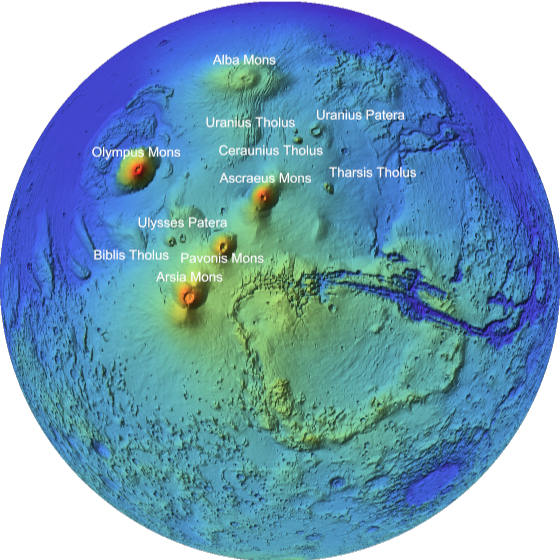
Here is a Map of the Tharsis region of Mars showing many of the known volcanic features in the area.
In[]:=
volcanoes=Text"Olympus Mons",,{0,-2},Text"Alba Mons",,{0,-2},Text"Uranius Patera",,{-1,-2},Text"Uranius Tholus",,{1,-1},Text"Ceraunius Tholus",,{.5,1.5},Text"Tharsis Tholus",,{-1,-2},Text"Ascraeus Mons",,{0,-2},Text"Biblis Tholus",,{1,2},Text"Ulysses Patera",,{0,-2},Text"Pavonis Mons",,{0,2},Text"Arsia Mons",,{0,-2};
In[]:=
GeoGraphics{White,volcanoes},GeoModel->,GeoCenter->,GeoRange->All,GeoProjection->"Orthographic",GeoBackground->"ReliefMap"
Out[]=
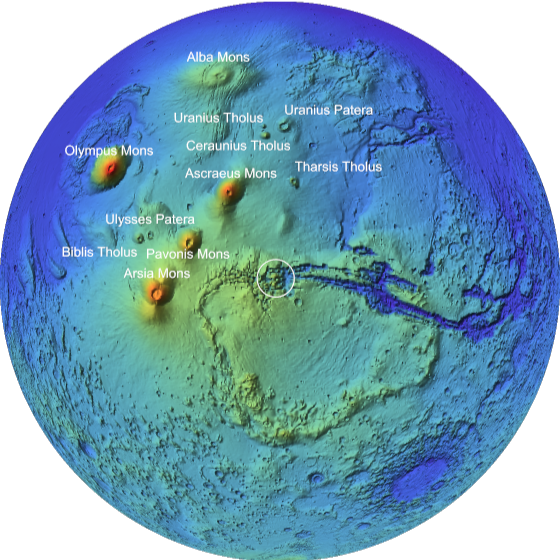
The new volcano was found right in the middle of this view, highlighted here in the white circle.
In[]:=
GeoGraphicsWhite,volcanoes,GeoCircleGeoPosition{-6.9,-94.8},,Quantity[225,"Kilometers"],GeoModel->,GeoCenter->GeoPosition{-7.5833,-93.9167},,GeoRange->All,GeoProjection->"Orthographic",GeoBackground->"ReliefMap"
Out[]=
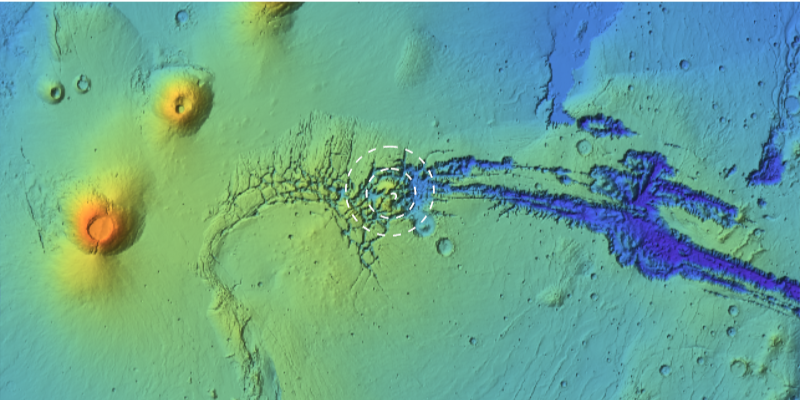
Zooming in further, several zones have been defined. The new volcano is found between the Noctis Labyrinthus “maze” of canyons and the much larger and wider canyons of the Valles Marineris canyon system.
In[]:=
circles=GeoCircleGeoPosition{-6.9,-94.8},,Quantity[225,"Kilometers"],GeoCircleGeoPosition{-7.1,-94.7},,Quantity[125,"Kilometers"],GeoCircleGeoPosition{-7.35,-94.5},,Quantity[15,"Kilometers"];
In[]:=
GeoGraphics{White,Dashing[.01],Thickness[.002],circles},GeoModel->,GeoCenter->GeoPosition{-7.5833,-93.9167},,GeoRange->Quantity[1000,"Kilometers"],ImageSize->{600,300},GeoBackground->"ReliefMap"
Out[]=
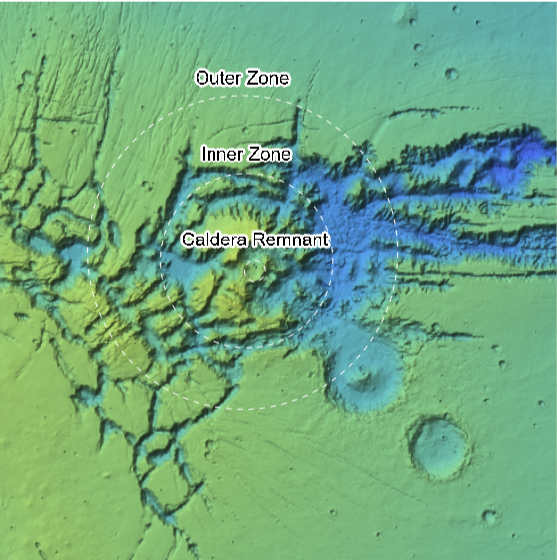
Zooming in even further, the newly identified zones can be examined in further detail. At the center, the remnants of a volcanic caldera can be seen.
In[]:=
GeoGraphicsWhite,Dashing[.01],Thickness[.002],circles,Haloing[],TextStyle["Caldera Remnant",Black,14],GeoPosition{-7.35,-94.5},,{0,-3},TextStyle["Inner Zone",Black,14],GeoPosition{-7.8,-94.7},,{0,-13},TextStyle["Outer Zone",Black,14],GeoPosition{-8.5,-94.8},,{0,-23},GeoModel->,GeoCenter->GeoPosition{-7.5833,-93.9167},,GeoRange->Quantity[400,"Kilometers"],GeoBackground->"ReliefMap"
Out[]=
Though the relief map is interesting to view, its resolution is limited. If we want to zoom in further, we need to use satellite imagery. The following map zooms into the caldera remnant and the inner zone.
In[]:=
GeoGraphicsWhite,Dashing[.01],Thickness[.002],circles,Haloing[Black],TextStyle["Caldera Remnant",14],GeoPosition{-7.35,-94.5},,{0,-7},TextStyle["Inner Zone",14],GeoPosition{-7.1,-95.7},,{-9,-10},TextStyle["Relict Glacier",14],GeoPosition{-7.1,-95.7},,{-7,10},GeoModel->,GeoCenter->GeoPosition{-7.5833,-93.9167},,GeoRange->Quantity[100,"Kilometers"]
Out[]=
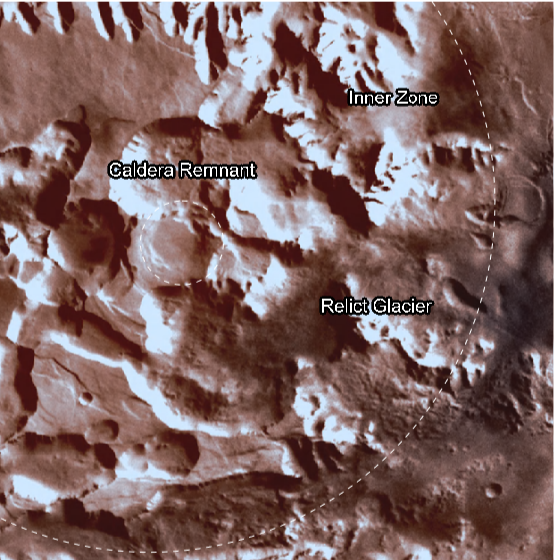
Examination of the area in 2023 revealed the likely presence of a relict buried glacier, including evidence of pyroclastic flows and evidence of rootless volcanic cones which form when explosive venting results from lava flowing over ice. Sulfate salts have also been observed on the surface. These details are not possible to see in this imagery, but high resolution Mars Reconnaissance Orbiter images showed them. The following image comes from the 2023 announcement of the buried glaciers before the discovery of the eroded volcano.
Here is an annotated version the of the “relict glacier” area.
CITE THIS NOTEBOOK
CITE THIS NOTEBOOK
New volcano on Mars hidden in plain sight
by Jeffrey Bryant
Wolfram Community, STAFF PICKS, March 18, 2024
https://community.wolfram.com/groups/-/m/t/3142811
by Jeffrey Bryant
Wolfram Community, STAFF PICKS, March 18, 2024
https://community.wolfram.com/groups/-/m/t/3142811