Is there a canonical Hamiltonian formalism for hypergraph rewriting? This question led us to the search for canonical Lie brackets and their generalizations. It turned out that gluing of two hypergraphs at a common sub-hypergraph generates various brackets on the vector space spanned by hypergraphs. We get Lie brackets if the common sub-hypergraph is a single vertex or a single n-edge. Each of these induces a Poisson bracket on the space of functions on hypergraphs. We can compute, for example, the Poisson bracket of the number of vertices and the number of edges. We elaborate on the idea that these brackets descend from a commutator bracket on the ruliad of rewriting rules. We propose graded versions. We propose some natural simultaneous gluings of multiple hypergraphs that may lead to higher arity algebras. Finally, we elaborate on what structural information can be read off from the multiway system .
Motivation from Hamiltonian formalism
Motivation from Hamiltonian formalism
Hamiltonian formalism consists of an algebra of observables equipped with a Poisson bracket . The Leibniz identity allows the interpretation of as an infinitesimal generator (of a transformation of an underlying space). The Lie algebra relations Antisymmetry: Jacobi identity: allow Lie integration of subalgebras of observables (to, e.g., symmetry groups). In classical mechanics, is the algebra of functions on the phase space and is the canonical Poisson bracket. The bracket is uniquely specified by the requirement that the phase space transformation induced by canonical momenta in certain direction is the linear translation of spatial coordinates in the same direction.

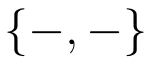

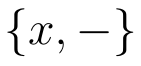


Insertion Lie bracket on rooted hypergraphs
Insertion Lie bracket on rooted hypergraphs
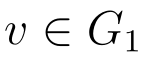
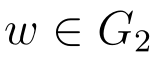
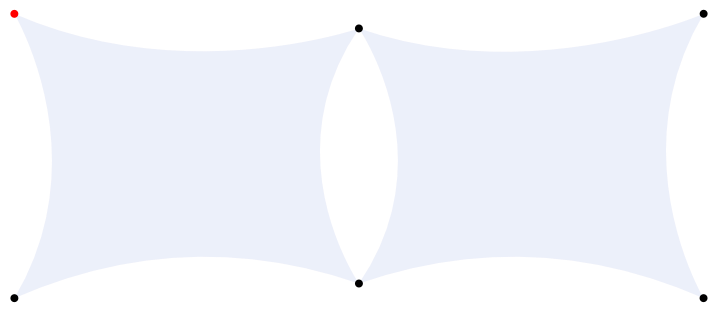
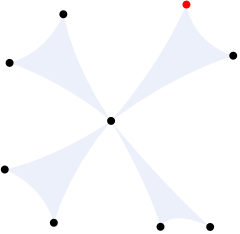
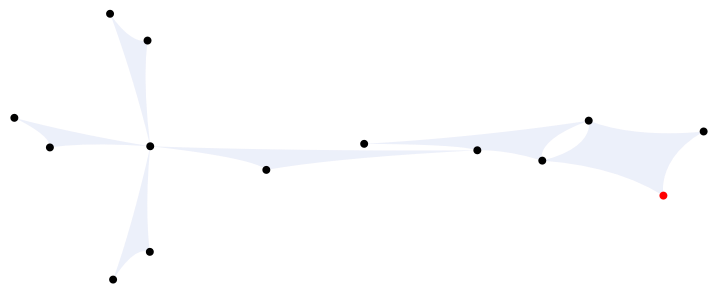
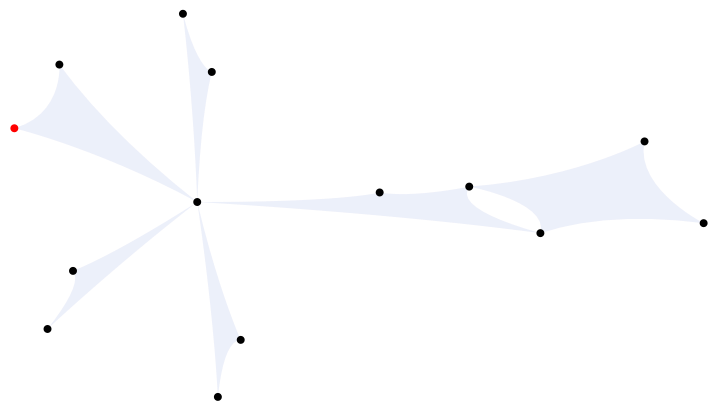
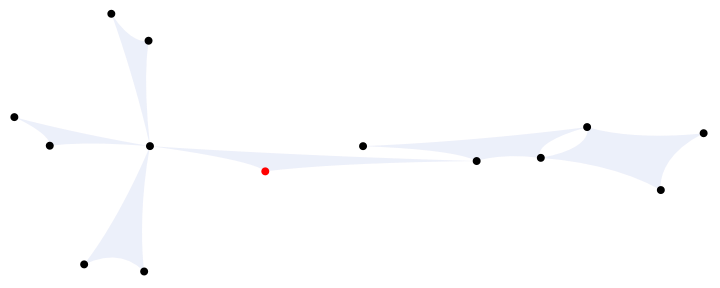
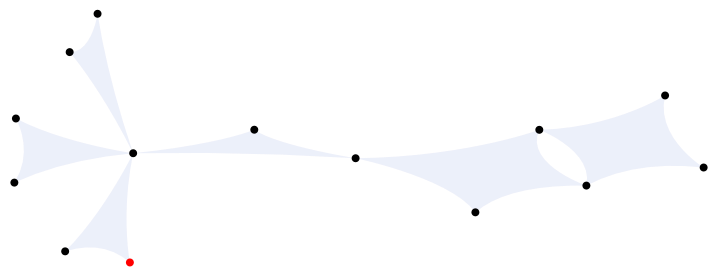
The simplest Lie bracket we consider is a straightforward generalization of the insertion Lie bracket for rooted graphs from M. Marcolli, A. Port, Graph grammars, insertion lie algebras, and quantum field theory, 2015. The insertion Lie bracket of two rooted hypergraphs and is defined as the sum of differences where in the first term is glued by its root to a vertex and in the second term is glued by its root to a vertex :
G
1
G
2




In[]:=
{g1,g2}={MarkRoot[PathHypergraph[2,2],1],MarkRoot[CorollaHypergraph[2,4],2]}RootedLieBracket[g1,g2]
Out[]=
,
Out[]=
1,
1,
1,
-1,
-1,
-1
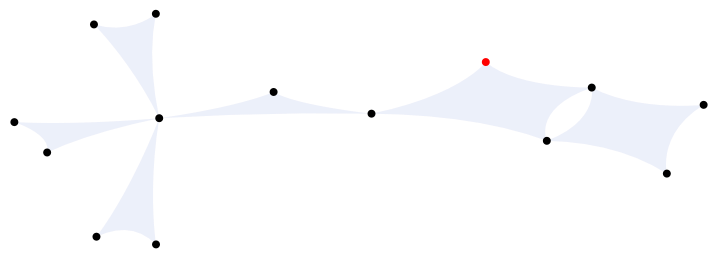
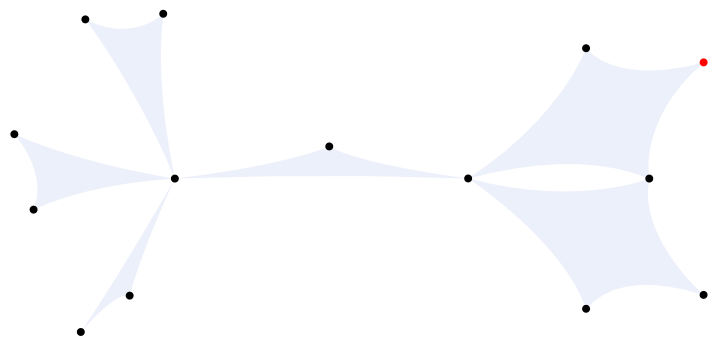
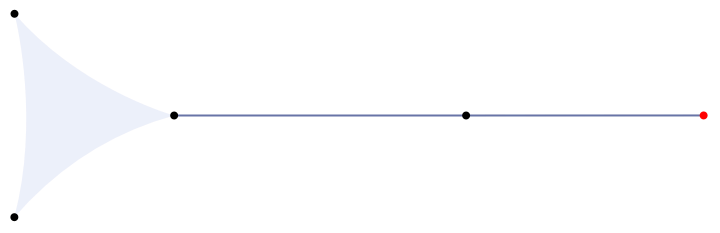
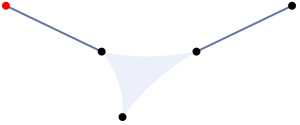
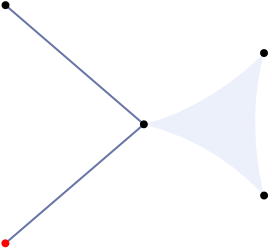
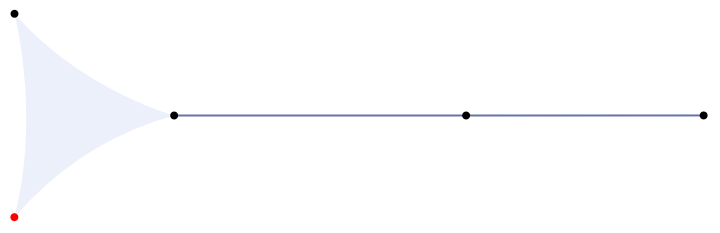
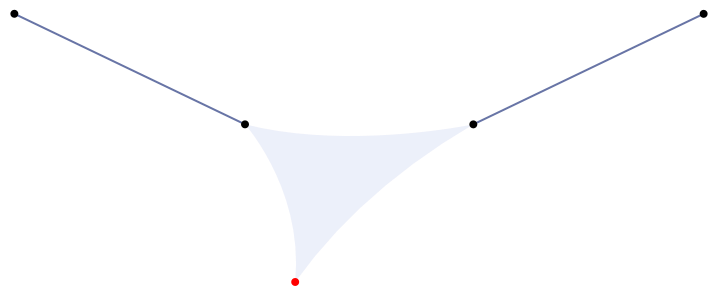
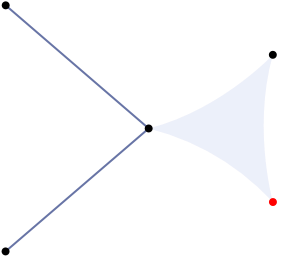
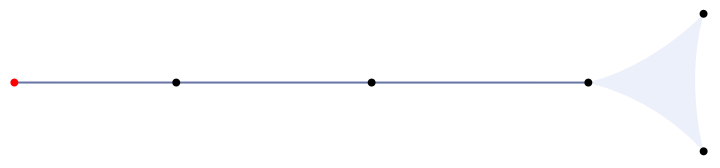
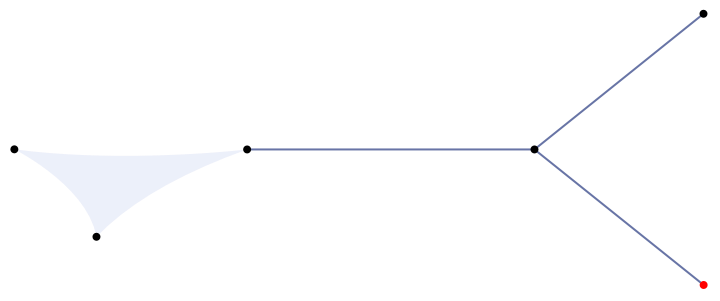
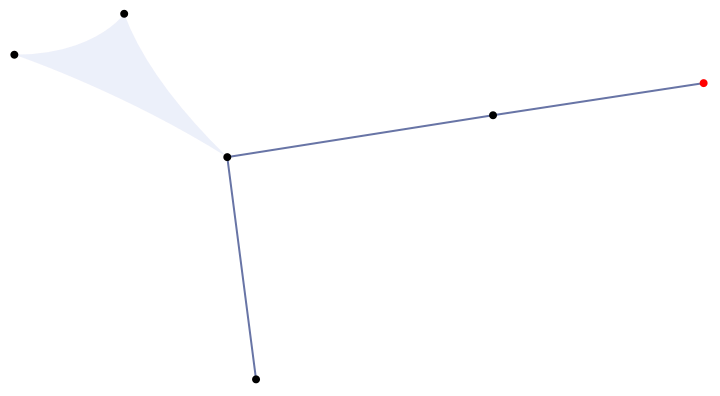
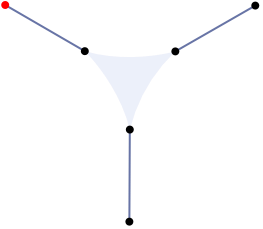
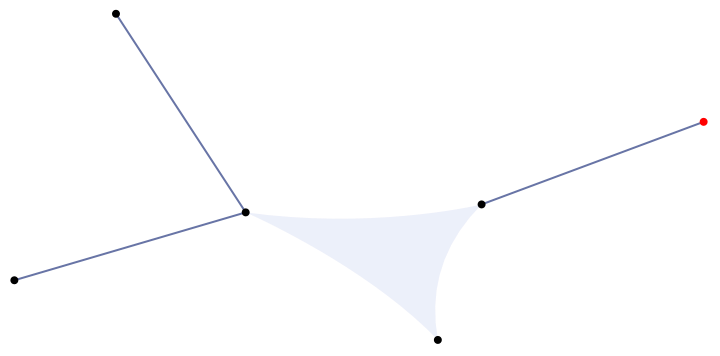
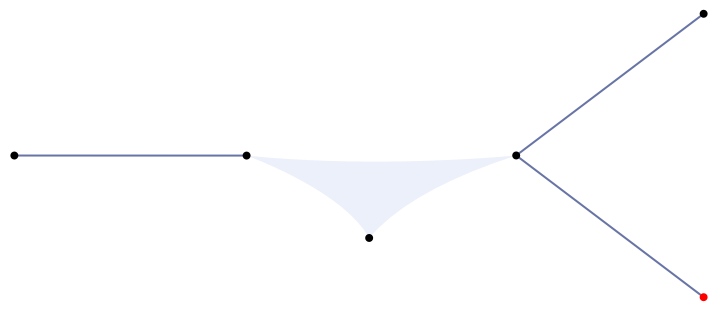
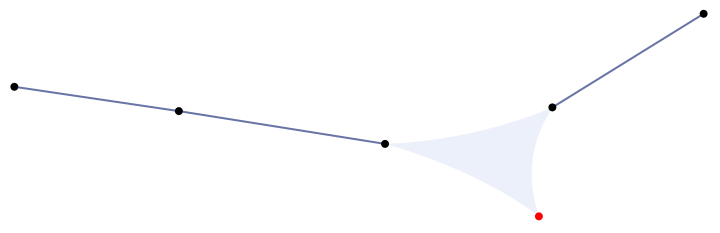
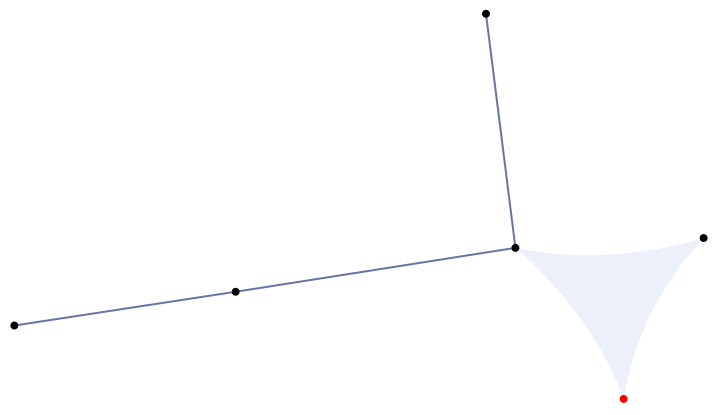
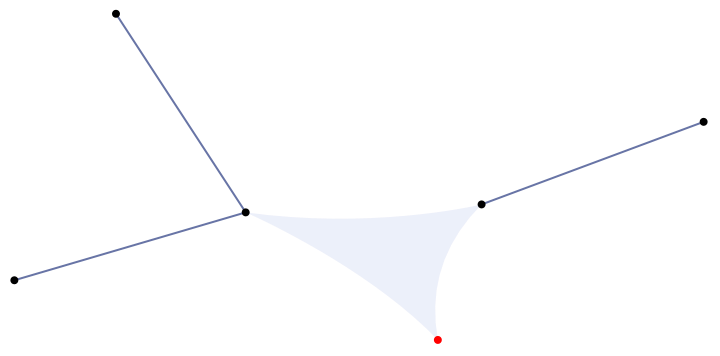
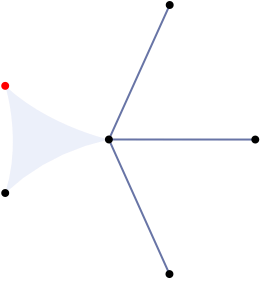
The evolution of along the transformation induced by can be approximated by the Campbell identity:
y
x

In[]:=
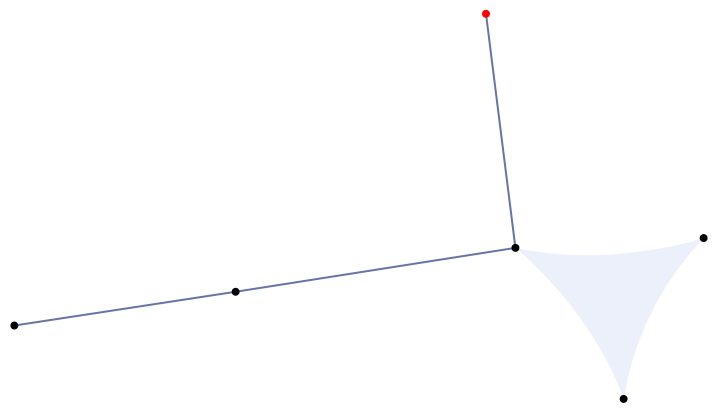
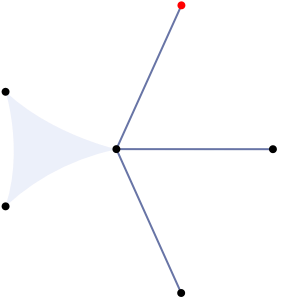
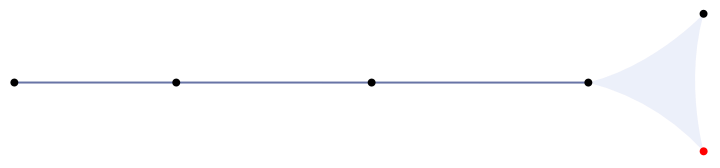
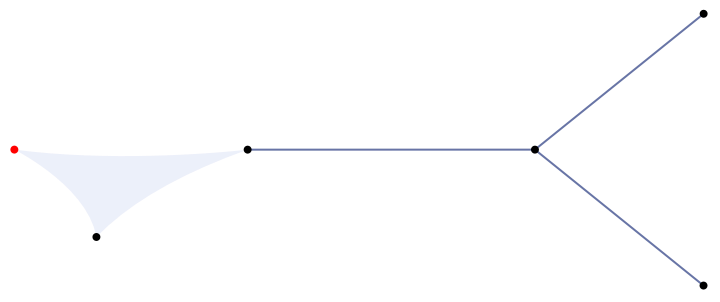
{g1,g2}={MarkRoot[CorollaHypergraph[1,1],1],MarkRoot[SimplexHypergraph[2,{3}],1]}CampbellIdentity[RootedLieBracket,<|g1->t|>,g2,3]
Out[]=
,

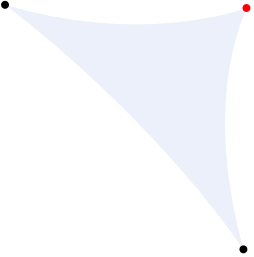
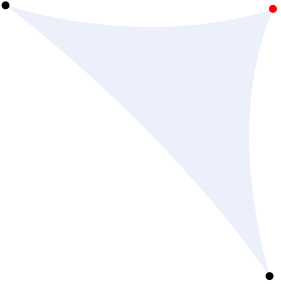
Out[]=
,,,,,,,,,,,,,,,,,,,,,
1,
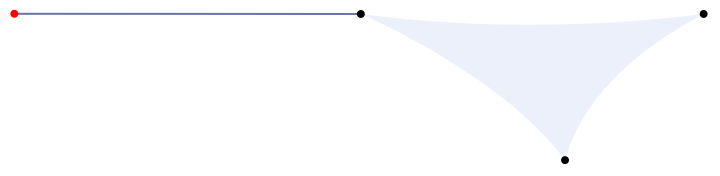
t,
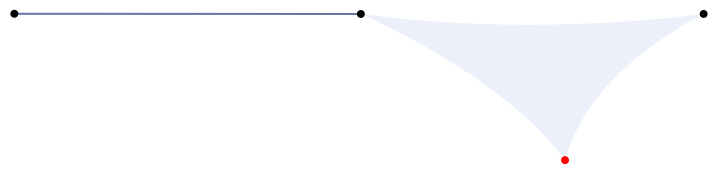
-t,
2
t
2
-
2
t
-
2
t
2
2
t
2
2
t
2
2
t
2
3
t
6
-
3
t
6
-

3
t
2
-
3
t
3

3
t
2
3
t
2
3
t
2
3
t
2
3
t
6
3
t
6
-
3
t
6
-
3
t
6
-
3
t
3
-
3
t
3
-
3
t
3
-
3
t
6
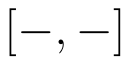
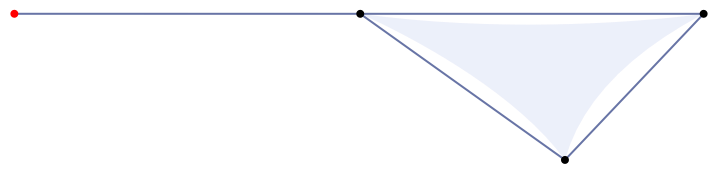
The insertion bracket extends bi-linearly to the vector space spanned by isomorphism classes of rooted hypergraphs which we denote by . Coefficients in a linear combination can be interpreted as values of a function on so that can be seen as a Lie bracket on functions on : It is well-defined even for non-finitary functions, like the number of vertices or the number of -edges , since a hypergraph can become disconnected by removing one vertex in only finitely many ways:




n

In[]:=
g=RootedHypergraph[1,{{1,2},{2,3},{3,4},{4,2},{2,3,4}}]RootedPoissonBracket[Vf,Ef[2]][g]
Out[]=
Out[]=
3
If we interpret functions on as linear functions on , then non-linear functions on can be understood as formal Taylor series whose monomials are symmetric products of linear functions. A Lie bracket on linear functions always extends to a Poisson bracket on non-linear functions:

Insertion Lie bracket on hypergraphs with tagged n-edge
Insertion Lie bracket on hypergraphs with tagged n-edge
Graded version
Graded version
Commutator bracket on ruliad
Commutator bracket on ruliad
Higher arity brackets
Higher arity brackets
Higher arity relations
Higher arity relations
Structure on multiway system
Structure on multiway system
Acknowledgments
Acknowledgments
Huge thanks to Carlos Zapata-Carratalá for setting the direction of the project, many discussions, and great enthusiasm. Huge thanks to Nik Murzin for pair programming, answering many technical questions, and helping visualizations until the last moment. Huge thanks to Xerxes Arsiwalla for sharing his insights and discussing topics from a higher perspective. All three were great inspiration for me. Huge thanks to all the staff of the Wolfram Winter School for the seamless organization, and huge thanks to Stephen Wolfram for supporting it. I loved the lectures and sessions and found the projects of the Wolfram Institute fascinating!
Further directions
Further directions
◼
Construct the graded versions.
◼
Can we have co-products and co-brackets by dissecting hypergraphs?
◼
Does it make sense to classify the Lie algebras constructed above and compute some of their invariants?
◼
Can any of this structure be used to make statements about dynamics of rewriting rules?
◼
Can any of the Lie brackets be uniquely characterized by a dynamical property similar to the case of classical mechanics?
Code backbone
Code backbone
CITE THIS NOTEBOOK
CITE THIS NOTEBOOK
Lie brackets on hypergraphs
by Pavel Hajek
Wolfram Community, STAFF PICKS, January 16, 2025
https://community.wolfram.com/groups/-/m/t/3358052
by Pavel Hajek
Wolfram Community, STAFF PICKS, January 16, 2025
https://community.wolfram.com/groups/-/m/t/3358052