ABSTRACT (original article): A unibike curve is a track that can be made by either a bicycle or a unicycle. More precisely, the end of a unit tangent vector at any point on a unibike curve lies on the curve (so the bike’s front wheel always lies on the track made by the rear wheel). David Finn found such a curve in 2002, but it loops around itself in an extremely complicated way with many twists and self-intersections. Starting with the polar square root curve and iterating a simple construction involving a differential equation apparently leads in the limit to a unibike curve having a spiral shape. The iteration gets each curve as a rear track of its predecessor. Solving hundreds of differential equations numerically, where each depends on the preceding one, leads to error buildup, but with some care one can get a curve having unibike error less than 10^-7. The evidence is strong for the conjecture that the limit of the iteration exists and is a unibike curve. CITATION (original article): Stan Wagon (2025), A Spiral Bicycle Track that Can Be Traced by a Unicycle, arXiv:2503.11847. https://doi.org/10.48550/arXiv.2503.11847
r=
t/(2π)
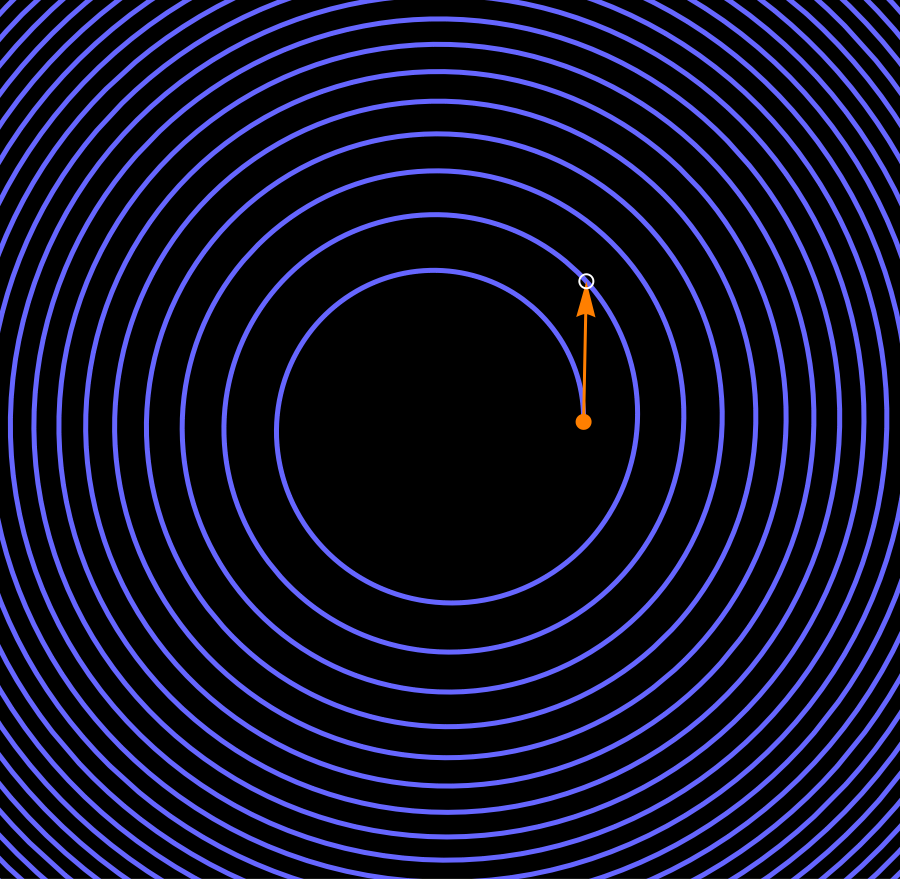
A spiral curve that can be traced by both wheels of a bicycle, with error less than 1 part in ten million.
Introduction
Introduction
An intriguing open question in the world of bicycle mathematics is whether there is a spiral track that a bicycle can follow. That is, we want both wheels of the bike to follow the same track. A curve that can be traced by both wheels of a bicycle is called a unibike track, as it can be traced by either a unicycle or a bicycle (we exclude a straight line). Here I will describe an iterative procedure that appears to generate a spiral unibike track in the limit. The image above shows the 128th step of the process along with the motion of a bike: both wheels stay on the curve, at least to our eyes. In fact, the front point is not exactly on the curve: the error is less than 1 part in 14,000,000.
Basic properties of bicycle tracks are at [4]. That post discusses how the tangent line to the rear track generates the front track and how one can get a rear track from a front track. All bikes in this discussion have unit length between the two points where the wheels touch the ground.
In 2002 David Finn [2] found a unibike track (Fig. 1; an animation is at [4]). His construction is clever, but the resulting track is excessively complicated and impossible to follow by a real bike. Consequently, many have wondered if the problem admits a spiral solution. A spiral is a polar curve with monotonically increasing radius.
r(θ)
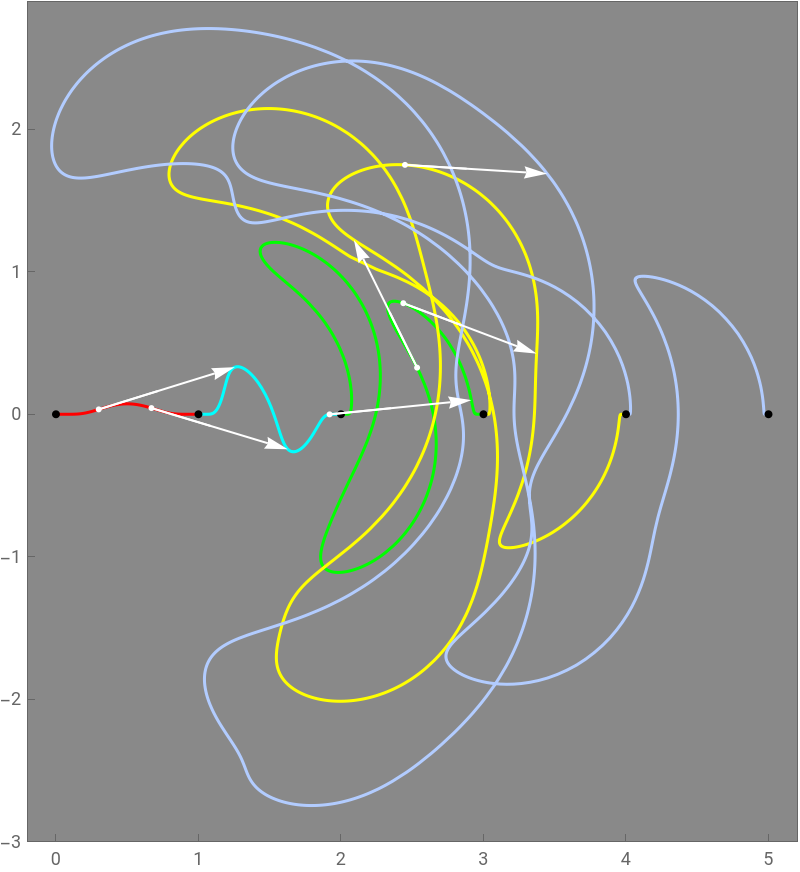
Figure 1. David Finn’s unibike curve, with white arrows showing some bicycle positions.
I have found a relatively simple method that appears to give a perfect spiral unibike curve. Proof is lacking but the evidence is very strong. My preprint is at [5].
The Polar Square Root
The Polar Square Root
The starting point is the polar square root spiral (known as a Fermat spiral), which here we take as (t)=(cost,sint) (Fig. 2). Figure 3 shows how the front track for almost coincides with . Figure 3 shows and how close it comes to being a unibike track.
F
1
t
2π
F
1
F
1
F
1
In[]:=
PolarPlot,{t,2π,20π},Frame->True,PlotStyle->Blue
t
2π
Out[]=
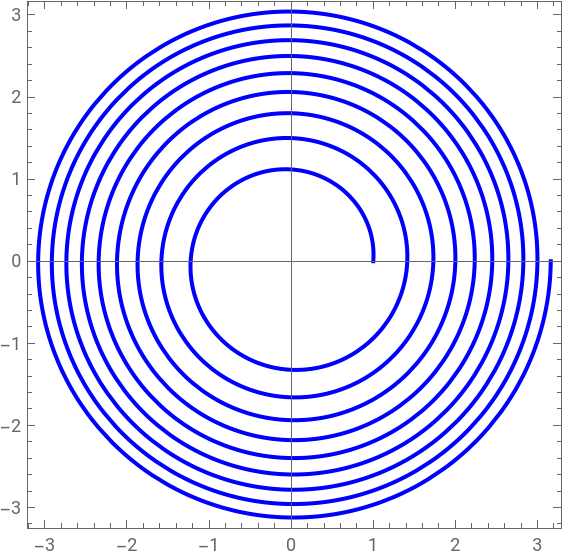
Figure 2. The polar square root (t).
F
1
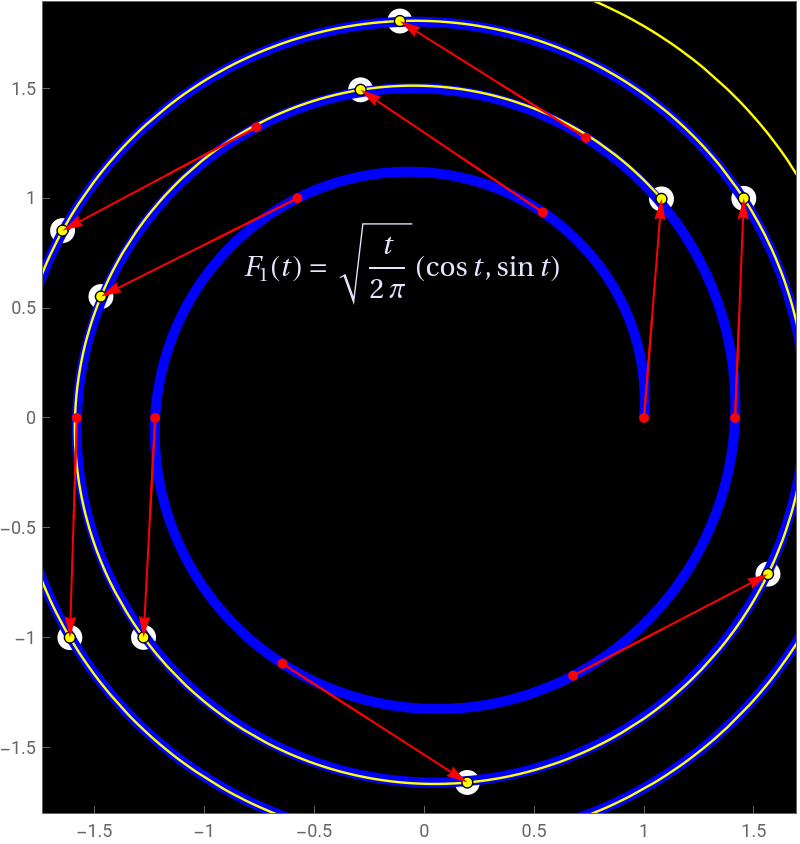
Figure 3. The polar square root (t) is shown in blue ; the corresponding front track in yellow comes tantalizingly close to matching the rear.
F
1
An inappropriate use of this spiral is as follows. Look at the curve over for large . This will indeed have vanishingly small unibike error as gets large. But this process will not have a limit as , so it cannot lead to a perfect unibike curve. Similarly, one can consider ; the error approaches 0 as , but there is no limiting curve. So these approaches are useless.
[n,∞)
n
n
n->∞
r=
1/n
θ
n->∞
The basic idea of a method that works is simple: Start with . Get , the corresponding rear track obtained by solving a differential equation, let be the same from , and continue this iteration. Full details and many variants and extensions are discussed at [5]. The motivation for this idea is the observation that going to a front track seems to make the unibike error larger. So one hopes that the front-to-rear transformation would make the error smaller. The figure at the top of this post shows . The evidence is overwhelming that this iterative process converges and that the limit is a spiral unibike track.
F
1
F
2
F
3
F
2
F
256
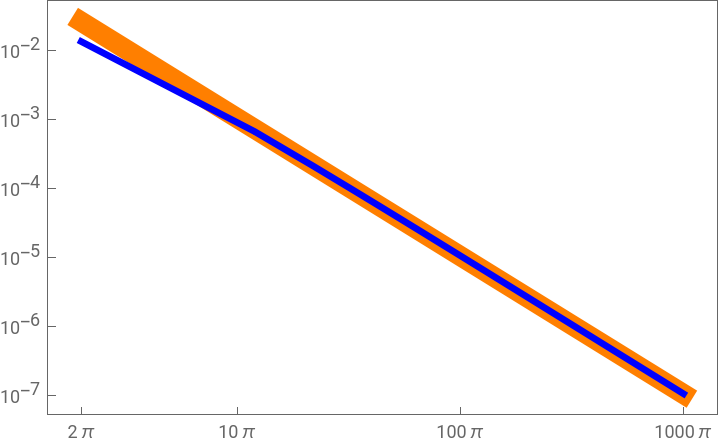
For a near-unibike track, we need a way to quantify the error. The unibike error of at is the minimum distance from , the front point corresponding to , to the curve . At the closest point on the rear track, the derivative vector () is perpendicular to the line joining ) and . So can be used on the appropriate vanishing dot product to quickly locate the closest point. High precision is useful. The unibike error for is shown in log-log form in Figure 4. That plot illustrates a theorem from [5]: the unibike error for is asymptotic to .
G(t)
t=
t
0
H()
t
0
G()
t
0
G(t)
G()
t
1
′
G
t
1
G(
t
1
H()
t
0
FindRoot
F
1
F(t)
π
3
-2
t
The Rear Track
The Rear Track
Towards a Perfect Unibike Track
Towards a Perfect Unibike Track
Conclusion
Conclusion
References
References
CITE THIS NOTEBOOK
CITE THIS NOTEBOOK
A spiral bicycle track that can be made by a unicycle
by Stan Wagon
Wolfram Community, STAFF PICKS, May 14, 2025
https://community.wolfram.com/groups/-/m/t/3461376
by Stan Wagon
Wolfram Community, STAFF PICKS, May 14, 2025
https://community.wolfram.com/groups/-/m/t/3461376