“If you wish to make an apple pie from scratch, you must first invent the universe.” -Carl Sagan
Entanglement entropy is a central concept in quantum information theory. It represents the extent to which pieces of a quantum system are entangled with each other, as measured by the von Neumann entropy of the reduced density matrix. An alternative measure of entanglement which is a kind of average over all partitions is due to work by Cocchiarella et al (2020), and is an example of an entanglement monotone, meaning that it scales with the entanglement in the system. This entanglement measure is substantially easier to compute than the entanglement entropy. In this work we show how this entanglement monotone can be computed to measure entanglement of quantum states represented as graphs in the Wolfram model. This is implemented by developing a correspondence between quantum states and graphs inspired by work by S. Wolfram and J. Gorard.
Entanglement in the Wolfram model
Entanglement in the Wolfram model
Introduction
Introduction
The Wolfram model is capable of recapitulating features of quantum theory, as outlined in work by S. Wolfram and J. Gorard. One aspect of the Wolfram model that has been studied comparatively less is how entanglement entropy can be understood from within this network based framework. The entanglement entropy represents a crucial tool in quantum information science. It quantifies the degree of entanglement present in (for instance) quantum many-body and field theoretic systems. The nature of entanglement entropy, namely how it scales with the system size (by volume or area for instance), is a hallmark of quantum effects. In this work, we walk towards an understanding of how entanglement manifests within the Wolfram model. In particular, we define subgraphs of the full states graph which can be associated with factors of a global Hilbert space. Then we appeal to prior work to associate quantum states to time slices of the causal multiway graph, which allow us to compute various measures of entanglement in the system.
Summary of Results
Summary of Results
We find that our method of partitioning the states hypergraph via “particle measures” can be used to construct Hilbert space factors, from which quantum states can be defined. Then, traditional measures of entanglement (entanglement entropy or entanglement monotones such as the one suggested in Cocchiarella et al (2020)) can be used to compute entanglement in the graph. We note that phase information introduced via rewrite rules contributes to the entanglement structure and therefore plays a significant role in the entanglement measure.
The choice of the particle measure update rule, in addition to the graph rewrite rule, together determine the effective evolution of particle states in this model. For some update rule choices, particle states may become sparsely distributed across the network over time, akin to dispersion. Lastly, we comment on how incorporating phase information with rewrite rules allows us to assign phase information to vertices in the causal hypergraph, which is analogous to a U(1) Gauge symmetry in QED.
The choice of the particle measure update rule, in addition to the graph rewrite rule, together determine the effective evolution of particle states in this model. For some update rule choices, particle states may become sparsely distributed across the network over time, akin to dispersion. Lastly, we comment on how incorporating phase information with rewrite rules allows us to assign phase information to vertices in the causal hypergraph, which is analogous to a U(1) Gauge symmetry in QED.
How is entanglement measured in traditional quantum theory?
How is entanglement measured in traditional quantum theory?
Entanglement Entropy
Entanglement Entropy
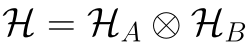
Quantum states are vectors in a Hilbert space (we’ll consider pure states for now), which is usually built from the tensor product of smaller Hilbert spaces,
Out[]=

representing degrees of freedom of subsystems, like particles. Thus, a generic state can be written as
Out[]=
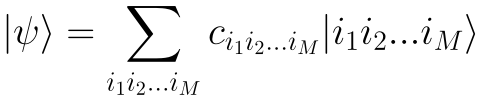
where ∈{1,2,...,} with giving the dimension of the -th factor, and where the coefficients ... are the complex-valued amplitudes. The set of states forms a basis for the full Hilbert space. A state is said to be entangled if it cannot be represented as a product state over the factors, i.e.
i
μ
d
μ
d
μ
μ
c
i
1
i
2
i
M
{|...〉...
i
1
i
2
i
M
}
i
1
i
2
i
M
|ψ〉
Out[]=

for some states in the -th Hilbert space factor. In other words, the state is necessarily some superposition of product states, it cannot be separated (for any basis choice).
How do we measure the extent of entanglement? The most common method is through a bipartite entanglement measure called the entanglement entropy. The idea is to divide the Hilbert space into two factors, and ask how strong are the correlations between the factors. This can be done for all bipartite partitions of the Hilbert space and the results can be averaged to get a global sense for the entanglement in the state. For a given partition, the entanglement entropy can be computed by performing a singular value decomposition of the coefficients tensor,
|〉
ψ
k
k
How do we measure the extent of entanglement? The most common method is through a bipartite entanglement measure called the entanglement entropy. The idea is to divide the Hilbert space into two factors, and ask how strong are the correlations between the factors. This can be done for all bipartite partitions of the Hilbert space and the results can be averaged to get a global sense for the entanglement in the state. For a given partition, the entanglement entropy can be computed by performing a singular value decomposition of the coefficients tensor,
Out[]=
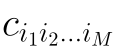
treating this tensor as a matrix in which the indices ... are grouped into two super-indices (blocks of indices). For instance, one can split the indices in half like this: (,...,) and (,...,), for even (although any bi-partition is suitable; it need not be consecutive as in this example). That is, one writes
i
1
i
2
i
N
i
1
i
1
i
M/2
i
2
i
M/2+1
i
M
M
Out[]=

and the non-zero diagonal entries in the rectangular matrix , also called Schmidt coefficients (real-valued), can be used to compute
D
{}
σ
a
a
Out[]=
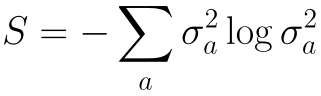
which is also called the von Neumann entropy. It can be shown that 1 for a normalized state. If it happened that were a product state for the partition chosen, the only Schmidt coefficient would be 1 and the von Neumann entropy would vanish. Mathematically, the idea behind the singular value decomposition (or Schmidt decomposition) is to the find a basis for each factor in the bi-partition so that the state can be represented as,
∑
a
2
σ
a
|ψ〉
|ψ〉
σ
a
Out[]=
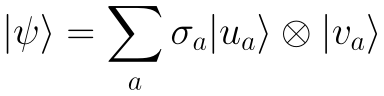
which can be viewed as an effort to disentangle the factors as much as possible. More entropy (entanglement) arises when there are more Schmidt coefficients, and when the coefficients
λ
a
Out[]=
with dimensions and respectively, then the number of Schmidt coefficients is less than or equal to,
d
A
d
B
Out[]=

so that if one splits the Hilbert space with many degrees of freedom on either side of the partition ( and are large) the entanglement entropy has the potential to be large (up to in fact). Conversely, if one divides the space between a small corner of the Hilbert space and everything else, so that one of the two dimensions is small (e.g. 2 for a single spin-1/2 particle) then the entanglement entropy can be comparatively lower.
d
A
d
B
logd
d
A
Entanglement monotones
Entanglement monotones
There are other measures of entanglement that do not involve a singular value decomposition, but which nevertheless scale monotonically with the entanglement injected into the state (entanglement monotones are defined as entanglement measures for which the application of local unitaries cannot increase the measure). One such entanglement monotone has been suggested in Cocchiarella et al (2020), in which one computes the total variance over a space of observables over each factor in the Hilbert space. The idea is that if the global state is entangled, this variance is larger than it would be in the case of a product state. This entanglement measure attains its largest value for maximally entangled states, and is shifted so that it vanishes for product states. More precisely, for a given state one computes a total variance for the generators of the algebra , for each factor of the Hilbert space (for each , is a matrix). Think of as Pauli matrices (observables) and their generalizations. The total variance for a given factor can be written as,
|s〉
T
μk
k
su()
d
μ
μ
k∈1,2,...,-1
2
d
μ
T
μk
d
μ
d
μ
T
μk
μ
Out[]=
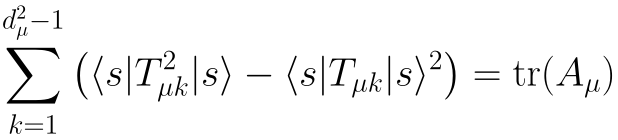
where the covariance matrix is given by,
A
μ
Out[]=

Then, the entanglement measure is defined as,
Out[]=
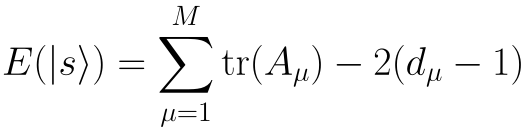
for which it can be shown that , achieving the lower bound when the part of factors out of the state. Thus and vanishes when fully factorizes.
tr()≥2(-1)
A
μ
d
μ
μ
|s〉
E(|s〉)≥0
|s〉
How might one define entanglement in the Wolfram model?
How might one define entanglement in the Wolfram model?
Classical “particles”
Classical “particles”
In order to apply the ideas of entanglement from traditional quantum theory to the Wolfram model, we see that we will need to understand what corresponds to factors in the Hilbert space. Traditionally, these factors are divided between particle states so that a generic state is a superposition of particle states. However, it is not yet fully clear how to define particle states in the Wolfram model. The general suspicion seems to be that particles can be regarded as persistent topological structures in the network, maintaining their structure (if not approximately) as the rewrite rules update the network over time. We will imagine that a certain subset of nodes in the network model (at any given moment) can be associated with a particle (shown in red below).
Out[]=
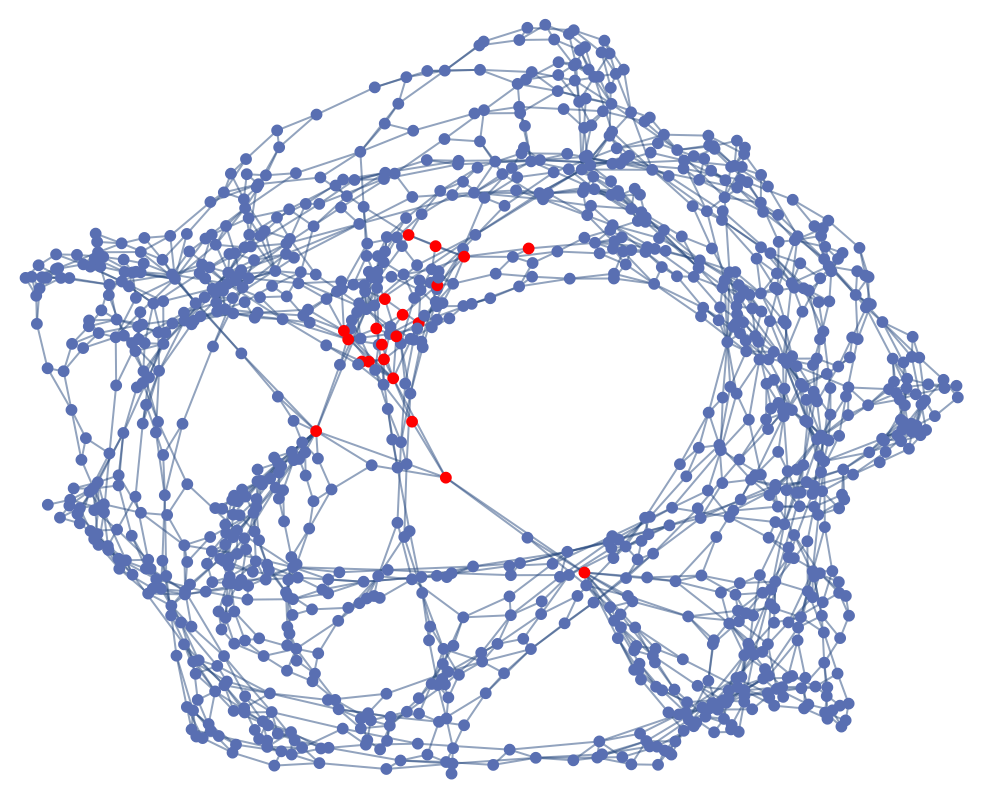
This subset (a classification of the nodes) represents an external structure imposed on the network by us, but which may nevertheless be a natural choice given a network’s course of evolution. As an example, think of assigning nodes based on whether they participate in vortices. More generally, one could imagine placing some kind of measure on the nodes so that a softer boundary between ‘particle’ and ‘not-particle’ can be achieved, possibly a Gaussian of some kind.
Furthermore, one imagines that the specification of which nodes participate in the particle-ness should evolve in time as well, so that as some nodes become more relevant in the participation, and others less so, the specification can be updated accordingly. In the figure below, the red nodes may evolve to the magenta nodes after some number of time steps, depending on the measures chosen.
Out[]=
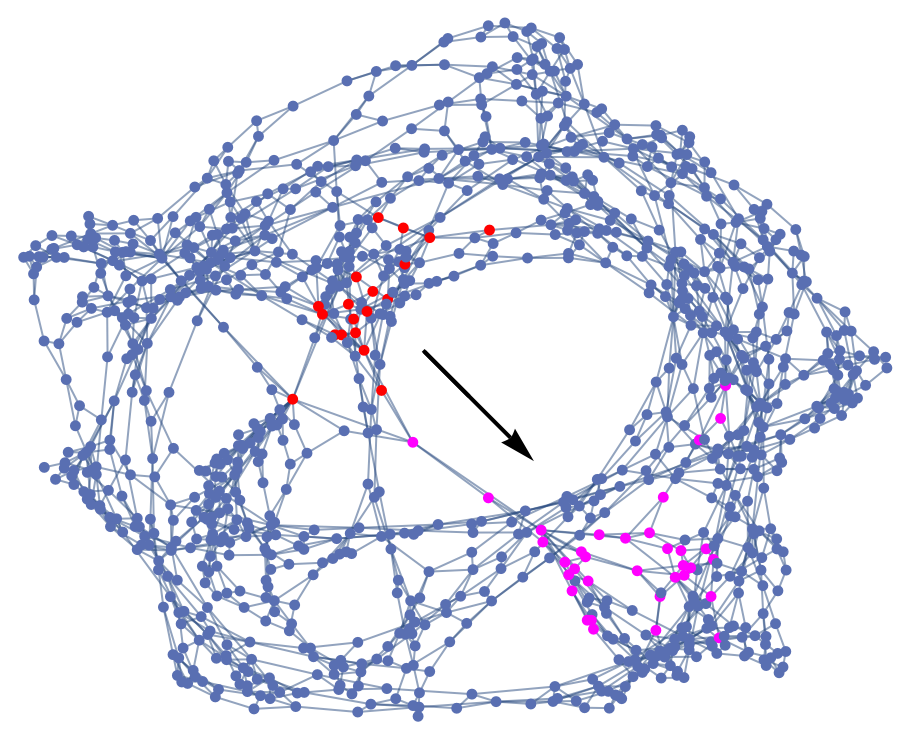
So far this has all been classical; no multiway graphs. We define a (classical) particle to be a real-valued measure over the nodes in the network at time ,
χ(t)(t),...,(t)
χ
1
χ
N
t
N
t
t
Out[]=

where,
where,
Out[]=
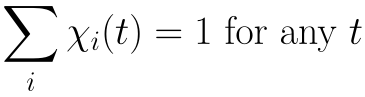
and if multiple particles need be defined we will use (t),(t), etc. Using this definition, we can partition the space of nodes at any time based on the values of the particle measures. Namely, we can assign a node to a partition factor (for ranging over the particle number say), based on the argmax of the particle measures. That is, node can be said to live in a (classical) factor at time iff,
(1)
χ
(2)
χ
i
μ
μ
M
i
μμ(i)∈{1,...,M}
t
Out[]=

Quantum "particles"
Quantum "particles"
Network states as vectors in a Hilbert space
Network states as vectors in a Hilbert space
We now have presented all ingredients necessary to compute entanglement in the Wolfram model. These steps are flexible and ultimately depend on two choices: (1) that of how to partition states via particle measures, and (2) how to assign phases to rewrite rules. Considering the space of these choices is a subject for future work.
Concluding Remarks
Concluding Remarks
We found that phase information introduced at the level of the graph rewrite rules determines the entanglement structure for a given particle measure. In this work, ad hoc particle measures and rewrite phases were introduced to demonstrate a pipeline to compute entanglement. Thus, future work should explore more natural choices for the phases introduced. In principle, these phases should be able to capture phase information introduced by unitary transformation (or by generic quantum channels more broadly). Additionally, a persistent challenge in the Wolfram model has been in carefully defining “particle” states. In this work, we consider particle measures as a mathematical method to define particle states, but we do not provide any justification, other than giving heuristics, for how to define measures more generally. Such a measure would consider the topological structure of the graph (possibly) in some region, and assign measure accordingly. The goal of that extension would be able to model particle dynamics in the limit of large graphs.
Additional work should consider the connection of quantum states in the Wolfram model to tensor networks, which also serve as models for quantum states, are are particularly suited to model the entanglement structure of the state. Tensor networks corresponding to a given quantum state may be able to be embedded into the Wolfram model as an alternative formulation of quantum states.
Additional work should consider the connection of quantum states in the Wolfram model to tensor networks, which also serve as models for quantum states, are are particularly suited to model the entanglement structure of the state. Tensor networks corresponding to a given quantum state may be able to be embedded into the Wolfram model as an alternative formulation of quantum states.
Loading MaTeX
Loading MaTeX
Acknowledgments
Acknowledgments
I would like to thank Sydney Needle for her enduring love and undying patience. Big thanks to Gary Louw and Floe Foxon for just being there. Thank you Xerxes Ariswalla for several thoughtful discussions and for steering me towards the light. Thank you Stephanie Bowyer for your tremendous flexibility, and thank you Stephen Wolfram for your engaging conversations throughout this project.
References
References
1
.J. Gorard & J. Dannemann-Freitag (2023), “Axiomatic Quantum Field Theory in Discrete Spacetime via Multiway Causal Structure: The Case of Entanglement Entropies”, arXiv:2301.12455v1. https://arxiv.org/abs/2301.12455
2
.D. Cocchiarella et al (2020), “Entanglement distance for arbitrary M-qudit hybrid systems”, Phys. Rev. A, vol. 101, iss. 4. https://link.aps.org/doi/10.1103/PhysRevA.101.042129.
3
.J. Gorard (2020), “Some Quantum Mechanical Properties of the Wolfram Model”, Complex Systems, vol. 29, iss. 2. https://www.complex-systems.com/abstracts/v29_i02_a02/.
4
.J. Gorard (2020), “A Short Note on The Double-Slit Experiment and Other Quantum Interference Effects in the Wolfram Model”, Wolfram Physics Project Bulletin. https://tinyurl.com/32depv3j.
Cite This Notebook
Cite This Notebook
Entanglement in the Wolfram model
by Miles Miller-Dickson
Wolfram Community, July 9, 2025
https://community.wolfram.com/groups/-/m/t/3497811
by Miles Miller-Dickson
Wolfram Community, July 9, 2025
https://community.wolfram.com/groups/-/m/t/3497811