At any given time, the Sun planets and sometimes the Moon are all found approximately along the ecliptic. This imaginary line in the sky represents the orbital plane of the solar system as viewed from Earth. Although these objects can always be found on or near this line, they may be scattered on opposite sides of the sky. On the morning of June 4, 2024, most of the planets and the Moon will be gathered in one particular area of the sky about 25 minutes before sunrise. Saturn and Jupiter are the outermost objects in this gathering, separated by about 73°.
In[]:=
loc=GeoPosition[{40.11,-88.22}];
In[]:=
date=Sunrise[loc,DateObject[{2024,6,4}]]-Quantity[25,"Minutes"];
In[]:=
frame={"Horizon",date,loc};
In[]:=
AstroAngularSeparation,,date
Out[]=
We can visualize the whole sky on that morning.
In[]:=
AstroGraphics[AstroReferenceFrame->frame]
Out[]=
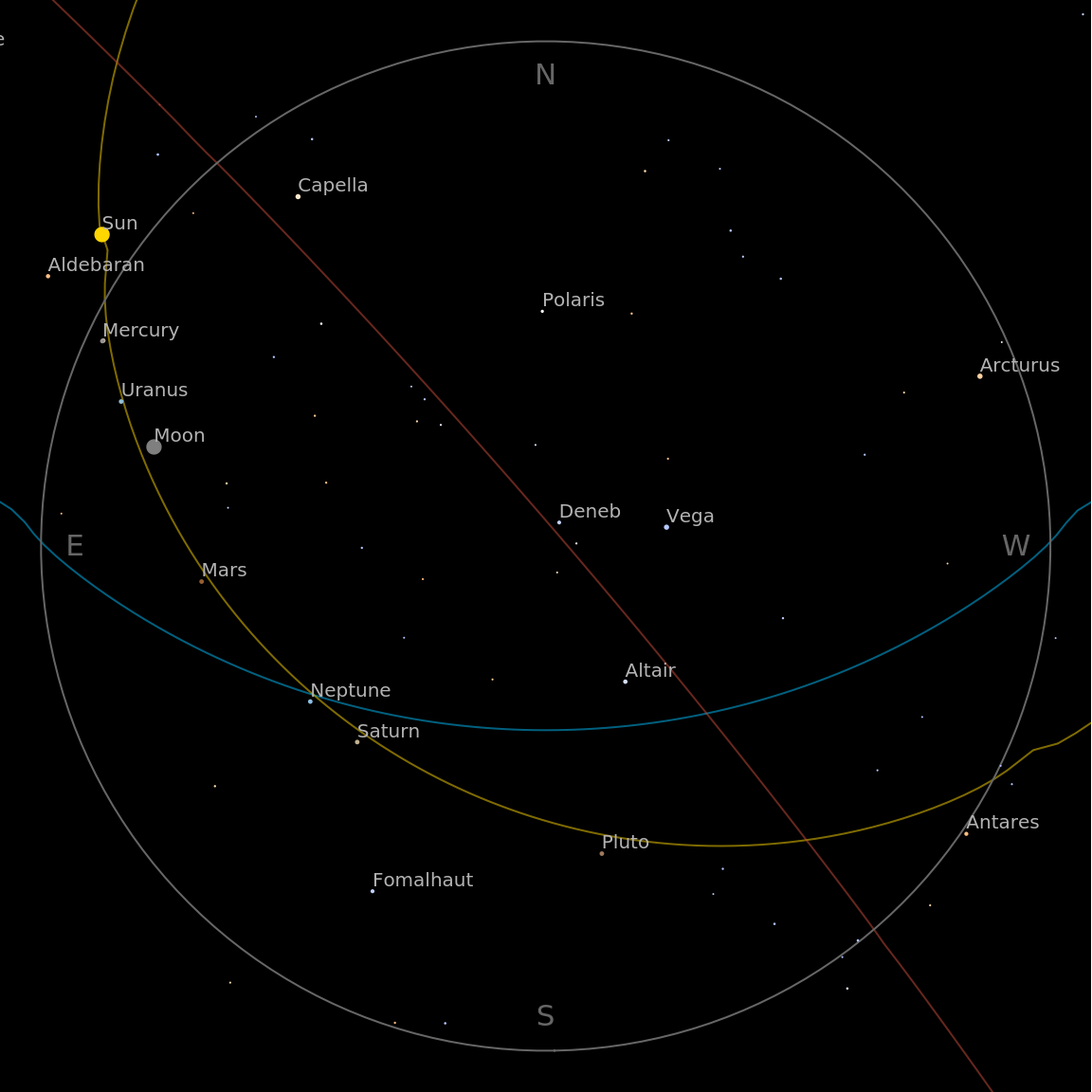
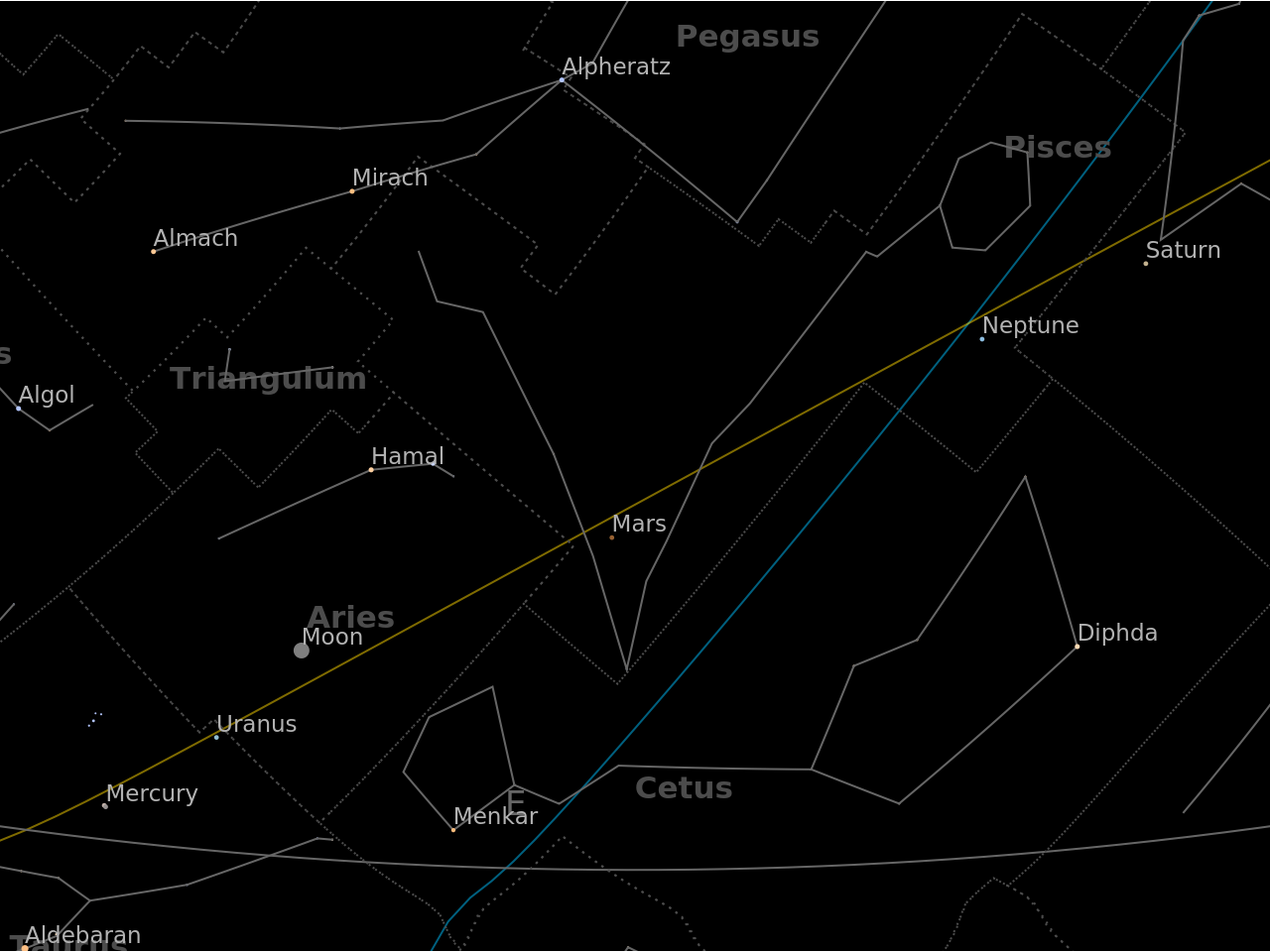
If you focus on the eastern horizon (gray curved line), centered about 30 degrees above the horizon, Mercury can be seen low on the horizon and moving up and to the right comes Uranus, the Moon, Mars, Neptune and Saturn.
In[]:=
AstroGraphics[AstroCenter->AstroPosition[{90,30},frame],AstroRange->{{60,135},{-5,50}},AstroReferenceFrame->frame]
Out[]=
In fact, a closer look at Mercury shows that Jupiter is found very close by. Through a telescope, both planets and the major moons of Jupiter can be seen right next to each other. Jupiter’s moon Europa is passing in front of Jupiter at this time.
In[]:=
AstroGraphicsAstroCenter->,AstroRange->Quantity[.2,"AngularDegrees"],AstroReferenceFrame->frame
Out[]=
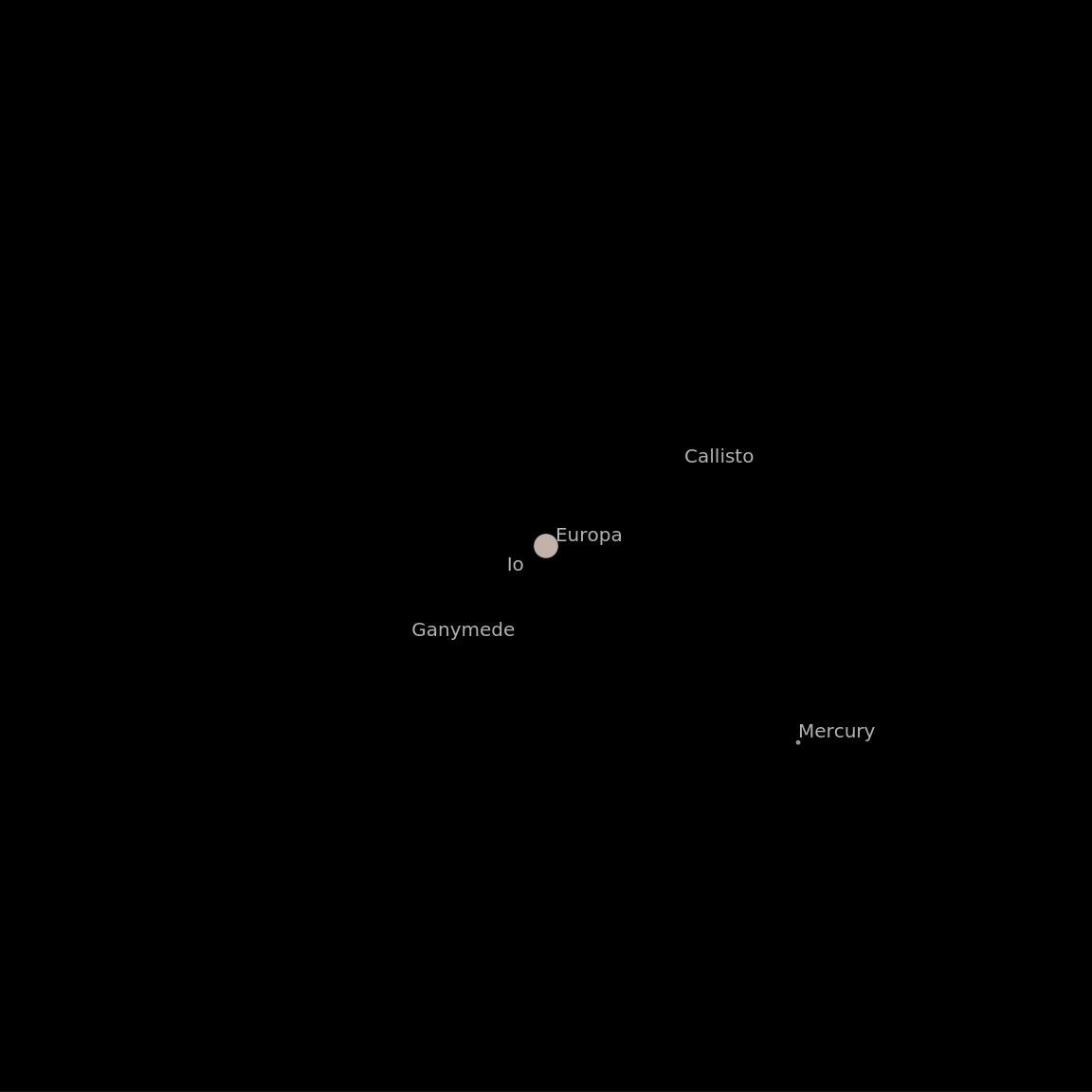
At this time, Mercury is only 1.8° above the horizon.
In[]:=
AstroPosition,frame["Altitude"]
Out[]=
1.88061
Mercury and Jupiter are only separated by about .1°.
In[]:=
AstroAngularSeparation,,date
Out[]=
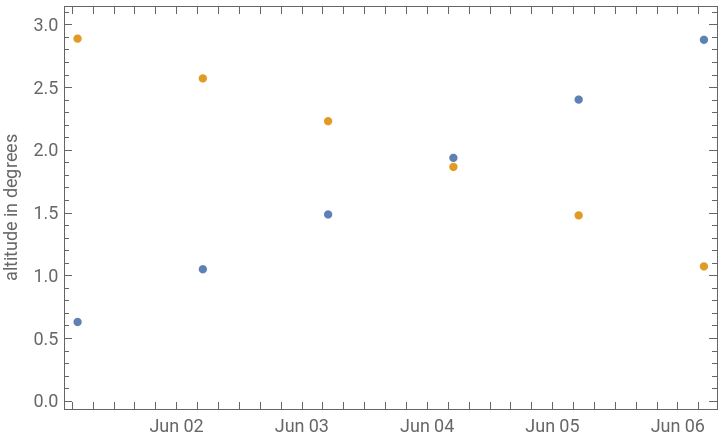
Although most of the objects can be seen for days on either side of June 4, Mercury and Jupiter are sensitive to the date. Mercury gets lower in the sky at sunrise after the 4th and Jupiter gets lower if you observe earlier than the 4th. So the date of June 4th strikes a nice balance, increasing the chance of seeing both. Though they will be very low in the sky even on this date.
In[]:=
dates=Table[Sunrise[loc,DateObject[{2024,6,d}]]-Quantity[25,"Minutes"],{d,1,6,1}];
In[]:=
DateListPlot<|"Jupiter"->#,AstroPosition,{"Horizon",#}["Altitude"]&/@dates,"Mercury"->#,AstroPosition,{"Horizon",#}["Altitude"]&/@dates|>,FrameLabel->{Automatic,"altitude in degrees"},Joined->False
Out[]=


More more orientation, we can include some other annotations to the scene. All of these objects are found in Taurus, Aries, Pisces, and Aquarius.
In[]:=
AstroGraphicsGrayLevel[0.7],TextStyle["Jupiter",FontSize->Scaled[0.018]],,{0,1},AstroRange->{{60,135},{-5,50}},AstroReferenceFrame->frame,AstroProjection->"Stereographic",AstroGridLines->Quantity[10,"AngularDegrees"],AstroBackground->AstroStyling[{"BlackSky","ShowConstellations"->{Entity["Constellation","Taurus"],Entity["Constellation","Aries"],Entity["Constellation","Pisces"],Entity["Constellation","Aquarius"]},"ShowConstellationIllustrations"->True,"ConstellationBoundaryStyle"->Directive[Dashing[{0,Tiny}],Opacity[0.4,Yellow]],"ConstellationIllustrationStyle"->Directive[Opacity[.1],White,EdgeForm[Directive[Opacity[.1],Darker[Gray,.1]]]]}]
Out[]=
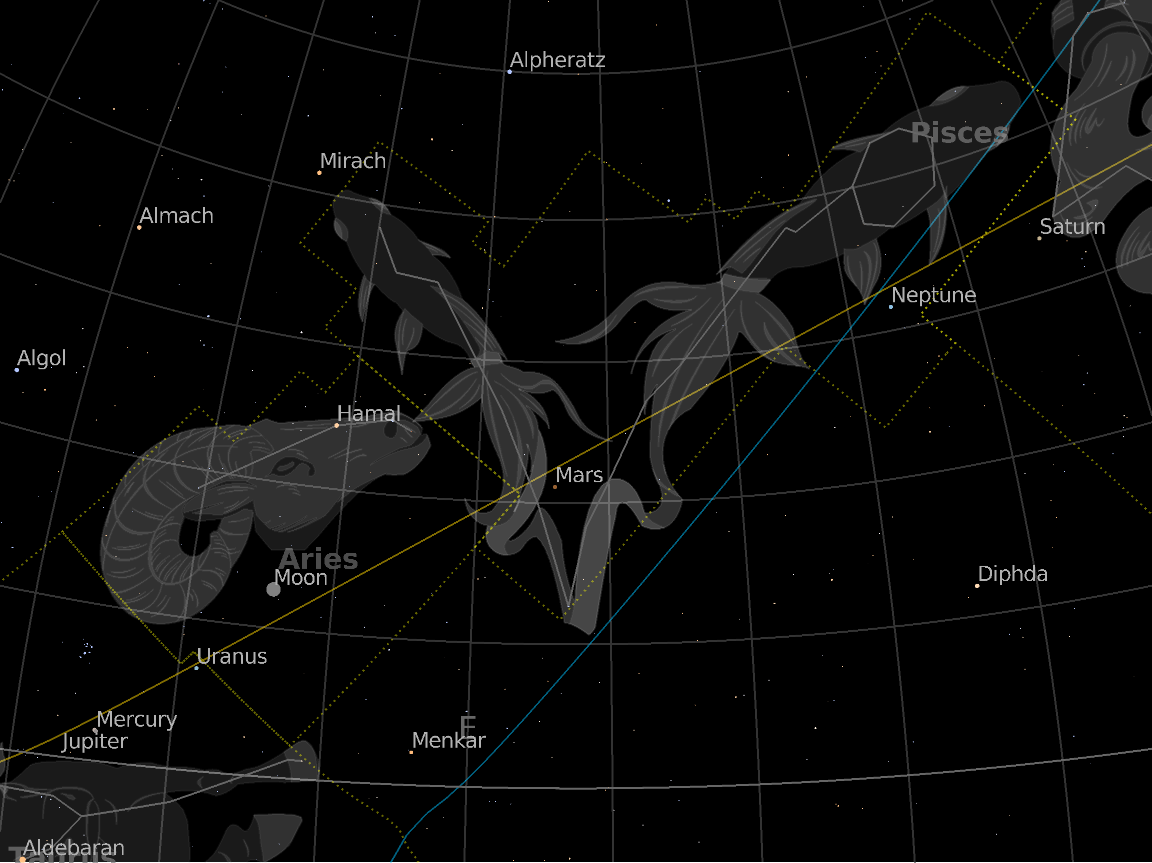
Viewed at an instance in time, as shown in the examples above, the objects look like a static gathering. But if we observe the situation over a range of times, starting at 2 AM and going until 5 AM on June 4, the objects rise one after the other in progression like a parade.
First, generate a sequence of frames.
Then generate a video from the generated frames.
Observing Note
Observing Note
Its important to recognize that of these sky objects, Uranus and Neptune will require a telescope to observe and Jupiter and Mercury will be mostly hidden in the glare of the approaching sunrise so will also require optical aid to observe. So, of all of these objects, Mars, the Moon, and Saturn will be the only objects easily seen with the naked eye.
CITE THIS NOTEBOOK
CITE THIS NOTEBOOK
Parade of planets: celestial maps for when & where to see rare planetary alignment early June 2024
by Jeffrey Bryant
Wolfram Community, STAFF PICKS, May 24, 2024
https://community.wolfram.com/groups/-/m/t/3181875
by Jeffrey Bryant
Wolfram Community, STAFF PICKS, May 24, 2024
https://community.wolfram.com/groups/-/m/t/3181875