ABSTRACT (original article): A peaking static (isothermal) microbial growth curve recorded in an isolated habitat is viewed as a manifestation of a conflict between the tendency of healthy cells to multiply by division, and the habitat’s progressive depletion of resources and deterioration which is intensified by the rising population’s density. This scenario can be described mathematically by the product of a monotonically rising growth term such as a stretched exponential (Weibull) term, representing the habitat’s uninterrupted growth potential, by a stretched exponential (Weibull) decay term, representing the fall of the cells’ survival probability and increased mortality rate. An alternative is to have the growth potential represented by the Verhulst/logistic differential rate model, and the decline by a superimposed falling log-logistic algebraic term that becomes negative as growth turns into mortality. Yet another alternative is a scaled version of a beta-distribution function-based model, which captures both the rise and fall regimes in a single algebraic expression. For dynamic (notably non-isothermal) growth, a convenient model has the basic structure of the static Verhulst/logistic rate model equation, except that its parameters are entered as functions of time. In contrast with the other model equations the Verhulst/logistic mode conversion from a static to dynamic state does not require the use of inverse functions, and hence special programming. CITATION (original article): Peleg, M., Normand, M.D. On Static, Dynamic and Stochastic Kinetic Models of Peaking Microbial Growth in a Closed or Resources-limited Habitat. Food Eng Rev 17, 532–548 (2025). https://doi.org/10.1007/s12393-025-09403-y
Wolfram Demonstration: https://demonstrations.wolfram.com/PeakedMicrobialGrowthCurvesInResourceLimitedEnvirons/
Wolfram Demonstration: https://demonstrations.wolfram.com/PeakedMicrobialGrowthCurvesInResourceLimitedEnvirons/
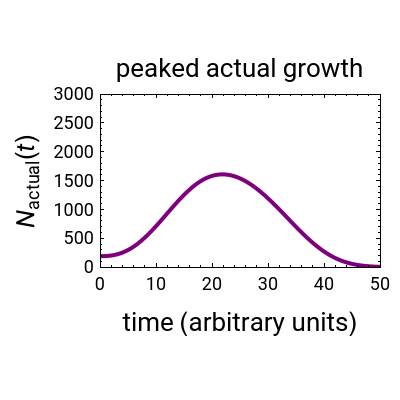
Most traditional organismic growth models, notably the Verhulst and Gompertz, describe an initially exponential rise when resources are abundant, being progressively moderated and approaching a plateau as resources become scarce. However, in an actual resource-limited habitat, high population density also intensifies competition and increases pollution, thus reaching injurious or lethal levels, which is manifested in the onset of a plummet in the population’s size. Such scenarios can be described by a model composed of a stretched exponential rise on which is superimposed a falling survival probability term described by a stretched exponential drop.
Peaked microbial simulation
Peaked microbial simulation
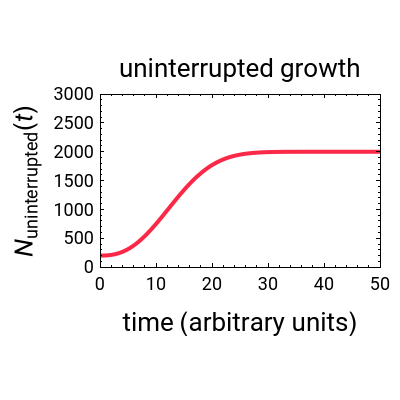
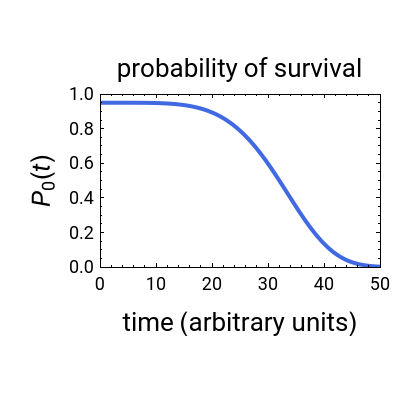
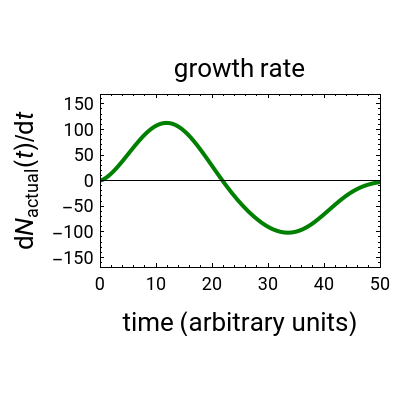
This demonstration simulates peaked microbial (and other organismic populations) in a closed habitat or an essential resource-limited medium. The underlying mathematical model is the product of two expressions: A traditional sigmoid rise term in the form of (t)=+(-)(1-Exp(-(t/)) describing initial exponential growth being progressively moderated when approaching the habitat's initial carrying capacity , where is the characteristic growth time and the shape factor, on which is superimposed a falling survival probability in the form , where is the characteristic time and the shape factor, i.e., (t)=(t)P(t). The corresponding momentary growth rate, which changes sign when net growth turns into mortality, is (t)=(t)/dt, where (t) is the momentary number as defined above.
N
uninterrupted
N
0
N
asymp
N
0
t
c1
m
1
)
N
asymp
t
c1
m
1
P(t)=Exp(-)
P
0
m
2
(t/)
t
c2
t
c2
m
2
N
actual
N
uninierrupted
r
g
dN
actual
N
actual
The screen display shows the four simultaneous plots, (t) vs. , vs. , (t) vs. , and the momentary growth rate (t) vs. , whose parameters are all set by their sliders. Also set by a slider are the plots' time axis maximum value. Clicking the setter when it's green resets all slider controls to their default initial values. Note that not all possible parameter combinations necessarily describe realistic growth scenarios.
N
interrupted
t
P(t)
t
N
actual
t
r
g
t
In[]:=
Out[]=


CITE THIS NOTEBOOK
CITE THIS NOTEBOOK
On static, dynamic and stochastic kinetic models of peaking microbial growth in a closed habitat
by Micha Peleg & Mark D. Normand
Wolfram Community, STAFF PICKS, October 14, 2025
https://community.wolfram.com/groups/-/m/t/3560438
by Micha Peleg & Mark D. Normand
Wolfram Community, STAFF PICKS, October 14, 2025
https://community.wolfram.com/groups/-/m/t/3560438