The Wolfram|Alpha math team has been hard at work on various new updates to both theoretical and applied mathematics. New functionality for both WANE and the Wolfram|Alpha website have been recently added. Included among the newest functionalities are updates to calculus, precalculus, number theory, complex analysis, abstract algebra, number representations, improved Common Core alignment, and more. Some of the newest features from the past couple of years are highlighted below:
Applications of Calculus
Applications of Calculus
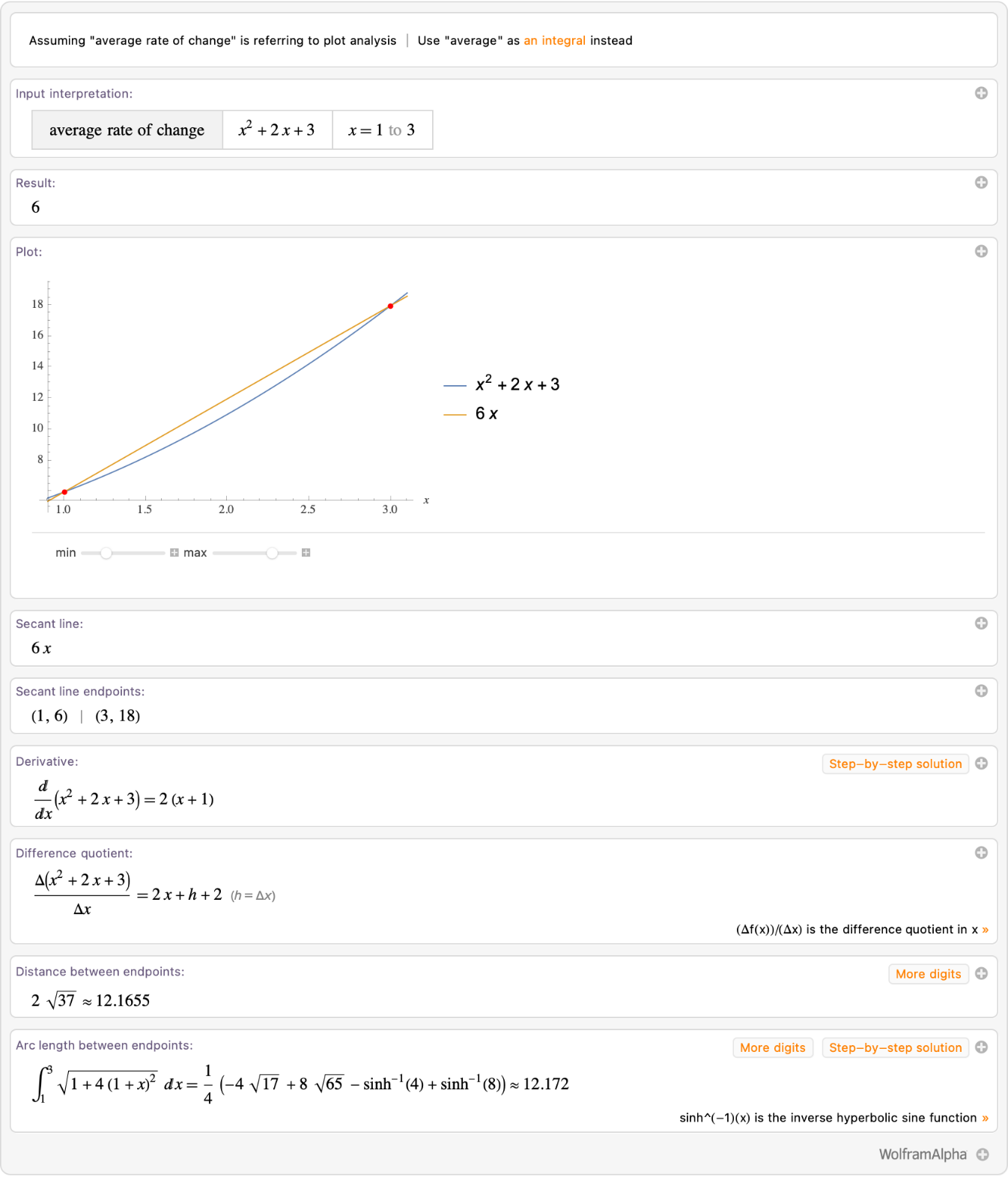
As part of precalculus and introductory calculus courses, students are expected to determine the average rate of change of a function between two points. The accompanying plot emphasizes the connection between secant lines and tangent lines: on a differentiable curve, as two points of a secant line approach each other, the secant line tends toward the tangent line.
In[]:=
average rate of change x^2 + 2x + 3 from 1 to 3
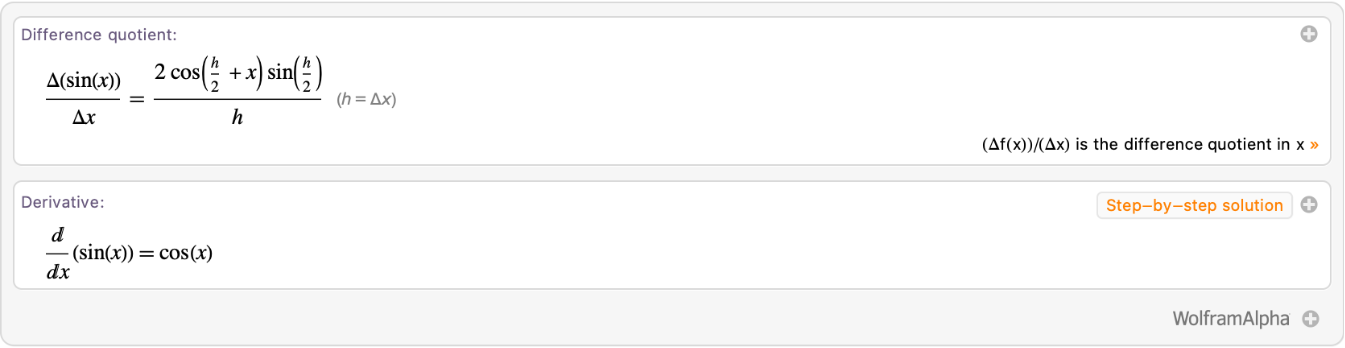
Wolfram|Alpha can also handle the difference quotient of a function. Note that the limit of the difference quotient as the change in the independent variable approaches 0 is the derivative:
In[]:=
difference quotient sin(x)
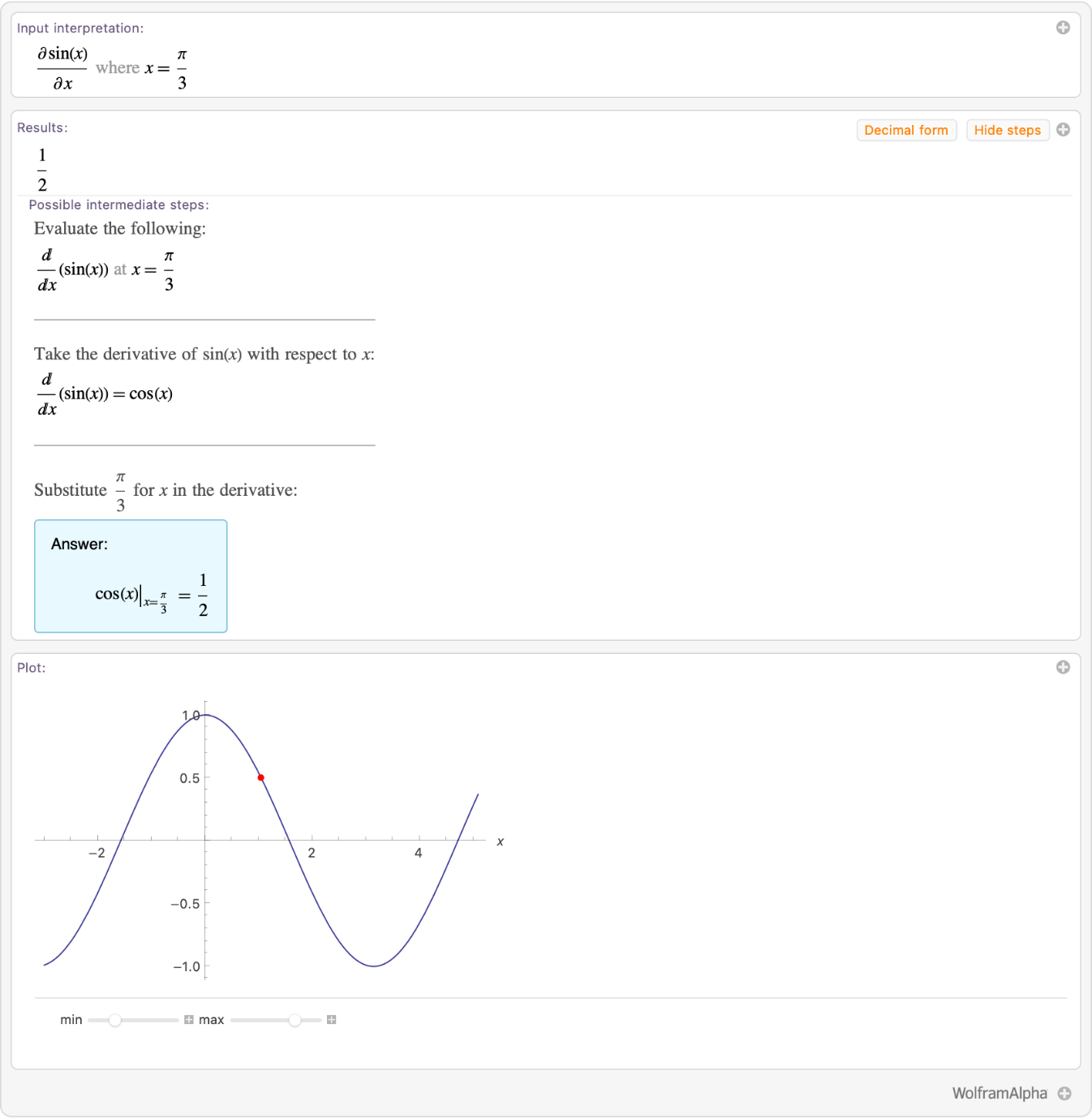
We also now have steps for computing the derivative of a function at a specified point:
In[]:=
evaluate derivative of sin(x) at x=pi/3
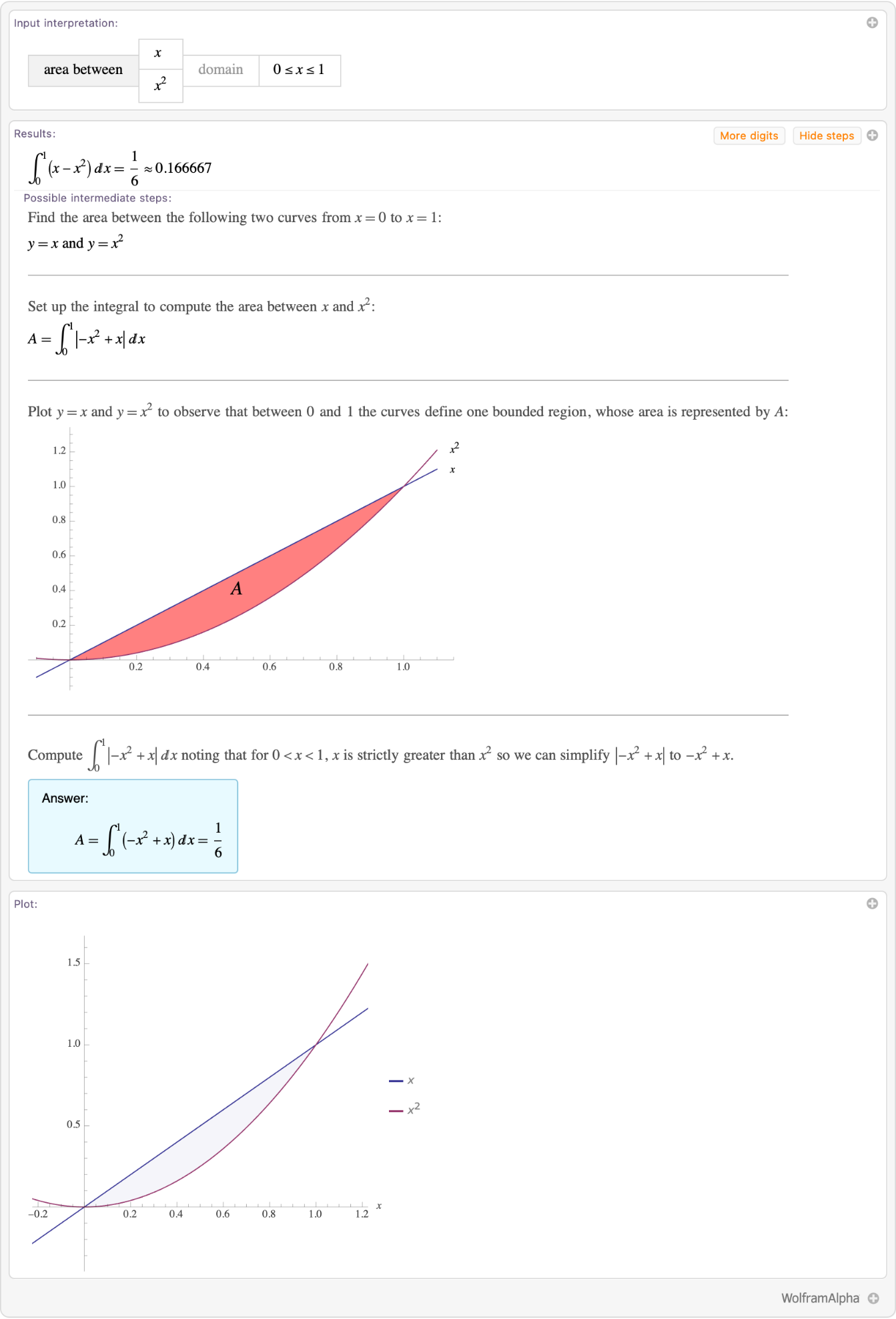
We also produce steps showing how to compute the area between two curves:
In[]:=
area between x and x^2 from 0 to 1
Vector Projections
Vector Projections
Our coverage of linear algebra-related topics continues to be expanded. We now offer results for a variety of vector projections and related queries:
In[]:=
projection of {1,2,3} onto the x-y plane
Sum convergence
Sum convergence
Convergence of summations is another key topic in the calculus sequence. Now Wolfram|Alpha provides steps for proving the convergence of a series using various convergence tests. This area is under active development and new tests for convergence continue to be added.
In[]:=
sum convergence 1/n^2
Polynomial and integer long division steps
Polynomial and integer long division steps
Recent improvements have been made to our existing step by step functionality for both polynomial long division and integer long division. Wolfram|Alpha now returns explanatory text for each step of the polynomial and integer long division algorithms in addition to the finished grid that students might be asked to display.
In[]:=
(x^2 + 4x + 5)/(x - 3) long division
In[]:=
long division 121/7
Function Transformations
Function Transformations
The results related to transformations of algebraically defined plane curves have been updated with new features recently. For instance, Wolfram|Alpha now can show reflections of curves about a given mirror curve. In the following, we see the parametric representation, reflection matrix, transformation mapping, matrix form, and a visualization of the queried reflection:
In[]:=
reflect y = x^2 about y= x
Tensors
Tensors
We also have been improving Wolfram|Alpha’s handling of tensors, including by updating input pods and by adding a calculation of the Hodge dual. Below is a preview of this functionality:
In[]:=
tensor product ({2,3},{{a,b},{c,d}},{x,y})
One can also compute the wedge product of two tensors:
In[]:=
tensor wedge {a,b,c}, {x,y,z}
The tensor dimension is also computable:
In[]:=
Tensor dimensions ({{1, 3}, {2, Pi}, {a, b}})
To compute the Hodge dual:
In[]:=
Hodge dual {a, b, c}
To compute the tensor transpose of a tensor:
In[]:=
Tensor Transpose ({{{0,0},{0,0}},{{0,0},{2 r,0}}},{1,3,2})
Complex analysis
Complex analysis
We are expanding existing results to include complex solutions in various polar forms.
For poles of complex functions, a poles and zeros plot has been added.
Alongside the new functionalities are related functions such as AbsArg (absolute value and phase angle) and ReIm (real and imaginary part of a number).
For poles of complex functions, a poles and zeros plot has been added.
Alongside the new functionalities are related functions such as AbsArg (absolute value and phase angle) and ReIm (real and imaginary part of a number).
Number theory
Number theory
New step by step solutions have been added for computing Euler phi, the sum of divisors, the divisor sigma, and the number of divisors for a given number. We also updated the steps for finding the greatest common divisor and least common multiple, including by adding hints to the steps.
Coordinate conversions
Coordinate conversions
We have added support for converting between polar and Cartesian coordinate systems, both for points and equations. This improvements includes step by step solutions for the conversions as well.
In[]:=
convert (0, 1) to polar
Signal processing
Signal processing
24 new signal processing functions were added. This functionality can also be used in WANE to build up examples and theory in signal processing courses:
In[]:=
Poisson window x
Incorporating functionality from the newest versions of the Wolfram Language
Incorporating functionality from the newest versions of the Wolfram Language
We continue to cover the newest functionality from the Wolfram Language (up to version 12) in WANE and Wolfram|Alpha. For example, list operations, AngleVector, IntegerReverse, ordering functions and various prime testing functionalities such as MersennePrimeExponentQ have been added to Wolfram|Alpha.
US Common Core Educational Standards
US Common Core Educational Standards
We are working on expanding and aligning Wolfram|Alpha’s math coverage of topics mentioned in Common Core math standards. This includes the addition of more example pages, as well as continued updates to various math results and also the ability to search for the math Common Core standards themselves:
In[]:=
common core algebra standards
In[]:=
CCSS.Math.Content.HSA-APR.A.1
Natural language processing
Natural language processing
Efforts continue to be made to expand and improve the ability of WANE to work with natural language. For instance, Bertrand’s paradox can be visualized and processed as a WANE activity:
WANE newest features
WANE newest features
Some of the more recent functionalities added to WANE include: Riemann sums, fraction pie charts, function differentiability, angles between clock hands, angles between planes, linearly independent matrices testing, normal lines, and truth tables.
Interactive plot quizzes (IPQ)
Interactive plot quizzes (IPQ)
We are excited to introduce one of our newest features to WANE: interactive plot quizzes. In 2021, many math team developers started working on tools that help students visualize and learn difficult concepts. The tools aid in the learning process by having the student actively plot and learn about the associated properties of a given function. For instance, the student learns through multiple representations of functions including verbal, visual, numerical, algebraical, and analytical. We continue to improve the interactive plot quizzes, in particular to improve speed and allow for cloud implementation. We are developing new plot quizzes for geometry and other subjects. The IPQs can be accessed through the Wolfram Function Repository and through WANE’s interactive IPQ browser. Currently, we have IPQs testing topics from algebra, geometry, precalculus and calculus.
Galois theory
Galois theory
WANE is particularly suitable for computing properties of functions that can be combined with theorems from classes such as abstract algebra. For instance, we’ve added the ability to compute Galois groups for polynomials over the reals up to and including degree 4. Using WANE, one may then analyze the result in detail to prove the result as would be demonstrated in a first course in field theory.
Algebraic computations in WANE now allow for computation of the Galois group:
To prove that the Galois group computed above is indeed the symmetric group, let’s compute this by using theorems from abstract algebra. Let’s take a look at the following example. First, note that the polynomial is irreducible:
Since the polynomial is irreducible, the order of the corresponding group is divisible by 4:
Note that the polynomial is separable since the polynomial and its derivative are coprime:
Now, compute the discriminant of the polynomial:
Note that 257 is not a square:
The resolvent cubic can be computed:
The resolvent cubic is:
Note that the resolvent cubic is irreducible:
The separable irreducible quartic with irreducible resolvent cubic must be the symmetric group on 4 elements.
Bug fixes
Bug fixes
The Wolfram|Alpha math team continues to make updates geared towards optimizing the computation of results. We are continuously working on improving mathematical computation and have fixed over 100 bugs in the last year. The fixes range from improving the formatting of results to computational optimizations to expanding handling to new cases, and more.
Outreach
Outreach
The mathematics team has contributed many talks and journal articles recently. Listed below are conference talks, courses, blog posts, community posts, and journal articles.
Wolfram Technology Conference:
Coding Competitions :
Wolfram U Courses:
Blog Posts :
Community Posts:
Summer school and camp mentors and directors:
Journal articles:
Coming soon to Wolfram|Alpha
Coming soon to Wolfram|Alpha
Expanded details have been recently implemented to clarify application of L’Hopital’s rule in our limit step by step functionality.
Step by step solutions for evaluating arithmetic functions — such as the Moebius μ, Liouville λ, and others — have recently been added.
We are working on returning function convexity and concavity for queries about whether a function is concave up or concave down.
We are working on returning step by step solutions for solving recurrence relations.
We also are improving our handling of subscripts in Wolfram|Alpha inputs.
Step by step solutions for evaluating arithmetic functions — such as the Moebius μ, Liouville λ, and others — have recently been added.
We are working on returning function convexity and concavity for queries about whether a function is concave up or concave down.
We are working on returning step by step solutions for solving recurrence relations.
We also are improving our handling of subscripts in Wolfram|Alpha inputs.
Coming soon to WANE
Coming soon to WANE
We are actively working on adding new trigonometric properties functions, root mean square computation, expansion to secant line and other line determining functionalities, expanded calculus coverage, various visualization functions, function parity determination, tape diagrams, Venn diagrams, analysis of rose curves and more.
What’s next
What’s next
As always, the Wolfram|Alpha math team is looking to improve and expand our coverage. Any thoughts, suggestions, and ideas for new functionality are encouraged and welcomed.