Under Development
A collection of classical geometry in computable formats along with code and diagrams.
Computable Euclid
›
Euclid Book 5
›
Browse books
Euclid Book 1
Euclid Book 2
Euclid Book 3
Euclid Book 4
Euclid Book 5
Euclid Book 6
Euclid Book 13
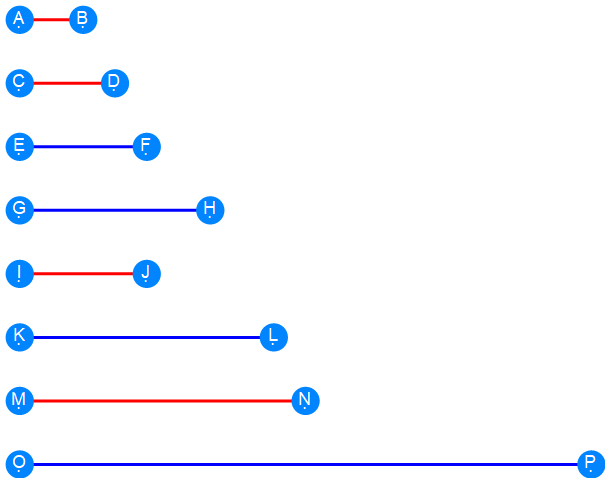
Euclid Book 5 Proposition 4
Statement
I
f
a
f
i
r
s
t
m
a
g
n
i
t
u
d
e
h
a
s
t
o
a
s
e
c
o
n
d
t
h
e
s
a
m
e
r
a
t
i
o
a
s
a
t
h
i
r
d
t
o
a
f
o
u
r
t
h
(
A
B
C
D
E
F
G
H
)
,
t
h
e
n
a
n
y
e
q
u
i
m
u
l
t
i
p
l
e
s
o
f
t
h
e
f
i
r
s
t
a
n
d
t
h
i
r
d
(
I
J
2
A
B
,
K
L
2
E
F
)
a
l
s
o
h
a
v
e
t
h
e
s
a
m
e
r
a
t
i
o
t
o
a
n
y
e
q
u
i
m
u
l
t
i
p
l
e
s
o
f
t
h
e
s
e
c
o
n
d
a
n
d
f
o
u
r
t
h
(
M
N
3
C
D
,
O
P
3
G
H
)
r
e
s
p
e
c
t
i
v
e
l
y
(
I
J
M
N
K
L
O
P
)
.
Computational Explanation
G
e
o
m
e
t
r
i
c
S
c
e
n
e
A
.
,
B
.
,
C
.
,
D
.
,
E
.
,
F
.
,
G
.
,
H
.
,
I
.
,
J
.
,
K
.
,
L
.
,
M
.
,
N
.
,
O
.
,
P
.
,
a
.
,
b
.
,
c
.
,
d
.
,
S
t
y
l
e
L
i
n
e
[
A
.
,
B
.
]
,
R
e
d
,
S
t
y
l
e
L
i
n
e
C
.
,
D
.
,
R
e
d
,
S
t
y
l
e
L
i
n
e
[
E
.
,
F
.
]
,
B
l
u
e
,
S
t
y
l
e
L
i
n
e
G
.
,
H
.
,
B
l
u
e
,
S
t
y
l
e
L
i
n
e
I
.
,
J
.
,
R
e
d
,
S
t
y
l
e
L
i
n
e
[
K
.
,
L
.
]
,
B
l
u
e
,
S
t
y
l
e
L
i
n
e
[
M
.
,
N
.
]
,
R
e
d
,
S
t
y
l
e
L
i
n
e
O
.
,
P
.
,
B
l
u
e
,
E
u
c
l
i
d
e
a
n
D
i
s
t
a
n
c
e
[
A
.
,
B
.
]
a
.
,
E
u
c
l
i
d
e
a
n
D
i
s
t
a
n
c
e
C
.
,
D
.
b
.
,
E
u
c
l
i
d
e
a
n
D
i
s
t
a
n
c
e
[
E
.
,
F
.
]
c
.
,
E
u
c
l
i
d
e
a
n
D
i
s
t
a
n
c
e
G
.
,
H
.
d
.
,
a
.
b
.
c
.
d
.
,
E
u
c
l
i
d
e
a
n
D
i
s
t
a
n
c
e
I
.
,
J
.
2
a
.
,
E
u
c
l
i
d
e
a
n
D
i
s
t
a
n
c
e
[
K
.
,
L
.
]
2
c
.
,
E
u
c
l
i
d
e
a
n
D
i
s
t
a
n
c
e
[
M
.
,
N
.
]
3
b
.
,
E
u
c
l
i
d
e
a
n
D
i
s
t
a
n
c
e
O
.
,
P
.
3
d
.
,
E
u
c
l
i
d
e
a
n
D
i
s
t
a
n
c
e
I
.
,
J
.
E
u
c
l
i
d
e
a
n
D
i
s
t
a
n
c
e
[
M
.
,
N
.
]
E
u
c
l
i
d
e
a
n
D
i
s
t
a
n
c
e
[
K
.
,
L
.
]
E
u
c
l
i
d
e
a
n
D
i
s
t
a
n
c
e
O
.
,
P
.
,
2
a
.
3
b
.
2
c
.
3
d
.
C
o
n
c
l
u
s
i
o
n
E
u
c
l
i
d
e
a
n
D
i
s
t
a
n
c
e
I
.
,
J
.
E
u
c
l
i
d
e
a
n
D
i
s
t
a
n
c
e
M
.
,
N
.
E
u
c
l
i
d
e
a
n
D
i
s
t
a
n
c
e
K
.
,
L
.
E
u
c
l
i
d
e
a
n
D
i
s
t
a
n
c
e
O
.
,
P
.
Explanations
For let a first magnitude
A
have to a second
B
the same ratio as a third
C
to a fourth
D
; and let equimultiples
E
,
F
be taken of
A
,
C
, and
G
,
H
other, chance, equimultiples of
B
,
D
; I say that, as
E
is to
G
, so is
F
to
H
.
For let equimultiples
K
,
L
be taken of
E
,
F
, and other, chance, equimultiples
M
,
N
of
G
,
H
.
Since
E
is the same multiple of
A
that
F
is of
C
, and equimultiples
K
,
L
of
E
,
F
have been taken, therefore
K
is the same multiple of
A
that
L
is of
C
.
[
V
.
3
]
For the same reason
M
is the same multiple of
B
that
N
is of
D
. And, since, as
A
is to
B
, so is
C
to
D
, and of
A
,
C
equimultiples
K
,
L
have been taken, and of
B
,
D
other, chance, equimultiples
M
,
N
, therefore, if
K
is in excess of
M
,
L
also is in excess of
N
, if it is equal, equal, and if less, less.
[
V
.
D
e
f
.
5
]
And
K
,
L
are equimultiples of
E
,
F
, and
M
,
N
other, chance, equimultiples of
G
,
H
; therefore, as
E
is to
G
, so is
F
to
H
.
[
V
.
D
e
f
.
5
]
Classes
Euclid's Elements
Theorems
Geometric Algebra
EuclidBook5