Under Development
A collection of classical geometry in computable formats along with code and diagrams.
Computable Euclid
›
Euclid Book 13
›
Browse books
Euclid Book 1
Euclid Book 2
Euclid Book 3
Euclid Book 4
Euclid Book 5
Euclid Book 6
Euclid Book 13
Euclid Book 13 Proposition 7b
Statement
Computational Explanation
Explanations
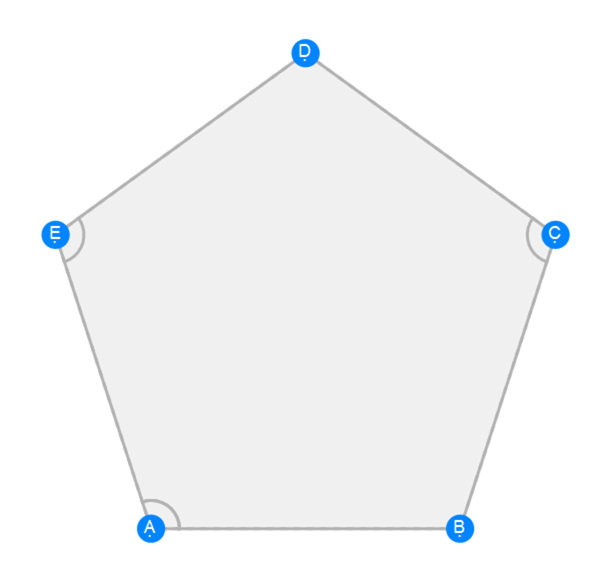
Let the given equal angles not be angles taken in order, but let the angles at the points
A
,
C
,
D
be equal; I say that in this case too the pentagon
A
B
C
D
E
is equiangular.
For let
B
D
be joined.
Then, since the two sides
B
A
,
A
E
are equal to the two sides
B
C
,
C
D
, and they contain equal angles, therefore the base
B
E
is equal to the base
B
D
, the triangle
A
B
E
is equal to the triangle
B
C
D
, and the remaining angles will be equal to the remaining angles, namely those which the equal sides subtend;
[
I
.
4
]
therefore the angle
A
E
B
is equal to the angle
C
D
B
.
But the angle
B
E
D
is also equal to the angle
B
D
E
, since the side
B
E
is also equal to the side
B
D
.
[
I
.
5
]
Therefore the whole angle
A
E
D
is equal to the whole angle
C
D
E
.
But the angle
C
D
E
is, by hypothesis, equal to the angles at
A
,
C
; therefore the angle
A
E
D
is also equal to the angles at
A
,
C
. For the same reason the angle
A
B
C
is also equal to the angles at
A
,
C
,
D
. Therefore the pentagon
A
B
C
D
E
is equiangular.
Q. E. D.
Classes
Euclid's Elements
MathWorld
Theorems
Polygons
EuclidBook13
MathWorld
RegularPentagon
Related Theorems
EuclidBook13Proposition7a
EuclidBook13Proposition8