Under Development
A collection of classical geometry in computable formats along with code and diagrams.
Computable Euclid
›
Euclid Book 13
›
Browse books
Euclid Book 1
Euclid Book 2
Euclid Book 3
Euclid Book 4
Euclid Book 5
Euclid Book 6
Euclid Book 13
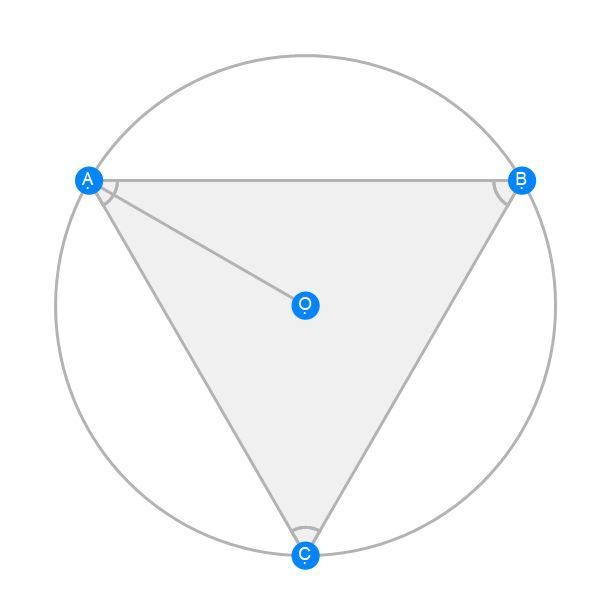
Euclid Book 13 Proposition 12
Statement
I
f
a
n
e
q
u
i
l
a
t
e
r
a
l
t
r
i
a
n
g
l
e
i
s
i
n
s
c
r
i
b
e
d
i
n
a
c
i
r
c
l
e
,
t
h
e
n
t
h
e
s
q
u
a
r
e
o
f
t
h
e
s
i
d
e
o
f
t
h
e
t
r
i
a
n
g
l
e
i
s
t
r
i
p
l
e
t
h
e
s
q
u
a
r
e
o
f
t
h
e
r
a
d
i
u
s
o
f
t
h
e
c
i
r
c
l
e
.
Computational Explanation
G
e
o
m
e
t
r
i
c
S
c
e
n
e
A
.
,
B
.
,
C
.
,
O
.
,
{
}
,
C
i
r
c
l
e
T
h
r
o
u
g
h
A
.
,
B
.
,
C
.
,
O
.
,
G
e
o
m
e
t
r
i
c
A
s
s
e
r
t
i
o
n
T
r
i
a
n
g
l
e
A
.
,
B
.
,
C
.
,
"
E
q
u
i
l
a
t
e
r
a
l
"
,
L
i
n
e
A
.
,
O
.
,
2
E
u
c
l
i
d
e
a
n
D
i
s
t
a
n
c
e
[
A
.
,
B
.
]
3
2
E
u
c
l
i
d
e
a
n
D
i
s
t
a
n
c
e
A
.
,
O
.
2
E
u
c
l
i
d
e
a
n
D
i
s
t
a
n
c
e
A
.
,
B
.
3
2
E
u
c
l
i
d
e
a
n
D
i
s
t
a
n
c
e
A
.
,
O
.
Explanations
Let
A
B
C
be a circle, and let the equilateral triangle
A
B
C
be inscribed in it; I say that the square on one side of the triangle
A
B
C
is triple of the square on the radius of the circle.
For let the centre
D
of the circle
A
B
C
be taken, let
A
D
be joined and carried through to
E
, and let
B
E
be joined.
Then, since the triangle
A
B
C
is equilateral, therefore the circumference
B
E
C
is a third part of the circumference of the circle
A
B
C
.
Therefore the circumference
B
E
is a sixth part of the circumference of the circle; therefore the straight line
B
E
belongs to a hexagon; therefore it is equal to the radius
D
E
.
[
I
V
.
1
5
]
And, since
A
E
is double of
D
E
, the square on
A
E
is quadruple of the square on
E
D
, that is, of the square on
B
E
.
But the square on
A
E
is equal to the squares on
A
B
,
B
E
;
[
I
I
I
.
3
1
]
[
I
.
4
7
]
therefore the squares on
A
B
,
B
E
are quadruple of the square on
B
E
.
Therefore, separando, the square on
A
B
is triple of the square on
B
E
.
But
B
E
is equal to
D
E
; therefore the square on
A
B
is triple of the square on
D
E
.
Therefore the square on the side of the triangle is triple of the square on the radius.
Classes
Euclid's Elements
Theorems
EuclidBook13