The question is simply:
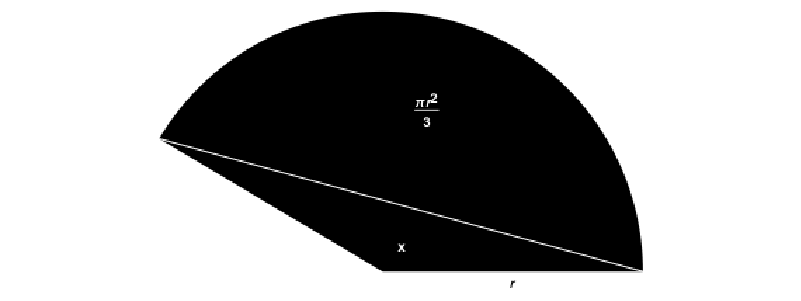
What angle x is subtended by the chord which cuts off 1/3 of the circle’s area?
How can this be hard? You just write the equation Area[x] = π r²/3 and solve for x. Only you can't! x appears both inside and outside a sine function. With algebra and trig, you can solve for one x or the other but not both. This is known as a "transcendental equation". With calculus, you can get a hairy infinite series. But Mathematica makes an easier way. Choose r := 1: Then area as a function of x is
How can this be hard? You just write the equation Area[x] = π r²/3 and solve for x. Only you can't! x appears both inside and outside a sine function. With algebra and trig, you can solve for one x or the other but not both. This is known as a "transcendental equation". With calculus, you can get a hairy infinite series. But Mathematica makes an easier way. Choose r := 1: Then area as a function of x is
In[]:=
Assuming[0<x<π,π/3Simplify@Area@DiskSegment[{,},1,{0,x}]]
Out[]=
π
3
1
2
Instead of Solve, use the more powerful Reduce:
In[]:=
Reduce[%,x,Reals]
Out[]=
x

Contrary to appearance, Reduce’s output is an exact solution. 2.605... is just the first approximation. Convert it to a substitution rule and test it:
In[]:=
Area@DiskSegment[{,},1,{0,x}]/.Rule@@%
Out[]=
1
2
Is this exactly π/3?
In[]:=
FullSimplify@%π/3
Out[]=
True