Particle Swarm Optimization Applied to the van de Vusse Mechanism
Particle Swarm Optimization Applied to the van de Vusse Mechanism


Consider the following complex reaction scheme (called the van de Vusse mechanism), taking place in a continuous stirred-tank reactor (CSTR) with a residence time and rate constants , , :
τ
k
1
k
2
k
3
ABC
k
1
→
k
2
→
2AD
k
3
→
The feed to the reactor is pure . Initially the reactor contains only species .
A
A
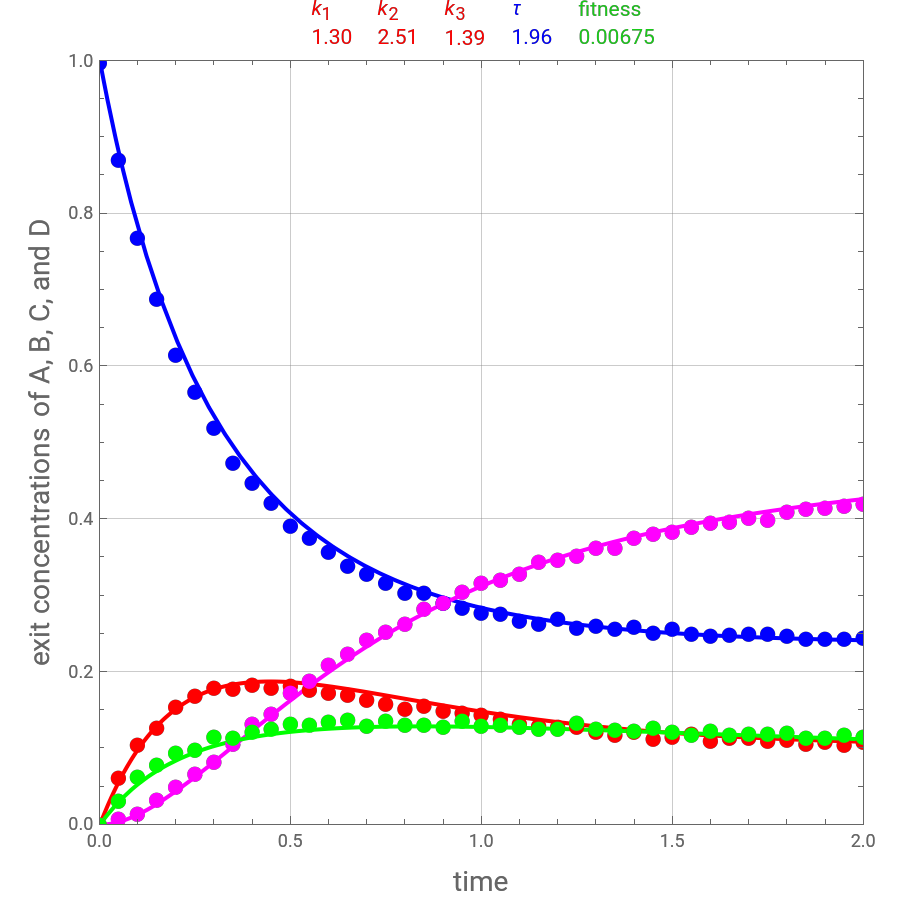
This Demonstration determines the values of the residence time and the rate constants using a set of experimental data. The method of resolution is based on particle swarm optimization (PSO). A plot of the exit concentrations of the chemical species , , , and versus time (in blue, red, magenta, and green, respectively) is given for the experimental data and the theoretical model. You can increase the noise of the experimental data. The resultant values of , , , and are indicated on the plot in red and blue, respectively. PSO finds the best solution after a number of iterations and for a chosen size of the swarm, both of which you can vary. Notice, however, their complementary effect.
A
B
C
D
k
1
k
2
k
3
τ
Here, the problem is four-dimensional, but its extension to higher-dimensional problems using the present code is straightforward. It is seen that the fit is almost perfect (i.e., the values of the fitness are very close to zero) when the noise of the experimental data is small (see first snapshot). A similar result is observed for large swarm sizes and number of iterations. Finally, when the value of the noise of the experimental data is large, the fit is not perfect and the fitness value is significantly larger than zero, as shown in the last snapshot.
Details
Details
Particle swarm optimization (PSO) resulted from the pioneering work of Kennedy and Eberhart[1, 2]. PSO algorithms mimic the social behavior patterns of organisms that live and interact within large groups, such as swarms of bees.
References
References
[1] J. Kennedy and R. Eberhart, "Particle Swarm Optimization," in Proceedings of the 1995 International Conference on Neural Networks, Vol. 4, New York: IEEE Press, 1995 pp. 1942–1948. doi:10.1109/ICNN.1995.488968.
[2] J. Kennedy and R. Eberhart, Swarm Intelligence, San Francisco: Morgan Kaufmann Publishers, 2001.
Permanent Citation
Permanent Citation
Housam Binous, Ahmed Bellagi, Ali Kh. Al-Matar, Brian G. Higgins
"Particle Swarm Optimization Applied to the van de Vusse Mechanism"
http://demonstrations.wolfram.com/ParticleSwarmOptimizationAppliedToTheVanDeVusseMechanism/
Wolfram Demonstrations Project
Published: November 24, 2014