This note describes the function ψ(z) which maps the exterior of unit disk to the exterior of the Mandelbrot set, allowing direct computation of approximations to its area.
The Mandelbrot set is the set of all complex numbers for which the sequence +c does not diverge to infinity when starting with 0.
c
z
n
2
z
n-1
z
0
As described in [
0
] and [0
] the functionψ(z)=z+
∞
∑
m=0
b
m
-m
z
(
1
)defined implicitly through iterated application of the Mandelbrot mapping (ψ(z))=+o(1) as , maps the exterior of unit disk to the exterior of the Mandelbrot set.
p
n
n
2
z
z->∞
For such maps the area, , is then determined directly by the coefficients :
b
m
=π1-m⟹<==π1-m
∞
∑
m=1
2
b
m
N
N
∑
m=1
2
b
m
(
2
)Direct Computation
Direct Computation
Definitions
Definitions
Define (z)=z:
p
0
p/::=zz
p
0
Define the nested Mandelbrot mapping (z)=(z)+z:
p
n
2
p
n-1
p/::=p/:=zEvaluate[[z]+z]
p
n_
p
n
2
p
n-1
To compute approximations to , define the (truncated) infinite sum,
ψ(z)
ψ
n
n
2
∑
m=0
b
m
-m
z
(
3
)which is implemented directly:
ψ
n_
n
2
∑
m=0
b
m
-m
z
Series Expansion
Series Expansion
Calculate the series expansion of (
3
) by nested application of the Mandelbrot mapping:SolveAlwaysNormal[[z]]-+O[z,∞]0,z
p
3
ψ
3
3
2
z
,-,-,0,,-,,-
b
7
987
32768
b
6
1
16
b
5
47
1024
b
4
b
3
15
128
b
2
1
4
b
1
1
8
b
0
1
2
Observe that the coefficients are binary rationals.
Inverse Series
Inverse Series
An alternative approach is to use :
Clear[ψ]
ψ/::=ψ/:=zEvaluate@SimplifyInverseSeriesNestp(+z),z,n+//Normal/.z,z>0
ψ
n_
ψ
n
2
p
n
2
O[z,∞]
n
2
z
Produce a table of the low order approximations:
Tablen,[z]+,{n,0,3}//ColumnForm
ψ
n
n
2
O[z,∞]
0,z+ 1 O 1 z |
1,z- 1 2 1 8z 2 O 1 z |
2,z- 1 2 1 8z 1 4 2 z 15 128 3 z 4 O 1 z |
3,z- 1 2 1 8z 1 4 2 z 15 128 3 z 47 1024 5 z 1 16 6 z 987 32768 7 z 8 O 1 z |
Visualize (), which is the image of exterior of the unit circle under the mapping, superimposed onto the Mandelbrot set for :
ψ
n
θ
2<=n<=6
ManipulateShowMandelbrotSetPlot[ColorFunctionHue],ParametricPlotReIm@[],{θ,0,2π},PlotStyle{Thick,Green},PlotPoints100,ImageSizeMedium,{n,Range[2,6]},SaveDefinitionsTrue
ψ
n
θ

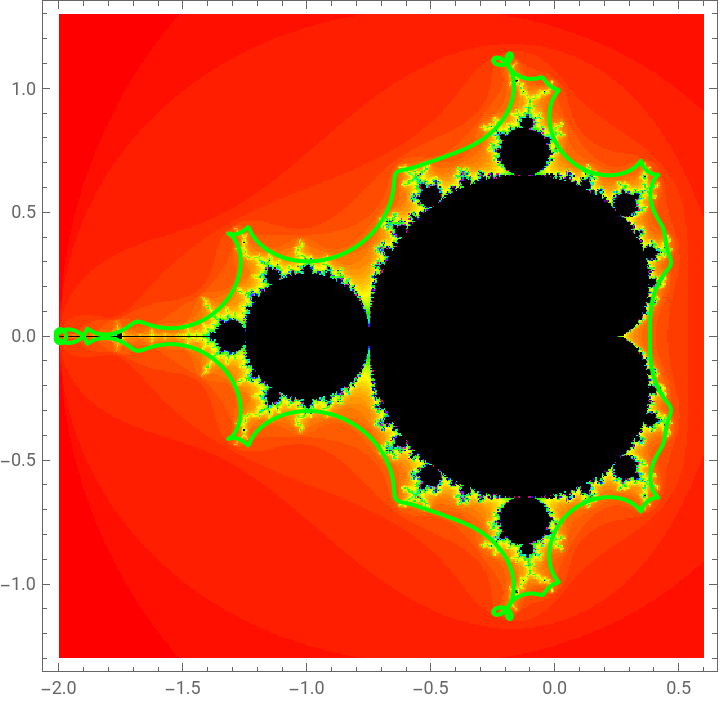
Using Böttcher Coordinates
Using Böttcher Coordinates
The built-in function gives the Böttcher coordinate of with respect to the Mandelbrot set. To approximate the sequence +c is iterated finite number of times.
B(z)
z
B(z)
z
n
2
z
n-1
One can compute asymptotic series approximations for the Böttcher function:
msb=MandelbrotSetBoettcher[z]+
15
O[z,∞]
z+-+-+-+-+-+-+-++
1
2
1
8z
5
16
2
z
53
128
3
z
127
256
4
z
677
1024
5
z
2221
2048
6
z
61133
32768
7
z
205563
65536
8
z
1394207
262144
9
z
4852339
524288
10
z
68586849
4194304
11
z
243751723
8388608
12
z
1741612525
33554432
13
z
6261719421
67108864
14
z
15
O
1
z
It is not explained in the documentation how “Make an asymptotic series approximation for the Böttcher function” works, but its inverse series up to order is just (z):
-(-1)
n
2
z
ψ
n
InverseSeries[msb]
z-+-+--+-+--++
1
2
1
8z
1
4
2
z
15
128
3
z
47
1024
5
z
1
16
6
z
987
32768
7
z
3673
262144
9
z
1
32
10
z
61029
4194304
11
z
689455
33554432
13
z
11
512
14
z
15
O
1
z
%-[z]
ψ
3
15
O
1
z
Computing the Area
Computing the Area
We can extract the coefficients, , directly from the of :
b
m
bs[n_]:=bs[n]=CoefficientListNormalInverseSeriesMandelbrotSetBoettcher[z]+z/.z,z
n
2
O[z,∞]
1
z
Define the area (
3
) in terms of the coefficients:/::=πTotal(2-Range[Length[bs[n]]])
n_
2
bs[n]
Compute a table of approximations to the area, , using up to +1 coefficients:
n
8
2
Table[{n,//N},{n,8}]//TraditionalForm
n
1 | 3.09251 |
2 | 2.57038 |
3 | 2.4437 |
4 | 2.27305 |
5 | 2.18304 |
6 | 2.10375 |
7 | 2.02781 |
8 | 1.97752 |
One observes that convergence is very slow.
References
References
Trott, M. The Mathematica GuideBook for Symbolics