Flying a Box Kite
Flying a Box Kite


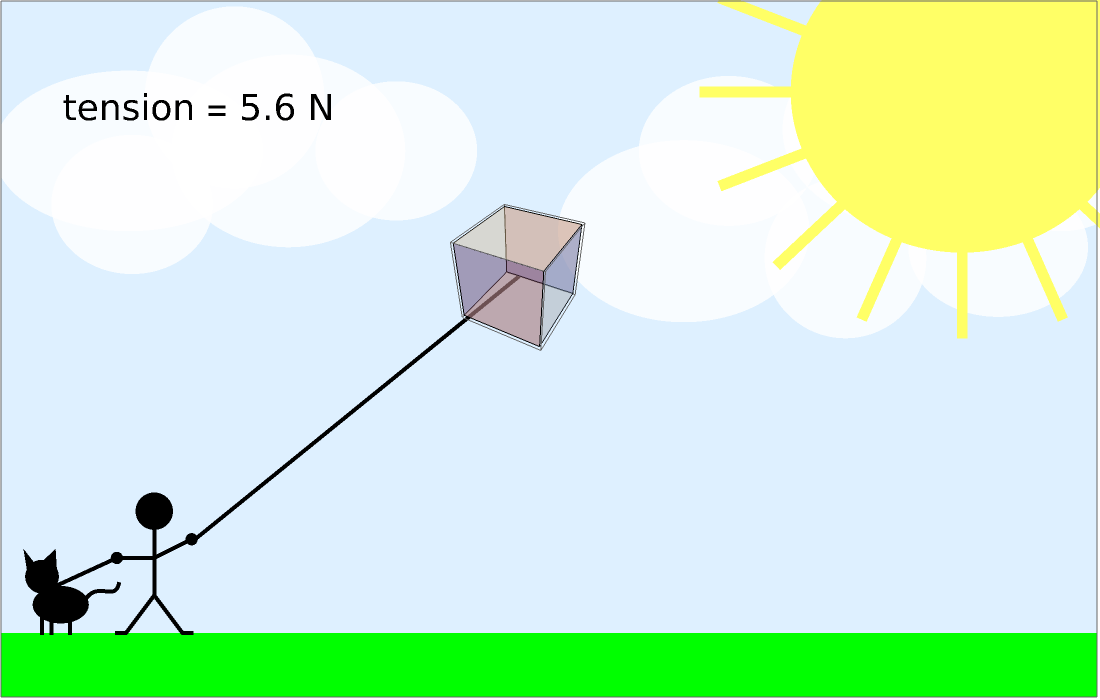
This Demonstration illustrates the flight angle of a cubic box kite and the tension force in the string. The tension and the angle are affected by the lift, drag, surface area of one side of the kite, wind velocity, kite mass and string length. The coefficient of drag is related to the aspect ratio (side A/side B) of the kite, which in this case is kept constant at 1. For simplicity, the coefficient of lift is assumed to be constant; actually its value would need to be found experimentally.
Details
Details
A force balance implies that the sum of the forces is zero, thus drag equals lift:
∑=-cosθ=0
F
x
F
D
F
T
∑=-mg+sinθ=0
F
y
F
L
F
T
where and are the forces in the and directions (N), is drag (N), is tension (N), is lift (N), is kite mass (kg) and , the gravitational constant.
F
x
F
y
x
y
F
D
F
T
F
L
m
g=9.8m/
2
s
The lift and drag coefficients are:
C
D
2
F
D
ρA
2
u
C
L
2
F
L
ρA
2
u
where is air density (), is wind velocity (m/s), and is the area of one side of the kite ().
ρ
kg
3
m
u
A
2
m
In this Demonstration the coefficients of lift and drag and are assumed constant, which enables calculation of the tension in the string using the above equations.
C
L
C
D
F
T
Permanent Citation
Permanent Citation
Jaeda C. Sichel, Rachael L. Baumann
"Flying a Box Kite"
http://demonstrations.wolfram.com/FlyingABoxKite/
Wolfram Demonstrations Project
Published: May 21, 2014