Questions I would like to know:
Questions I would like to know:
◼
How long will a retirement portfolio last?
◼
Would 4% retirement distribution rate or withdrawal of 100K$ per year work out?
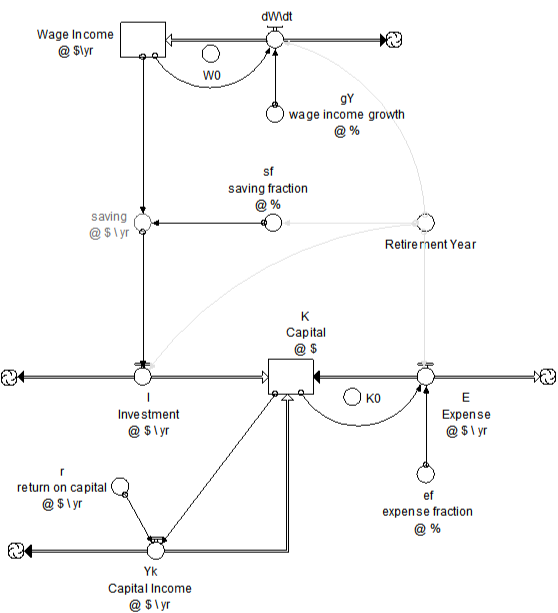
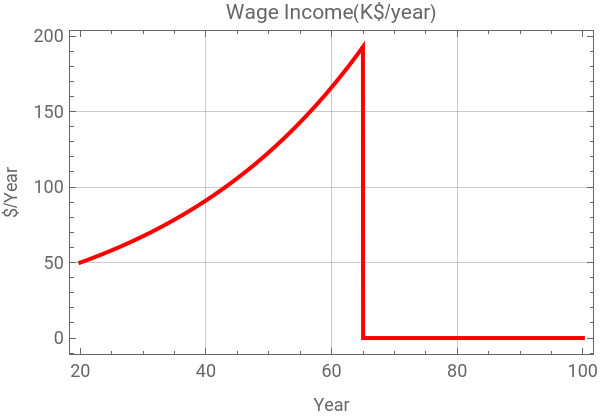
I start working and saving at the age of 20 and plan to retire at 65 (All parameter values can be adjusted). My initial wage, W[t=20], is $50,000 per year. The wage grows by 3% per year (gW) until 65. I save 10% (s) of my wage every year, and the rate (r) of return on savings or capital, k[t], is 5% per year. The initial value of capital is zero. After retirement at 65, there is no wage income and thus no saving, and the capital still grows at 5% per year. At the retirement, I have two options. I can choose to either (1) withdraw 4% of the savings per year or (2) withdraw a fixed, constant amount.
Stock and Flow Diagram: income (W), capital (K), saving
Stock and Flow Diagram: income (W), capital (K), saving
Model Equations
Model Equations
W[t]
t
|
(
1
)K[t]
t
|
(
2
)W[tMin]=w0,K[tMin]=k0tMin=20,tMax=100
(
3
)Simulate: These values can be changed for different scenarios
Simulate: These values can be changed for different scenarios
In[]:=
tMin=20(*thefirstyearofinvesting*);tMax=100(*endofsimulationyear*);retireYear=65(*retirementyear*);w0=50.0(*initialwageatthefirstyearofinvesting(tMin),$/year*);k0=0.0(*initialsavingsatthefirstyearyoustartinvesting(tMin),$*);gW=0.03(*gW=3%.annualgrowthrateofwage*);s=0.10(*s=10%.savingfraction*);r=0.05(*r=5%,returnoncapital*);(*Twowithdrawoptions*)d1=0.04(*d=5%,widthdrawthed%ofcapital(%/year)*);d2=80.0(*d2=incomerequaredatretirement($/year)*);
In[]:=
ndsol=NDSolve[{(*Iwillretireat65*)w'[t]==If[t<=retireYear,gW*w[t],0.0],(*Option2:aconstantwithdrawlamountafterretirement:d2*)k'[t]==If[t<=retireYear,s*w[t]+r*k[t],-d2+r*k[t]],(*Option1:acontantpercentageofwithdrawafterretirement*)(*k'[t]==If[t<=retireYear,s*w[t]+r*k[t],-d1*k[t]+r*k[t]]*)w[tMin]==w0,k[tMin]==k0(*initialvaluesofwageandsavingsatt=tMin*),WhenEvent[t>retireYear,{w[t]->0.0}](*aftert=65,nowageincome*)},{k,w},{t,tMin,tMax},Method->{"TimeIntegration"->{"ExplicitRungeKutta","DifferenceOrder"->4}}]
Out[]=
kInterpolatingFunction,wInterpolatingFunction


Plot the retirement scenario
Plot the retirement scenario
In[]:=
PlotEvaluate[w[t]/.ndsol],,PlotEvaluate[k[t]/.ndsol],,PlotIf[t<=retireYear,0.0,d2],//Row
Out[]=
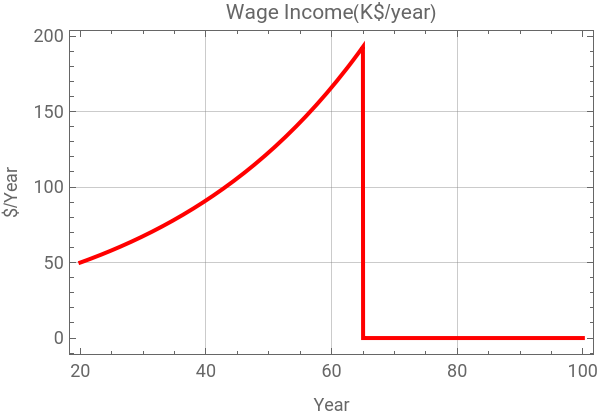
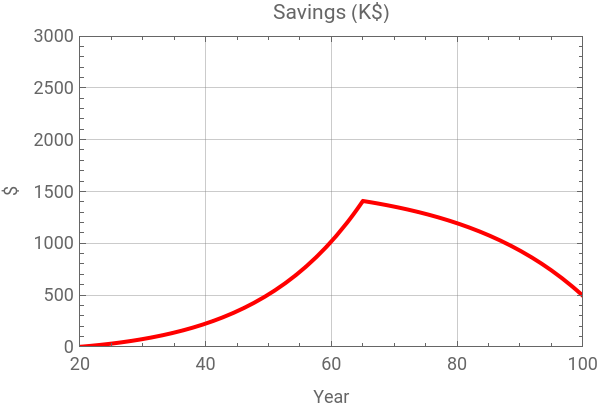
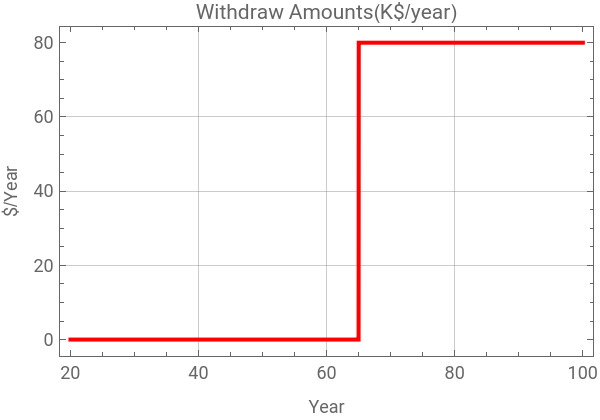
Examples of 3 scenarios:
Examples of 3 scenarios:
◼
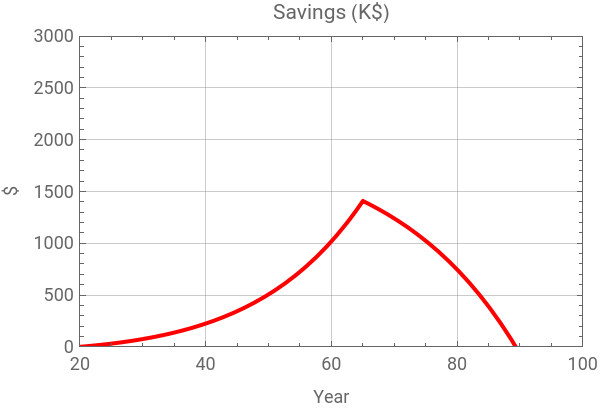
Scenario 1 (My savings will earn a 5% rate of return thorough lifetime and I withdraw 100K$/year after retirement)
◼
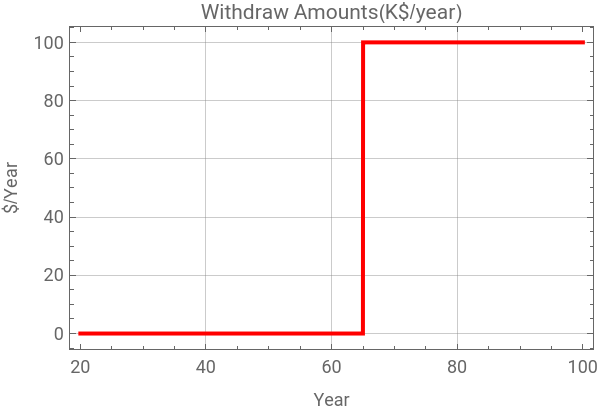
Begin saving when I am 20 years old and plan to retire at 65 with an initial salary of $50,000 and no initial savings. My annual salary will increase by an average of 3%, and I’ll save 10% of my salary each year until retirement. My savings will earn a 5% rate of return (This is a key assumption!) between 20 and 65 years. After I reach 65, I’ll withdraw $100,000 annually from my savings.
◼
The saving is depleted at 90 years
◼
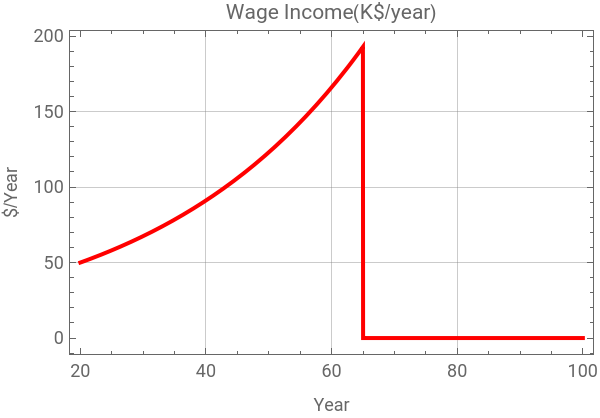
Scenario 2 (My savings will earn a 5% rate of return thorough lifetime and I withdraw 80K$/year after retirement):
◼
The savings last beyond 100 years old
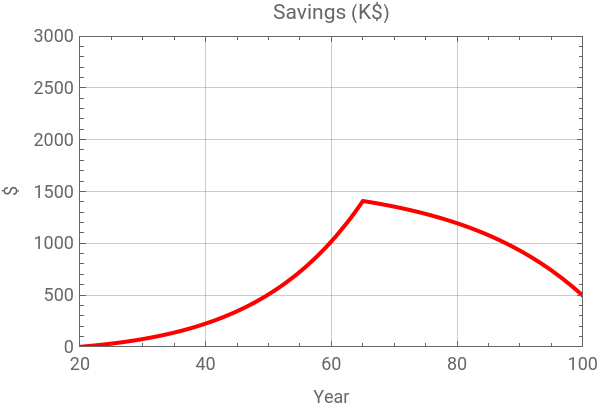
◼
Scenario 3 (My savings will earn a 6% rate of return thorough lifetime and I withdraw 100K$/year after retirement)
◼
All parameter values remain unchanged as the Scenario 1 except my savings will earn a 6% rate of return, instead of 5% return .
◼
The saving continue to grow to 3 million dollars.
Table
Table
Key learning
Key learning
◼
The key parameter throughout one’s lifetime is the overall rate of return on savings (r). For example, comparing a 5% return to a 6% return will determine whether my savings can last or if I will run out of saving
◼
The saving rate (s) is also another key parameter.
◼
The key fact in post-retirement financial planning hinges on the difference between the rate of return on my investments and the amount or percentage I withdraw. In simple terms, it’s the gap between what I am earning from the savings (i.e., financial gain or inflow) and what I am spending (withdrawals or outflow). When this gap is small but positive, it results in the ongoing growth of my financial assets. Conversely, if the gap is negative, it leads to a depletion of my savings.
CITE THIS NOTEBOOK
CITE THIS NOTEBOOK
Dynamical model for retirement planning: how much to save and how much to withdraw
by Sangdon Lee
Wolfram Community, STAFF PICKS, October 19, 2023
https://community.wolfram.com/groups/-/m/t/3052634
by Sangdon Lee
Wolfram Community, STAFF PICKS, October 19, 2023
https://community.wolfram.com/groups/-/m/t/3052634